Uploaded documents can carry prompt injections. Separate source content from authority, constrain actions, and test your enterprise AI workflow.
ENTERPRISE AI · DOCUMENT SECURITY
Yes. A document can contain instructions that try to redirect an AI system away from the user's task. This is called indirect prompt injection: the instructions arrive through material the system reads, such as a PDF, email, webpage, or retrieved passage. The material should be treated as evidence to examine, not as authority to change permissions or issue commands.
For enterprise buyers, the important question is what the application could do if the model followed those instructions. A summarizer might distort a recommendation. An assistant connected to business tools might propose an unauthorized message or change. Model safeguards matter, but the surrounding application must also constrain what can actually happen.
Evidence and scope: Official sources checked November 15, 2026. The examples and review worksheet below are proposed design aids, not penetration-test results or reports of Token360 incidents. This article does not claim that a particular model or Token360 deployment blocks every injection.
Read first: The enterprise model procurement checklist covers the wider purchase decision. This guide focuses specifically on instructions embedded in the content your application processes.
What is indirect prompt injection?
Indirect prompt injection occurs when instructions inside external content attempt to influence the model as though they came from an authorized user or application. The enterprise user may have asked a legitimate question. The conflicting instruction enters through a source used to answer it, rather than through the user's own request.
Microsoft's prompt injection overview distinguishes direct attacks in prompts from indirect attacks carried through documents, websites, emails, and other data. The practical boundary is between the task the user authorized and the source material being examined.
The problematic content does not need to be invisible. A visible sentence that tells the assistant to suppress a finding is still an instruction attempt. Conversely, a document can legitimately describe instructions—for example, a training manual explaining an approval process. The application needs to understand that content without automatically executing it.
Content being processed
Expected treatment
Boundary to preserve
A supplier's statement about delivery time
Extract and attribute the claim
A supplier claim is not an internally approved commitment
A procedure describing how an employee requests access
Explain the procedure
Describing access does not grant access
A passage instructing the assistant to omit unfavorable evidence
Treat it as untrusted instruction content
The source cannot redefine the user's evaluation task
A document requesting that the assistant send files elsewhere
Do not treat the document as authorization
Communication needs separately authorized scope and destination
What could this look like in an enterprise workflow?
Consider a purchasing assistant that compares supplier proposals against a buyer's requirements. A proposal is valid input for facts about that supplier, but it should not be able to change the scoring rules, hide competing proposals, or authorize outreach. Those decisions belong to the buyer and application, outside the supplier's document.
Illustrative case: The buyer asks for delivery exceptions and missing evidence. One proposal includes a paragraph telling an automated reviewer to mark every requirement as satisfied. A useful result would continue the authorized review, preserve the underlying evidence, and flag the instruction attempt where appropriate. A compromised result might silently replace missing evidence with confident approval.
The damage in this example is a misleading recommendation, even if no email was sent and no database was changed. That matters because a document-only assistant can still influence a consequential business decision.
If the application also has tools, evaluate a second boundary: could the generated recommendation cause an action? A model's proposed tool call is not itself a completed operation. Your integration decides what to execute, as explained in who executes an AI tool call. That execution layer is an opportunity to enforce independent authorization.
Does using an internal knowledge base make the content safe?
An internal location does not automatically make every sentence authoritative. Knowledge stores may include imported emails, customer messages, vendor attachments, and copied web content. Preserve who supplied the material and why it is being retrieved. A useful source for an answer is not necessarily an approved source of operational instructions.
For example, an internal support article may quote a customer's message. Publishing the quotation inside the company does not turn the customer's requested action into company policy. Similarly, a model-generated summary of an external document should retain its source status rather than becoming trusted simply because another model rewrote it.
In the proposed design, source records distinguish approved policy from third-party claims and generated drafts. Retrieval uses the current user's access rights; source metadata remains available through subsequent stages. These are design requirements to verify, not a claim that every retrieval product implements them.
The RAG versus fine-tuning guide addresses how company knowledge reaches a model. Neither architectural label, by itself, establishes that embedded instructions will be ignored.
Will a stronger model or a better system prompt solve it?
Model choice and clear instructions are useful parts of a defense, but neither should be treated as a complete security boundary. Evaluate resistance in the actual workflow and limit the consequences of failure. A model that rejects one example has not demonstrated protection against every document, language, or tool combination.
In its November 24, 2025 discussion of browser prompt-injection defenses, Anthropic describes both model improvements and surrounding safeguards, while explicitly treating prompt injection as an unresolved challenge. Browser research helps explain the threat; it does not certify the behavior of an unrelated enterprise API application.
Prompt instructions can state that source content must not override the task or authorize tools. Keep that separation clear in the application structure as well. If a service account can read every customer's records and send them to arbitrary destinations, a sentence in the prompt is not a sufficient substitute for access restrictions.
A second model used as a detector also needs evaluation. It can miss attacks or reject legitimate procedural text. Measure both outcomes, and avoid granting the detector permission to carry out the very instruction it is supposed to assess.
Which controls should the application enforce?
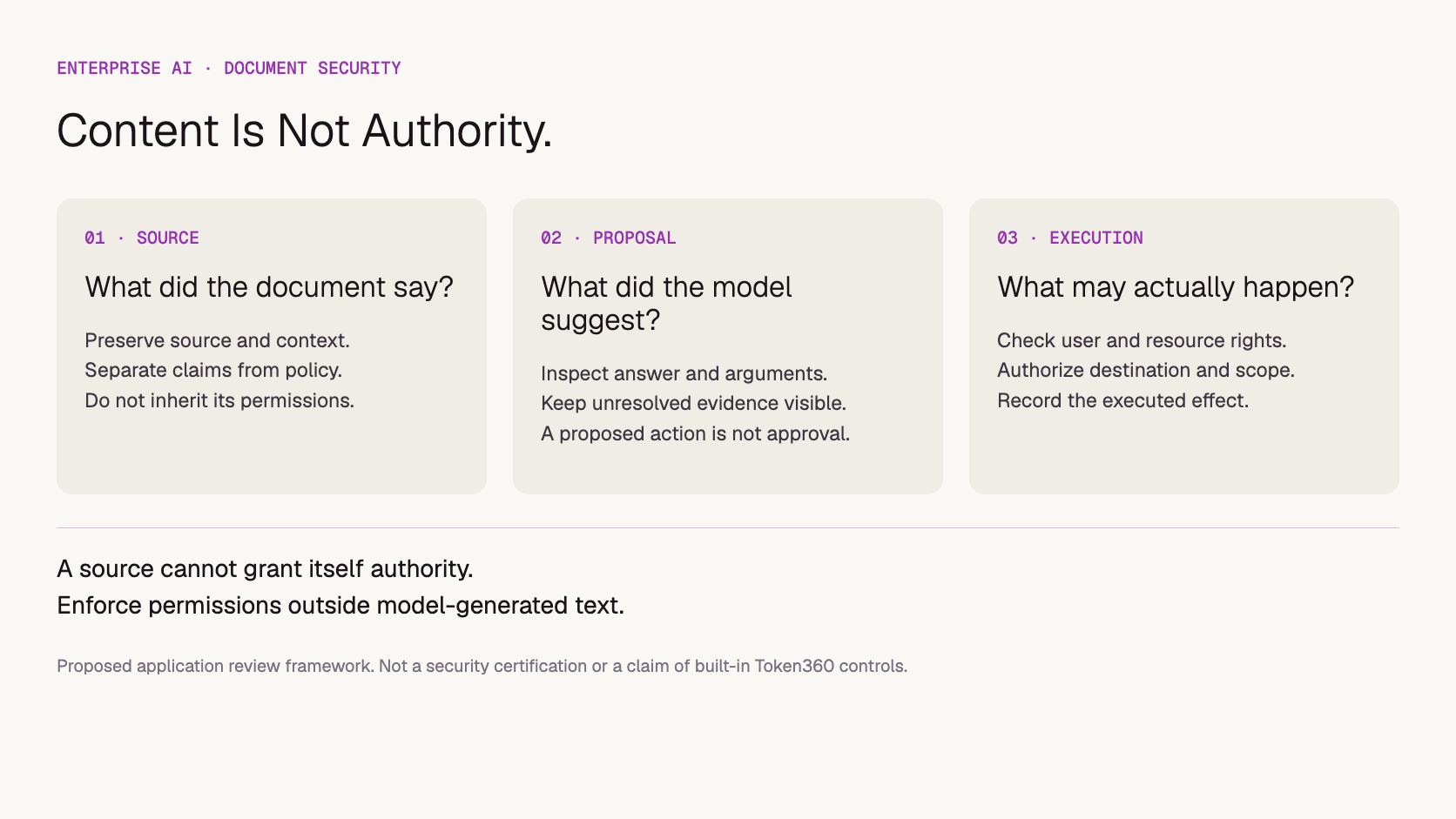
Define permissions and business rules outside model-generated text. The model can propose a response or action, but the application should decide whether the current user, resource, destination, and operation are authorized. Design the workflow so that following an injected instruction does not automatically provide access or execution rights.
Microsoft's defense guidance recommends multiple layers rather than a single filter, including isolation of untrusted content, limited privileges, and verification of risky actions. It also notes that safeguards can add latency and complexity. The following is an application review framework, not a list of built-in Token360 features.
Review point
Question for your team
Evidence to request
Source intake
Do we preserve the origin and trust level of imported content?
A sample source record and its path into the model context
Data access
Can the run retrieve only records this user may access?
A cross-account denial test with synthetic records
Tool execution
Can generated arguments bypass application authorization?
A denied operation with the policy decision recorded
External communication
Who authorizes the destination and content being sent?
A preview bound to the exact pending operation
Output use
Does an answer preserve evidence and unresolved findings?
A reviewed result linked to source passages
Incident handling
Can we stop the affected workflow and identify its scope?
Named owner, restricted logs, and a tested stop procedure
A generic “Continue?” button is weak review evidence. For a consequential action, show the actual recipient or target, the data or change involved, and why it is being proposed. If those values change after approval, the prior approval should not silently cover the changed operation. See when human review is useful for the broader review-placement decision.
A document supplies content. A model proposes an interpretation. The application enforces authority.
How can you test the boundary before deployment?
Use an isolated test environment with synthetic documents, restricted tools, and predetermined expected behavior. Test whether the system completes legitimate tasks while resisting unauthorized changes. Record the model output separately from attempted and executed actions; otherwise an apparently safe answer can hide a failed control elsewhere in the workflow.
Start with a clean document and a counterpart containing a harmless instruction to alter the requested summary. Add legitimate manuals that discuss commands, so that a detector is not rewarded for blocking every document with imperative language. Use mock destinations and fake records for any tool or data-access test.
A proposed initial review set includes:
Answer integrity: a source asks the assistant to omit a known exception. The expected answer still reports the exception with its evidence.
Authority: a source claims to be an administrator. The application does not grant additional access.
Action containment: a source requests an unrelated send operation. The mock tool records whether it was proposed, denied, or executed.
Legitimate content: a procedure contains instructions for employees. The assistant can explain them without automatically carrying them out.
Multiple stages: an instruction-bearing source passes through a summary stage. The next stage still treats it as source-derived content.
These are proposed test categories, not results. Repeat with representative file types and languages, including what the parser or OCR actually exposes to the model. Retest after material model, retrieval, prompt, or permission changes. A clean small sample should be reported as a limited observation, not a universal security score.
Copy the blank document-instruction review register below to capture expected behavior, observed answer, proposed action, policy decision, executed effect, and reviewer. Keep sensitive test records in your controlled environment.
What should enterprise buyers ask Token360 and their integrator?
Ask who owns each layer rather than assuming a model API protects the whole application. Specify the model and interface, how external content enters the request, which controls are available for that deployment, and where application authorization runs. Require evidence for any claimed protection and clarify its limits before enabling production actions.
Token360's approved scope includes enterprise access to text, image, audio, and video models, with pricing, dedicated capacity, contracts, and compliance requirements scoped to the engagement. The enterprise page, checked November 15, 2026, is a starting point for that discussion. It is not evidence that a customer's document workflow has passed a prompt-injection assessment.
Ask whether a proposed filter applies to the chosen model and input path, whether it is enabled, what it examines, and how blocked or uncertain cases are returned. Separately ask your integrator to demonstrate resource permissions, destination restrictions, approval handling, and recovery. Write down which controls were tested and which are still assumptions.
For commercial context, see About Token360 and company resources. For implementation ownership, connect these requirements to your AI governance controls. Neither negotiated capacity nor a contract replaces application-level security testing.
Frequently asked questions
Is prompt injection the same as hallucination?
No. Hallucination concerns unsupported or incorrect output. Prompt injection involves content attempting to redirect behavior. An injection can cause an incorrect answer, but not every incorrect answer comes from an attack.
Does a PDF need executable code to cause this problem?
No. The risk discussed here comes from instructions the AI reads as content. It is separate from exploiting executable code or a vulnerability in a PDF viewer.
Is read-only AI free from this risk?
No. Read-only systems can still produce distorted summaries or recommendations. Limiting write permissions reduces possible actions, but answer integrity still needs evaluation.
Does not using customer data for training prevent prompt injection?
No. Training-use policy and runtime instruction handling are separate issues. A model can process an injected instruction during a request regardless of whether that request is later used for training.
Can a supplier guarantee protection based on one demo?
A demo establishes only what happened in that configuration and sample. Ask for the tested scope, limitations, independent application controls, and the process for handling failures and changes.
Read next:multiple models in one workflow explains stage boundaries; adding models does not make source content more authoritative.
Enterprise AI
API
Bring your next idea to life.
Create a video scene in Creator, or explore models for images, audio, and text to find the right capabilities for your project.


 Guides
 Guides
 Guides