Reuse approved voice recordings with a supported AI speech API. Check reference inputs, voice similarity, approval criteria and enterprise quote scope.
ENTERPRISE AUDIO · REFERENCE RECORDINGS
What to verify before turning approved voice material into new speech.
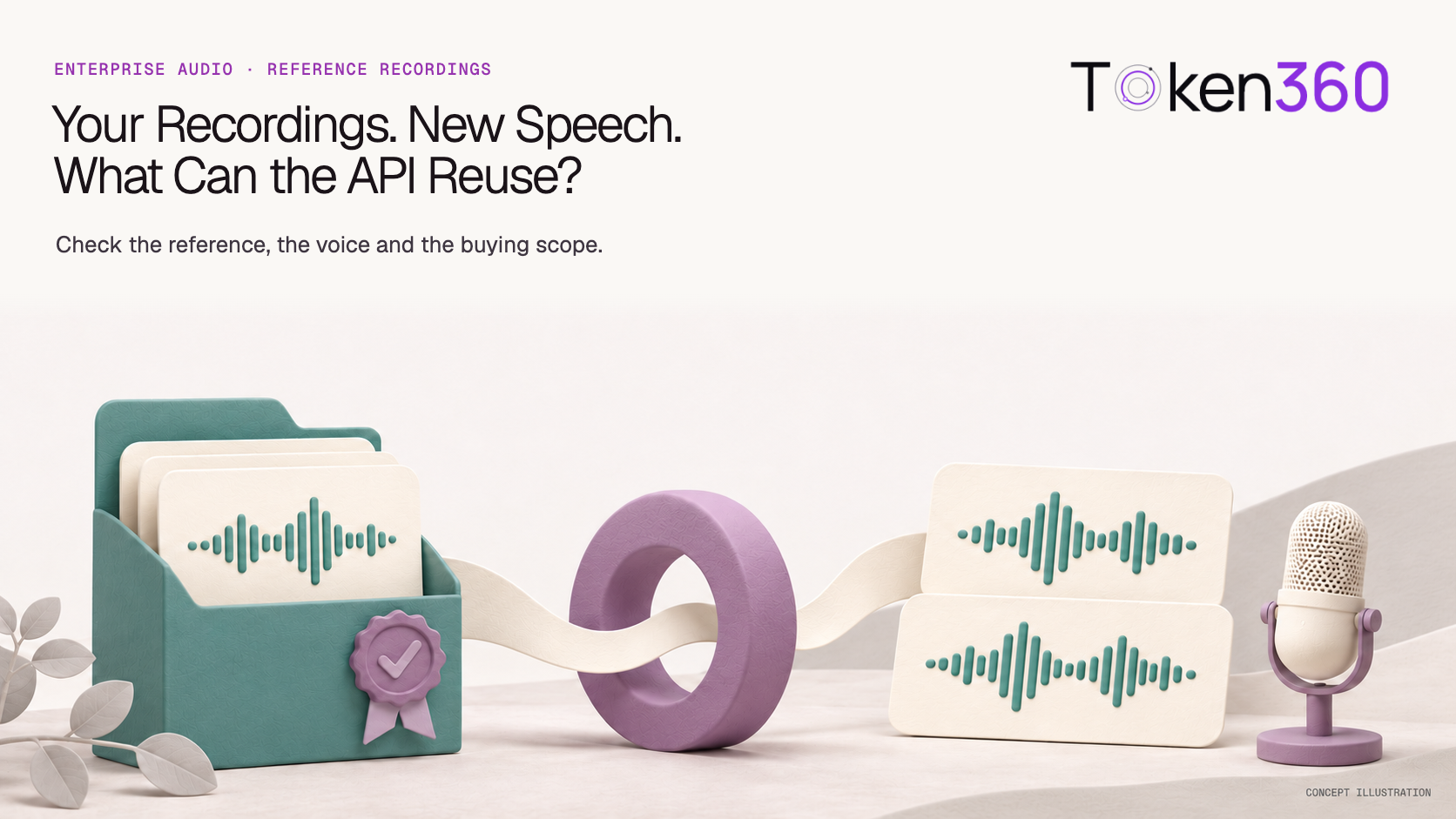
Yes, a supported reference-audio workflow can accept an existing recording as an input for new speech. Token360 documents that option on its speech endpoint, subject to the selected model. That establishes an input capability—not a promise of an exact voice match, a permanently stored custom voice or permission to reuse a speaker's identity.
For an enterprise with a voice-over archive, the useful buying question is narrower: Can our authorized recording produce acceptable new lines through the proposed model, under terms we can approve? Answer that before committing a campaign or a recurring production budget. This article separates documented input support from the listening test and commercial scope needed to make that decision.
What does Token360 document about reference audio?
Token360's speech endpoint documents reference-audio generation when the selected model supports it. Buyers should therefore confirm the model and reference-input route together. A generic text-to-speech endpoint is not enough evidence that every model accepts recordings, and an exposed reference field does not establish how closely a generated result will resemble the supplied speaker.
The Create speech API reference, reviewed November 24, 2026, identifies POST /v1/audio/speech and reference fields including audio_url, audio_data and speaker. Text remains the content to synthesize; the reference is a separate resource.
The public model catalog snapshot checked November 23 lists seed-audio-1.0. Its audio-reference schema calls for exactly one of a speaker ID, audio data or an audio URL per audio reference. Confirm the current schema and account availability before implementation. This article did not submit an authenticated generation request.
A technical contact should demonstrate which path your integration will use and what happens when a supplied resource cannot be read. The procurement team needs that answer to distinguish a usable integration from a feature name on a proposal.
Is a reference recording the same as a reusable voice clone?
No. Supplying a recording with a generation request and enrolling a reusable custom voice are different purchase requirements. The presence of a speaker-ID field does not prove that a service will create a new persistent identity from your file. Ask separately about enrollment, reuse, lifecycle controls and the scope of any promised voice similarity.
What your team asks for
What must be confirmed
What not to assume
Use a recording to guide a new line
Selected model accepts that reference and produces an acceptable result
Any recording works equally well
Reuse one custom identity across campaigns
Whether enrollment exists, how reuse works and who controls it
A permanent voice is created by submitting audio once
Use a provider speaker ID
Which IDs are available and what they represent
The ID represents your own speaker
Use the same identity in other languages
Supported language behavior and listening approval in each intended language
Similarity and pronunciation carry over automatically
Receive exclusive use of a voice
Explicit commercial terms, if offered
A reference upload grants exclusivity
Consider a business that owns finished training videos and wants to replace a few spoken sentences. It might need reference-conditioned speech for those edits, or it might need a managed voice identity for years of future training. Those are different scopes. This is an illustrative buying scenario, not a reported Token360 customer deployment.
Which recordings should you prepare for evaluation?
Prepare authorized material that represents the voice and delivery your team actually wants, together with the new scripts and an approval owner. Ask the supplier for the selected model's input limits before converting the archive. Do not replace unknown requirements with a guessed minimum duration, file size or recommended recording format.
A buyer's preparation pack should identify the speaker, the intended use, the source file, any edits made to it and who can approve the generated voice. Include a description of the desired delivery: for example, calm instructional narration rather than an energetic advertisement. A reference recorded for one purpose may not represent the delivery required for another.
For a controlled evaluation, keep different speakers in separate samples and label music, noise or overlapping speech that remains in a file. This is a proposed test-design practice, not a claim that the model requires silence or rejects mixed audio. If cleanup is necessary, review that as a separate voice-isolation task and retain both the original and processed file.
Ask who can access the reference, how it is retained and how removal requests are handled. These are procurement questions, not confirmed Token360 retention or deletion guarantees. General permissions belong in the commercial-use review; ownership of a finished recording alone should not be treated as a completed approval process for new speech.
How should you judge whether the new speech is usable?
Judge the generated speech against the actual production brief, using listening review rather than waveform appearance alone. Separate resemblance to the intended voice from script accuracy, pronunciation, delivery and technical usability. A convincing voice can still read a product name incorrectly, omit a word or miss the tone required for the campaign.
Use a small, representative script set chosen by the production team. Include an ordinary line, a line containing the product terminology that matters and a passage representative of the expected length. These are suggested cases, not a validated benchmark. Agree on acceptance criteria before hearing the results so that an attractive sample does not redefine success after the fact.
Review dimension
Question for the reviewer
Record separately
Voice identity
Is the result acceptable against the authorized reference?
Reviewer judgment and uncertainty
Script fidelity
Were the required words delivered without unwanted additions?
Missing, altered or added words
Pronunciation
Are brand names, numbers and specialist terms acceptable?
Exact phrase needing correction
Delivery
Do pace, emphasis and emotion fit this use?
Where a new take or edit is required
Technical handoff
Does the file meet the receiving team's requirements?
Actual format and any conversion work
Have an appropriate voice or brand reviewer assess identity and a content owner check the script. For another language, involve a reviewer competent in that language. Keep rejected outputs, request settings and the associated source sample. A single approved line establishes that line's acceptability, not consistency across every future script.
Use the reference-voice evaluation worksheet (template below) to record observations. It is blank intentionally: no similarity score, failure rate or production outcome has been measured for this article.
For a script containing a company or product name, the AI brand-name pronunciation guide adds a specific listening test. Similarity to an approved reference voice does not establish that the name is spoken correctly inside the final sentence or advertisement.
What belongs in the enterprise quote?
The quote should distinguish reference-based generation from any custom-voice enrollment, storage, support or production work being offered. Specify the proposed model, expected usage and acceptance process, then ask how each charge is measured. Do not infer the commercial scope from an API parameter or assume every listed step is a supported service.
Token360's confirmed enterprise pricing position is tiered quotation: higher usage receives lower quoted rates. Token360 does not charge a separate service fee. Neither statement establishes the rate or the availability of an additional custom-voice service for this project. The proposal must identify what is actually offered.
Ask which usage unit applies to generation and how unsuccessful requests, requested revisions and optional extra work are treated. Keep a separate estimate for your own review and editing effort. For a full rate comparison, use the text-to-speech pricing framework; this article's purchase decision is whether existing reference material is usable, not which pricing meter is cheapest.
If the intended application is a live telephone agent, state that explicitly. Reference-based file generation does not establish streaming latency, interruption handling or a complete calling application. Those requirements belong in the voice API versus complete phone-agent scope.
What should you ask Token360 before sending your archive?
Ask Token360 to confirm the supported reference-audio route, input requirements and handling terms before sending production recordings. Provide the intended use, scripts and acceptance criteria, and request a scoped evaluation. If the requirement is a reusable custom voice rather than request-level reference audio, make that distinction explicit in the first inquiry.
We have authorized recordings of [speaker or role] and want to create [type of new speech] for [use]. We need [request-level references / a reusable custom voice, subject to confirmation]. Please confirm the proposed model, input limits, reference handling, supported languages, billing scope and how we can evaluate the result before committing volume.
Start with the material and script needed for that evaluation rather than assuming the entire archive must be transferred. Ask the supplier to list open requirements alongside confirmed ones. That makes it possible to approve a limited test without mistakenly approving an unverified production capability.
Token360 provides model access across text, image, audio and video. For this purchase, the useful evidence is narrower: a documented reference path, a result your reviewers accept and a written scope that matches the intended use.
Frequently asked questions
Is reference audio the same as a reusable voice clone?
No. A model may use a recording for one request without creating a persistent voice asset. Confirm whether the route returns a reusable identifier, what it retains and how subsequent requests work. None of those behaviors follows from a reference-audio field alone.
Can we submit any recording from our archive?
Use recordings for which the organization has the necessary permission for the proposed voice use. Prepare samples with clear speech and identify the intended language and output. Having a recording in an archive does not by itself establish permission to synthesize a voice from it.
Will a longer reference recording guarantee a closer voice match?
No guarantee is established here. Follow the selected route’s documented input limits and compare representative outputs by listening. Evaluate identity, intelligibility and delivery separately; this article reports no measured similarity or reliability result.


 Guides
 Guides
 Guides