Check model terms, input permissions and output restrictions before commercial release. Build a rights record for AI images, video and audio.
ENTERPRISE AI · BLOG 152
By Token360 · Editorial review: November 5, 2026
Commercial use of AI-generated content requires more than a paid API request. Check the terms governing the selected model and service, permission to use the inputs, and restrictions affecting the finished output. Keep evidence for each component. Permission to use an output commercially is also different from copyright protection or exclusivity.
A marketing team may combine a reference photograph, generated product footage and generated background music in one advertisement. A successful generation confirms that the service returned a result. It does not answer whether that particular advertisement is cleared for the intended audience, territory and distribution channel.
This guide proposes a practical review record for enterprise teams using model APIs. It is not a legal opinion, a clearance certificate or a tested guarantee of compliance. The worked campaign below is hypothetical. Use qualified review where a permission or contract interpretation remains uncertain.
Read first: use the Token360 model documentation to identify the actual model behind a workflow. A commercial-use review needs that identity, not just a project nickname.
What should an AI commercial-use review actually cover?
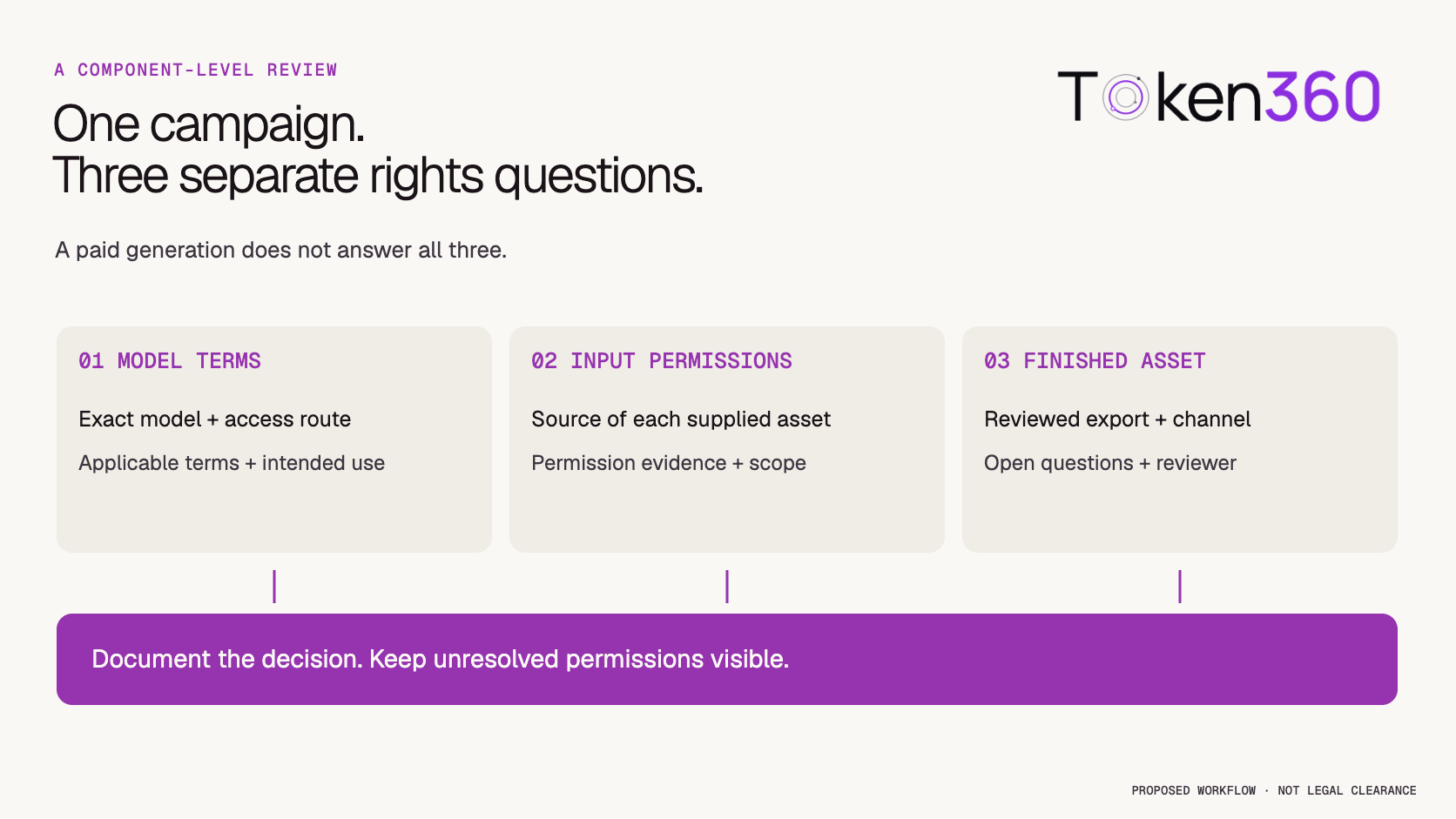
Review three separate layers: the service and model terms, the material supplied as input, and the finished asset’s intended use. None replaces the others. A permissive model license does not grant rights to a photograph uploaded by a user, and permission to upload that photograph does not necessarily settle every downstream use.
Layer
Question to answer
Evidence to retain
Insufficient on its own
Service and model
Does the applicable arrangement permit this business activity?
Model ID, service route, applicable terms and dated clarification.
A paid invoice or a successful request.
Inputs
Can we submit and use each supplied asset for this purpose?
Source and permission record for images, audio, scripts and likenesses.
A public download link.
Finished output
Does the proposed release introduce unresolved third-party rights or contractual restrictions?
Reviewed export, intended channels and any required approvals.
A visually convincing result.
Ownership claims
What rights can we accurately promise to a client?
Scope of human work, applicable agreement and jurisdiction-specific review.
The phrase “AI-generated” or “commercial use allowed.”
This is a review framework, not a list of legal requirements that applies identically everywhere. Its purpose is to expose missing answers before a team makes a release commitment. Treat an unanswered question as unresolved rather than converting it into an assumption that the asset is approved.
Why should you check the exact model and access route?
Start with the model actually used and the agreement under which it was accessed. A model family name is too broad for a durable record. Record the model identifier, provider or route when disclosed, generation date and applicable terms. API access and downloading weights are different activities and may require different documentation.
The fal Model APIs FAQ, checked November 5, 2026, answers commercial-use questions at the model level: it directs users to each model’s license and commercial-use marking, while distinguishing research-only restrictions. That is a useful discovery question, not evidence that every model on another platform has the same permission.
For an API workflow, collect the service terms and any incorporated model restrictions. For a self-hosted workflow, also establish which weights and license version were obtained. Do not import a conclusion from a similarly named model or from a different access arrangement.
If a platform handles routing, ask what information it can provide for the record and which restrictions govern that route. A business request should be concrete: “We plan to use this model’s output in paid product advertisements distributed by our client. Which terms cover that use?” Avoid asking only whether the model is “commercial.”
What do Token360’s terms establish—and what needs confirmation?
Token360’s terms distinguish rights in inputs and outputs from access to its service. Review both against the intended activity, rather than treating output ownership as blanket authorization for every deployment. When the planned use includes a customer-facing product or redistribution, obtain clarification of the relevant service scope before relying on an assumption.
Token360 Terms of Service, version 1.1.1, effective June 15, 2026 and checked November 5, 2026, state that customers retain input and output ownership as between themselves and Token360, subject to third-party model licenses and applicable law (§5.1). They also address necessary input rights (§5.4), separate third-party terms (§2.2), and service access for internal business purposes (§2.1).
For a proposed activity outside a clearly understood scope, use the enterprise contact route to confirm the applicable agreement. Do not interpret this article as an approval of resale or a promise of infringement protection.
Which input permissions are easy to overlook?
Check every input that contributes to the result, including material supplied indirectly through a client or contractor. Establish where it came from and what the permission covers. Receiving a file is a technical handoff; it does not by itself document authorization to submit it to a third-party service or use the resulting asset commercially.
For a reference photograph, record its source, the person or organization that supplied it, and the permission relied on. For a recognizable person, voice, product design or brand asset, identify whether additional review is needed for the proposed use. Do not assume a stock license, employee relationship or client email answers every question.
Prompt provenance belongs in the record too. If a workflow adapts someone else’s published script, distinguish the source text from your additions and determine what may be reproduced. Changing words is not a reliable substitute for checking permission. An article showing a prompt and a campaign using generated footage can also involve different publication decisions.
A useful request to the asset owner is specific: identify the file, the intended AI processing, the campaign’s channels and any planned client delivery. Save the response with the asset’s version. A general “looks good” message without an identifiable scope is difficult for a later reviewer to interpret.
Does commercial permission mean copyright or exclusivity?
No. Permission under a service or model agreement, copyright protection and exclusivity are separate questions. A team should not promise a client exclusive rights merely because a generation was paid for. The legal treatment of the final work depends on the relevant jurisdiction and facts, including the nature of human creative contributions.
In its January 2025 report on AI and copyrightability, the U.S. Copyright Office distinguishes protectable human expression from purely AI-generated material. It describes the assessment as case-specific and recognizes that human selection, arrangement or modification may matter. Its discussion of then-current technology does not treat prompts alone as sufficient human control over expressive elements.
That is a U.S. copyrightability framework, not worldwide clearance for a campaign. Keep a factual record of human-created material and editorial work without assuming those records guarantee protection. Equally, uncertainty about protection does not establish that a result is free of third-party rights concerns.
How would this work for a multimodal product advertisement?
Review the components separately before evaluating the combined advertisement. The point is not to collect three generic approvals; it is to connect each permission to an identifiable asset and use. A hypothetical product campaign shows why missing evidence in one component should not be hidden by successful generation in another.
Hypothetical scenario: a team receives a perfume-bottle photograph from a client, generates a short product video, and adds generated instrumental music. No actual campaign, customer clearance or licensing test is represented here.
Component
Known in the example
Still unresolved
Next review action
Reference photograph
The client supplied the file.
Who created it and what use was authorized?
Obtain the source and scoped permission record.
Generated video
The team has a model ID and output file.
Which terms apply, and does the export introduce unintended branding or identifiable material?
Record applicable terms and review the final export.
Generated music
An audio file was returned.
What use conditions apply to that model and route?
Resolve the music permissions before combining it with the campaign.
Combined advertisement
Editing is technically complete.
Are the promised client rights and distribution scope supported?
Compare the release scope with the collected evidence.
Proposed review workflow. The diagram is not a legal clearance or an automated Token360 feature.
Suppose the photograph’s permission remains unclear. The correct record is “input permission unresolved,” not “commercial model, therefore cleared.” Suppose music terms are confirmed but the final edit changes the intended distribution channel. Review that change rather than assuming an earlier approval covers every later version.
This exercise produces an actionable handoff: the team knows which evidence is missing, who must provide it and which release version was reviewed. It does not produce an invented success rate or a claim that a provider has cleared the entire advertisement.
What should go into a reusable rights record?
A useful record connects an asset, a permission source, an intended use and a reviewer. It should let a colleague reconstruct the decision without searching private chat history. Keep the original terms or permitted evidence of them, distinguish confirmed facts from open questions, and tie any approval to the reviewed version.
Copy the worksheet below into a local CSV file. Blank fields are for your own review:
. It is an original blank working aid, not a contract or certification. Use one row per component; duplicate rows when different models, input sources or intended uses need separate review.
Identify the artifact: project, asset ID, export version and generation date.
Identify the generation context: model ID, disclosed route, account agreement and applicable terms version.
Identify the input basis: source, permission reference and unresolved limitations.
Describe release scope: client, channel, territory and intended duration where relevant.
Record the review: evidence location, responsible reviewer, decision date and open questions.
Revisit material changes: new inputs, model changes, revised terms or a different release scope.
Do not put API credentials or confidential source materials in a widely shared worksheet. Reference an appropriately controlled evidence location. The record should make evidence discoverable to authorized reviewers without turning the checklist into a public repository of sensitive files.
Read next: compare the intended activity with the applicable Token360 terms and resolve open scope questions before release. For publisher context, see About Token360.
Does paying for an API request make the result commercially cleared?
No. Payment establishes a transaction, not the full rights position of the finished asset. Review the model and service conditions, inputs and intended release separately.
Can I use one commercial-use approval for every model?
Do not assume that. Record the actual model and applicable terms for each workflow. A model change is a reason to check whether the existing conclusion still applies.
Does using an API instead of a playground change output rights?
The interface alone does not establish a different permission. Check the agreement, model and route actually used; do not infer rights from how the request was submitted.
Can a client-provided image be treated as fully authorized?
Record the client’s permission and its scope rather than assuming possession settles the question. Escalate any uncertainty about the source or proposed processing.
Does this checklist certify legal compliance?
No. It organizes evidence and unresolved questions. It does not replace review of the actual agreements, asset and relevant law.
Enterprise AI
API
Build faster with one AI API.
Use Token360 to call video, image, audio, and text models with one key and one bill.


 Insights
 Guides
 Guides