Does a Voice API Include a Complete AI Phone Agent?
Separate phone connectivity, speech, model access and business actions before buying a voice API. Compare scope, costs and end-to-end pilot requirements.
A voice API supplies only the components its documentation and agreement describe; it does not automatically include a complete phone agent. Token360 documents transcription and speech generation. Procurement should separate those model capabilities from telephony, conversation orchestration and application integrations, and confirm any real-time requirements independently.
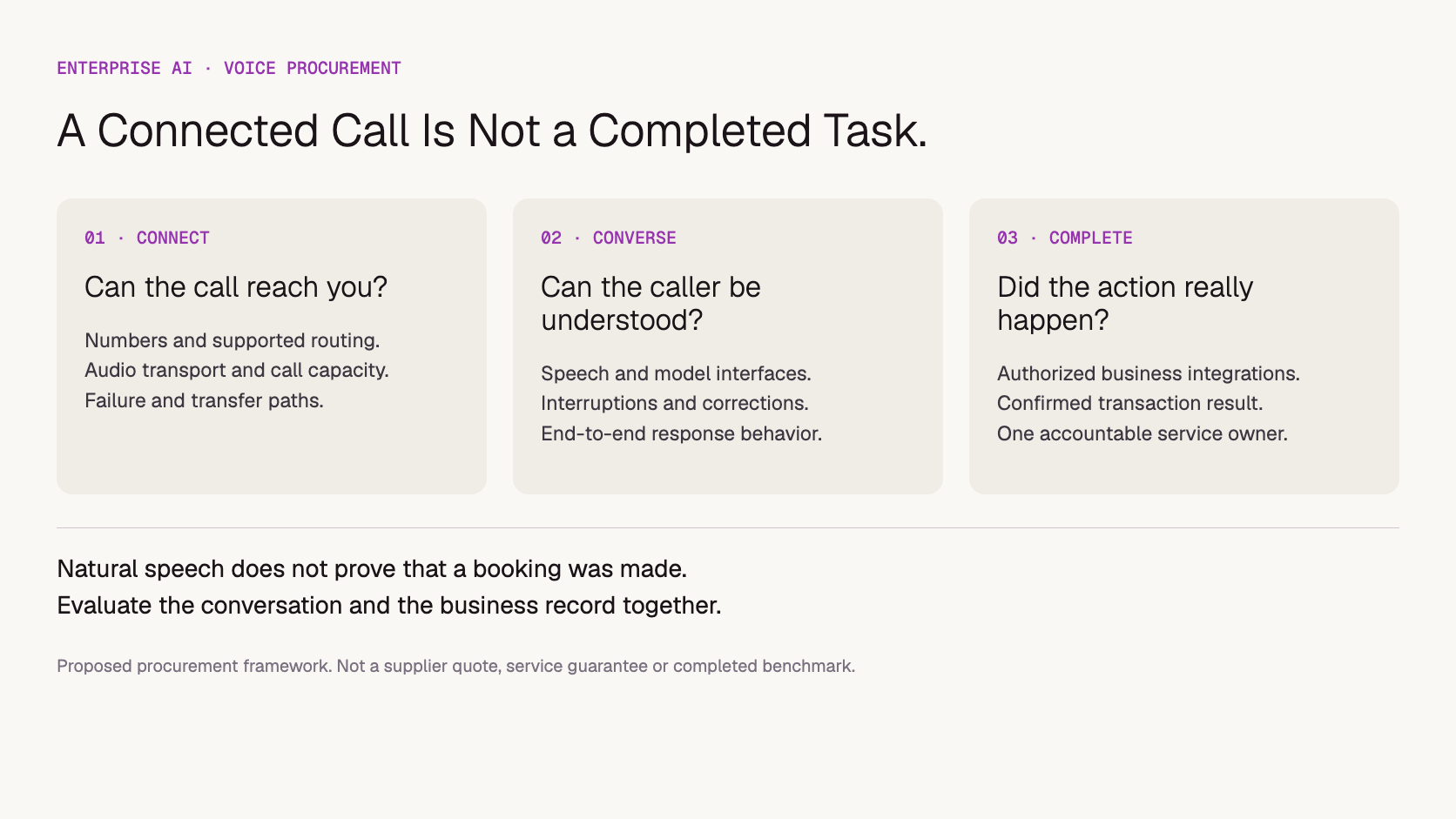
“We want AI to answer our calls” is a business requirement. “We need a voice API” is only a possible part of the solution. A system that speaks naturally can still fail to retrieve an order, confirm an appointment or transfer a caller when it should.
This guide separates those responsibilities so enterprise buyers can compare quotes on the same scope. It is a procurement analysis, not a tested phone-agent implementation or a ranking of voice providers.
What might a supplier mean by “voice API”?
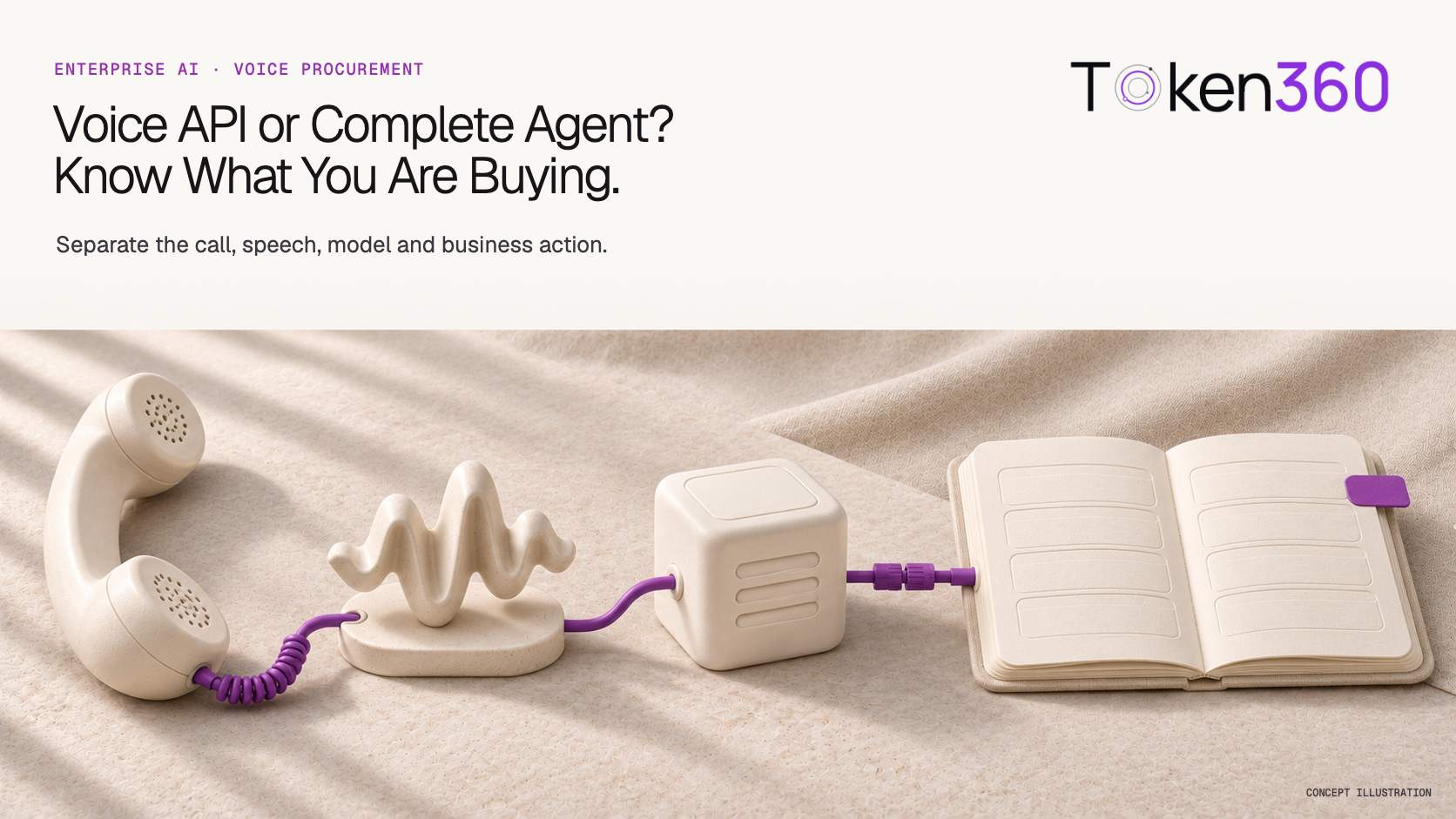
The term can describe different layers: making and receiving calls, transporting live audio, transcribing speech, generating spoken audio or coordinating a conversation. Some services bundle several layers. Request a concrete feature list and interface description rather than assuming the name identifies a ready-to-use business agent.
For example, Twilio’s Media Streams documentation describes access to call audio, including bidirectional streaming between a call and a WebSocket application. Its ConversationRelay documentation describes a different abstraction that handles speech recognition and speech generation while developers build their application. These are examples of distinct service scopes, reviewed November 18, 2026; they are not identical products or evidence of Token360 compatibility.
Layer
What to verify
What should not be assumed
Telephone connectivity
Numbers, inbound/outbound calling, routing and supported destinations
That a model API can place a telephone call
Audio and speech
Streaming, transcription, synthesis, supported languages and turn handling
That generating an audio file creates a live conversation
Model reasoning
Request interpretation, response generation and supported tool interactions
That a spoken answer proves an action happened
Business application
Identity checks, records access, booking or order integration and confirmation rules
That these are included with inference access
Operations
Monitoring, escalation, outage behavior and ownership of incidents
That several supplier contracts provide one accountable service owner
When should you buy components instead of a complete agent?
Buying components makes sense to evaluate when your team needs control over the conversation, model selection and business integrations, and can own their operation. A packaged agent may fit a standard workflow with limited engineering capacity. Compare the actual supported process and customization limits; neither purchase type guarantees a successful deployment.
A component approach lets you select a telephony service, a speech layer and a model provider independently where their interfaces support the design. It also creates integration work: passing events correctly, managing interrupted responses and coordinating failures. Lower unit prices do not remove that work.
A packaged offer may include configuration tools, connectors and operational support. Ask what those connectors can actually do and who maintains them. A connector that reads a customer record is different from one authorized to change it. Request a demonstration of your required action and failure path, not only a polished conversation.
If the immediate need is processing recordings rather than handling live calls, first distinguish speech-to-text and text-to-speech APIs. A batch transcription or audio-generation purchase answers a narrower requirement.
Why do interruptions and delays belong in the buying checklist?
A live caller can interrupt, correct a detail, pause unexpectedly or speak while audio is playing. The complete system must decide what was heard, what response remains valid and what audio should stop. Test these behaviors end to end because a fast model response alone does not establish a usable phone experience.
Twilio’s ConversationRelay WebSocket documentation includes conversation events and text-to-speech messages. That illustrates why an application has to handle a protocol and state, rather than only send isolated prompts. The required behavior still depends on the selected service and configuration.
In a proposed booking test, the caller changes “Tuesday” to “Thursday” while the system reads a confirmation. Evaluate whether the stale response stops, whether the new request is understood and whether the eventual booking uses the corrected day. Testing only a transcript can miss audio that the caller actually heard.
Measure caller-perceived response delays across the whole path, including speech processing, model work, business lookups and playback. Report typical and slow interactions under the expected concurrent-call workload. Do not turn a supplier’s model latency number into a promise about complete calls.
A proposed scope checklist, not a validated phone-agent architecture.
What should a supplier quote include?
Ask for a quote tied to one defined call workflow and workload. Separate connectivity, speech or realtime processing, model inference, application hosting and support where they are charged separately. Also identify bundled components to avoid counting them twice. A per-minute headline is meaningful only when you know what the minute covers.
Provide expected call volume, average and long-call scenarios, peak simultaneous calls, destinations, languages and the required business actions. Ask how silence, transfers, failed calls and additional call legs are metered under the actual offer. Do not infer billing behavior from the phrase “voice API.”
Compare cost per correctly completed interaction alongside the cost per call. A cheaper call that needs a subsequent human correction can have a different operating cost. If synthesis is separately billed, the TTS pricing comparison guide covers that component without treating it as the full phone-agent budget.
Use the blank voice procurement worksheet to assign scope and evidence to each supplier. It includes no invented price, latency target or test result.
Where can Token360 fit in a voice-agent purchase?
Token360 can be considered for the model-access part of a proposed workflow, subject to the selected model and verified interface requirements. Its enterprise positioning is not a claim that it supplies phone numbers, a complete call platform or every realtime speech interface. Confirm the exact scope before designing an integration around it.
Token360 focuses on enterprise access across text, image, audio and video models, with pricing, dedicated capacity, contracts and compliance requirements scoped to each engagement. For a phone-agent project, provide the intended workload and required capabilities through enterprise procurement. See About Token360 for company context. No specific Twilio integration or complete phone-agent deployment is verified in this article.
Token360 documents audio transcription and speech generation (reviewed November 19, 2026). Those component references do not establish telephone connectivity or a native real-time conversation service.
What else should buyers ask?
Can a text model power part of a voice agent?
Yes, a design can convert speech into text, use a text model and convert the response into speech. Other designs use audio-capable models. Evaluate the actual supported interfaces and complete interaction rather than assuming either design is universally better.
Does an audio model automatically support telephone calls?
No. Audio generation or understanding does not establish telephone connectivity, live streaming support or business integration. Confirm those capabilities separately.
Should we choose the lowest per-minute price?
Only after normalizing the scope, workload and completion criteria. Check what is bundled, what is additional and how failed or escalated interactions affect operating cost.
Evidence boundary: Procurement analysis based on official documentation reviewed November 18, 2026. The booking example and pilot are proposed evaluation materials. No deployment, compatibility test, call-quality benchmark or cost saving is claimed.


 Guides
 Guides
 Guides