Compare speech API billing units on the same scripts, then include revisions and review to calculate cost per approved audio minute.
Compare text-to-speech quotes on the same scripts, required voices and accepted audio, not their headline billing units alone. Record all chargeable attempts and separate correction labor from inference charges. Token360 documents speech generation; the selected model’s rate and supported voice controls still need to match the proposed purchase.
An enterprise buying narration for training modules, product explainers or customer messages needs more than an attractive voice demo. The relevant question is what it costs to deliver approved speech in the required languages and formats, then update that speech when the source material changes.
This is a pricing-comparison method, not a supplier cost benchmark. Public documentation was checked on November 17, 2026. The example below is hypothetical; no Token360 speech price, measured acceptance rate or tested cost advantage is asserted.
Why are text-to-speech API prices hard to compare?
Speech APIs can charge for different units and different voice tiers. A character-based rate describes input volume; a model with separate text-input and audio-output charges requires both quantities. A quotation only becomes comparable after you apply its counting rules to the same scripts, settings and required output rather than comparing the headline numbers.
For example, the Google Cloud Text-to-Speech pricing table lists character-priced voices and Gemini-TTS entries with separate text and audio token rates. Its character-counting guidance includes spaces, newlines and most SSML tags. This is a reason to check the exact pricing row and billing definition, not to assume every offering on a speech platform uses the same unit.
Quoted unit
What to collect
What not to assume
Characters
Billable submitted text, including applicable markup and repeated requests
A character always represents the same amount of spoken time
Text input and audio output tokens
Both usage quantities and their separate rates
The input-token price represents the entire request
Generated duration, if offered
Billed seconds or minutes and any rounding rule
Only the final selected take is billed
Plan or committed volume
Included usage, eligible voices, overage and commitment terms
Unused allowance is equivalent to consumed production value
Use only the rows relevant to the actual supplier offer. This table is a quote-reading framework, not a claim that each supplier offers every billing method.
Why do pronunciation and revisions change the budget?
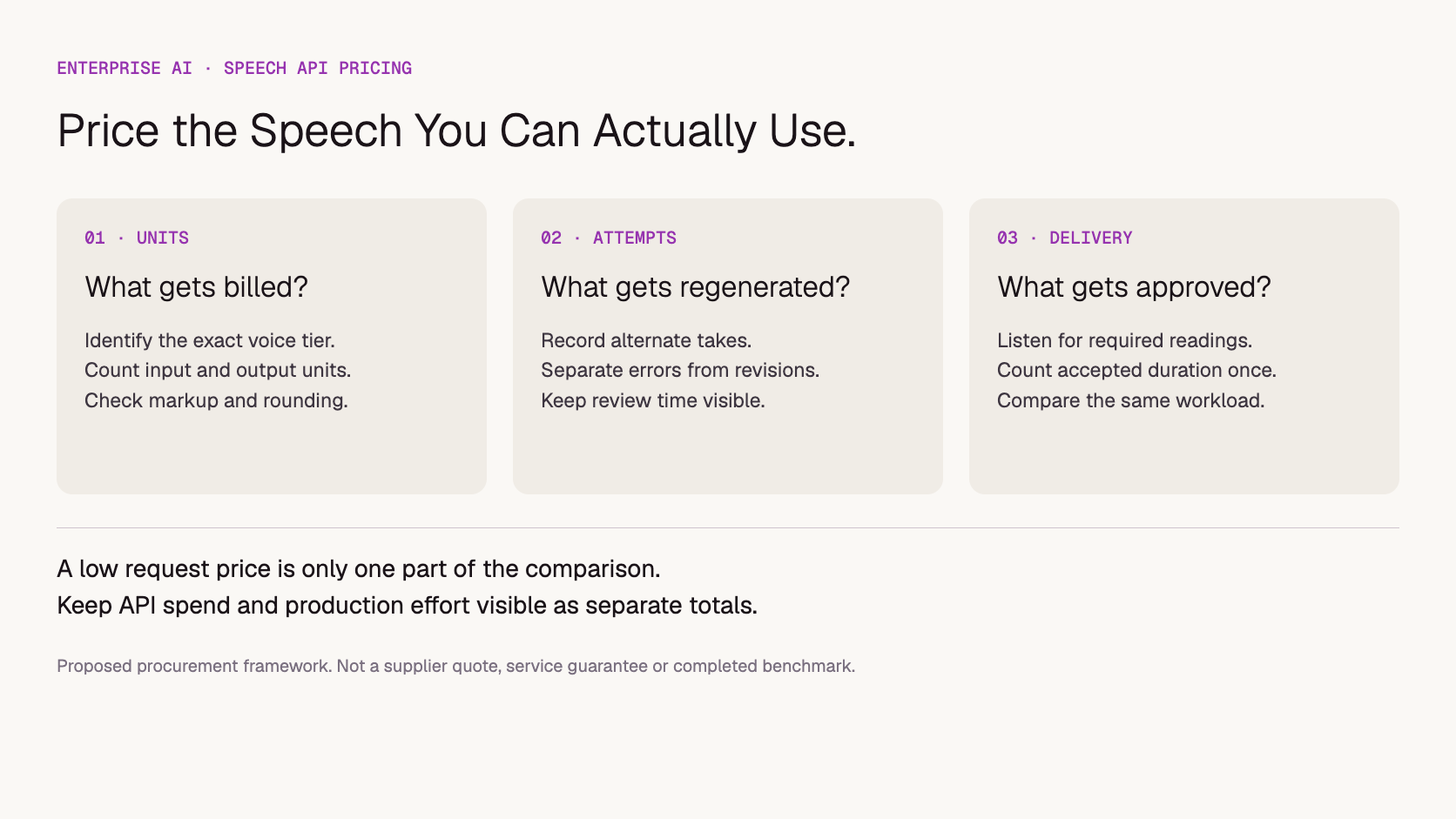
A completed audio request can still need correction before release. Product names, abbreviations, dates and numbers deserve specific checks because a natural-sounding voice may read them differently from the intended meaning. Record all chargeable attempts and distinguish technical failures from successfully generated takes that your editorial team rejects.
Microsoft’s pronunciation documentation describes SSML phonemes and custom lexicons as pronunciation controls. Their existence does not establish support in another model or voice. Ask whether your selected endpoint offers a repeatable correction method and test that method on your terminology.
Separate three revision causes in the pilot: an incorrect reading, a creative preference and a changed source script. They have different remedies. A pronunciation control may address the first; a clearer voice brief may reduce the second; editorial sign-off before synthesis can reduce avoidable work from the third.
Do not count downloading the same saved output as a fresh generation unless a new synthesis actually occurs. Conversely, do not assume reusing the same text automatically avoids billing. Confirm caching behavior, storage and reuse terms for the chosen service.
Include amounts, dates and reference numbers in the evaluation scripts. Check their spoken meaning before counting audio as approved. No pronunciation listening test is reported in this article.
How do you calculate cost per approved audio minute?
Add the API charges attributable to the job, then divide by the duration of the distinct audio approved for delivery. Keep review and correction labor in a separate, explicitly labeled total-cost calculation. This makes it possible to compare inference spend without hiding the operational cost of selecting and fixing takes.
API cost per approved minute = total attributable API charges ÷ distinct approved audio minutes.
Production cost per approved minute = (API charges + attributable review, correction and other production costs) ÷ distinct approved audio minutes.
For a hypothetical project delivering 100 approved minutes, one candidate might generate 120 minutes across all takes and another 105. The generation-to-delivery ratios would be 1.20 and 1.05. Those ratios are planning illustrations, not measured results. They do not prove the second candidate is cheaper: its rates, billable units and review costs still matter.
If nothing is approved, report the spend and failure reasons rather than a finite cost per approved minute. Also keep delivery volume separate from audience consumption: replaying one approved training clip for many employees does not create many distinct approved clips. Hosting or distribution charges, if applicable, belong in their own line.
Normalize the workload and acceptance criteria before comparing quotes.
What should you include in a speech pricing pilot?
Use scripts that represent your languages, specialist terms, lengths and playback environments. Keep the required meaning and acceptance criteria consistent across candidates, while allowing each service’s documented pronunciation controls. Record the corrections needed to reach acceptance instead of selecting the best demo and discarding the work behind it.
Script set: versioned text, language and locale, required readings for names, numbers and abbreviations.
Voice configuration: model, voice ID, speaking rate, style and any pronunciation instructions.
Usage: input and output units, generated duration, request outcome and actual charge.
Acceptance: omissions, altered words, incorrect readings, unwanted pauses and required format checks.
Operational effort: review time, corrections, regenerated segments and the final accepted duration.
Listen to the audio; a waveform or file metadata cannot establish pronunciation accuracy. Include reviewers who understand the intended locale. For training material, test ordinary target playback conditions as well as headphones. Define which faults block release before comparing results.
Download the speech pricing pilot worksheet. It is a blank evaluation template, not a record of completed tests. If the underlying requirement is still unclear, first distinguish speech recognition from speech synthesis.
What should the enterprise quotation specify?
The quote should identify eligible models and voices, billing units, volume assumptions and what happens when usage or requirements change. Ask for separate treatment of retries, alternate takes, free allowances and optional features. A quoted synthesis rate is not automatically a complete price for a finished narration workflow or a conversational voice application.
Request a clear answer on voice availability in each locale, custom-voice scope if needed, applicable usage rights, input-data handling, output retention and any minimum commitment. Confirm throughput and support separately from unit price. A pre-rendered training library and an interactive application can have very different operational requirements.
Keep one-time evaluation allowances outside the steady-state forecast. Ask what the same expected monthly workload costs after allowances expire. For a broader application budget, use the AI feature unit-economics framework; this article focuses on comparing synthesis quotes, not pricing the whole product.
For a character-metered voice-service example, the Google Text-to-Speech API pricing guide separates voice selection and applicable meters before converting the proposal into a production speech budget.
The Speechify API enterprise budget guide separates plan fees, model usage and top-ups; use those components when comparing the full offer with another voice-model quote.
How should you discuss speech costs with Token360?
Give Token360 your script samples, required languages and voices, expected production volume and acceptance criteria. Token360 provides enterprise model access across text, image, audio and video, with commercial terms scoped to the engagement. Confirm the specific speech model and controls before treating them as available in your proposed implementation.
The company has confirmed that it does not charge a separate service fee. Model usage still has a cost; that statement does not establish free synthesis, upstream list-price pass-through or the lowest total production cost. Ask for the applicable model rate and counting rule in the quote.
Review the model catalog and discuss the workload through Token360 enterprise procurement. The About page provides company context. No particular voice, pronunciation feature or savings level is guaranteed by this article.
The speech API reference, reviewed November 19, 2026, documents POST /v1/audio/speech and shows seed-audio-1.0. Its response describes duration-related usage fields. Confirm the actual model’s price and meter rather than assuming all voices are billed alike.
What other speech pricing questions matter?
Is the cheapest voice always the best purchase?
No. Compare required languages, correctness, correction effort and actual charges on your scripts. A cheaper voice can be appropriate if it meets the acceptance criteria; a premium label alone does not prove better business results.
Are rejected takes free?
Do not assume so. A technically successful request that your team rejects is different from a service failure. Ask the supplier how both are billed and record the actual charges during evaluation.
Does text-to-speech pricing include a complete voice agent?
Not necessarily. Speech recognition, reasoning, telephony and orchestration may be separate components. Compare synthesis quotes within that narrower scope before estimating the complete interactive service.
Can we update only part of an existing narration?
That depends on the workflow. Test whether regenerated segments match the surrounding voice and pacing, and confirm whether your implementation can replace them cleanly. Do not assume a sentence change requires, or avoids, regenerating the entire recording.


 Guides
 Guides
 Guides