AI music stem separation can give an editor more control over an existing soundtrack, but the returned tracks are estimates—not the original recording session. Before buying API volume, test whether the specific layer you need can be changed without unacceptable leakage, damaged instruments or timing problems in the finished video.
Consider a brand team with an approved product film and only a mixed music file. The next version needs quieter drums under narration while retaining the melody. Generating a new song would change the approved soundtrack; lowering the whole track would also lower the melody. Separating the musical parts is a different purchasing need.
This guide addresses that need: evaluating an audio-model service for selective remixing of authorized music. It is a documentation-based procurement guide, not a listening benchmark. No stem-separation test or Token360 endpoint compatibility is claimed.
What does an AI music stem separation API provide?
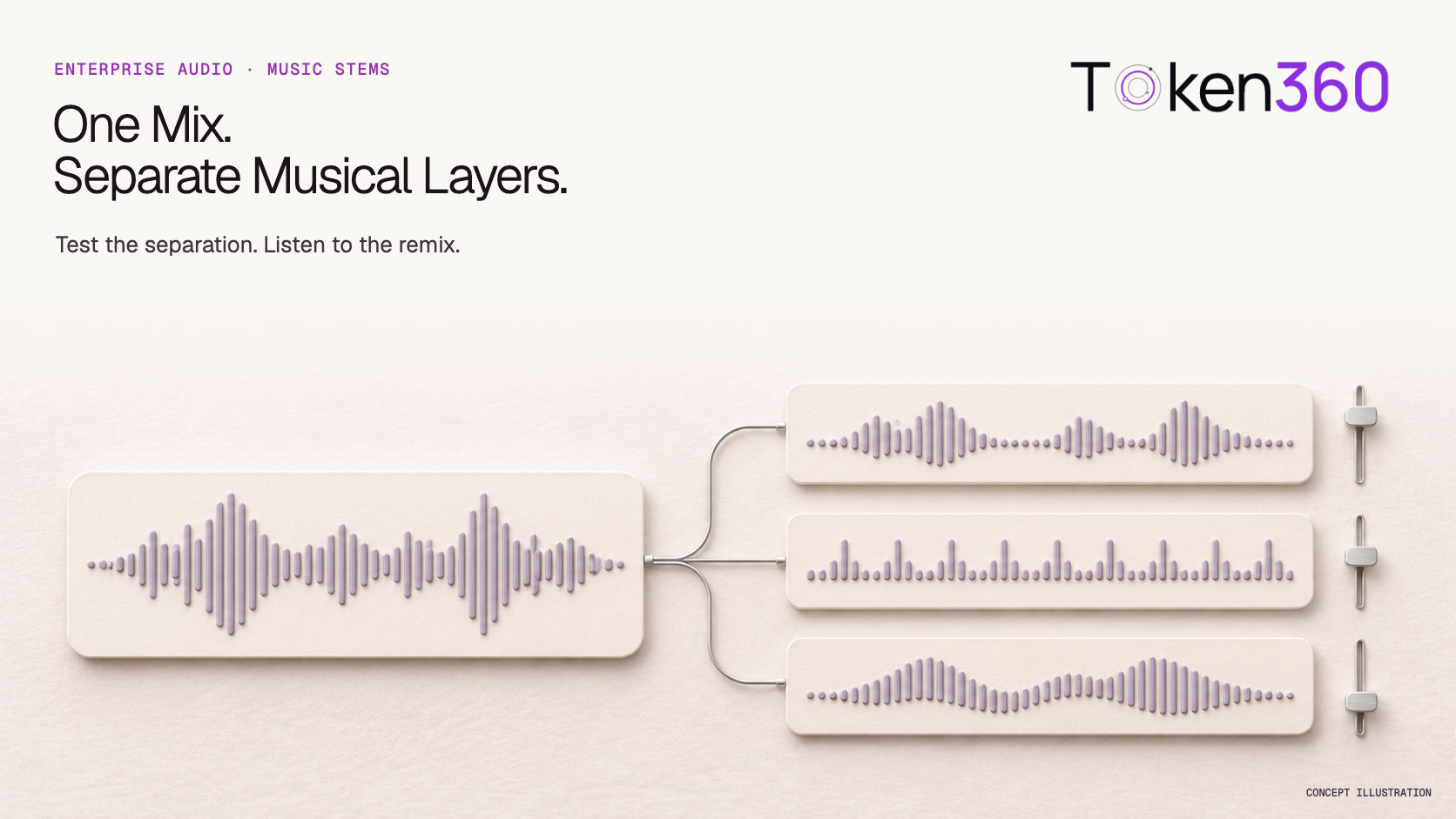
A music stem separation API processes a mixed recording and returns estimated component tracks, such as vocals, drums, bass and a remaining instrumental group. The available groups depend on the model. Buying this capability does not mean receiving the original studio tracks, individual instrument recordings or an editable production session.
As reviewed on November 24, 2026, fal’s Demucs API documentation lists model-dependent stem choices and WAV or MP3 output. Its six-stem option includes guitar and piano; those categories are not available across every listed model. This is evidence of a specific provider’s schema, not a promise about every separation service or Token360.
The adjacent production need is also visible in Higgsfield’s audio workflow guide, which discusses changing audio after the visuals are finished. That page describes voice and translation workflows; it does not establish a stem-separation feature. The useful editorial question is what control a buyer needs over the existing soundtrack.
Choose the deliverable by the edit you actually need.| Requested change | Deliverable to evaluate | Boundary to confirm |
|---|
| Reduce drums while retaining melody | Drum stem and the complementary musical parts | Whether the needed rhythm is isolated cleanly enough |
| Remove singing beneath a new voiceover | Instrumental remainder | Residual singing and damage to instruments |
| Adjust one specific synthesizer | Original session track, if obtainable | A broad “other” stem may combine many instruments |
| Create a different song | New composition or music generation | Separation does not compose a replacement |
For cleaning spoken dialogue, use the separate voice isolation evaluation guide. Preserving intelligible speech and separating the instruments in a music mix require different acceptance tests.
What should you specify before requesting a sample?
Describe the edit, the authorized source file and the layer that must remain unchanged. Give the provider the actual mix rather than a convenient demonstration track. Specify the passages where separation matters most, the target delivery format and who will decide whether the resulting remix is acceptable for the campaign.
A useful brief says: “We need to reduce the percussion beneath the spoken product claim while keeping the melody recognizable and the existing edit timing intact.” A request for “clean stems” leaves the most important decision unstated. The editor should also identify exposed endings, quiet pauses and transitions where a defect would be difficult to hide.
Ask the original composer, agency or music supplier whether suitable stems already exist. Obtaining an approved instrumental or drum-free version can avoid a reconstruction problem altogether. Confirm permission to upload and modify the source for the intended campaign; a processing tool is not evidence that the music itself is cleared.
Keep the original file unchanged. Record its version, duration, channel count and sample rate, together with the requested stem categories and model identifier. If the only available source is compressed or already contains speech and effects, disclose that limitation. A vendor example made from a clean music mix is not a matched test of a finished advertisement soundtrack.
Do not treat “vocals” as a guarantee of separate tracks for a singer, narrator and background speakers. If those must be independently editable, ask for a representative sample demonstrating that exact separation.
How should a buyer judge the separated music?
Listen to each required stem alone, then listen to the intended remix against the original at comparable playback levels. Check the passages affected by the edit, not just a pleasing opening. A technically valid response is insufficient if leakage or artifacts become distracting when a layer is lowered or removed.
Begin with the commercial objective: can the quieter-drum version support the narration without spoiling the music? Solo playback helps locate issues, but approval belongs to the actual use. A faint artifact hidden in the original balance may become obvious when the remaining instruments are exposed.
Proposed listening checks—not results from an experiment.| Check | What to listen for | Decision to record |
|---|
| Leakage | Singing or percussion remaining in a track where it should be reduced | Acceptable at the planned mix level, or requires revision |
| Instrument preservation | Missing notes, softened attacks or unstable sustained sounds | Whether a required musical detail survives |
| Transitions and tails | Abrupt endings, pumping or exposed remnants between phrases | Which exact time ranges need attention |
| Finished video | Distraction beneath narration or a changed emphasis at a product reveal | Editor approval for the intended placement |
Use the same source and edit objective when comparing candidate services. Record the model, settings and output files for each run. Let the editor hear the versions without relying on a model label as a quality signal. Retain unsuccessful examples alongside accepted ones so the purchasing decision is not based on a selected showcase.
Define outcomes narrowly: accepted for the specified remix, accepted with manual repair, or unsuitable for this use. Do not convert a few sample outcomes into a model-wide success rate. If every acceptable result requires substantial manual work, include that work in the purchase comparison rather than reporting only API cost.
This evaluation differs from adding new sound effects to an approved video: here the question is whether an existing musical layer can be changed while the rest remains usable.
Which files and timing checks should the editor receive?
Request individually named audio files, a source identifier, the separation settings and a clear statement of the shared start point. Check duration and alignment after importing the files into the editor’s actual project. A collection of download links is not enough if someone must guess which source, timing or stem each file represents.
Confirm the required audio format, sample rate and channel layout before the sample is generated. A WAV container does not prove that separation restored lost detail or recovered the original recording. Likewise, a high-resolution file does not establish that it sounds acceptable. Treat file compatibility and listening quality as separate checks.
Import the source and returned tracks at the agreed start position, without automatic trimming. Inspect a distinctive beginning event and another near the end to detect an offset or drift. Check that quiet lead-ins and reverb tails have not been cut unexpectedly. These are proposed acceptance checks; this article does not assert that a particular service changes timing.
Ask whether the service normalizes the tracks independently. If it does, summing them without adjustment may not reproduce the starting balance. Have the editor document any gain changes used in the approved remix. Keep the untouched source, returned stems and final mix as distinct assets rather than overwriting one with another.
For repeat deliveries, agree on filenames and a short readable handoff note: source version, requested part, model/settings, editor changes and approval status. Ask about download expiry and retention before relying on temporary result URLs as an archive. None of these delivery properties should be assumed merely because an API returns audio.
What should enterprises confirm with Token360 before buying?
Ask Token360 to confirm the exact separation model, available stems, accepted inputs and returned file formats before discussing volume. Then agree on a representative sample and acceptance criteria. General access to audio models does not establish that a particular stem-separation endpoint, export option or editing integration is available for your account.
Token360 focuses on enterprise model access across text, images, audio and video. Its enterprise quotes are tiered: higher usage receives lower quoted rates, and there is no separate service fee. Those company-confirmed commercial facts do not establish a price for an unconfirmed separation model or make inference free.
Bring a procurement brief containing the expected input duration, file count, required turnaround, simultaneous workload, output categories and editor acceptance conditions. Ask what is billable: submitted duration, successful processing, repeated requests or a different defined unit. Confirm treatment of technical failures and subjective quality rejections separately. Do not assume retries or manual repair are included.
For sensitive or unreleased music, have the enterprise discussion cover upload access, processing parties, retention and deletion requirements. Request confirmation for the proposed service and agreement rather than inferring terms from the general category “audio API.” The same applies to capacity and turnaround commitments.
Make the initial decision a bounded one: proceed with the demonstrated workflow, request a different sample, or obtain original stems from the music supplier. If the sample cannot preserve the required musical detail, a larger volume discount does not solve the production problem. Use the enterprise inquiry to confirm model availability and a scoped quote before committing production volume.
Frequently asked questions
Can AI separation recover the original studio multitracks?
It should not be represented as original-session recovery. Separated files are estimated components from the supplied mix. If the work requires individual microphones, takes, plugins or automation, request the source project or approved exports from its owner.
Does a six-stem model provide six individual instruments?
Not necessarily. Category labels describe the model’s output groups; a group can contain several sounds, and an instrument absent from the source does not become a useful recording. Confirm the categories and inspect the actual files instead of purchasing by stem count alone.
Can I remove singing and keep all the music unchanged?
That is an acceptance objective, not a guaranteed result. Test the instrumental remainder for residual singing and missing musical details, especially in the exposed sections of the planned edit. If an approved instrumental version exists, compare that option before commissioning separation.
Is a stem-separation API better than a desktop tool?
An API may fit a repeated processing workflow; a desktop tool may fit an editor’s occasional task. Compare actual output, review time, file handoff and total scoped cost. Neither delivery method alone demonstrates better separation quality.
Does Token360 already support the required separation model?
This article does not verify a specific Token360 stem-separation model or endpoint. Send the source requirements and requested outputs to the enterprise team for confirmation. Do not build a production integration from another provider’s example and assume the same controls are supported.
Evidence reviewed November 24, 2026. Provider documentation establishes the cited workflow and schema boundaries only. The listening checklist and procurement brief are proposed methods; no original audio comparison or performance measurement was conducted.
About the author
Yuki Yu is Marketing Manager at Token360.


 Guides
 Guides
 Guides