ENTERPRISE IMAGES · PRODUCT VIEWS
A believable rear view is not proof of what is on the back of your product.
AI-generated product angles need evidence for every commercially important detail they reveal. A front photograph can guide appearance, but it does not establish the location of hidden ports, seams or fasteners. Before buying a multi-angle image workflow, decide which views require factual accuracy and how your team will verify them.
This matters when a retailer needs a product-page gallery, an agency needs alternative compositions, or a software team wants to automate product imagery through an API. The deliverable is a usable set of images of the same SKU—not merely several attractive objects that resemble it. This article proposes a procurement and review method; it does not report a completed model benchmark.
Can AI create accurate new views from one product photo?
AI can be used to generate alternative viewpoints, but an unseen surface cannot be verified from a front photograph alone. Treat a generated back, underside or interior as unconfirmed until it matches independent product evidence. Visual plausibility and factual product accuracy should be separate acceptance decisions, especially for sales imagery.
fal's Multiple Angles endpoint describes generating a scene from different azimuth and elevation angles. Higgsfield's product image series workflow organizes reference-based main views and detail shots. These official examples establish a useful category to evaluate. They do not establish the accuracy of your SKU, and their controls should not be attributed to another platform.
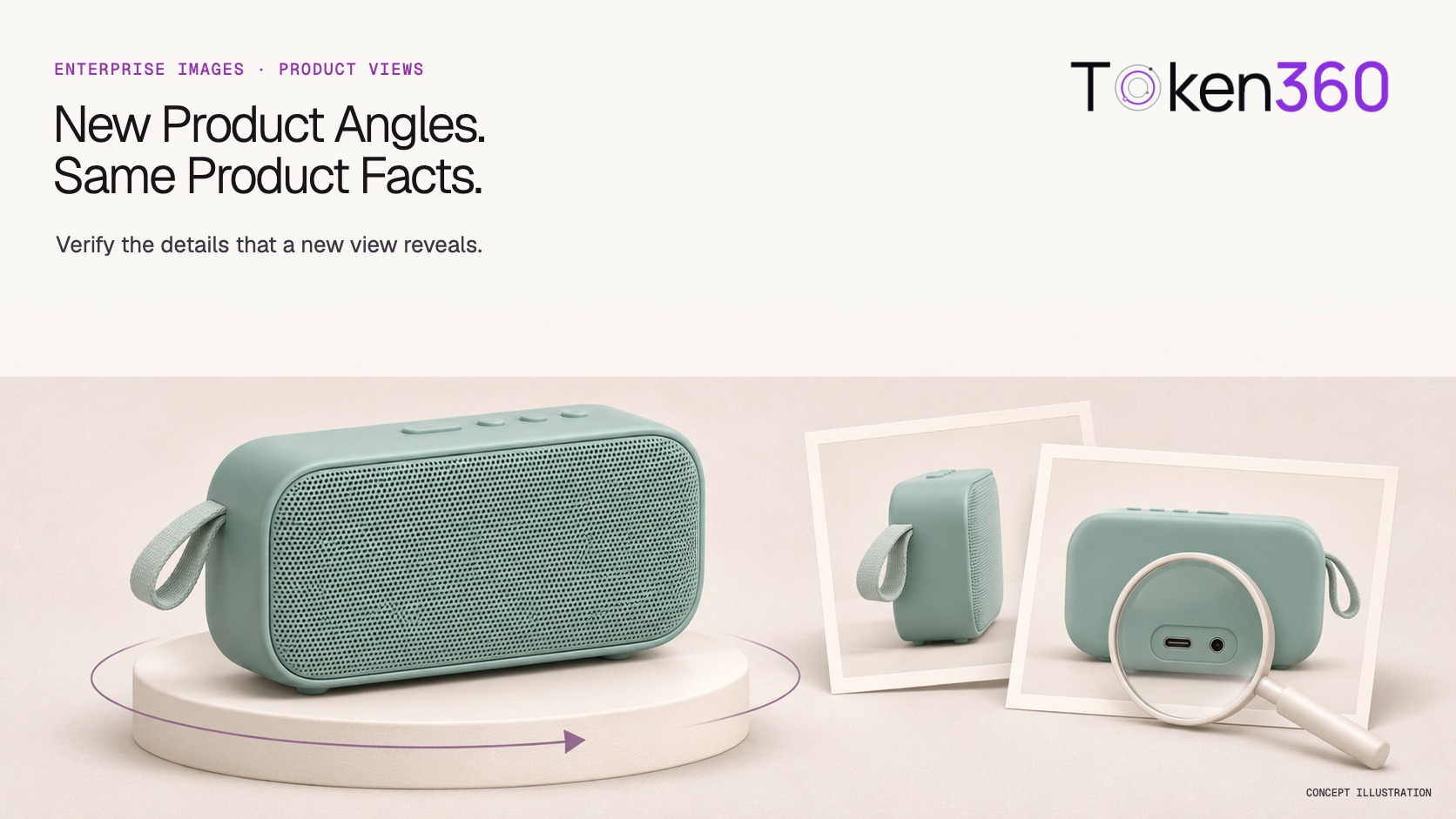
Consider a compact speaker photographed from the front. A generated rear view might look polished while showing a charging port the real device does not have. Conversely, a perfectly plain rear panel might omit a real socket. Neither image can be accepted simply because its color and silhouette match the front.
For concept development, an invented view may be useful when everyone understands its status. For a product listing that customers use to assess connections or construction, the same uncertainty needs resolution. Set the intended use before judging the output.
What reference material should buyers provide?
Provide evidence for the surfaces and features that the requested views will expose. Match references to the exact SKU and revision, and separate product facts from styling instructions. A moodboard can explain the desired composition; it cannot confirm a connector, seam or label that the real product must contain.
A proposed evidence map for a new product-view brief
| Requested view | What needs evidence | Useful reference | If evidence is missing |
|---|
| Three-quarter front | Side depth, controls and front-to-side transition | Matching side and front photographs | Keep the view in concept review |
| Rear | Ports, switches, fastening points and label | Clear rear photograph of the same revision | Do not approve invented hardware |
| Top or underside | Openings, feet, vents and surface layout | Actual top or underside reference | Request an additional capture |
| Open or assembled state | Interior construction and component relationships | Matching state photographs or approved design assets | Treat as a separate brief, not a camera move |
Check the source set for contradictions before sending it to a model. Old packaging, a prototype handle and a production body may all look similar in isolation. Together they create an ambiguous target. Name the SKU, revision and view in the asset manifest, and identify which files are authoritative.
A product team can also mark which details may change: background, crop and styling may be flexible while button count and label content are fixed. This is narrower than the overall ecommerce catalog workflow: it defines the evidence needed for one product's new viewpoints.
What can you confirm about Token360 before buying?
Token360 documents image creation and editing from text plus reference images, but that does not establish a dedicated multi-angle product tool. Before buying this workflow, confirm the selected model's accepted inputs and controls, then test the required views. Do not infer precise camera rotation or accurate hidden geometry from general image-editing support.
As reviewed on November 24, 2026, the Create image documentation describes POST /v1/images/generations and an images reference array. The relevant model determines which parameters and input combinations are usable. This article has not verified a Token360 camera-orbit interface, numerical angle controls, 3D reconstruction or guaranteed view consistency.
Give the supplier the actual reference pack and required output views. Ask whether the chosen route can accept that pack, how references are distinguished, which output sizes are available, and what happens when a requested input or control is unsupported. A common API surface is not evidence that all image models behave identically.
If the main question is whether the job needs generation or editing at all, start with the image generation versus editing decision. Here, the buying question is more specific: can the available route deliver verified additional views of your product?
How should you review the generated views together?
Review every output against its matching product evidence, then review the full set for consistency. A front view and rear view can each look convincing while describing different objects. Record accuracy failures separately from aesthetic preferences so a beautiful composition cannot compensate for a missing connector or changed product shape.
Use a shared review sheet with the source view, requested output view, SKU revision, generated file and reviewer decision. The blank product-view review worksheet (template below) provides fields for those records; it contains no invented test results.
- Geometry: compare component count, connections, openings and relative placement. Perspective changes apparent dimensions, so a pixel mismatch alone is not a failure.
- Identity: check color variant, material, branding and label content against the approved product, not another generated image.
- Cross-view agreement: check that a side control stays on the correct side and that parts do not appear or disappear between views.
- Use readiness: check framing, resolution and the intended placement only after factual defects have been resolved.
For example, a rear socket that moves to the side in a three-quarter view is a structural discrepancy. A highlight moving as the viewpoint changes is not automatically one. A product specialist and a creative reviewer should resolve those distinctions using the same reference pack.
Review the set, not just the strongest frame. Preserve rejected outputs and their reasons, and record changes to the prompt or source assets. Otherwise, a curated gallery can hide how much work it took to get a usable result. These are proposed evaluation steps, not claims about a measured failure rate.
When should you use photography or a 3D asset instead?
Prefer a new photograph or a verified 3D asset when the missing view must accurately reveal product structure and you cannot validate a generated alternative. AI remains an option for exploratory compositions, but adding a plausible back view does not create product evidence. Choose the method according to the consequence of an incorrect detail.
A rear-panel image used to show available connections needs stronger evidence than an internal moodboard. If obtaining the missing photo is straightforward, compare that effort with generating, reviewing and correcting an uncertain view. Do not assume generation is the lower-cost route before measuring the complete production task.
An approved CAD or 3D asset can provide explicit geometry, but it still needs the right revision, materials and configuration. A render of an outdated design is not made accurate by the rendering method. The source of truth remains the product.
Also separate camera changes from other edits. Extending a canvas addresses placement, while product relighting changes apparent illumination. Neither task necessarily requires showing an unseen side. If the existing view already serves the brief, avoid introducing a new structural uncertainty just to create variation.
What should a pilot and enterprise quote include?
Scope a pilot around named products, required views, reference availability and acceptance rules before discussing production volume. Ask for the selected model and supported workflow in the proposal. Compare total spending on the approved view set, including review and correction, rather than assuming a quoted generation price represents the cost of usable imagery.
The brief should distinguish mandatory catalog views from optional creative variants. Specify whether every view must pass for the SKU set to be usable, who approves product accuracy, and what the team will do when a hidden detail cannot be confirmed. Include representative difficult products, not only smooth objects without labels or hardware.
Record generation charges, failed or rejected attempts, human review and any retouching or replacement photography separately. If you calculate cost per accepted set, define the set consistently and use actual observed spending. No price, acceptance rate or savings estimate has been measured for this article.
Token360 serves enterprise model procurement across text, image, audio and video. Its confirmed commercial approach uses tiered enterprise quotes, with higher usage receiving lower quoted rates, and no separate service fee. The specific models, eligible usage and terms belong in the quote; these facts do not promise a dedicated multi-angle feature or eliminate model usage charges.
A useful inquiry is: “We need these verified views for these SKU revisions. Here are the reference images and the details that cannot change. Which currently available model route can you evaluate, what inputs does it accept, and how will we decide whether a complete set is usable?” That gives the supplier an assessable task and gives procurement a concrete deliverable to buy.
Evidence boundary: this is a documentation-based buying framework. No generation pilot was conducted for this article. Competitor features are attributed to their own documentation; Token360 view accuracy and dedicated angle controls remain unverified.
Frequently asked questions
Can one product photo reveal the true hidden side?
It does not provide evidence of surfaces that are not visible. A generated new view may infer details rather than recover them. Supply verified views or a suitable product asset when hidden geometry matters, and do not treat a plausible result as a technical reference.
How do we check whether several generated angles agree?
Compare the views against the same approved product references. Review proportions, seams, controls, labels and features that appear in more than one view. Judge agreement across the set instead of approving each image solely on visual appeal.
When should we use photography or a 3D asset instead?
Use a verified source workflow when exact unseen geometry or repeatable camera placement is essential. AI-generated views can be evaluated for creative uses, but this article does not establish them as a substitute for accurate product documentation.
Review worksheet template
SKU,revision,requested_view,source_evidence,generated_file,geometry_check,identity_check,cross_view_check,decision,reviewer,rejection_reason,generation_cost,review_minutes
,,,,,,,,,,,,
About the author
Yuki Yu is Marketing Manager at Token360.


 Guides
 Guides
 Guides