Video references can guide motion, but exact copying needs testing. See what Token360 buyers should verify about inputs, action fidelity and quote scope.
ENTERPRISE VIDEO · MOTION REFERENCES
Turn “make it move like this” into a testable production requirement.
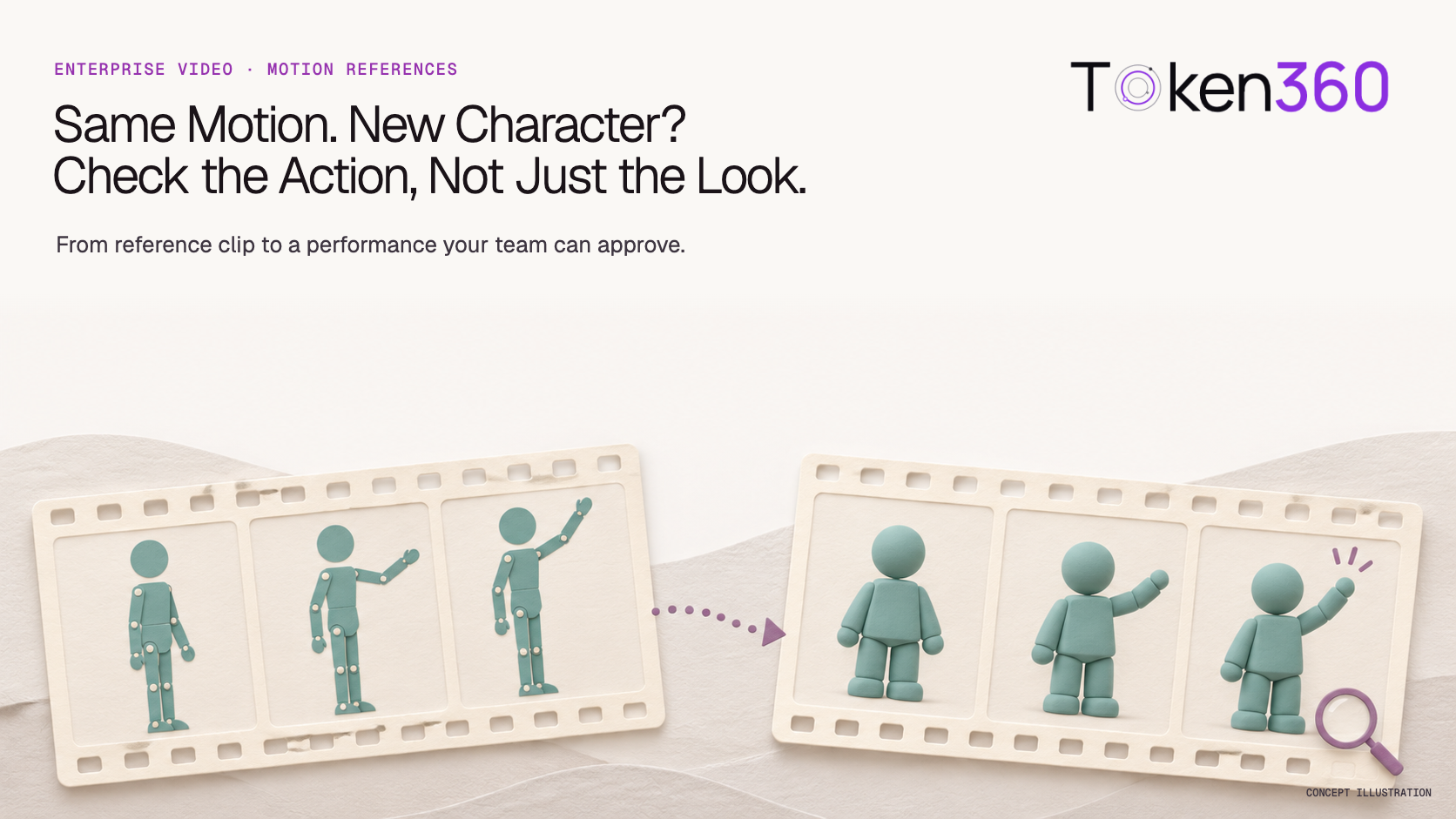
Some AI video workflows use a reference clip to guide a new performance, but accepting video input does not guarantee exact motion transfer. Before buying, specify whether you need the same action, timing, pose sequence or product interaction. Then test those requirements on the exact model and route proposed for your project.
For Token360 buyers, there is a concrete starting point: the public Seedance 2.0 schema lists video-reference inputs. There is also a clear evidence boundary: this article has not tested how accurately that route follows a performance. The buying decision should depend on the delivered movement, not merely on a successful upload or an attractive still.
What does following a motion reference actually mean?
Following a motion reference means using a source performance to guide movement in a new output. The buyer must define which aspects matter: action order, pose, direction, timing or interaction with an object. Those requirements differ from matching a character's appearance or asking the camera to orbit around a subject.
The category is visible in both fal's Motion Control API documentation, which describes a character image paired with a movement reference, and Higgsfield's motion-control workflow, which presents separate motion and character inputs. These are useful examples of the task buyers are being offered. They are not evidence that Token360 exposes those exact routes or matching controls.
The team says
The requirement to clarify
What would not be enough
“Use this gesture”
The specific hand or body movement and its direction
A similar mood without the gesture
“Keep this timing”
Which event must happen at which point
The action occurring somewhere in the clip
“Show how this product works”
Correct contact, object state and operation sequence
The product merely appearing beside the character
“Keep the person recognizable”
Approved character identity
Motion fidelity with a changed identity
“Keep this camera move”
Camera path and framing
A subject moving inside a stationary frame
An agency may accept a broadly similar wave for a stylized campaign. A product team may need a specific latch to open before a lid lifts. Both involve movement, but the second brief has a stricter state sequence. Neither example is a reported customer result.
Does Token360 accept reference videos?
Token360's public catalog lists reference-video inputs for Seedance 2.0, providing a documented starting point for a reference-guided video evaluation. It does not establish exact action copying, a dedicated motion-control interface or compatibility with another provider's request format. Confirm the selected route and account availability before treating the workflow as ready for production.
On November 24, 2026, the public model schema exposed input_references with a reference_videos definition for MP4 and MOV inputs, with a maximum of three listed reference videos. That is an input contract, not a quality score. It should not be interpreted as a recommendation to use three references in every request.
Token360's model-capability guidance makes the selected model page and public schema the source of truth. Ask the integration owner to identify how the clip is supplied and what role it plays. A source to edit, a clip to extend and a performance to reference are not interchangeable instructions.
A paid evaluation should proceed only after those inputs are understood. This article did not run one, and does not claim that Token360 offers the same motion-transfer behavior, scene controls or output fidelity described on fal or Higgsfield.
Which reference assets should your team supply?
Supply an authorized performance reference, the intended subject or character reference, and a brief naming the motion that must survive. Keep the first evaluation focused enough that reviewers can identify a mismatch. Ask for route-specific media limits rather than assuming another platform's duration, orientation or reference requirements apply.
A useful brief separates three roles: what should move, how it should move, and what may change. For instance, the new character may have a different outfit while retaining a simple arm gesture. If the background, camera, object and gesture all change at once, the buyer needs to state which changes are intentional.
Prefer a clearly visible action for an initial test. Occlusion, cuts or multiple interacting subjects make the review more ambiguous; this is a test-design consideration, not a claim that every such input will fail. Keep the source unchanged in the evaluation record so that later reviewers know what the model received.
Use assets approved for the intended project and record who owns that approval. Where the identity is a real person or a fictional brand character, the character-asset purchasing decision is a separate prerequisite. This article does not determine whether a particular source performance is authorized for reuse.
How do you test motion fidelity rather than visual appeal?
Review the source and generated video together, checking the required events in order before judging polish. Record where movement starts, which direction it takes, whether contact happens and what state the subject or object reaches. A thumbnail can show appearance, but it cannot establish that a sequence of actions was executed correctly.
Create an event sheet before generation. For an illustrative “pick up a cup and place it on a coaster” brief, reviewers could check the initial cup location, the hand reaching it, credible contact, the lift and the final placement. If the cup jumps to the destination without the required interaction, the business should not mark that requirement as passed because the final frame looks right.
Review dimension
Evidence to record
Decision
Event coverage
Required actions that appear or are omitted
Did the requested sequence occur?
Order and direction
Reversed, swapped or mistimed movements
Does the sequence communicate the intended action?
Contact and state
Hand/object contact, object position and state changes
Is the demonstrated interaction acceptable?
Timing
Source and output event times
Does timing meet the brief's stated tolerance?
Identity and framing
Appearance or framing deviations
Is the result usable for this campaign?
Set any timing tolerance with the production owner; do not borrow an arbitrary threshold from a marketing demo. Keep visual appeal as a separate review dimension. A result can pass the style review and fail the action review, or the reverse.
Use the motion-reference review worksheet (template below) to capture source and output event times. It contains no benchmark data. Review the full clip; where a contact or transition is uncertain, inspect that interval closely rather than concluding from isolated screenshots. Keep rejected attempts and their settings alongside accepted ones.
When is motion transfer the wrong requirement?
Motion transfer may be the wrong purchase when the task actually requires preserving existing footage, continuing a scene or reaching a specified closing image. Define the transformation before choosing a model. If the original action must remain unchanged, ask whether an editing workflow better matches the brief and test its preservation separately.
If you want to change a background around an existing performance, compare that requirement with video editing rather than extension. If you need a particular opening and closing composition, the first-and-last-frame workflow addresses a different constraint. Neither should be substituted for motion fidelity without an explicit decision.
For a demonstration in which small mechanical actions must be exact, consider retaining verified footage for those actions and evaluating generation only for scenes that tolerate interpretation. That is a production option to assess, not a tested fix or a claim that generated demonstrations cannot work.
This article does not replace a motion and camera prompt guide. Prompt wording is one input; the purchase still needs a supported route and a result that meets the action criteria.
What should an enterprise request and quote specify?
An enterprise request should name the source assets, required movement, permitted changes and acceptance owner. The quote should identify the actual model route and its billing unit, with the evaluation scope and unresolved capabilities stated separately. A model listing alone should not be treated as a commitment to reproduce a performance accurately.
We want to use an authorized reference clip to guide [specific action] in a new brand video. The required events are [sequence], and [identity, scene or camera elements] may change. Please confirm the proposed model and input format, supported controls, evaluation scope, billing rules and which requirements need validation before a production order.
Token360 uses tiered enterprise quotes: higher usage receives lower quoted rates, and there is no separate service fee. Ask how the proposed reference-video workflow is metered and whether reference processing changes the applicable charge. Do not assume a competitor's per-second rate, input allowance or retry policy applies.
Clarify whether the offer covers generation access, additional editing or a finished deliverable, and who decides whether an output needs another attempt. Those scope boundaries matter before negotiating volume. A team that needs exact actions should not purchase against a vague promise of “better motion.”
Token360 is relevant here as a model-access provider. The next useful step is a scoped evaluation of the supported reference route—not an assumption that a reference upload guarantees a production-ready performance.
Frequently asked questions
Will a motion-reference API copy the movement exactly?
A reference-video input is not evidence of exact motion reproduction. Define the movement, timing and contact events that matter, then compare the generated sequence with the reference. Treat missing or altered actions as separate failures even when the result looks attractive.
Can we keep a product unchanged while transferring motion?
That must be tested as a separate requirement. Review product geometry, markings and interactions throughout the sequence. Motion similarity does not establish product fidelity, and this article does not promise that a Token360 route preserves both.
What should we provide besides the reference video?
Provide authorized appearance references, the intended output specification and a short list of required actions. Explain which parts of the reference describe motion and which should not be copied. Ask the supplier to confirm the accepted inputs for the proposed model.


 Guides
 Guides
 Guides