Buy AI through a reseller when its pricing, procurement or support terms add value. Compare direct access, total cost and delivery responsibilities.
ENTERPRISE AI · PROCUREMENT CHANNELS
Enterprises should consider buying AI through a reseller or service provider when that arrangement solves a concrete procurement or operating problem: negotiated terms, access to several models, billing coordination or a defined support obligation. Buy directly when the provider relationship already meets your needs. Choose on documented responsibilities and comparable workload costs, not the label “reseller.”
A company may know which model it wants and still be unsure whom to pay. The model developer, an inference platform, a marketplace and a service provider can occupy different parts of the same purchase. A familiar model name in a catalog does not explain which company owes you support, which terms govern your data or what happens if access stops.
This article helps procurement, engineering and finance teams choose a purchasing route for model API access. It is a decision framework, not a ranking of suppliers or evidence that an intermediary is always cheaper. Public offering details were checked on November 12, 2026; examples below are hypothetical.
What does buying AI through a reseller actually mean?
Buying through a reseller usually means purchasing access from an intermediary rather than contracting only with the original supplier. But an AI gateway, inference host, managed service provider and authorized reseller are not interchangeable roles. Establish the seller, the service being supplied and the underlying rights before comparing commercial offers.
Here, direct purchase means contracting with the company whose inference service you will use, without another seller arranging that purchase. That company may be a model developer or an independent inference host. For an open-weight model, the model creator and the company operating the endpoint may be different organizations.
For this article, service provider is the broader term. A company might sell its own hosted inference service, aggregate third-party endpoints, manage a customer's existing provider account or resell a specifically authorized product. Those arrangements can have different obligations even if the customer sends similar API requests.
There are formal resale structures. In AWS Marketplace's channel partner private-offer process, the software vendor gives a channel partner a selling authorization, and the partner creates a buyer-specific offer. That is an example of a documented authorization relationship, not evidence that every AI API intermediary has the same arrangement.
Ask the prospective supplier to describe the actual transaction: “What are we buying from you, which entity signs the agreement, and on what basis can you provide this model access?” Do not infer authorized-partner status from a logo or compatible API. Equally, do not assume that a company hosting a model under an applicable license must be reselling a developer's hosted API.
When is a service provider worth considering?
A service provider is worth considering when it can take responsibility for work your team otherwise has to perform across suppliers, or offer commercial arrangements that fit your workload. The benefit must be concrete: a clearer buying process, suitable capacity terms, useful technical coordination or a better documented total cost.
Consider a product company using text models for support, image models for catalog content and audio models for narration. Its problem may be less about finding another model and more about coordinating pricing, access and support across production workloads. A provider able to cover that scope may simplify procurement, provided the proposal identifies exactly which services and obligations are included.
Another buyer may need a volume-based proposal or a capacity arrangement tied to a launch. The useful question is whether the offer specifies the required models, limits, period and escalation process. A sales conversation about dedicated capacity is not itself a capacity reservation. If no written arrangement exists, keep it as an open requirement.
Support also needs a practical definition. A provider that receives tickets but cannot obtain upstream diagnostic information may add a handoff. A provider with an agreed escalation process can give the buyer a clearer operating contact. Request an example incident workflow and the contractual response obligations; do not assume a dedicated contact can guarantee a model-provider recovery time.
When should an enterprise buy directly instead?
Direct procurement is a strong option when one provider already meets the workload, commercial and governance requirements, and your team can operate the integration. It may also suit a product that depends on provider-specific capabilities. An intermediary should earn its place by adding relevant value rather than duplicating a relationship that already works.
If most production usage sits on one model family, the existing provider contract is satisfactory and engineering already has effective support, a second purchasing layer may offer little benefit. Compare the incremental value with the additional onboarding, data-flow review and operational dependency.
Direct access can also matter when a particular capability is essential. Check exact feature support, release availability and parameter behavior on each route instead of assuming API compatibility means feature parity. This is a buying decision informed by engineering; the implementation tradeoffs are covered separately in AI gateway versus direct API architecture.
Neither route establishes output quality or latency by itself. If those decide the purchase, run matched requests against the actual proposed endpoints and settings. We have not run such a comparison for this article and do not claim that direct access is always faster or that service-provider access improves generation quality.
How should direct, service-provider and marketplace purchases compare?
Compare purchasing routes against the same workload and obligations. A marketplace describes where a transaction occurs; it does not necessarily identify who delivers inference or handles incidents. A service provider may also sell through a marketplace. Keep the commercial route, technical route and responsibility chain separate in your evaluation.
Decision criterion
Direct provider purchase
Service-provider purchase
Marketplace transaction
Best reason to consider it
The provider already meets your needs.
The supplier adds relevant commercial or operating value.
The transaction fits an established purchasing process.
What to verify
Account terms, feature access and support scope.
Service scope, basis for supplying access and upstream dependencies.
Actual seller, offer terms and service operator.
Price comparison
Your applicable negotiated or published rates.
The quoted usage rates plus all applicable charges and commitments.
The specific offer, billing conditions and eligible commitments.
Incident ownership
Provider support plus your application team.
Named support owner and explicit escalation boundaries.
Not established by the marketplace label; inspect the offer.
Main reason to decline
Requirements remain unmet or fragmented across suppliers.
Added dependency without sufficient documented value.
Purchasing convenience does not match the required service terms.
This table is an evaluation framework, not a promise that any route includes a particular discount, compliance control or SLA. A mixed approach can be sensible: retain an important direct relationship and use a service provider for additional workloads. Avoid duplicating commitments that neither purchasing channel can use.
For a prepaid purchase, check whether unused AI API credits expire before committing funds; validity, eligible usage and refund terms belong in the purchasing decision.
Who should be responsible when something goes wrong?
Before signing, identify who owns billing disputes, service incidents, access changes and upstream escalation. One invoice does not automatically mean one party accepts responsibility for every failure. The contract and operating process should explain what the supplier controls, what depends on another provider and what remains with your application team.
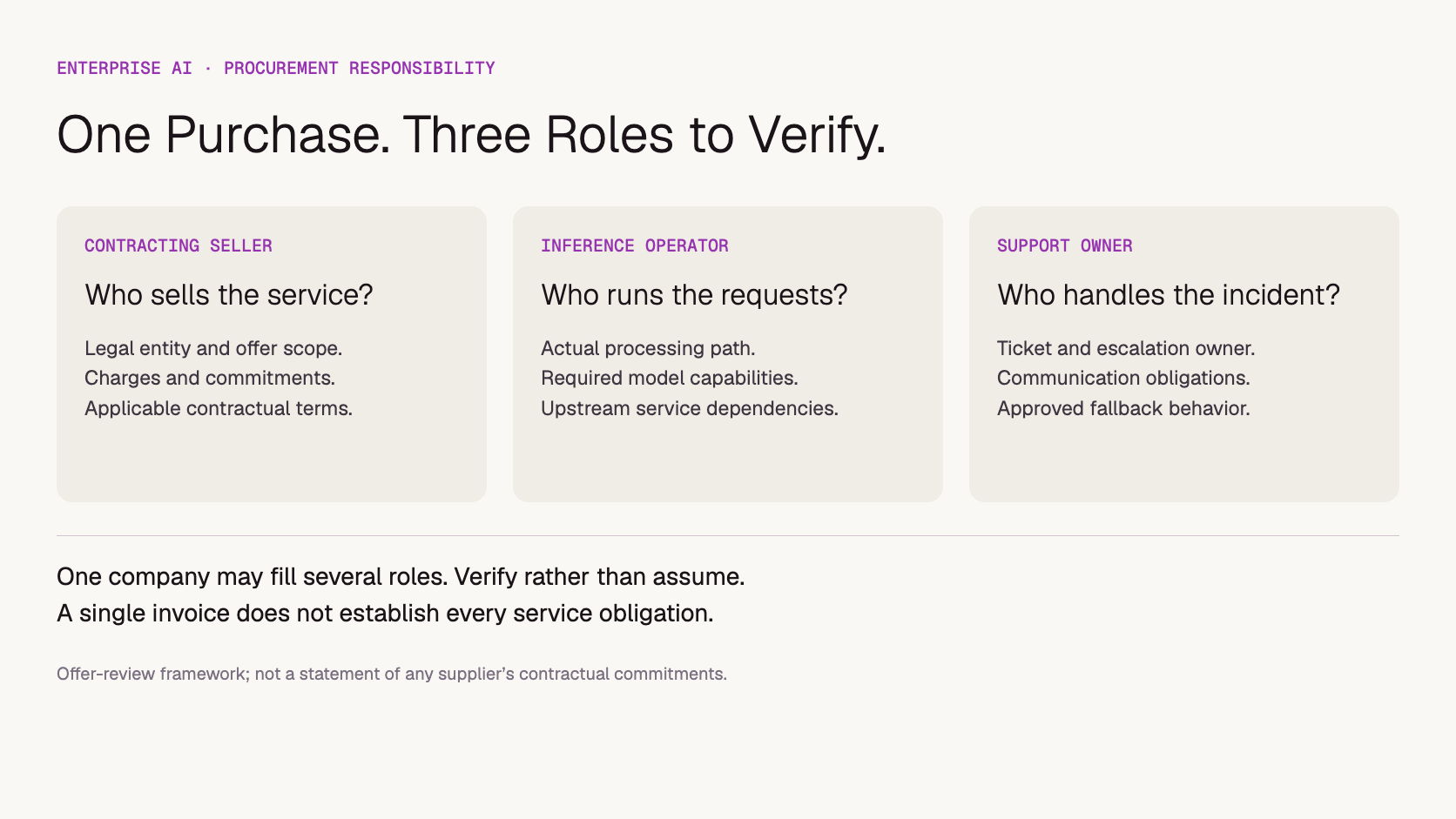
Role map for offer review. One company may fill several roles; a single purchasing interface does not prove that it does.
Use a real operational question during evaluation: “Our approved model becomes unavailable during a customer-facing workflow. Who receives the ticket, what information do we receive, and can anyone substitute another model without our approval?” The answer should cover the proposed fallback policy as well as communication and escalation.
Separate an acknowledgment target from a recovery commitment. Ask how request identifiers, timestamps and redacted error details move between teams. Establish whether you can see enough usage information to reconcile an invoice without needing access to an upstream account you do not own.
For data handling, request documentation for the proposed processing path, including relevant operators and contractual terms. Do not treat fewer invoices as proof of fewer processors or transferable compliance assurances. Any required data location, retention or processing restriction needs confirmation for the actual service configuration.
A useful review artifact is a short responsibility register: issue, buyer contact, supplier owner, upstream dependency, supporting contract clause and unresolved gap. Copy the blank procurement responsibility register below and fill it from the offer; the template contains no assumed supplier commitments.
An intermediary can cost more, less or approximately the same for a particular workload. Compare the final offer with the direct terms actually available to your company, using the same usage assumptions and service requirements. A separate platform fee, an embedded margin and a negotiated model rate are different commercial mechanisms.
For example, OpenRouter's published pricing policy states that inference is not discounted, while enterprise fee discounts are available. That policy describes OpenRouter's offer; it is not a universal rule for AI intermediaries. Its enterprise offering also includes procurement and support arrangements, so it should not be described as a developer-only service.
Prepare a common usage basket before comparing proposals: model versions, input/output mix, cache assumptions where applicable, media generation settings, expected volume, concurrency and required support. Record minimum commitments, unused-credit treatment and any additional charges. If quotes use different assumptions, a lower headline number cannot settle the buying decision.
Keep operational savings separate from invoiced savings. Fewer supplier onboarding processes may save staff time, but that is an internal estimate until measured. Use your own onboarding and support records to estimate that work; keep assumptions separate from measured savings. For the data to send suppliers, use the enterprise AI API quote preparation guide.
Where does Token360 fit in this decision?
Token360 is an enterprise-focused option for purchasing model access across text, image, audio and video. Enterprises can discuss pricing, dedicated capacity, contracts and compliance requirements for a specific engagement. Evaluate the resulting proposal against your direct option; this positioning does not establish universal reseller authorization, a default SLA or guaranteed savings.
Token360's enterprise page describes multimodal REST access and custom enterprise pricing. As checked on November 12, 2026, priority support and SLAs remain marked “Coming Soon,” while higher throughput is a sales discussion. Do not treat these as standard entitlements merely because an enterprise inquiry has been submitted.
Token360 does not charge a separate service fee, according to company-confirmed commercial information. Model usage remains chargeable, and no separate fee does not mean no margin or automatic provider-list-price pass-through. See what Token360's service-fee policy means. Volume-based model pricing is subject to the actual quote.
For setup, start with the required models and API workflow, then establish the enterprise account, access and billing arrangements applicable to the engagement. Validate the relevant endpoints before moving production traffic. Model access is not a promise of a ready-made integration into your business application. Background on the company is available through Token360's About and resources page.
How can a buying team make the final decision?
Choose the route that meets mandatory requirements and provides enough documented value to justify its dependencies. Start with a workload definition, obtain comparable offers and close responsibility gaps before committing. If the only clear benefit is a small headline discount while service ownership remains unclear, the evaluation is not finished.
Define the purchase. Identify models, use cases, expected volume, feature requirements and required processing conditions.
Identify the parties. Record the seller, service operator, support contact and basis for providing access.
Compare like for like. Use the same usage basket and required support scope for direct and intermediary offers.
Verify the operating path. Test required functions and review escalation, billing visibility and model-change rules.
Document exit conditions. Confirm treatment of credits, account access, usage exports and transition support.
Keep a written reason for the decision and a review trigger, such as a major workload change or renewal. Channel selection should remain revisitable. For application-level preparation, read what to keep portable when choosing an AI vendor.
Frequently asked questions
Is an AI API gateway the same as a reseller?
No. A gateway describes a technical access or routing layer. Resale describes a commercial relationship. A supplier may perform both roles, but the API design alone does not establish who sells the service or which authorization and terms apply.
Can we use a service provider and keep direct accounts?
Yes, a buying strategy can include both, subject to the relevant agreements. Decide which workloads belong on each route and check whether commitments, credits and support obligations are separate. Do not assume usage on one route counts toward another contract.
Does a reseller guarantee access to new models?
No. Confirm model availability, version policy, required capabilities and change notifications in the proposed service. A broad catalog or unified endpoint is not a guarantee that every new model or provider feature will be available immediately.
Do we have to accept the intermediary's replacement model?
That depends on the agreed routing and substitution policy. Specify when a fallback is allowed, which alternatives are approved and when the request should fail instead. A model replacement can change behavior even when the API response format remains compatible.
What should we send Token360 to evaluate an enterprise offer?
Send the model list, workload mix, expected volume, peak requirements and relevant contract or data-handling requirements. Request an explicit scope and quote rather than assuming a general enterprise description covers your needs. Do not send credentials or production personal data as part of an initial pricing request.
Evidence note: this analysis uses official AWS Marketplace, OpenRouter and Token360 pages plus company-confirmed Token360 commercial information. It contains no measured supplier cost, latency or reliability comparison and no assertion of a specific vendor's reseller authorization.
Enterprise AI
API
Bring your next idea to life.
Create a video scene in Creator, or explore models for images, audio, and text to find the right capabilities for your project.


 Guides
 Guides
 Guides