Batch API vs. Real-Time Inference: When Is Waiting Worth It?
A Batch API can lower costs when tasks can wait. Compare deadlines, accepted results, and rerun costs before choosing batch over real-time inference.
PRODUCT PERSPECTIVE · WORKLOAD ECONOMICS · NOVEMBER 2, 2026
By Yuki Yu
A Batch API is worth considering when independent tasks can wait and the discounted processing cost outweighs the work of managing delayed results. The decision starts with the business deadline, not the number of requests. A large workload can still require immediate responses; a small offline workload may tolerate a delay.
For product teams, batch inference is a scheduling choice with economic consequences. Evaluate the complete path from preparing inputs to accepting results, including failures and any urgent reruns. A cheaper request that arrives too late is not equivalent to a usable result delivered on time.
Prepared for Token360 on November 2, 2026. Provider examples are linked to official documentation. The cost scenario and deadline framework below are editorial analysis, not a Token360 batch-service announcement, price quote, or measured production result.
How is a Batch API different from concurrent requests?
A Batch API accepts a collection of requests for asynchronous processing; concurrency merely means multiple requests are in flight together. Sending many ordinary calls at once does not automatically qualify them for batch pricing or a batch completion contract.
Anthropic’s Message Batches documentation describes independently processed requests submitted together, with results retrieved after processing ends. Its current documentation advertises a 50% reduction against standard API prices and a 24-hour expiration boundary. These are service-specific terms, not a promise about every provider or gateway.
The distinction changes application design. An interactive request usually has a user waiting for a response. A batch job needs a durable record of what was submitted, when results are needed, and how completed outputs will be associated with their original tasks.
Which tasks are reasonable candidates for batching?
Independent tasks with flexible deadlines are the clearest candidates. Examples include preparing draft summaries for later review, running an offline evaluation set, classifying an archive, or enriching records before the next reporting cycle.
Workload
Timing requirement
Starting choice to evaluate
Live support reply
A person is waiting now
Interactive inference
Historical document classification
Results needed before a scheduled review
Batch, if the completion window fits
Offline model evaluation
No immediate response needed per case
Batch with per-case result tracking
Sequential agent task
Next step depends on the previous answer
Interactive orchestration, or batch only independent stages
These are starting points, not universal rules. An archive analysis may become urgent during an incident. A live product may generate some background suggestions that can wait. Classify the individual task rather than assigning one execution mode to the whole application.
How much waiting can the workflow actually tolerate?
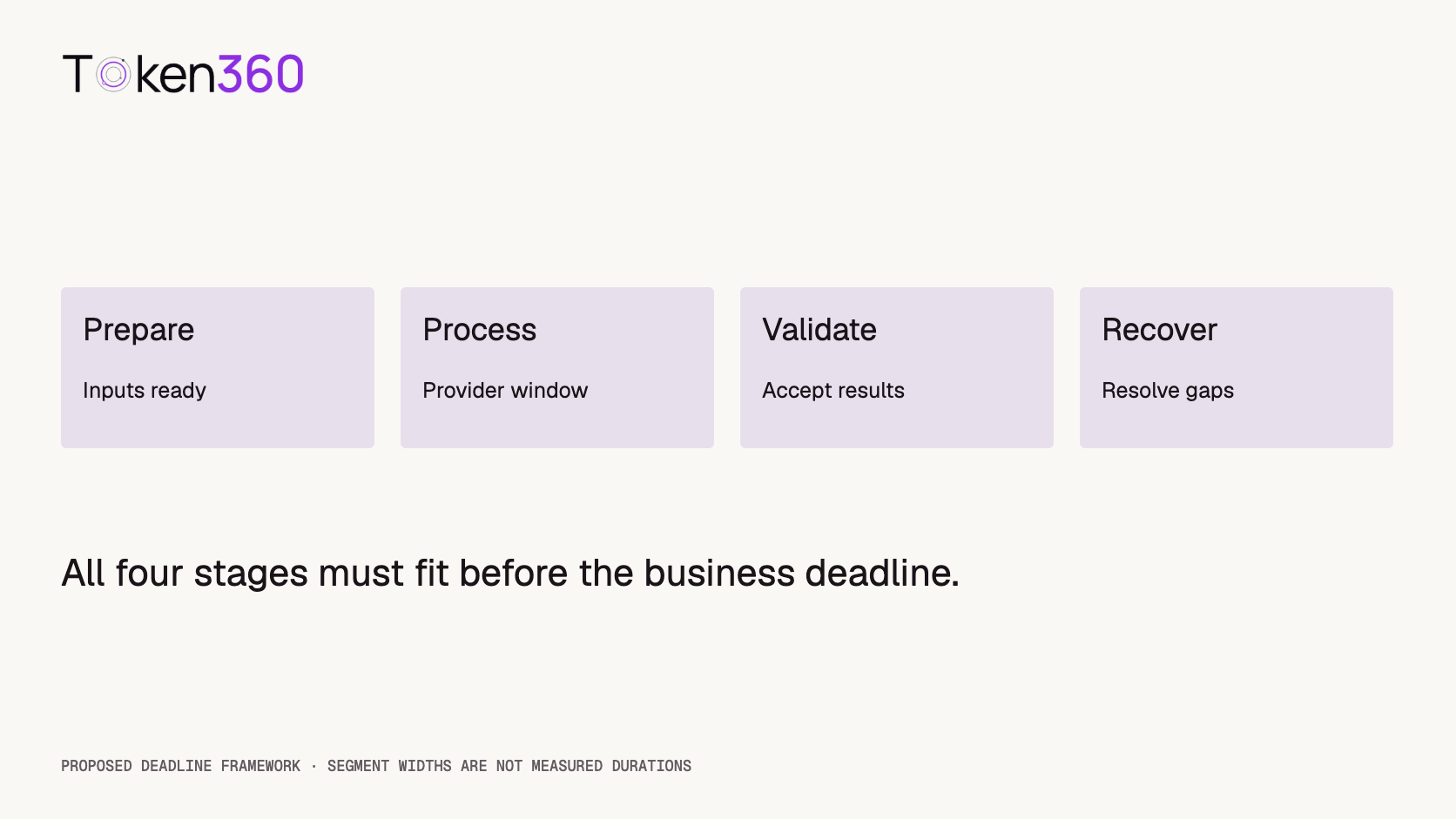
Budget for the entire completion path, including preparation, provider processing, result validation, and recovery. A provider’s processing window is only one component of the time available before the business deadline.
For example, a report needed tomorrow morning may require results early enough for someone to review them. Submitting immediately before the maximum documented processing window would leave no time for missing outputs or corrections. A service’s typical completion time is not a substitute for the conditions you can rely on.
Define an internal decision point: when will the team stop waiting, inspect what is available, and choose a recovery path? Record the consequences of that choice, including duplicate processing risk and possible additional charges. The recovery path should be part of the plan before submission.
Proposed deadline framework. Segment widths do not represent measured durations.
Why does a finished job not necessarily mean every task succeeded?
Job completion and task acceptance are different states. A collection can stop processing while some items still have errors, unusable outputs, or unresolved review decisions. Track outcomes at the item level.
Give each logical task a stable identifier and preserve its relationship to the submitted request and retrieved result. Reconcile the submitted set with the results actually received. Do not depend on result order unless the selected interface explicitly documents that behavior.
Amazon Bedrock’s batch inference documentation illustrates another delivery pattern: inputs are provided through files in Amazon S3 and outputs are retrieved from S3. That difference matters operationally even though the work is still asynchronous inference.
Validation should include both technical usability and task quality. A response can be valid JSON while assigning the wrong category. Use the model evaluation framework to define acceptance criteria before expanding the job.
What does a realistic cost comparison need to include?
Compare the bill for accepted, timely outcomes, not only the advertised per-request discount. Include preparation, storage or transfer where applicable, validation, reruns, and any alternative path used to meet the deadline.
Keep costs that are the same in both designs separate from costs introduced by batching. If both routes need human review, assigning all review cost to the batch route would be misleading. If the batch route requires a new result-ingestion process, ignoring that work would also distort the comparison.
Verify the applicable model, endpoint, and pricing categories. A direct-provider discount does not establish the same rate through another serving route. Equally, an asynchronous video-generation job is not automatically the discounted text-model batch product described in another provider’s documentation.
How can urgent reruns change the savings?
Reruns can reduce the benefit, even when the initial batch receives a substantial discount. The following hypothetical example makes that effect visible without assuming a real model price or error rate.
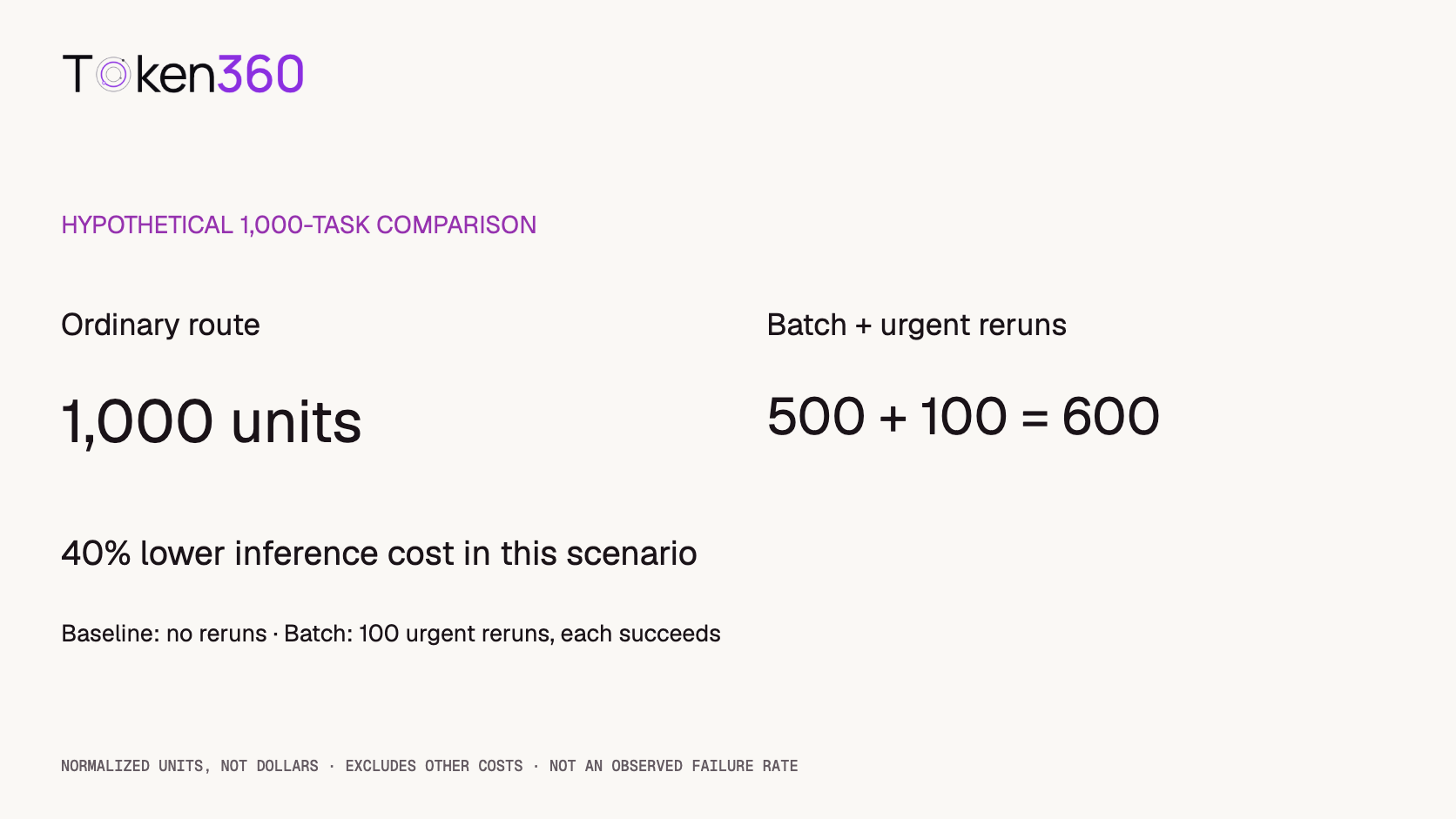
Suppose 1,000 comparable tasks would cost 1 normalized unit each on an ordinary route. Assume the initial batch costs 0.5 unit per task, and all 1,000 attempts are charged. If 100 outputs require one urgent rerun at 1 unit each, and those reruns all succeed, inference spending becomes 500 + 100 = 600 units.
Hypothetical component
Calculation
Cost
Ordinary-route baseline
1,000 × 1
1,000 units
Initial batch
1,000 × 0.5
500 units
Urgent reruns
100 × 1
100 units
Combined inference cost
500 + 100
600 units
Against a simplified baseline that succeeds without reruns, the reduction is 40%, rather than the initial 50%. That baseline is an explicit assumption; if ordinary calls also require reruns, their cost must be included. The example excludes orchestration and other charges, assumes comparable task costs, and does not claim that batching causes more errors.
Under the same assumptions, 500 urgent reruns would bring inference spending to 1,000 units, eliminating the modeled saving. This is a sensitivity calculation, not a forecast. Real token usage and failure billing can differ by item and service.
Original normalized scenario. Units are not dollars, and the rerun share is not measured.
Should failed items trigger a full resubmission?
Usually, first identify which logical tasks remain unresolved rather than automatically repeating the entire job. Preserve successful outputs, classify the remaining issues, and choose a retry scope that matches the evidence.
A formatting defect may need a corrected input. A quality failure may need a changed prompt or model. A still-running item may simply need more time. Treating all three as the same retry condition can create unnecessary work and obscure the source of the problem.
If results feed another system, keep result retrieval separate from applying changes. Re-reading a result file should not create duplicate records or repeat a consequential action. Define how a logical task becomes complete so a recovery operation can be reconciled safely.
Can batching and prompt caching be combined?
They address different parts of the workload, but their interaction must be verified for the selected service. Batching changes when a collection is processed; prompt caching changes the handling of eligible repeated input.
Do not multiply two advertised discounts and assume the combined result will appear on the bill. Cache timing, matching, processing order, and pricing treatment can affect the outcome. A configuration that hits a cache during rapid ordinary calls may behave differently when processing is deferred.
Measure applicable usage and charges on the actual route. Keep the comparison tied to the same accepted task set so an apparent improvement is not merely a consequence of shorter outputs or skipped items.
What should a Token360 team verify before adopting a batch workflow?
Confirm endpoint support, completion behavior, result handling, and pricing before building around a batch assumption. Shared request syntax alone does not establish that a route exposes a provider’s batch product.
Token360’s enterprise model-rate negotiation is separate from any batch discount or batch execution contract. Verify the selected model, supported batch workflow and applicable account rate before combining savings assumptions. This article does not establish automatic upstream discount pass-through or a batch capability merely from the platform’s procurement positioning. About Token360. Token360’s model capability documentation.
Run a bounded pilot with representative tasks and a real deadline. Record submission time, retrieval time, accepted outputs, unresolved items, and charges. The AI API observability guide helps connect those records to the workload.
FAQ: What do teams ask about Batch APIs?
Is a Batch API just a faster way to send many calls?
No. It is an asynchronous processing interface with its own timing and delivery behavior. Concurrent ordinary calls do not automatically receive batch terms.
Is batch inference suitable for a live chatbot?
Usually not for the reply a user is waiting for. Separate background tasks may be candidates if their deadlines permit deferred processing.
Does a 50% batch discount mean 50% lower total cost?
No. Reruns and other workflow costs can change the result. Verify which billing categories receive the discount and compare the complete accepted workload.
Does a completed batch mean all outputs are usable?
No. Reconcile each submitted task with its result and apply the relevant acceptance criteria. Completion of processing does not establish answer quality.
Should I resubmit everything if some items fail?
First identify unresolved tasks and their failure causes. Repeating successful work can add cost and complicate downstream reconciliation.
What original data would validate a batch decision?
A representative pilot showing accepted outputs by the required deadline, actual charges, and recovery work. The calculations here illustrate tradeoffs but are not such a pilot.
Read next: use the evaluation framework to define acceptable results before comparing processing modes.
Commercial scope reviewed November 4, 2026. Token360 pricing and engagement scope are company-confirmed; individual discounts, capacity commitments and compliance evidence require a written proposal. Token360 enterprise page. Historical test charges remain dated observations, not current universal quotes.
Editorial revision: November 4, 2026. Test dates and dated source snapshots remain as stated in the article.
API
Batch Inference
Comparison
Build faster with one AI API.
Use Token360 to call video, image, audio, and text models with one key and one bill.



 Prompt Library
 Insights
 Insights