AI Video Reflections Prompts: Keep the Subject and Its Reflection Together
Write AI video reflections prompts with clear surface and motion cues. Review mirror consistency, use a six-request test plan, and report accepted output yield.
A useful AI video reflections prompt specifies one reflective surface, one subject, a simple movement, and a stable camera. Review the subject and its reflection as one event: they should remain recognizable, move coherently, and change together throughout the shot. A convincing first frame does not prove that the reflection will stay consistent.
This guide provides an original cup-and-reflection prompt, a geometry sanity check, and a small comparison plan. These are production tools, not results from a completed model benchmark. No generation success rate, latency, or cost has been measured for the examples below.
What should stay consistent in an AI video reflection?
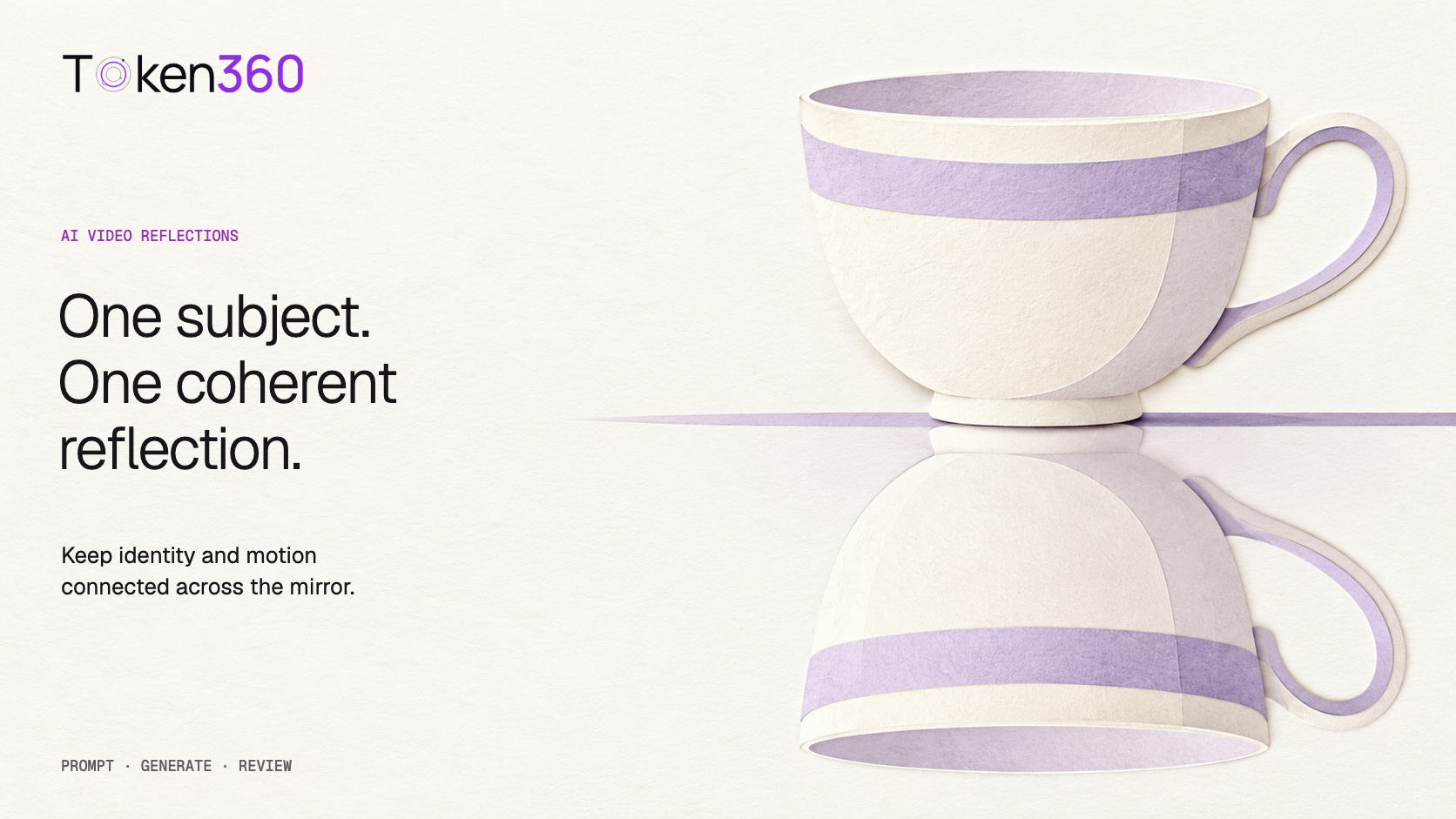
Start with a visible relationship, rather than the broad instruction “perfect reflections.” A cup should retain its handle, rim, and stripe while its reflection remains attached to the same scene. If the cup stops, the reflection should not continue gliding independently. If the surface stays flat, it should not suddenly become rippling water.
Separate three questions. Does the reflected subject retain its identity? Does its motion correspond to the real subject and camera? Does the reflective surface behave like the material you requested? A shot can pass one and fail another. A recognizable cup reflected on an unexpectedly liquid table is still a material failure.
Relationship
Observable check
Example failure
Identity
Handle, stripe, and silhouette remain compatible
A second handle appears only in the reflection
Timing
Starts, stops, and turns form one coherent event
The reflected cup moves after the cup stops
Geometry
Placement is plausible for the plane and viewpoint
The reflection detaches or jumps to another surface
Material
Sharpness and distortion fit the surface
A rigid mirror develops waves without a cause
Choose the surface before writing the prompt
A flat mirror, polished stone, brushed metal, and moving water are different briefs. Their reflected appearances need not be equally sharp or complete. Begin with a single flat mirror when your purpose is to inspect correspondence; introduce roughness, curvature, or waves only when those properties belong to the finished shot.
A shadow is also a different phenomenon. Asking for “a soft shadow reflection” leaves the desired relationship unclear. For a product scene, describe the mirrored image and any contact shadow separately. Do not reject a legitimate shadow merely because you expected only one reflection.
For a water scene, plausible ripples can bend and interrupt the reflected silhouette. That makes exact shape matching a poor acceptance rule. Instead, review whether the reflection retains a credible relationship to the object and the moving water. Save this more complicated scene for a separate test condition.
Build a reference that makes mistakes visible
Use one ivory cup with a pale lavender stripe on a clean, horizontal mirrored surface. Keep the whole cup and the useful reflection inside the frame. A handle and a stripe provide two recognizable features without adding tiny lettering that could create an unrelated text-rendering test.
Inspect the source image before generating motion. If the reflection already has a missing handle or a disconnected base, the resulting video cannot cleanly isolate a temporal failure. Start with a reference whose geometry you accept, and retain that exact source file for every comparable request.
Runway’s image-to-video prompting guide recommends focusing the text on motion when an input image supplies the visual scene. Apply that as a drafting principle, not a guarantee that any provider will preserve mirror geometry. Keep the movement description short enough that its intended outcome can be checked.
A starting prompt for a cup on a mirrored surface
For an image-to-video model with a suitable reference, try this motion-focused brief:
The camera remains fixed. The cup glides slowly a short distance to the right across the flat mirrored surface, maintaining its orientation, then comes to a gentle stop. Its reflected image follows the same continuous movement and stops with it. The handle and lavender stripe remain consistent. The surface stays flat and still.
This is a stylized product animation: the cup glides without a visible hand. It is not a test of how a cup would accelerate under real contact forces. If a hand belongs in your commercial shot, add it in a later condition and explicitly review the hand’s reflection and occlusions too.
For text-to-video, prepend a brief scene description: “One ivory ceramic cup with one handle and one lavender stripe rests on a clean horizontal mirror, against a warm white background. Both the cup and its reflection are visible.” Keep the subsequent action unchanged when comparing revisions.
Duration, resolution, seed support, and reference inputs must come from the selected model’s schema. Token360’s Model Capabilities documentation identifies the model page and public schema as the source of truth. Reflection language in a prompt does not imply a supported API field such as reflection_lock.
Use mirror geometry as a sanity check, not a pixel template
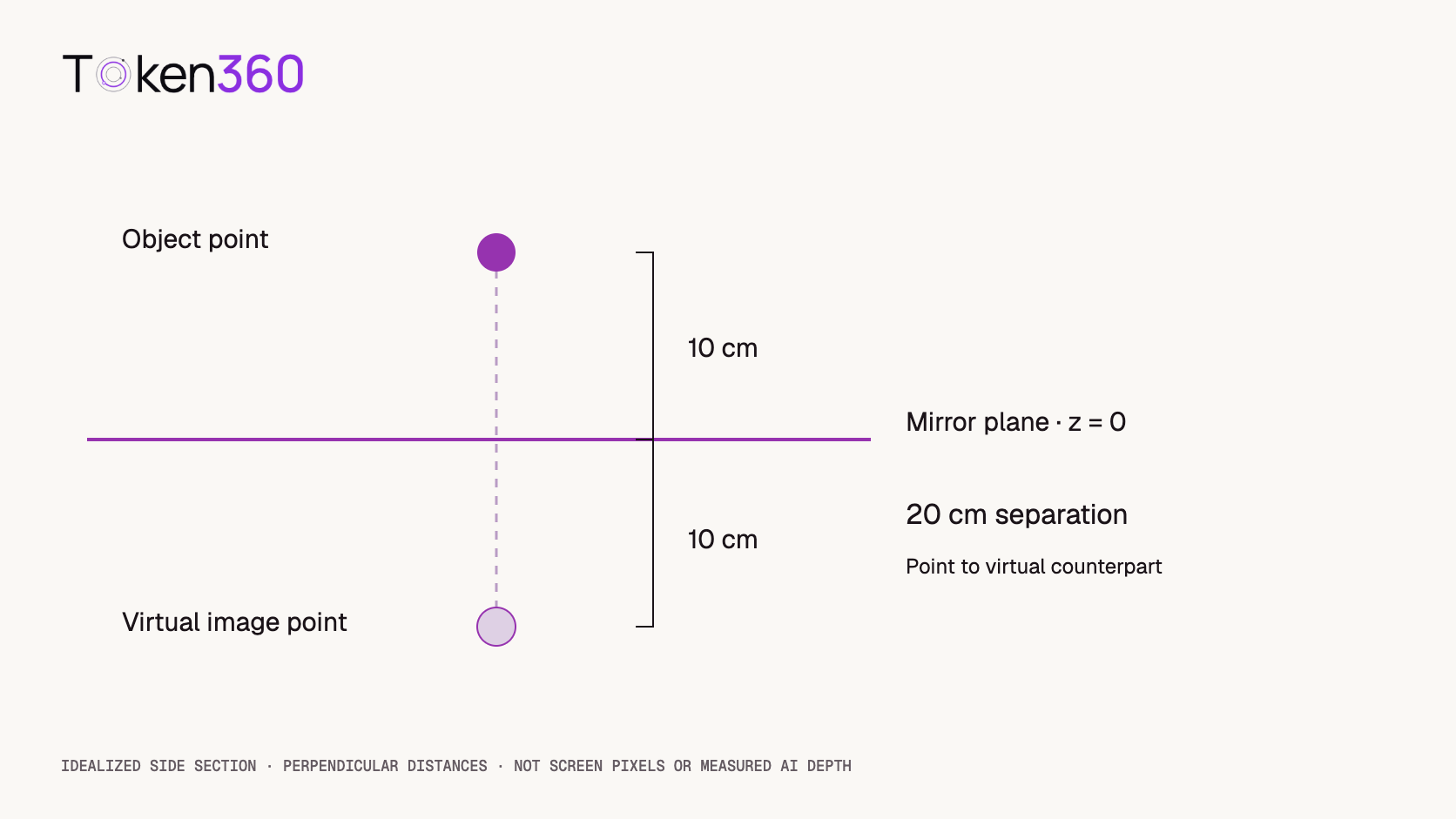
For an ideal plane mirror, an object point and its virtual image lie at equal perpendicular distances on opposite sides of the mirror. OpenStax’s plane-mirror explanation provides the optical basis for this relationship. The virtual image is not a second physical object behind the surface.
Here is an original numerical illustration. Set a horizontal mirror at height zero. A marked point 10 cm above it has a virtual counterpart 10 cm below it, producing a 20 cm point-to-image separation. If that point moves parallel to the plane while retaining its height, its virtual counterpart retains the corresponding height relationship.
Idealized geometry, not measured AI scene depth. Distances are perpendicular to the mirror.
Do not convert that rule into “the reflection must occupy the same number of pixels.” Camera perspective and the visible portions of the object affect the projected image. Likewise, reflected horizontal movement does not always reverse screen direction. The useful check is whether the entire relationship is plausible for this surface and viewpoint.
Review the full movement, including the stop
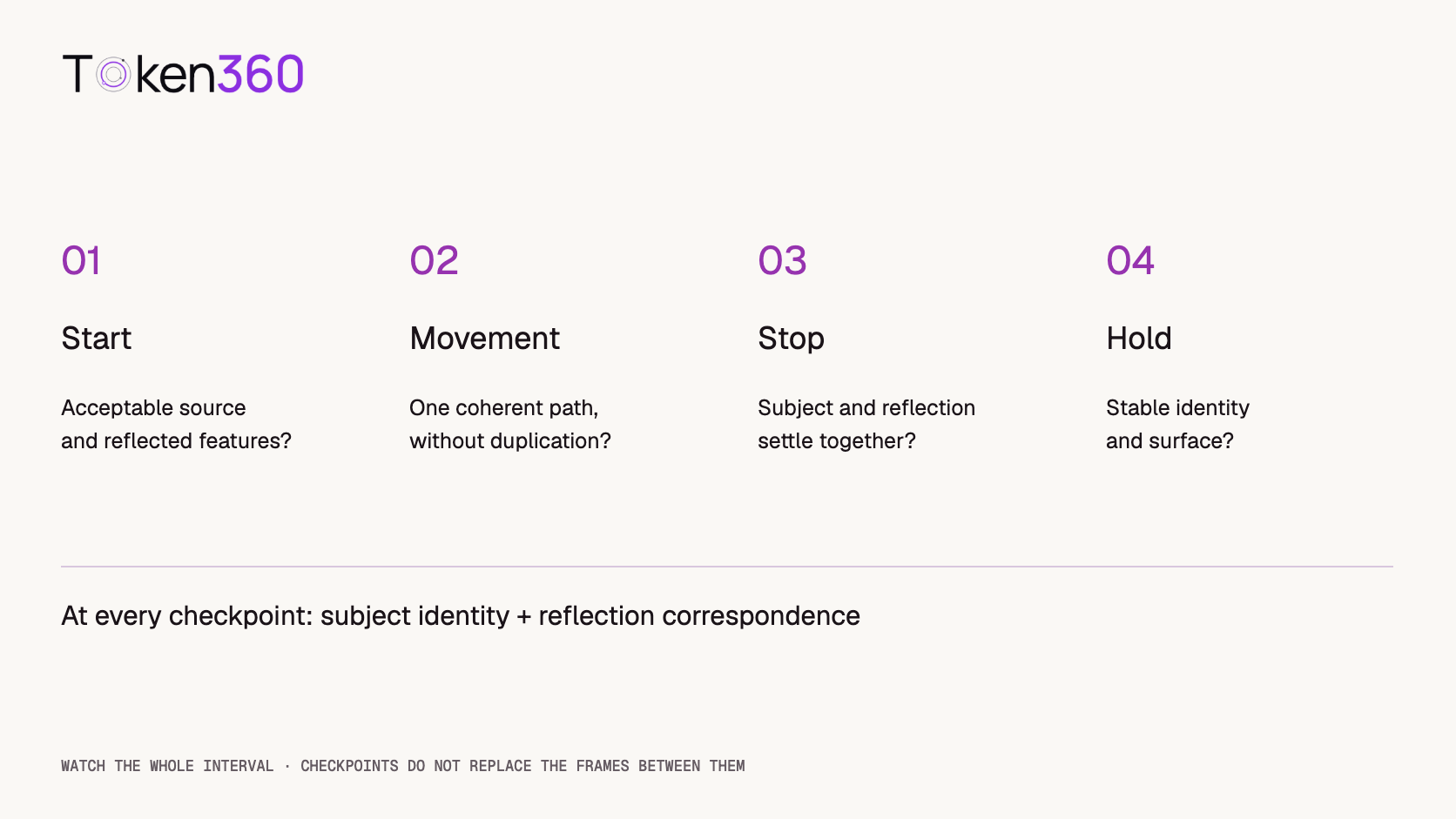
Watch the clip once at normal speed before pausing. A reflection can look acceptable in isolated stills while flickering, lagging, or briefly duplicating between them. Then inspect the start, middle, stopping transition, and final hold. These checkpoints help locate failures; they do not replace viewing the intervening frames.
Review cup and reflection side by side at each checkpoint. Note whether a feature changed on the cup, only in its reflection, or in both. A handle disappearing from both may be an identity problem; a handle changing only below the mirror line is a reflection-specific mismatch.
Use “unclear” when compression, occlusion, or crop prevents a confident decision. An unseen reflection is not a demonstrated pass. Evaluate the exported crop too: a usable landscape master may lose the reflected handle in a portrait version.
Review the same relationship through time, including the frames between checkpoints.
A six-request comparison you can run
Keep the reference, model ID, duration, resolution, and supported settings fixed. Generate three candidates with a baseline prompt and three with the relationship-focused prompt above. The baseline can simply request the same short rightward glide and stop, without the additional reflection sentences.
This is a proposed test, not a completed experiment. Alternate baseline and revised requests if practical, and record execution order. If seeds are supported, document how you assign them; do not assume an identical seed makes cross-prompt outputs identical or fully controlled.
Record
What to retain
Input
Source file, complete prompt, model ID, supported settings
Actual charge and currency, including any billed failed attempts
Decide the acceptance rule before looking at the outputs. For this simple shot, require all four checks to pass over the intended usable interval. Report accessible outputs separately from accepted outputs. Six requests are useful for discovering failure modes, but insufficient for a stable provider-wide reliability claim.
Report useful yield without hiding failures
Suppose a hypothetical six-request run produces five accessible clips, four of which allow a clear reflection judgment, and three pass. The overall accepted yield is 3 ÷ 6 = 50%. The pass fraction among clearly judgeable clips is 3 ÷ 4 = 75%. Both numbers matter, but they describe different denominators.
Do not publish the second percentage alone as the generation success rate. Keep the inaccessible and unclear cases visible. Calculate cost per accepted clip by dividing the actual total charges for the defined run by its accepted count. If none pass, report zero accepted outputs rather than a misleading zero-dollar accepted cost.
These counts are illustrative, not Token360 results. To turn the plan into first-party evidence, attach representative outputs, identify the tested configuration, and publish the scoring method alongside the results. Use the video API cost guide for the broader candidate-budget workflow.
Change one source of complexity at a time
If timing fails, shorten the movement and retain the final hold. If identity fails, simplify the cup’s markings or improve the reference. If geometry fails, test a fixed camera and a clearly defined flat plane before adding an orbit. If material fails, remove competing descriptions such as “mirror-like water on polished marble.”
For a production deadline, consider a controlled composite or a shot with less visible reflection. Record that editorial choice honestly. A cropped-out error can make an asset usable for one placement; it does not establish that the model solved the original reflection task.
FAQ
What is the best prompt for realistic AI video reflections?
There is no universally best prompt. Specify the reflective surface, subject, movement, and camera, then describe how the reflection should stay related to the subject. Test the exact model and reference you intend to use.
Should a reflection move in the opposite direction?
Not as a universal screen-space rule. The mirror plane and camera determine the projected motion. A rightward glide across a horizontal mirror should not be instructed to produce an arbitrary leftward reflected glide.
Why does a reflection change while the subject stays recognizable?
The visible mismatch shows that correspondence failed in that clip. It does not reveal the model’s internal cause. Record the specific feature and timestamp rather than diagnosing an unobserved mechanism.
Can a negative prompt fix a broken reflection?
It may be worth testing if the selected model supports negative prompting, but it is not a geometry constraint. Start with a clear positive relationship and an acceptable reference; verify the output rather than assuming compliance.
Does a mirror rule also apply to rippling water?
A moving water surface has changing local orientations, so a single flat-plane construction cannot describe the whole reflection. Use material-appropriate review criteria and keep that test separate from the rigid-mirror baseline.
Can I claim success from the first and last frames?
No. Endpoints can look plausible while the intervening reflection flickers or detaches. Review the full usable interval, and report unclear regions explicitly.


 Prompt Guide
 Prompt Guide
 Prompt Guide