When a generated object passes behind something, review its entry, the hidden interval, and its reappearance separately. The returning object should satisfy the intended identity, count, direction, and timing requirements. A plausible final frame alone cannot establish that the whole event was coherent.
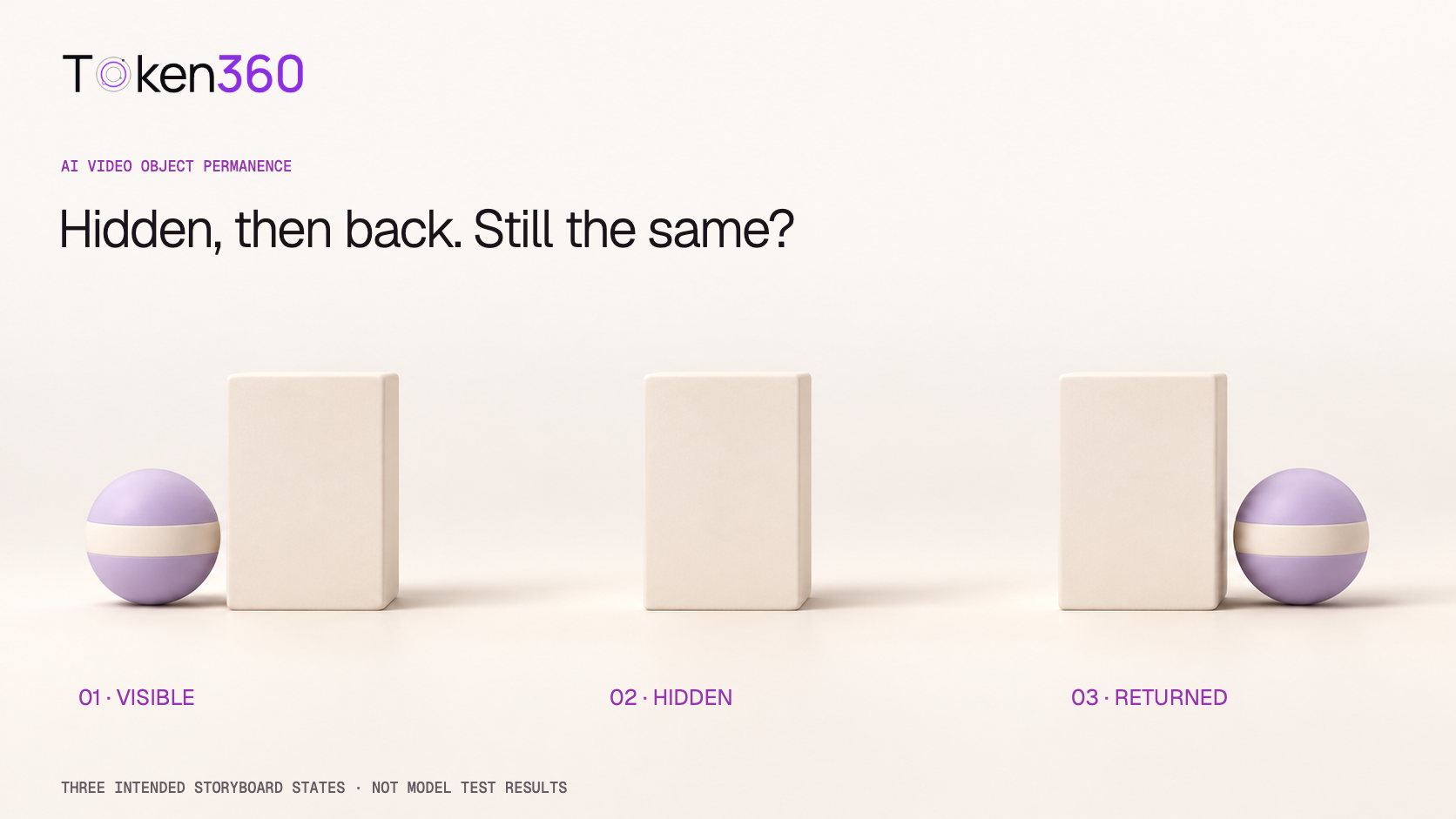
This guide uses an original marked-sphere example, a simplified occlusion calculation, and a proposed six-request comparison. It does not report a completed model test. The cover shows intended storyboard states, not frames extracted from generated video.
Read first: the image-to-video workflow covers reference preparation, while the evaluation framework helps turn consistency requirements into review criteria.
Define the observable requirement
Object permanence concerns an object continuing to exist when it is not visible. For a production review, however, you cannot inspect an object during complete occlusion. You can inspect whether the visible evidence before and after hiding is consistent with the intended event.
OpenAI’s 2024 report on video generation as world simulation discusses long-range coherence and object permanence in the model it studied. It is historical research context, not a guarantee for a current model, route, or particular request.
Use a concrete acceptance statement: one marked sphere moves right, disappears behind an opaque block, and returns from the right side with its identity intact. That statement is more testable than “perfect physics.” It also avoids claiming that a visually successful clip proves the model’s internal representation of hidden objects.
Keep occlusion separate from leaving the frame
An object behind a visible blocker and an object outside the camera view both become unseen, but they create different evidence. With a blocker, the entry and exit edges can be reviewed against a fixed structure. When the subject leaves the frame, more of its path is unconstrained by visible scenery.
| Situation | What remains observable | Review limit |
|---|
| Partial occlusion | Some object features remain visible. | The hidden portion cannot be directly checked. |
| Complete occlusion | Blocker, scene, entry, and eventual exit. | The hidden object’s exact state is unobserved. |
| Out of frame | Frame boundary and any later return. | The off-screen path is not visible. |
| Cut to a new shot | Separate views before and after the cut. | There is no continuous visible transition to inspect. |
Do not count a cut that hides the difficult moment as equivalent to a continuous occlusion result. It may be a valid editorial solution, but record it as an edit rather than an unmodified continuity success.
Design one simple object and one blocker
The original test scene uses a pale-lavender sphere with one broad ivory equatorial band. It moves horizontally behind a stationary ivory block. The mark helps compare appearance, while the simple silhouette makes changes in size or object count easier to spot.
Use a fixed camera and steady light for the baseline. Camera travel changes apparent scale and overlap; moving shadows can complicate interpretation. Those variations can be useful later, but they make the first consistency check less isolated.
The example asks the sphere to glide without rotating, as a stylized animation. This is an intentional simplification, not a test of realistic rolling mechanics. If you instead ask for a rolling ball, account for the mark’s legitimate rotation before labeling a changed appearance as an identity failure.
Prompt the full sequence, including the return
Runway’s image-to-video guide emphasizes motion, camera work, and temporal progression. Apply that structure to the event: what moves, what hides it, and what happens afterward.
A single pale-lavender sphere with one broad ivory equatorial band glides steadily from left to right without rotating. It passes behind the stationary opaque ivory block, becomes completely hidden, then emerges from the block’s right side as the same marked sphere. It continues moving right. The camera stays fixed and the lighting remains steady.
This is an original proposed prompt, not a validated recipe. The word “same” is a requested condition, not evidence that it will be satisfied. Save the exact prompt and reference file with each output.
Check the selected model’s supported settings in Token360 Model Capabilities. Do not invent a persistence, object-ID, or hidden-state parameter simply because the task would benefit from one.
Understand what the hidden interval actually means
A simplified screen-space example helps separate partial from complete occlusion. Assume an opaque blocker spans 240 pixels horizontally, the sphere’s projected diameter is 80 pixels, and its center moves at a constant 80 pixels per second. Ignore perspective, blur, rotation, and changes in scale.
From the sphere’s leading edge first touching the blocker to its trailing edge fully clearing the other side, the center travels the blocker width plus the sphere diameter: 240 + 80 = 320 pixels. At 80 pixels per second, the entire overlap event lasts 4 seconds.
Complete hiding occupies a shorter interval. The center travels the blocker width minus the sphere diameter while the whole sphere is behind it: 240 − 80 = 160 pixels, or 2 seconds. Entry and exit each take one second in this example.
| Phase | Center travel | Illustrative duration |
|---|
| Entering partial occlusion | 80 px | 1 second. |
| Completely hidden | 160 px | 2 seconds. |
| Leaving partial occlusion | 80 px | 1 second. |
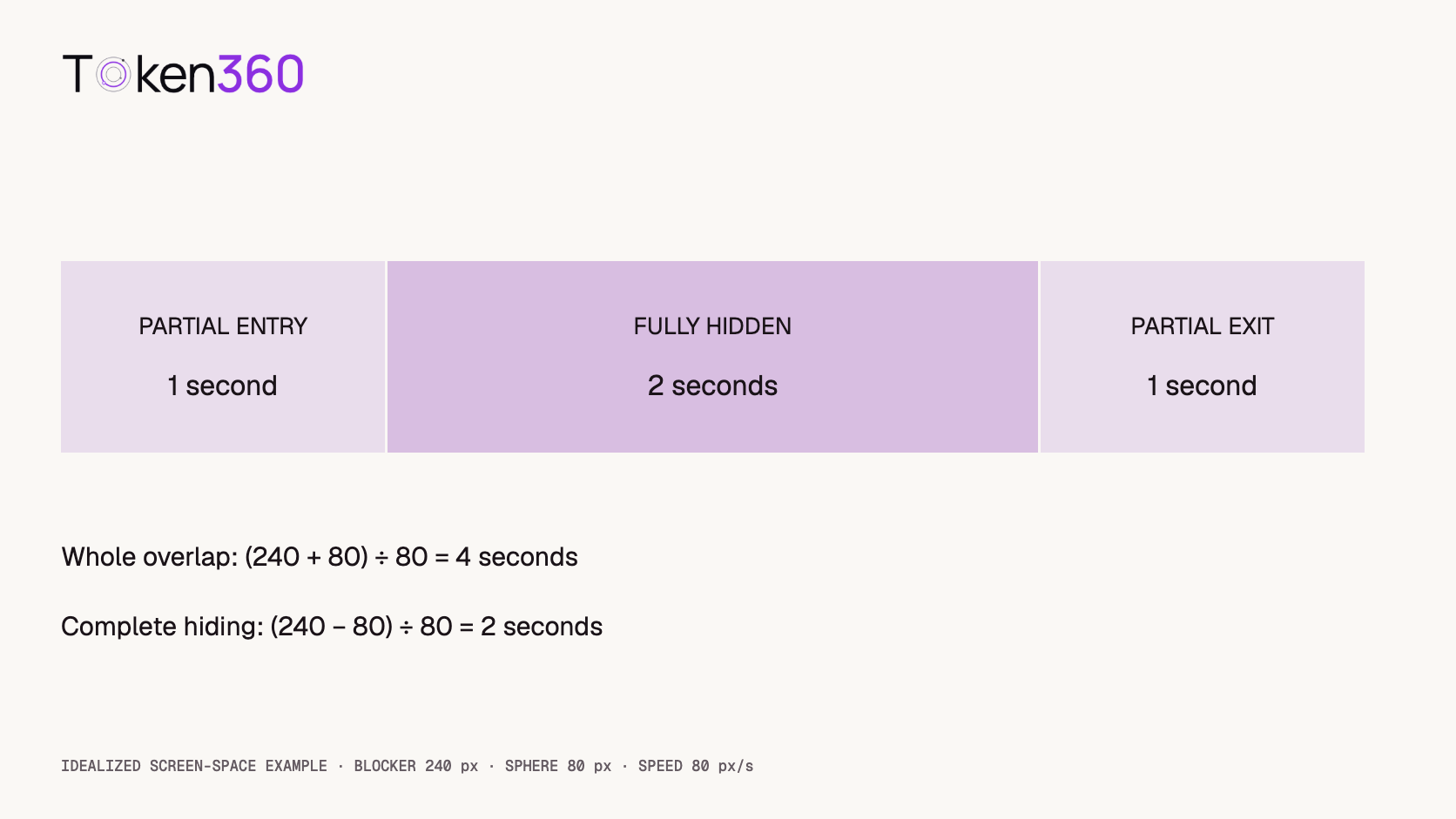
These values are not measurements of the cover or instructions that an API must execute exactly. A narrower blocker, changing speed, camera motion, or perspective changes the calculation. If the blocker is narrower than the projected object, this simple configuration has no positive-duration interval of complete hiding.
When reporting an actual clip, define the visible event boundaries. “Hidden for two seconds” should not silently include the time when half the sphere remains visible.
Review identity, count, and exit behavior separately
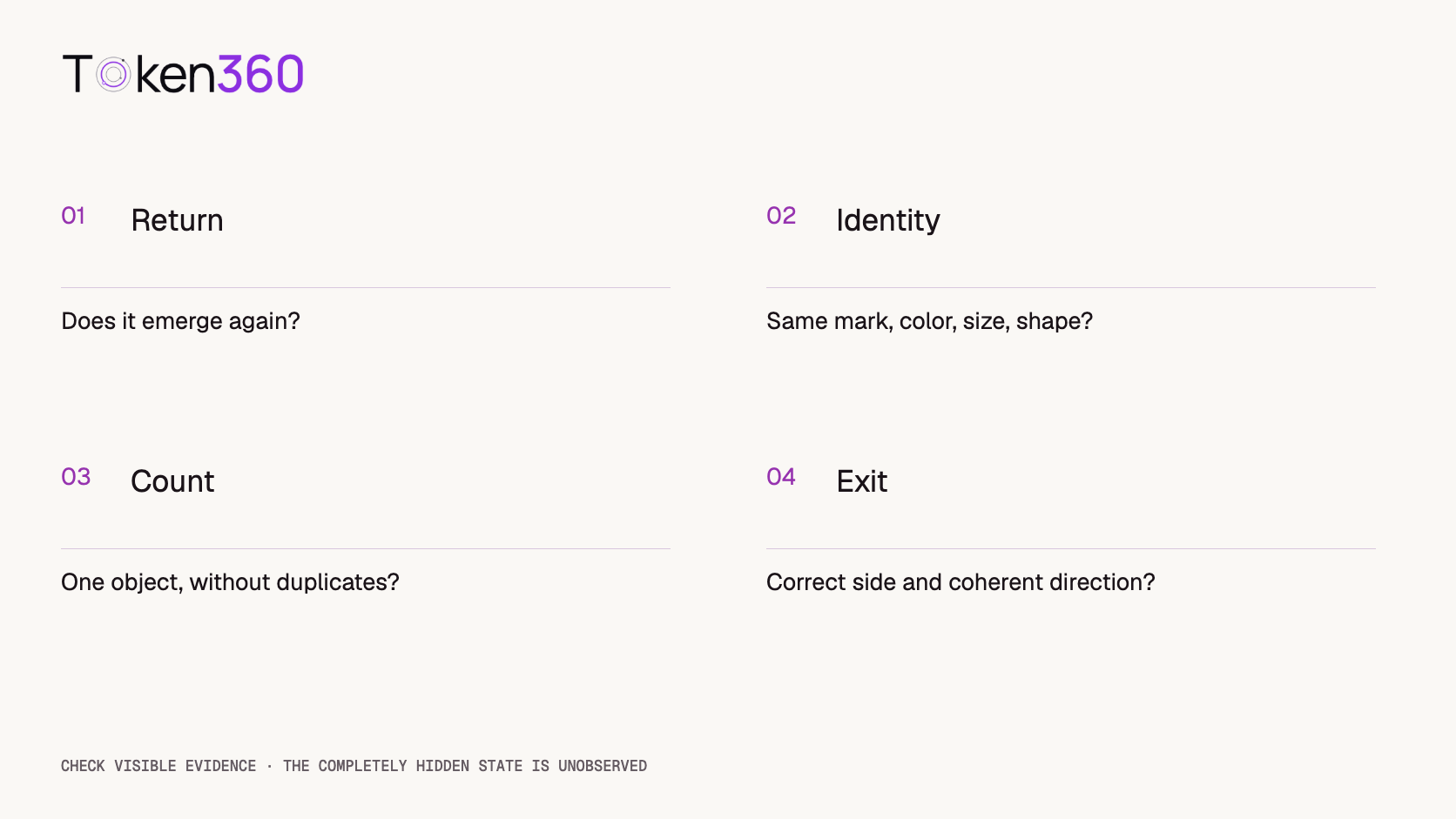
First ask whether the sphere reappears at all. Then ask whether it retains the intended shape, color, marking, and size under the chosen shot conditions. Returning from the correct side with an altered band is a different failure from disappearing permanently.
Count objects through the visible sequence. A duplicate appearing at the exit while the original remains visible elsewhere should not pass merely because one sphere looks correct. Also inspect whether the object passes through the blocker’s front surface instead of being occluded by it.
Review direction and pace near the exit. An unexplained reversal, jump, or pause can break the intended event even when appearance is preserved. Do not infer an exact path inside the hidden region from a plausible reappearance alone.
Use checkpoints without pretending they cover every frame
Save a view before entry, a view just before complete hiding, a view during full occlusion, a view at reappearance, and a view after full exit. These checkpoints organize evidence; they do not replace watching the entire event.
The fully hidden checkpoint should document the blocker and scene, not a fabricated location for the invisible sphere. If you draw an expected path for explanation, label it as a hypothesis or intended trajectory rather than a tracked measurement.
Inspect the overlap edges frame by frame when something looks wrong. A single leaked fragment, a shrinking sphere, or a brief duplicate may occur between saved checkpoints. For strict frame-level acceptance, the review needs correspondingly complete coverage.
Keep timestamps tied to the original asset. Cropping, trimming, retiming, or frame interpolation can change what is visible and when. Save the edited derivative separately and identify which version supports each claim.
Run an exploratory occlusion comparison
A proposed six-request plan compares two blocker widths, with three candidates per width. Keep the sphere, motion instruction, camera, and supported model settings fixed. Use documented input methods; do not assume the API accepts exact screen-space blocker dimensions.
The references differ intentionally, so this compares two scene configurations. If the model changes speed as well, record that difference. Do not claim that longer hiding alone caused a failure when multiple properties changed in the returned clips.
For every request, record whether an accessible video was returned, whether complete occlusion occurred, and whether reappearance passed the written checks. Keep unsuccessful requests and uncertain cases. A scene that never fully hides the sphere cannot demonstrate complete-occlusion behavior.
Report the denominator explicitly. Reappearance among clips with a complete hiding event answers a different question from usable results across all submitted requests. Neither should be presented as a universal model reliability score from this small exploratory plan.
For illustration only, suppose six requests yielded five accessible clips, four clips contained complete hiding, and three of those passed every return check. The end-to-end usable yield would be 3/6 = 50%, while the pass fraction among qualifying occlusion clips would be 3/4 = 75%. These describe different denominators, not contradictory results. Neither figure is observed data from this article. Keep the missing output and the clip without complete hiding visible in the report so that the higher conditional fraction does not conceal production failures.
Choose a revision that addresses the observed failure
If the sphere never becomes hidden, revise the blocker geometry or viewing arrangement. If it fails to return, simplify the event and allow room for a visible exit. If the returning sphere changes identity, inspect the reference details and reduce unrelated motion before adding more complexity.
If only the final state matters for the project, a cut may be acceptable. If continuous passage is central to the story, that cut changes the requirement. Record the choice rather than treating an editorial workaround as proof that generation succeeded unassisted.
For an exact geometric animation, consider a controlled 2D or 3D workflow. A successful stylized demonstration can be useful, but it should not be described as evidence that the model understands all hidden-object physics.
Frequently asked questions
What does object permanence mean in AI video?
It concerns continuity of an object when it becomes unseen. In an output review, inspect whether the visible entry and return are consistent with the intended event without claiming direct knowledge of the hidden state.
Is partial hiding enough to test complete occlusion?
No. Some features remain visible during partial hiding. Record whether the entire object becomes hidden and distinguish that interval from entry and exit.
Does saying “the same object” guarantee consistency?
No. It states the desired result. Verify appearance, count, direction, and timing in the generated sequence.
Can a correct last frame prove object permanence?
No. The object may duplicate, leak through the blocker, change shape, or jump during the transition. Review the full event.
Should I mark an invisible object’s position in the evidence?
Only as an explicitly labeled expected or hypothetical position. Complete occlusion provides no direct visual measurement of the hidden object.
How should I report a small test?
State the submitted-request count, available outputs, qualifying occlusion events, and acceptance criteria. Separate edited results from original outputs and keep failures visible.
Read next: use the evaluation framework for a review record and the video cost guide to budget additional candidates.


 Prompt Guide
 Prompt Guide
 Prompt Guide