AI Video Localization: When Is Dubbing Worth More Than Subtitles Alone?
Explore when AI video localization needs dubbing, subtitles, or visual edits, with YouTube audience evidence and a practical framework for planning review work.
AI dubbing is worth evaluating when spoken explanation is a meaningful barrier for the audience you want to reach. Subtitles may be sufficient for some videos; others need translated speech, revised on-screen text, or a different edit. The decision starts with how viewers use the content, not with how many languages a generation tool can produce.
For a product team, localization is an investment in a complete viewing experience. A fluent voice track cannot fix an untranslated demonstration or an offer that leads to an unavailable product. The useful question is which changes let the intended audience understand and act on the video.
This article is a content-strategy analysis checked October 30, 2026. Platform facts are attributed to YouTube; the decision matrix and workload example are Token360 editorial analysis. We have not conducted a dubbing experiment or measured conversion gains.
What the audience opportunity actually tells us
YouTube reported in September 2025 that creators uploading multi-language audio received, on average, more than 25% of watch time from non-primary-language views. Its footnote dates the underlying observation to July 2025. This is a platform-reported share for creators using the feature, not a controlled estimate of incremental growth. See YouTube’s announcement.
The observation makes language expansion worth investigating. It does not predict the result for a new channel, one particular language, or a paid campaign. Some viewers may have watched the original track anyway; other viewers may be newly reached. The reported aggregate does not separate those possibilities.
A sound business case therefore begins with evidence of audience demand. Existing viewers, customer questions, regional traffic, and content requests can help identify a language to evaluate. Geography alone is an imperfect proxy: viewers in the same country may prefer different languages.
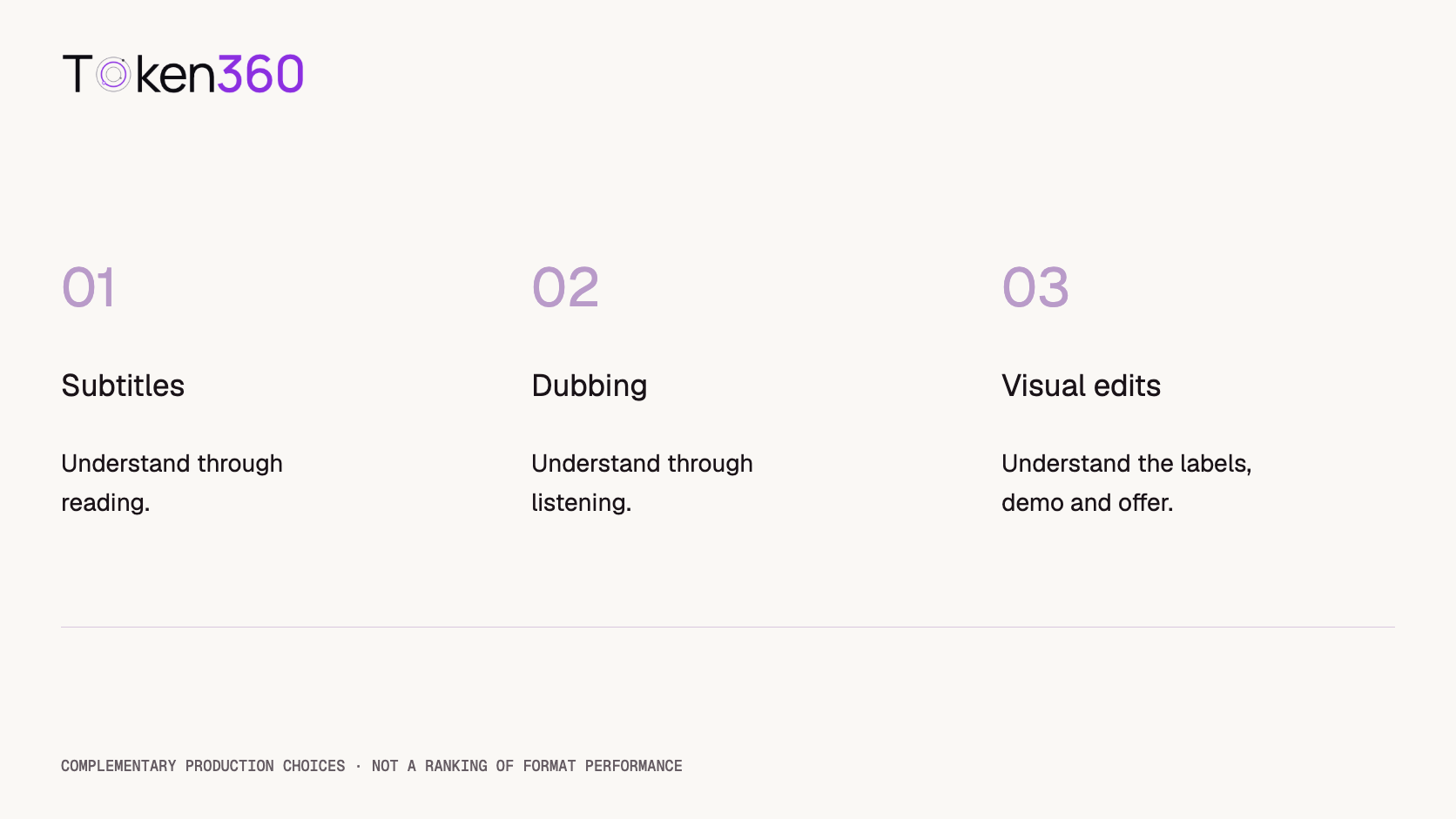
Subtitles, dubbing, and localized edits solve different problems
Production choice
Barrier it addresses
Question to resolve
Translated subtitles
Understanding spoken content through reading
Can viewers follow the text while watching the relevant action?
Translated voice track
Understanding spoken explanation through listening
Is the meaning accurate and the delivery usable at the existing pace?
Localized visual edit
Understanding labels, demonstrations, offers, and visual context
Does the audience see the information the narration refers to?
These are complementary choices. A dubbed video can still benefit from captions. A subtitle version may also need translated graphics. The production plan should identify the actual barriers rather than treating the options as a competition with one universal winner.
Consider a silent product montage with a short closing message. Rewriting the visible message may matter more than adding a narrator. Now consider a tutorial in which the explanation carries most of the meaning. Listening access may deserve much more attention. These are illustrative scenarios, not measured format rankings.
Choose the layer that addresses the audience’s obstacle.
Multi-language audio is not the same as automatic dubbing
YouTube distinguishes uploading additional language tracks from automatically generating them. Its multi-language audio feature allows creator-supplied tracks on a single video or Short. The documentation also describes discovery through translated titles and descriptions. These are distribution features, not evidence that every supplied track has been reviewed. See YouTube’s multi-language feature documentation.
That distinction matters when assigning work. A platform may provide the place to distribute an audio track while a separate workflow produces and approves it. An automatic dubbing service may generate the track, but the organization still needs to decide whether the result is suitable for publication.
The review should examine the whole viewing experience. A track that sounds natural in isolation can be misaligned with the visual explanation. A correctly translated sentence can arrive after the relevant screen has disappeared. The useful unit of acceptance is the localized video experience, not just the audio file.
Meaning and timing create the real production constraint
YouTube’s current automatic-dubbing guidance notes possible errors involving pronunciation, accents, background noise, proper nouns, idioms, and jargon. It also identifies overly fast source speech as a possible eligibility issue. These are documented limitations of that platform’s feature, not universal error rates for all dubbing tools. See automatic dubbing guidance.
For a brand video, a product name or technical term may be central to the message. Reviewers need a terminology reference and enough context to decide whether a translation preserves meaning. Merely asking whether the voice sounds polished can miss the most consequential mistake.
Timing adds a separate decision. If a translated explanation needs more time, the team may shorten the wording, extend the visual, or change the edit. Each choice has a trade-off. Shortening must preserve the claim; extending must preserve pacing; changing the edit requires renewed review of the sequence.
This is one reason to keep an editable script and production source. A finished video can be localized, but a reusable source makes it easier to change the right layer without rebuilding unrelated work.
Do not leave the picture in the original language by default
A 2023 study by Rocío Baños examined automatic dubbing of educational YouTube videos, including issues of accuracy and naturalness. It also illustrates why audience usefulness and production defects can coexist. It is historical research on a particular tool and context, not a measurement of present-day commercial systems. See the original study.
For product content, the visual question is immediate: does the narration refer to labels, buttons, diagrams, or claims that remain untranslated? Sometimes retaining the source label helps viewers match the actual interface. Sometimes it makes the explanation harder to follow. The choice should reflect the product available to that audience.
Visible prices, release dates, and offers deserve similar attention. Translating the spoken message does not verify that the offer applies in a new market. The content owner should confirm the commercial details before the language reviewer approves the final version.
A localized landing page is part of the same journey. If the video promises an easy next step, the destination should make that step understandable and available. Otherwise, the team may improve viewing access without improving the intended customer experience.
Original planning example: six videos, three target languages
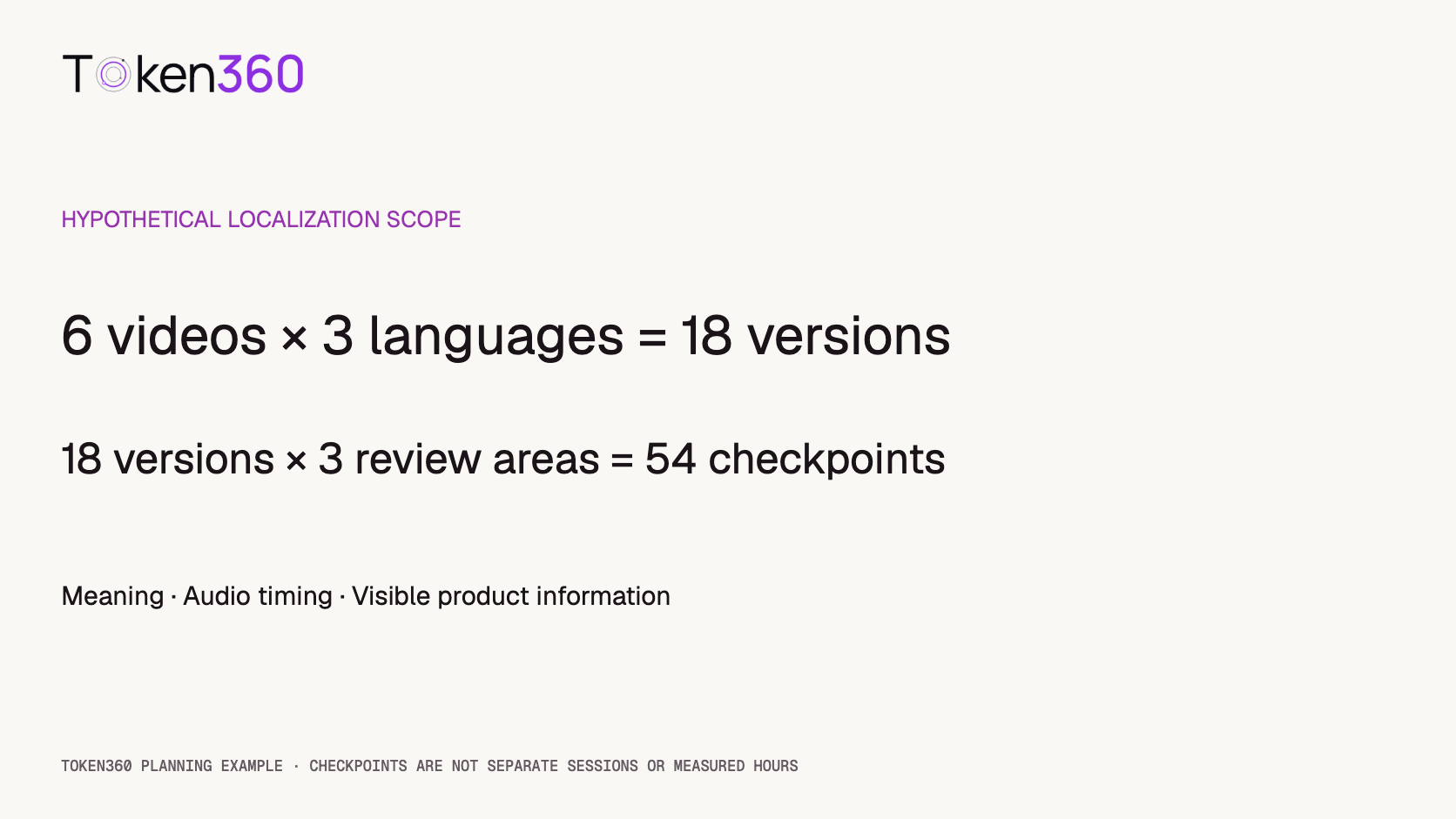
Suppose a team chooses six existing product videos and three target languages. That creates 18 video-language versions to approve, even if the original picture is reused. This is a hypothetical scope calculation: 6 × 3 = 18. It is not a prediction of generation cost, demand, or review time.
If each version needs checks for meaning, audio timing, and visible product information, the plan contains 54 review checkpoints: 18 × 3. These are checkpoints, not necessarily separate review sessions or equal units of work. The calculation makes a frequently hidden workload visible.
Planning input
Illustrative value
Source videos
6
Target languages
3
Versions requiring approval
18
Review areas per version
3
Review checkpoints
54
A phased rollout could start with fewer videos or one language, then expand after the team understands the correction work. That is a scope decision, not a recommendation to sacrifice review quality. It can make the experiment interpretable and keep the learning tied to the content being tested.
Original scope arithmetic. No prices, measured labor, or performance gains are implied.
What would justify expanding the program?
Before production, define the question the pilot should answer. A channel may want to understand language-specific viewing demand. A software company may want to know whether users can follow a setup explanation. A campaign team may want to inspect the journey from viewing to a relevant destination.
YouTube’s help documentation recommends examining views and watch time by audio language. That provides a way to observe consumption of language tracks. It should be interpreted alongside the content, audience, and distribution context rather than automatically labeled incremental growth. See multi-language analytics guidance.
Track production evidence too: corrections requested, timing issues, terminology changes, and which assets needed visual edits. Those observations can explain why one language or content category costs more effort. They also help distinguish a translation issue from a poor source video.
If the team wants a causal growth claim, the evaluation needs an appropriate comparison design. A before-and-after view count alone can reflect distribution changes, seasonality, or a different topic. This article offers a planning framework, not a tested attribution model.
Where generation APIs fit
An API workflow may help generate or process components of a localized asset, but each stage needs the capability it actually requires. Text-to-speech, sound-effect generation, music generation, translation, and dubbing are different tasks. The presence of an audio model does not establish that it can replace speech in a finished video.
Use Token360’s model capability documentation and the selected model’s schema to verify inputs, outputs, and supported parameters. This article does not announce a Token360 dubbing endpoint or claim support for a particular language, voice, or lip-sync workflow.
The content strategy remains independent of the tool choice: choose a meaningful audience, identify the language barriers in the full asset, and approve the resulting experience. Generation becomes useful when it serves that plan.
FAQ
Is dubbing always better than subtitles?
No. It depends on how much the video relies on speech and how the audience watches it. Subtitles, audio, and visual edits can be combined.
Does YouTube’s 25% figure mean a 25% increase in views?
No. The cited figure is a share of watch time from non-primary-language views among creators uploading multi-language audio, based on July 2025 data.
Are multi-language audio and automatic dubbing identical?
No. YouTube distinguishes uploading creator-supplied tracks from automatic track generation. Production and distribution should be planned separately.
Should translated speech match the existing video duration?
The track needs to work with the edit. Review pacing and synchronization; revise the wording or visuals when needed rather than assuming the first generated track fits.
Do we need to translate every on-screen label?
Review each label in context. It may need translation, explanation, or preservation to match the interface the audience will actually use.
Is the eighteen-version example a tested production result?
No. It is transparent planning arithmetic for six videos and three target languages, with three proposed review areas per version.



 Tutorial
 Tutorial
 Tutorial