AI Model Communication Style Is Becoming a Product Decision
Explore how AI model communication style affects product voice, response design, and model selection, with AA-PersonalityBench context and practical examples.
AI model communication style deserves its own place in model selection. A response can contain the right information and still make a product feel slow, overbearing, evasive, or inconsistent. The product team needs to evaluate how the answer works in its interface, alongside whether the underlying task was completed correctly.
This is a product perspective informed by AA-PersonalityBench, checked October 30, 2026. We use “personality” to describe observable output patterns, not human feelings or a model’s inner identity. The response examples and product scenarios below are original editorial illustrations, not outputs from named models or results from a user study.
What a communication benchmark adds to the conversation
Artificial Analysis’ AA-PersonalityBench reports 30 judged traits, eight grouped indexes, and 21 directly measured communication characteristics. Its results describe the prominence of traits rather than an overall best personality. The benchmark explicitly separates communication style from correctness. See the AA-PersonalityBench results.
That distinction changes how a product team should use the evidence. A style profile can suggest which candidates to examine. It cannot establish that customers will prefer a model, trust it appropriately, or finish their work faster. Those are separate questions requiring evidence from the intended application.
The methodology uses 900 questions, with one answer per question and no system prompt. Its indexes are relative percentile ranks across evaluated models. The design gives a view of default behavior; it does not test your instructions, conversation history, interface, or audience. See the published methodology.
In other words, this is a useful starting observation. The deployment decision still concerns the configured product. A baseline that appears too verbose might respond well to the product’s instructions; a pleasing baseline might behave differently once it must cite sources, ask for missing details, or explain a failed operation.
Brand voice has to survive ordinary work
It is easy to agree on a broad description such as “clear, friendly, and helpful.” The harder question is what those words mean when a user is frustrated, a request is ambiguous, or a tool cannot complete an action.
A friendly assistant might acknowledge a failed export once, explain the next step, and stop. Another might add an apology, reassurance, a summary, and an offer of further assistance. Either can sound reasonable in isolation. Inside a narrow product panel, one may require substantially more attention before the user finds the instruction.
We suggest treating voice as a set of observable choices: where the answer starts, how much explanation it includes, when it asks a question, and how it distinguishes known facts from assumptions. These are easier to discuss and review than whether a response “feels like us.”
Voice should also vary with the job. A brainstorming workspace has room for exploration. A status panel may need a short update. A research interface needs visible evidence. Consistency means applying the product’s principles appropriately, not giving every situation the same length or emotional tone.
One situation, three editorial responses
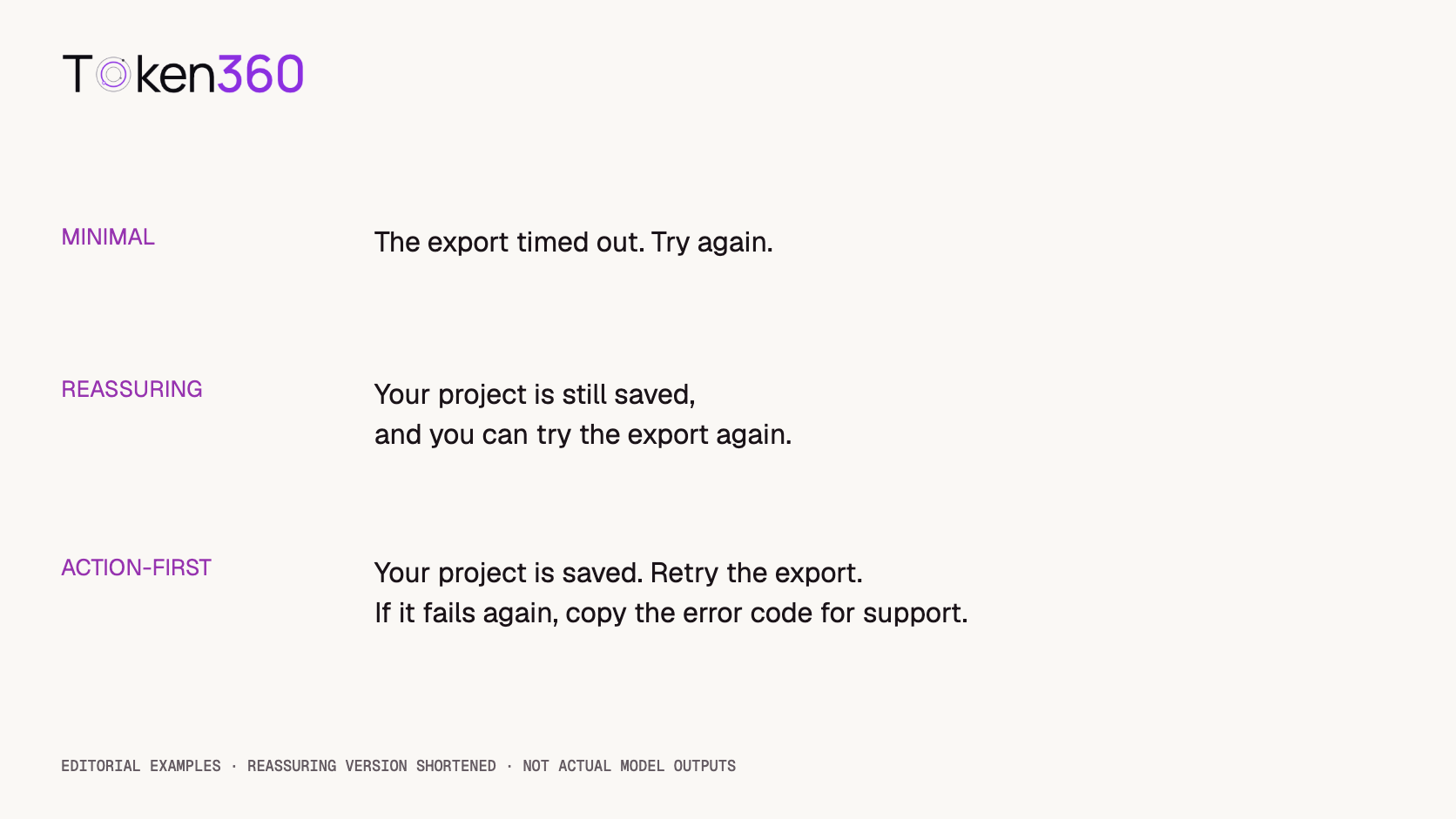
Suppose a user says: “The export failed. What should I do?” Assume the application has confirmed that the export timed out and that the saved project is intact. The following examples are written for this article; no model produced them.
Style
Illustrative response
Product question
Minimal
The export timed out. Try again.
Does brevity leave the user uncertain about saved work?
Reassuring
I’m sorry the export did not finish. Your project is still saved, and you can try the export again.
Is this level of acknowledgment appropriate for the moment?
Action-first
Your project is saved. Retry the export. If it fails again, copy the error code for support.
Is the suggested recovery path actually supported?
All three communicate a recovery action, but they distribute attention differently. The third also introduces a product dependency: the interface must expose an error code and provide the indicated support path. A response can sound well designed while promising an action the product does not offer.
That is why style review should sit beside factual and functional review. Before debating whether a sentence is warm enough, confirm that it is true and that its instruction can be followed. Copy quality cannot compensate for missing product behavior.
Original examples for discussion, not a head-to-head model test.
Confidence, warmth, and correctness need separate judgments
A decisive answer can be useful when the product has enough evidence. The same tone becomes a problem when the underlying information is incomplete. Likewise, a cautious answer may appropriately expose a limitation, or it may bury a simple answer under unnecessary qualifications.
The distinction is contextual. A team should ask whether the response’s certainty matches the evidence available in that task. Evaluating only assertiveness rewards a surface property; evaluating only caution can reward hesitation even when the answer is clear.
Warmth raises a similar issue. Acknowledging frustration can help the conversation make sense, but agreement is not always helpful. If a user proposes an impossible action, the product needs to explain the constraint. A response that affirms the proposal and later fails to execute it has created a worse experience, whatever its tone.
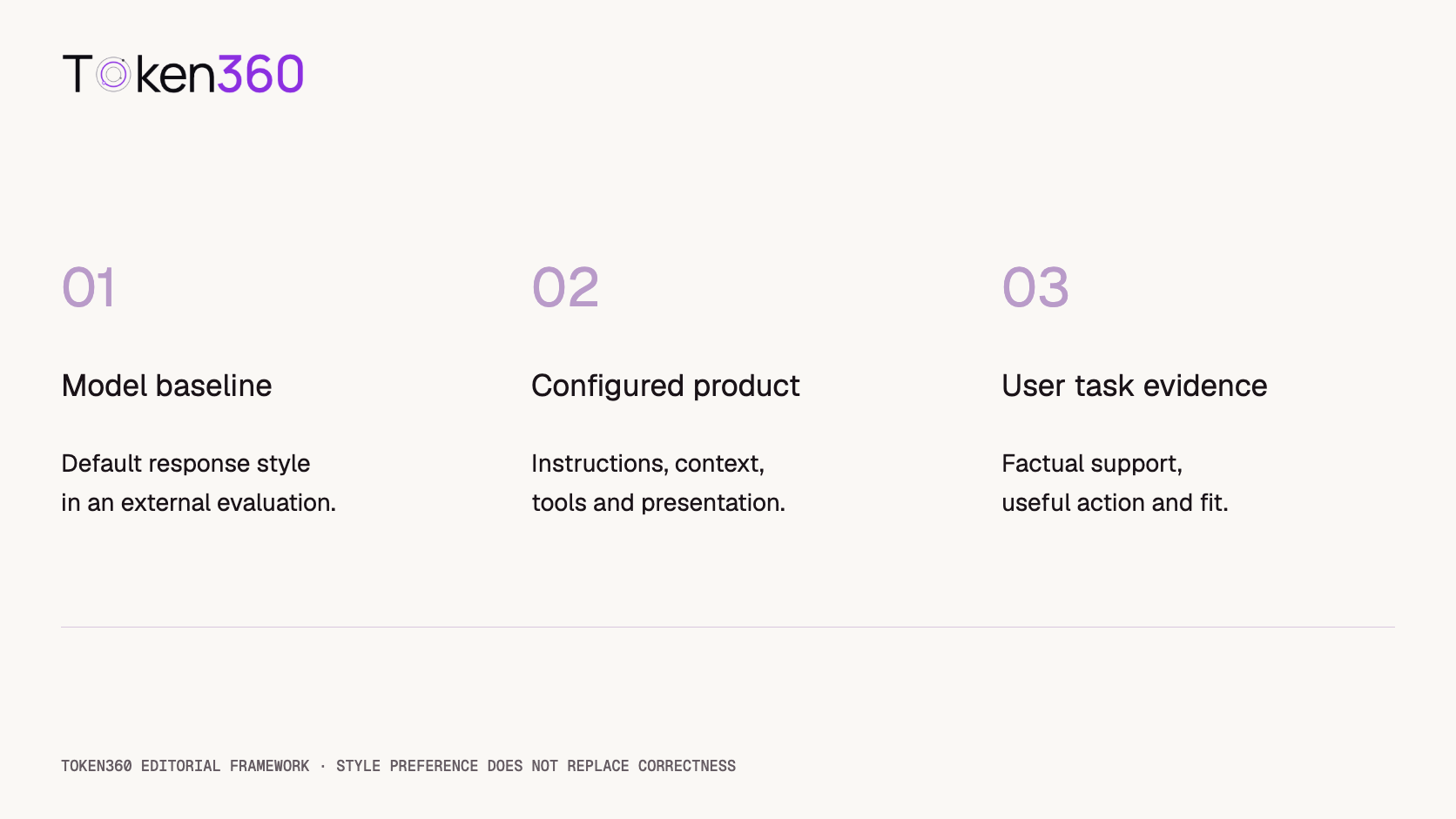
Our editorial recommendation is to review three dimensions independently: factual support, useful action, and communication fit. A failure in the first two should remain visible rather than disappearing inside a combined “likability” score.
Three product contexts want different behaviors
Customer support: make the next action easy to find
In a support workflow, useful language connects the issue to a real next step. The desired response may acknowledge the situation, identify what is known, and offer the supported recovery action. Unnecessary exploration can distract from resolution.
Potential evaluation questions include whether the user can identify the next step, whether the response invents a policy, and whether the conversation needs another turn because the instruction was unclear. These are proposed measures, not improvements we have observed from a particular model.
Research: keep evidence and interpretation distinguishable
A research product may benefit from more explanation. The user needs to see which claims are supported, which are inferences, and what information is missing. Concision remains valuable, but removing an important qualification can make the output less useful.
The review should inspect source support as well as presentation. A neatly organized response is not enough if the references fail to substantiate the conclusions. Formatting can make evidence easier to inspect; it cannot supply evidence that is absent.
Creative work: leave room for alternatives
A creative product may need exploratory responses that preserve several directions. Here, an immediate confident recommendation can narrow the work too early. The desired behavior depends on whether the user is generating possibilities, comparing options, or asking for a final edit.
One interface can contain all three modes. A good product specification can distinguish them explicitly, rather than assuming a model’s default tone will fit each stage.
The missing layer is the configured product
A model shortlist often begins with external evidence, but the customer interacts with a configured system. Product instructions, available context, tools, and presentation all contribute to what the user sees. The baseline and the final product should therefore be evaluated separately.
For a candidate comparison, retain the same task and relevant context. Record the model configuration and product-instruction version. Inspect whether a style change preserves the factual content and required behavior. If an instruction improves brevity while removing the only useful recovery step, that is a regression rather than a clean improvement.
Token360’s model capability documentation identifies the exact model page and schema as the basis for checking supported behavior. Do not assume identical configuration controls across providers or infer support from a family name.
External style evidence and application evidence answer different questions.
What useful first-party evidence would look like
A practical internal review would keep examples from the real product states that matter: routine answers, incomplete requests, incorrect assumptions, failed actions, and requests for more detail. It would preserve the rejected responses as well as the selected ones.
Before asking reviewers which response they prefer, ask them to identify factual errors and unusable instructions. Then ask whether the remaining responses fit the task and product voice. This keeps fluent wording from hiding a functional problem.
For a user study, define the decision in advance. A support team might care about finding the next step; a research team might care about identifying unsupported claims. Preference can be recorded alongside those outcomes, rather than standing in for them. This article does not supply a tested sample size or claim a measured conversion benefit.
Our AI API observability guide addresses connecting application operations to model requests and outcomes. For style evaluation, the same connection helps distinguish a changed model, changed instructions, and changed task context.
A model update can also be a voice update
Even when a replacement clears the application’s functional checks, the product team should inspect representative conversations. The new behavior may produce longer answers, more questions, or a different pattern of qualification. Those are review questions, not predictions about every model update.
A small set of approved examples can make the intended voice concrete. Preserve the reason each example works: answer placement, evidence handling, useful detail, or appropriate acknowledgment. Otherwise, the examples can become a superficial imitation exercise that misses their purpose.
The product decision is to choose communication behavior that supports the user’s work. External style measurements can improve the shortlist, while local evidence determines whether the configured experience meets that goal.
FAQ
What does AI model communication style mean?
It means observable choices in responses, such as length, organization, tone, directness, and qualification. It does not imply human feelings or identity.
Does AA-PersonalityBench identify the most accurate model?
No. It describes communication traits. Task correctness needs separate evidence.
Does a higher personality percentile mean a better product?
No. A percentile is relative to the evaluated group and trait. Whether that trait helps depends on the product and task.
Can product instructions change a model’s default style?
The configured response should be tested rather than assumed to match the default. The cited benchmark uses no system prompt, so it does not measure your product configuration.
Are the export replies actual model outputs?
No. They are editorial examples created to make the comparison concrete. No model-specific performance conclusion follows from them.
Should we retest communication style after switching models?
Yes. Include representative conversations alongside functional checks, and compare the resulting behavior with the product’s intended voice.


 Tutorial
 Tutorial
 Comparison