AI model ID suffixes can identify variants or routing rules. Check the platform catalog and version policy before mapping a request to Token360.
MODEL INTEGRATION · BLOG 159
By Token360 · Editorial review: November 5, 2026
AI model ID suffixes have platform-specific meanings. A suffix may select a separate catalog entry, modify routing or form part of a version identifier. Treat the complete identifier and the API platform as a pair. Before moving a request to Token360, verify its public model ID and supported behavior instead of copying or stripping another platform’s suffix.
The practical question is not whether two strings look similar. It is whether they name the intended model and preserve the behavior your application needs. A request that stops returning an error after you remove a suffix might still be the wrong request.
The topic comes from OpenRouter’s FAQ question about model variants. This article uses that question to build an integration checklist, rather than treating one platform’s naming convention as an industry standard. It contains documentation analysis and explicitly hypothetical examples, not a live compatibility benchmark.
Read first: Token360’s model catalog guidance establishes which public name belongs in the request. This article covers identifier interpretation, not model retirement planning or a ranking of routing providers.
Is a suffix a different model or a routing instruction?
A suffix has meaning only within the platform that accepts it. Determine whether it selects a catalog entry, changes request handling or belongs to the release name. Keep these possibilities separate: choosing model metadata, choosing an execution route and choosing a version are related configuration decisions, but they are not interchangeable.
OpenRouter documents two classes: catalog variants have their own catalog metadata; routing variants modify request routing and use base-model metadata. Examples include :free for a listed catalog variant and :nitro for a routing preference. A valid routing string therefore need not appear as an exact catalog entry. The documentation also notes that service-tier selection can affect the actual charged rate. These are OpenRouter-specific rules, checked November 5, 2026. See its model-variant reference.
Question
Evidence to inspect
Unsafe shortcut
Is this a separately selectable offering?
Exact catalog entry and its capabilities, limits and pricing.
Copy every field from a similar base name.
Does this select how a request is served?
Platform documentation for that exact request modifier.
Assume the suffix names different model weights.
Does this identify a fixed release?
Publisher and platform version policies.
Infer stability from whether a date appears.
Is this string valid on the destination API?
Destination catalog and supported request syntax.
Assume an OpenAI-compatible interface shares all model names.
This table is a proposed review framework. It does not declare that every platform supports all three categories. When the meaning is undocumented, record it as unknown rather than making the parser guess.
Does a model ID without a date mean a rolling alias?
No. A dateless identifier can name a fixed release, while another short identifier can be an alias. Read the applicable version policy rather than deriving the answer from punctuation. For a reproducibility requirement, record the documented guarantee and any unresolved mapping; the visual shape of the name is not sufficient evidence.
Anthropic provides a useful counterexample. Its model ID and versioning documentation says the Claude 4.6 generation and later uses dateless canonical IDs for pinned snapshots. Earlier models can have short convenience aliases resolving to a dated snapshot. It also distinguishes fixed weights from serving infrastructure that can change. Those statements describe Anthropic’s documented naming policy, not an automatic guarantee about a gateway’s public alias.
For example, an internal approval record could say “publisher documents a pinned release; destination mapping not yet confirmed.” That is more useful than marking the whole integration “pinned” solely because the publisher has a stable ID. The unresolved part remains visible to whoever approves deployment.
Do not turn a version check into a promise of identical answers. Your application may also change prompts, parameters, tools or retrieval context. A fixed identifier helps define the configuration; it does not replace output evaluation.
Can you reuse an OpenRouter model string on Token360?
Do not assume a model string is portable between platforms. Resolve the intended model in Token360’s current catalog, then check the relevant endpoint and request options separately. Preserve any source-platform behavior as an explicit requirement. If the destination documentation does not establish an equivalent, leave that requirement unresolved instead of silently dropping it.
Token360’s Models documentation instructs callers to use the public model name shown in the console catalog and GET /public/models. This is the basis for selecting the destination request value. It is not evidence that Token360 accepts OpenRouter suffix syntax.
Suppose an application configuration contains a source ID plus a low-price routing preference. The migration review has two questions: which destination ID identifies the intended offering, and how will the team satisfy the price requirement? Replacing the string alone answers neither question reliably. A commercial requirement may need a quote or an approved operational policy rather than a name transformation.
For enterprise evaluation, Token360’s company-confirmed scope includes text, image, audio and video access, with pricing, capacity and contract requirements discussed per engagement. That commercial scope does not imply a particular suffix implementation. Keep the technical mapping and the procurement agreement as separate evidence.
How should an application handle an unfamiliar suffix?
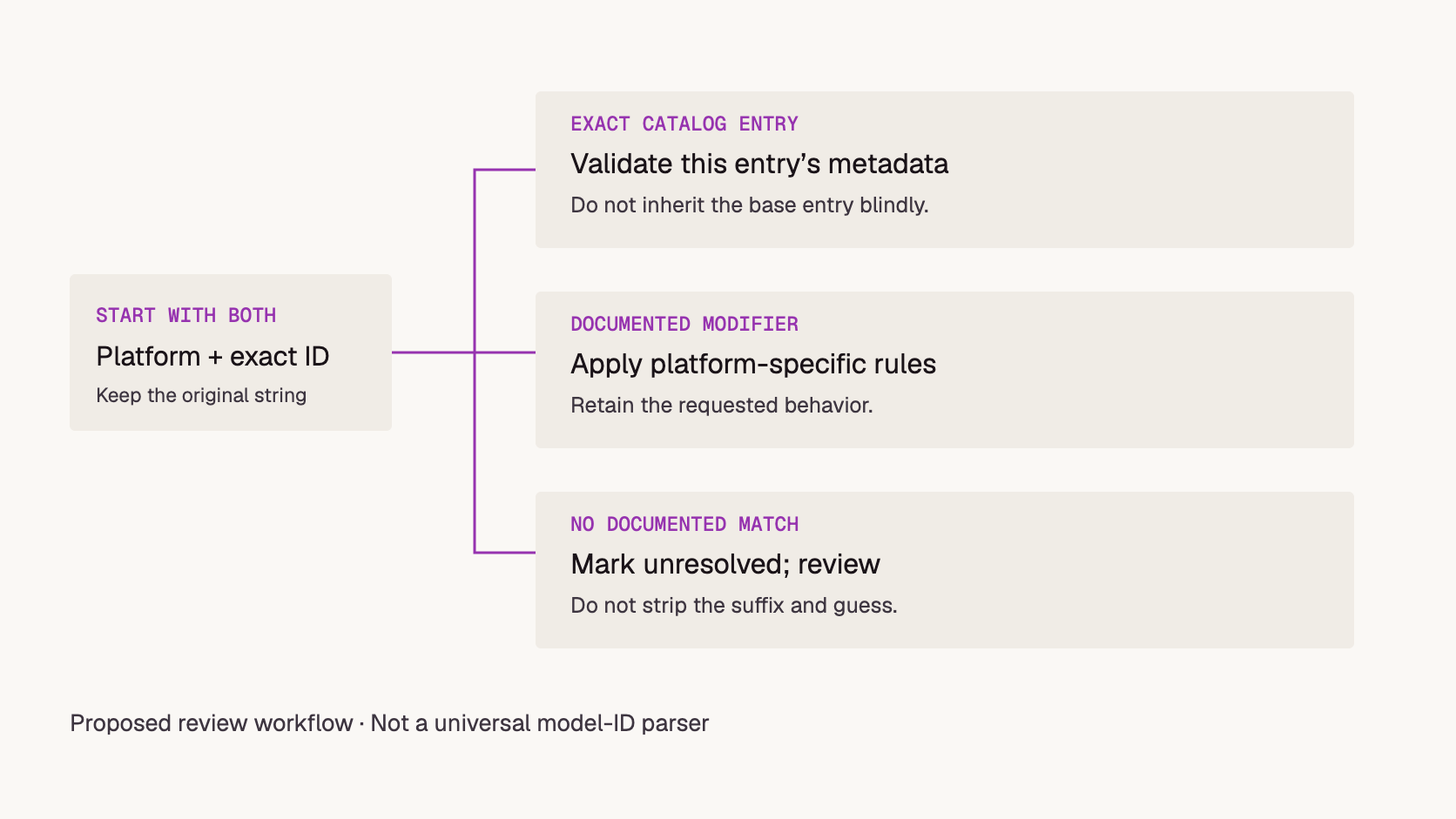
Keep the original request string intact while validating it against the selected platform’s documented rules. Resolve known forms deliberately and send unknown forms for review. Do not make a general repair function that strips everything after a colon: that can erase an intended variant or reinterpret a legitimate part of an identifier.
A proposed validation workflow, not a universal parser or a description of Token360 internals.
The following cases use fictional identifiers. They are design examples, not requests submitted to a provider:
Hypothetical configuration
Proposed handling
Reason
vendor/model-a:special, exact entry exists in the selected platform’s catalog.
Validate that entry’s metadata.
The suffix may distinguish an offering; the base entry is insufficient.
vendor/model-a:route-x, absent as an exact entry but explicitly documented as a routing modifier.
Use the documented resolution rule; retain the requested modifier.
Catalog absence alone does not establish invalid syntax.
vendor/model-a:mystery, no entry or documented rule.
Stop automatic mapping and request review.
Guessing could change the intended behavior.
The same literal string appears in two platform configurations.
Review each platform-specific mapping.
String equality is not proof of equivalent serving or billing.
Implement this as a platform adapter with an explicit set of supported rules, not as a universal regular expression. Test the adapter with known catalog entries, supported modifiers and deliberately unknown inputs. The expected result for an unknown input should be a clear validation error or review state, not an invented fallback.
Display both the friendly model name and the exact request ID in an administrator view. A label such as “Fast model” can be useful for users, but it should not be the only value available when diagnosing a configuration change.
What belongs in a model-ID mapping record?
Record the source platform, exact source string, destination platform, exact destination ID and the behavior that must survive the change. Add the source of each mapping decision and its check date. Distinguish documented, tested and unknown fields so that a successful request does not conceal an unverified version, capability or pricing assumption.
Field
What to capture
Request identity
Platform, base URL, exact model value and applicable endpoint.
Interpretation
Catalog variant, request modifier, version identifier, alias or unknown; include evidence.
Required behavior
Input/output modality, structured output or tool needs, constraints and commercial requirements.
Destination verification
Catalog reference, documented options and unresolved differences.
Validation result
Test date, sanitized request/response references and the specific assertions checked.
Decision
Approver, accepted differences and conditions requiring another review.
Copy blog159-model-id-mapping.csv:
Checked UTC,Source platform,Exact source model ID,Interpretation,Evidence URL,Required behavior,Destination platform,Exact destination model ID,Destination endpoint,Catalog evidence,Version mapping status,Capability validation,Commercial evidence,Sanitized test record,Unresolved differences,Approver
,,,,,,,,,,,,,,,
. It is a blank review template, not a tested migration map. Store secrets outside it; request references should point to sanitized records.
A useful acceptance test checks more than HTTP success. For a document extraction workflow, verify that the required structured result is present and that a representative input fits the selected offering. For a tool workflow, verify the expected tool interaction. Choose checks based on the application’s requirements rather than assuming a shared model family makes them unnecessary.
Record actual cost only when you have a bill or usage record with a defined measurement basis. Do not calculate savings from the text of a suffix. If a request’s route, service tier or negotiated terms are unresolved, the financial comparison should stay unresolved too.
Which mistakes should trigger a mapping review?
Review a mapping when the exact identifier is rejected, required behavior changes, a catalog entry disappears or the documented interpretation changes. Preserve the failing configuration and evidence before trying alternatives. A replacement that returns output may be useful for diagnosis, but it should not silently become the new approved production configuration.
Separate the incident from the remedy. “The destination rejected this model value” is an observation. “Removing the suffix preserves the intended offering” is a claim that needs evidence. Keep those statements apart in a ticket or release note.
For a shared configuration used by multiple teams, make one owner responsible for the mapping record. Teams can still own their workload evaluations. This prevents one application’s quick fix from becoming another application’s undocumented model change.
Model names are useful inputs to validation, not substitutes for documentation. The questions below address common shortcuts when configuring an API gateway or migrating a request. They do not establish live compatibility for any particular model pair. Verify the current destination catalog and keep unsupported assumptions visible in the integration record.
Can I remove a suffix to fix “model not found”?
Only after checking what it means and whether the resulting request preserves the intended behavior. A successful response alone does not prove that the change is equivalent.
Does an exact catalog match prove two platforms are equivalent?
No. It helps establish identifier acceptance. Compare required capabilities, version policy, request options and the applicable commercial terms separately.
Should I store the requested ID or the returned ID?
Keep the requested ID and any returned model identifier in separate fields. Do not overwrite the original configuration with a response value whose meaning has not been established.
Does this article verify any Token360 suffix support?
No. It uses Token360’s documented public-ID guidance and proposes a mapping workflow. It does not report live suffix tests or claim compatibility with another platform’s modifiers.
Developer Guide
API
Build faster with one AI API.
Use Token360 to call video, image, audio, and text models with one key and one bill.


 Guides
 Guides
 Guides