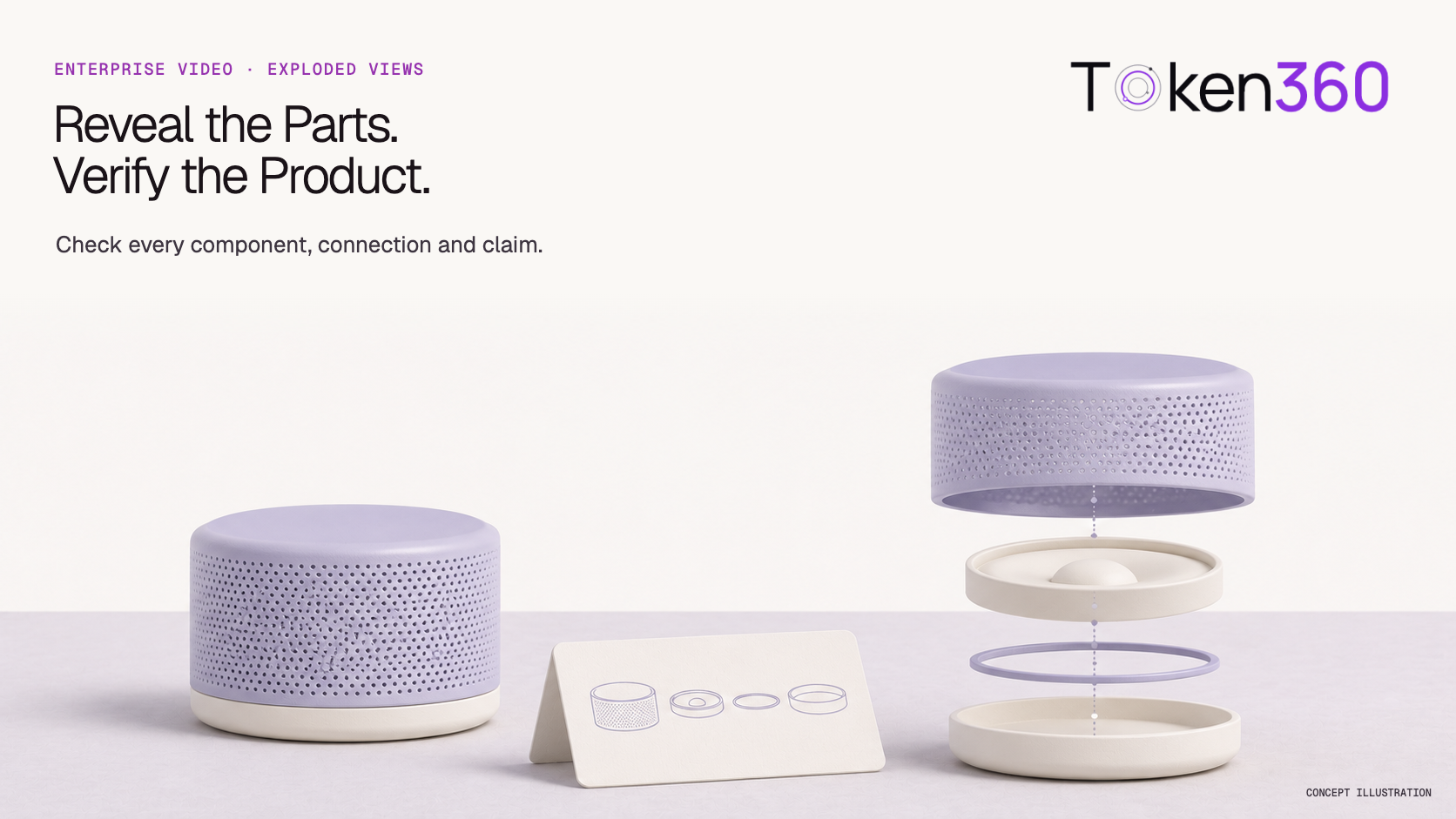
AI can create the visual effect of a product separating into parts, but an impressive exploded-view animation does not prove that those parts are real or correctly assembled. For enterprise marketing, choose the workflow according to the claim: a stylized reveal can be conceptual; a feature explanation needs approved component evidence and product-team review.
Imagine a speaker advertisement in which the enclosure lifts away to reveal a driver, a seal and a base. A buyer may read that sequence as an explanation of how the speaker is built. If the model invents an extra component or shows the wrong connection, attractive motion becomes a misleading product demonstration.
Evidence and scope: Official sources were reviewed on November 25, 2026. This article proposes a purchasing brief and review process; it does not report an exploded-view test on Token360. Specific model access, CAD ingestion, editable 3D output and component-preservation capabilities remain unverified unless confirmed for the engagement.
Are you buying a visual effect or a product explanation?
An exploded-view effect separates a subject into visible pieces for visual impact. A product explanation must show the correct pieces and their relationships. Decide which deliverable you need before commissioning generation, because a plausible arrangement of floating objects may satisfy an artistic brief while failing a factual product demonstration.
Higgsfield’s Exploded View effect page describes a subject breaking apart into layers or sections. That establishes an effect category, not verified accuracy for the internal structure of a particular product. Its separate Blender assembly workflow starts from a supplied scene and describes manipulating its parts while retaining an editable scene. Generating an effect and animating existing geometry are different scopes.
Reference-guided video is another possible input route. fal’s Kling O1 reference-to-video documentation describes a start frame with optional references and object elements. Those inputs can communicate appearance, but the documentation is not evidence that the model reconstructs a bill of materials or validates mechanical relationships. Nor does that endpoint’s availability establish Token360 support for the same inputs.
| Intended use | What the visual may imply | Required approval basis |
|---|
| Abstract launch teaser | Shape, energy or design language | Creative approval and a clear boundary against factual internal claims |
| Feature advertisement | A named component exists and contributes to a benefit | Approved component references and product-owner sign-off |
| Assembly or service instruction | The shown order and connections are usable instructions | Authoritative technical assets and qualified technical review; an unverified generated effect is insufficient |
A “concept illustration” label can explain an artistic treatment, but it does not make an incorrect factual explanation correct. If the message depends on a real seal, driver or filter, the visual should be checked against that actual component. For changing exterior viewpoints rather than revealing internals, see reviewing AI-generated product camera angles.
What source assets should a buyer provide?
Provide the approved assembled view, a verified list of the components to be shown, and reference material for their shape and connections. An exterior product photograph does not reveal hidden construction. If internal accuracy matters, supply approved internal photos, diagrams or a suitable 3D assembly through a workflow that actually accepts them.
Do not confuse a procurement package with model input. A component spreadsheet or CAD file may be useful to the production team even when the generation endpoint accepts only images. Ask who translates the approved references into supported inputs and who verifies that translation. Do not assume uploading an unsupported format gives the model access to its contents.
The useful package identifies the exact SKU and revision. Similar-looking products may have different internals. Mark which pieces must appear, which small parts may be omitted for clarity, and whether any illustrative enlargement is allowed. Keep those decisions attached to the source version so a later marketing revision does not accidentally reuse an outdated assembly.
For a speaker example, the brief might identify the enclosure, driver and base as the only visible parts. It should also state whether wires, mounting hardware and seals must be shown or are intentionally excluded. “Show all the technology inside” leaves both the component inventory and the claim undefined.
Share only materials approved for that supplier and use. Internal geometry can reveal information that a public product photograph does not. Confirm access, storage and handling terms for the specific project before sharing confidential assets; this article does not claim a particular Token360 retention policy or certification.
How should the animation brief define the assembly?
Specify a small sequence with an assembled state, a separated state and a final state. Identify each visible component and its intended movement between those states. The brief should make it possible to reject a clip for a missing part, wrong connection or changed product even when the camera work looks convincing.
Start with a still approval of the separated arrangement. The product owner can check component identity and layout before the team evaluates motion. Then describe the permitted paths: the casing lifts vertically, the driver remains aligned, and the parts return to the approved assembly. This is a proposed workflow, not a tested prompt guarantee.
Separate explanatory spacing from physical assembly. A marketing illustration may spread pieces farther apart to make them legible. That does not mean the animation demonstrates a feasible manufacturing or repair process. State whether the motion is an explanatory separation or an actual assembly procedure, and avoid using the latter language without appropriate evidence.
| Brief requirement | Example question for the reviewer | Reason to revise |
|---|
| Part inventory | Does each approved visible part appear once? | A driver splits into two or a new ring appears |
| Part identity | Does each piece retain its approved shape and appearance? | An enclosure changes its openings during motion |
| Relationships | Are the orientation and connection points correct? | A component faces the wrong direction or meets the wrong surface |
| Motion sequence | Can the intended separation and return be followed? | Parts disappear, pass through solid material or switch places |
| End state | Does the final product match the approved assembled view? | The product closes with a changed silhouette or extra feature |
Keep camera movement subordinate to the explanation. A dramatic orbit can hide the connection a buyer needs to understand. If the goal is showing the order of components, a stable view may be easier to inspect. Avoid combining a long list of transformations, fast cuts and precise assembly requirements without testing whether the result is readable.
Labels should be a separately reviewed layer in the production plan when exact names matter. A generated label that looks technical can introduce an incorrect component name. The guide to product labels and text distortion in AI video covers that issue without making it the primary topic here.
How should the team review the generated result?
Review the complete sequence against the approved component list and source assets, not just its opening and final frames. Follow each visible part through separation and return. A clip can begin and end correctly while inventing geometry in between, so visual polish and structural fidelity need separate acceptance decisions.
First watch at normal speed to judge whether the explanation reads clearly. Then examine the transitions and connection points more slowly. Use frame comparisons where useful, but retain continuous playback for motion review. A handful of attractive screenshots cannot establish that a part traveled consistently through the clip.
Assign clear review ownership. Creative staff judge readability, composition and pacing; the product owner checks the depicted construction and associated claim. Neither role should silently substitute for the other. Record which source revision was reviewed and which exceptions were accepted, such as deliberately omitting small fasteners in a conceptual advertisement.
If the same part changes shape during the sequence, note the time range and the approved reference it violates. A specific decision such as “the driver changes diameter before returning to the enclosure” is more useful than “the AI looks wrong.” These are hypothetical review examples, not observations from a Token360 test.
Evaluate all candidates in the pilot rather than only the selected result. Record generation settings, source versions, rejected outputs and manual repairs. This helps determine the practical production work, but a small pilot should not be presented as an overall model success rate. The product reference-preservation test plan provides broader testing context; this article adds component inventory and assembly relationships.
When required accuracy cannot be established, change the production scope. An artist can animate approved geometry in a suitable 3D workflow, or the campaign can use real component photography. AI may still help explore staging or visual direction. Do not describe those alternatives as a proven fix for the untested generation route.
What should a Token360 enterprise quote cover?
Ask Token360 to confirm the available model route, supported references and the intended output before agreeing a production volume. Distinguish inference access from geometry preparation, animation editing and technical review. An enterprise quote should identify who performs those tasks and which acceptance criteria apply, rather than treating a generated clip as a complete product explanation.
Token360 focuses on enterprise model access across text, image, audio and video. Enterprise quotes use volume tiers, with higher usage receiving lower quoted rates, and Token360 does not charge a separate service fee. That does not mean generation is free or that 3D preparation, editing or review is automatically included. Confirm the scope and billing terms for the engagement; About Token360 provides company context.
For an exploded-view campaign, describe the number of products, source revisions and desired variants. Ask which reference formats the proposed endpoint accepts and whether it returns a video file, images or anything editable. A model’s name alone does not establish CAD support, named-part tracking or an editable Blender project.
Agree the pilot’s spend limit, candidate count and review responsibilities before scaling. Include the cost and time of any separately scoped asset preparation and repair in the evaluation. There is no defensible savings percentage in this article because no matched production experiment was run.
The buying decision is whether the proposed route can deliver the required claim with sufficient control. A stylized teaser may be suitable for generative exploration. A precise demonstration of hidden components needs evidence that connects the visual back to the actual product. Confirm that boundary first, then choose the production route.
Teaching case: track three approved parts through an exploded view
Consider a fictional display stand with three approved components: P01 base, P02 upright and P03 display plate. The reference contains no screws or hidden electronics, so the animation must not invent them. This is a component-tracking example, not a claim about the internal construction of a commercial product.
| Part | Assembled state | Exploded state | Return condition |
|---|
| P01 base | At the origin | Stays at the origin | Same outline and orientation |
| P02 upright | Seated on P01 | Moves upward along the approved axis | Returns to its original seat |
| P03 display plate | Attached above P02 | Moves farther upward without duplication | Returns with its front face unchanged |
Review the complete sequence for missing, duplicated or interpenetrating parts. An attractive end frame does not prove the transitions are valid. For a technically grounded animation, use approved component geometry and retain its part IDs in the scene. A generated effect without that geometry remains a visual concept, not an assembly instruction.
The actual geometry, rendered sequence and filled inspection record are still needed to demonstrate a completed result. The inventory above defines what a reviewer must check; it is not a passed test.
Frequently asked questions
Can one product photo produce an accurate exploded view?
An exterior photograph does not establish hidden parts or connections. A model may generate a plausible interior, but plausibility is not evidence of accuracy. Use approved internal references or geometry when the advertisement explains real construction.
Is an exploded-view effect the same as CAD animation?
No. An effect can synthesize the appearance of separating parts. A geometry-based animation manipulates objects in a scene. Even supplied geometry needs verification against the product revision and intended claim; the workflow label alone is not a quality certificate.
Does Token360 offer an exploded-view preset or CAD input?
This article has not verified either capability. Ask Token360 to confirm the exact model route, inputs and deliverables. A preset or Blender integration documented by another provider should not be assumed to exist on Token360.
Can we use a generated clip as an assembly instruction?
Do not rely on an unverified clip as an instruction. Assembly content needs authoritative sequence and connection information plus qualified review. A marketing separation effect may intentionally use spacing and movements that are not a real assembly procedure.
What is a sensible first pilot?
Choose one product with approved references and a limited component set. Agree the visible parts, movement and final state, review every candidate, and record repairs. Expand only after the product and creative reviewers accept the output for its intended use.
About the author
Yuki Yu is Marketing Manager at Token360.


 Guides
 Guides
 Guides