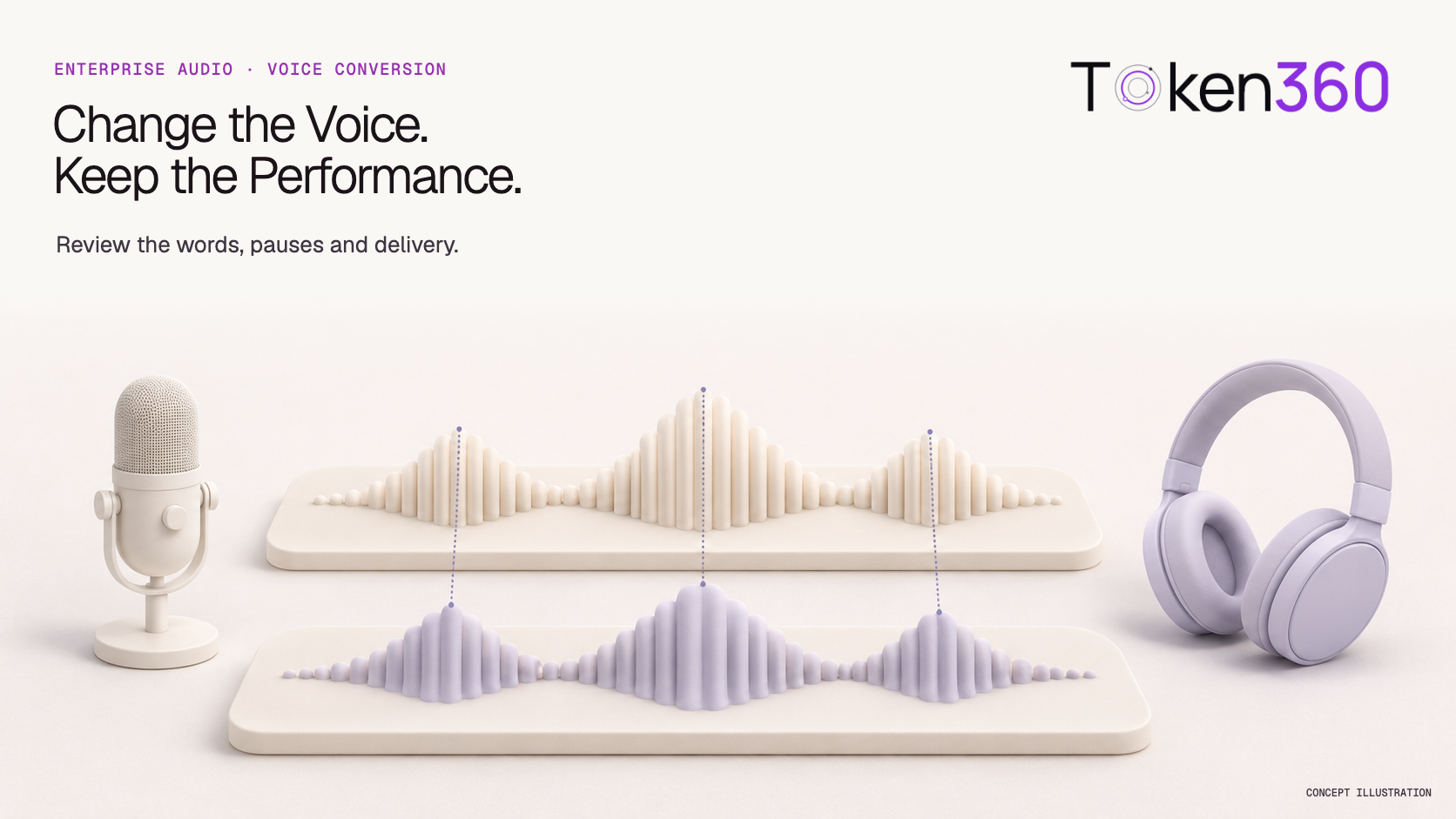
AI voice conversion can change the sound of a recorded voice while aiming to retain the performance, including its pauses, emphasis and delivery. For an enterprise campaign, that is a capability to test against the approved take—not a promise of identical timing or an automatically finished soundtrack.
The buying question is specific: “We like this recording and the video is already edited. Can we use a different authorized voice without directing the whole performance again?” A new text-to-speech read may be attractive but move the pauses that make the edit work. Voice conversion starts with the recorded delivery instead.
Evidence and scope: Official documentation was reviewed on November 25, 2026. This is a workflow evaluation guide, not a Token360 listening experiment. A particular voice-conversion endpoint, target-voice library, background-preservation feature or video-editing integration has not been verified on Token360.
What is voice conversion, and when does it fit?
Voice conversion uses a recording as the performance input and produces speech in a different target voice. It fits briefs where the words and delivery are already approved but the vocal identity needs to change. It is a different task from writing new dialogue, translating it or generating a new performance from text.
fal’s ElevenLabs Voice Changer API documentation specifies an input audio file, a target voice and an audio output. Higgsfield’s Audio guide describes Change Voice as a way to change the voice on existing video without regenerating the visual clip. These examples establish the workflow category; they do not establish that Token360 exposes the same controls or that a converted take will pass your edit review.
A useful enterprise example is an approved product-demo narration that must be recast for a brand campaign. The action cues, pauses and spoken words should remain useful, while the voice changes to an authorized target. The result still needs listening and picture review before it replaces the original.
| What needs to change? | Workflow to evaluate | What to avoid assuming |
|---|
| Vocal identity, with the existing delivery retained | Voice conversion / voice changer | Exact timing, accent or background preservation without testing |
| Script or a newly directed delivery | Text-to-speech or a new recording | That the new take will fit the approved edit unchanged |
| Language | Translation and dubbing | That changing a voice also translates the speech |
| One revised sentence | Replacement-line generation and editorial assembly | That voice conversion fixes incorrect words in the source |
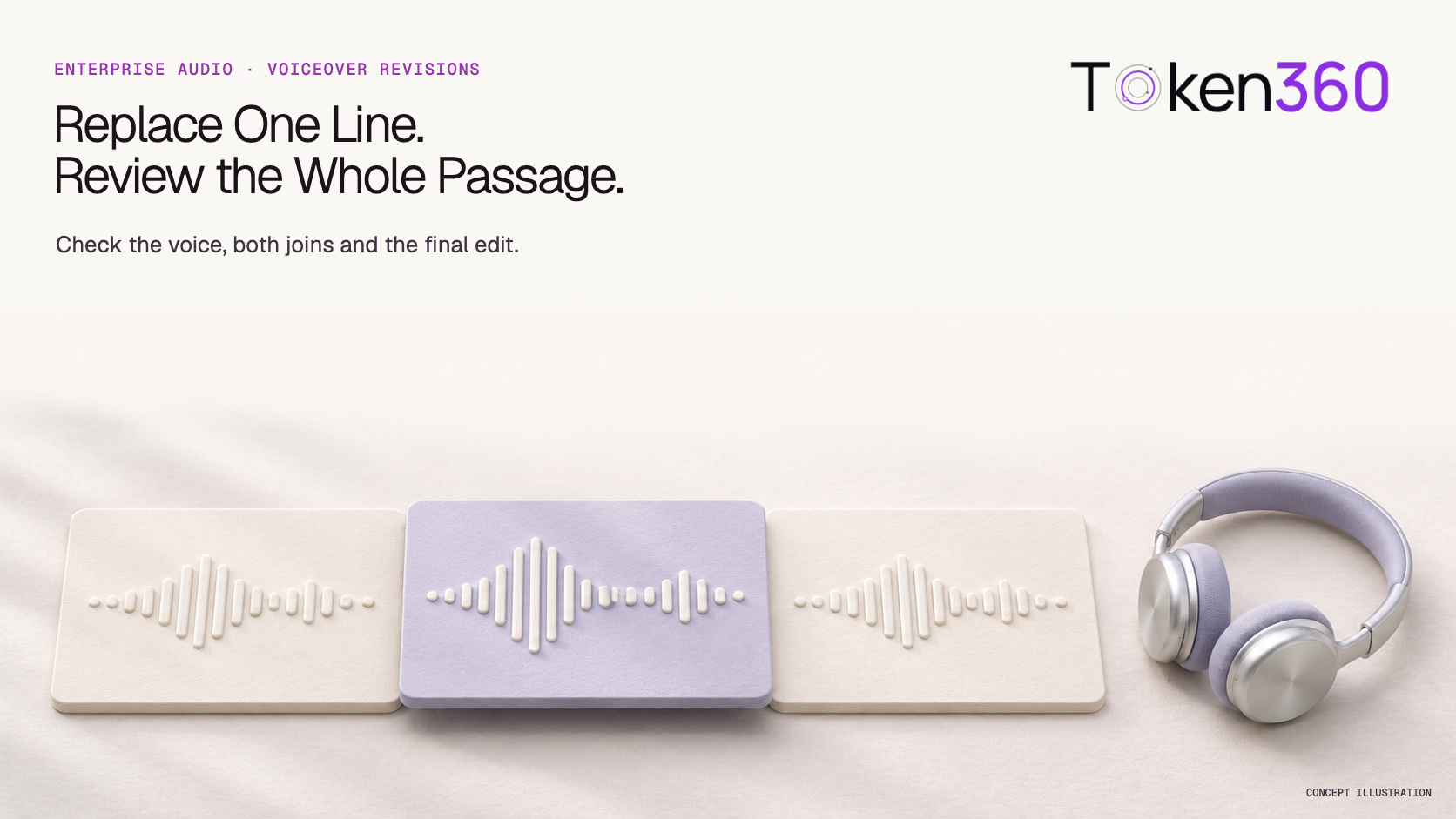
The guide to replacing one AI voiceover line covers script revisions. Here, the approved performance is the asset to preserve. That distinction keeps the pilot focused: a conversion should not be judged as successful merely because its voice is pleasant.
Which parts of the performance should remain?
Specify the words, pauses, emphasis, pace and nonverbal sounds that matter to the edit. Then separate those requirements from the target voice’s sound. “Keep the performance” is too broad for acceptance: a changed pause, dropped breath or different stress can alter the meaning even when the transcript remains correct.
ElevenLabs’ Voice Changer guide describes retaining delivery and cadence and explains that the source recording influences the output accent. Treat this as the provider’s documented behavior to evaluate, not an independent performance guarantee. Choosing a voice associated with a different accent does not necessarily make the source performance adopt that accent.
For example, a demo may pause just before “now,” when a feature appears on screen. The total duration could remain similar while that word moves enough to weaken the moment. Identify that cue in the brief. Do the same for a soft reassurance, a deliberate contrast or a stressed product benefit.
Agree how to handle breaths, laughter and other nonverbal elements. Some are part of the intended delivery; others are recording artifacts. A producer who removes every breath may change the emotional effect. A model that reproduces a cough may preserve something the campaign never wanted. Name the important exceptions before generation.
Do not use a waveform shape as proof of equivalent performance. Two voices naturally produce different signals, and a similar-looking waveform cannot establish pronunciation or emotional intent. Listen to the words and cues in context. If the main problem is directing emotion from written instructions, the separate AI voice tone and emotion guide addresses that decision.
What recording should the team prepare?
Use the approved take in the cleanest available form, ideally as a separate speech track rather than a finished mix with music and effects. Retain the unmodified master and identify the exact section being converted. Confirm the source and target voices are authorized for the intended use before sending files to a provider.
A clean source is a production input, not a requirement to recreate the speaker’s identity. The recording supplies the performance; the target-voice selection supplies the desired vocal identity. A reusable voice clone is a separate asset and may have different setup and permission requirements. The reference-audio procurement guide covers that distinction in more detail.
Ask the supplier which file formats, durations and channel arrangements the specific endpoint accepts. A website upload flow and an API can expose different limits and options. Do not carry settings from one product into another solely because they share a model family name.
fal’s documented Voice Changer route includes a background-noise removal option. That is not a promise to preserve music, room tone and effects in a completed soundtrack. If only a mixed video is available, scope the separation and remixing steps explicitly. Obtain approval for any cleanup that changes the source before evaluating conversion, so you can tell which stage caused an audible change.
For multiple speakers, confirm how the proposed workflow handles speaker selection. A single audio input and target voice should not be assumed to provide speaker-by-speaker routing. Start with isolated, authorized speech for the pilot where possible, and retain the original timing reference for reinsertion into the edit.
How should buyers run a listening comparison?
Compare the source and converted take at a similar perceived listening level, both on their own and inside the intended edit. Review intelligibility, vocal fit, performance cues and synchronization separately. Use a small set of representative passages, retain every candidate and record specific failures rather than selecting only the most attractive sample.
Choose material that represents the actual campaign: ordinary speech, a key brand term, an intentional pause, an emphatic line and any required nonverbal delivery. This is a proposed pilot design, not a completed experiment. Avoid testing only an easy greeting if the purchased workload is expressive narration or tightly timed product demonstrations.
| Review dimension | What to listen or look for | Acceptance evidence |
|---|
| Content | Missing syllables, changed words or altered product names | Reviewer checks against the approved transcript |
| Delivery | Pause placement, stressed words and intended emotional direction | Notes tied to source and output time positions |
| Voice fit | Target character and consistency across passages | Brand reviewer approves the complete listening set |
| Audio quality | Clicks, unstable tone, damaged consonants or unnatural breaths | Solo review followed by review in the final mix |
| Edit fit | Action cues, visible speech and caption timing | Playback in the actual timeline, not a duration check alone |
Use one shared set of criteria for every candidate. Do not change the meaning of “good” after hearing a compelling voice. A clip can have the desired vocal character but lose the deliberate pause; another can retain timing but sound unsuitable for the brand. Keep those decisions separate instead of averaging away a mandatory requirement.
Record the source version, target voice, model route, settings and any preprocessing. Note manual timing repairs and rejected candidates. If a producer fixes the result in an editor, describe the delivered asset as an edited result rather than evidence that the raw conversion preserved everything automatically.
Do not infer an overall success rate from a few passages. The pilot is a purchasing check for the tested material and conditions. If results require substantial direction or editing, compare that work with a new recording or text-to-speech read before deciding whether conversion fits the production process.
What should the final delivery and quote include?
Confirm whether the purchase supplies converted speech alone or also separation, remixing and reinsertion into video. Ask for the exact model access, target-voice options, output format and billing basis. The final acceptance should cover the finished edit, while responsibilities for work outside the inference call should be written into the production scope.
Token360 provides enterprise model access across text, image, audio and video. Enterprise pricing is tiered by usage, with lower quoted rates at higher volumes, and Token360 does not charge a separate service fee. Inference still has a cost. Specific voice-conversion access and any separately agreed production services need confirmation for the engagement; see About Token360 for company context.
Describe the volume in terms of source audio and required versions, then ask which billing unit applies and how retries are handled. Do not assume that a text-to-speech character rate also prices an audio-to-audio workflow. Include the effort of preparing clean tracks, listening and repairing outputs in the evaluation without inventing a universal cost-saving percentage.
For delivery, identify the audio format and the timeline start point. Retain sufficient information to place the new track against the original picture. Check sound levels and the mix after insertion. If the track accompanies visible speech, review lip synchronization separately; audio conversion alone is not evidence that mouth movements were corrected.
Keep the approved source and final converted version together with their review notes. If words or timing changed during production, recheck captions and other dependent versions. For a voice-only change, the correct decision may be to retain existing captions after verification, rather than automatically regenerate them.
A productive first conversation with Token360 is concrete: “We have this approved take, this authorized target voice and these timing cues. Which route can we evaluate, what does it return, and what work remains outside the API?” That gives the supplier a testable brief without assuming a particular model or integration is already available.
Frequently asked questions
Is voice conversion the same as voice cloning?
No. Conversion transforms a recorded performance into a target voice. Cloning creates or configures a voice representation that may be used in a supported workflow. A target can be a permitted preset or an authorized custom voice; a conversion request does not necessarily create a reusable clone.
Will the converted audio have exactly the same timing?
Do not assume exact timing. Check the important word positions, pauses and final duration in the actual edit. Similar overall length does not establish that each action cue or visible mouth movement still aligns.
Can voice conversion translate a recording?
Changing vocal identity and translating speech are different tasks. Confirm a dedicated translation or dubbing workflow if another language is required. Do not expect a target-voice choice to change the spoken language automatically.
Will music and sound effects stay untouched?
That depends on the workflow and inputs and has not been verified here. Prefer a separate speech track where available, and confirm separation and remixing responsibilities. A noise-removal setting is not a guarantee of preserving the finished mix.
Does Token360 support the voice-changing tools described here?
This article has not verified a particular Token360 voice-conversion endpoint, voice library or video integration. Ask Token360 to confirm current access and supported settings against your brief. fal and Higgsfield documentation describes their own offerings, not Token360 compatibility.
About the author
Yuki Yu is Marketing Manager at Token360.


 Guides
 Guides
 Guides