AI Feature Unit Economics: What Does Each Customer Cost?
Calculate AI feature cost per customer, include variable delivery costs, and check heavy-user economics before setting subscription allowances.
Calculate AI feature unit economics at the customer-account level: compare revenue attributable to the feature with the variable cost of serving that account over the same period. Include all model calls behind each business task, then inspect heavy-use accounts separately. A manageable average API bill can hide a feature that loses money whenever customers use it extensively.
This guide is for enterprise product teams adding AI features to software they sell. It answers a commercial question: does the way customers pay match the way the feature consumes resources? It does not recommend a subscription price or claim a Token360 customer outcome.
Use the unit that matches the commercial decision. For a monthly AI add-on sold to companies, start with an account-month. For a feature sold per completed report, start with a report. Keep model requests as an underlying cost measure: a customer action may trigger several requests before it produces a useful result.
Define “customer” before calculating anything. One company may have many seats, multiple workspaces and several API keys. Counting each key as a separate paying customer can make costs appear artificially small. Conversely, dividing by purchased seats when only a few are active can hide concentrated usage. Keep the paying account as the commercial denominator and use active seats as a diagnostic view.
The basic contribution calculation is:
Feature contribution per account-month
= net feature revenue for that account-month
− variable costs attributable to serving the feature
Contribution is what remains to cover fixed costs and, eventually, profit. It is not net profit, project ROI or a complete gross-margin accounting policy. Fixed engineering, security work and central overhead still matter; keep them in the project business case rather than quietly assuming they disappear.
If AI is bundled into an existing subscription, do not assign the entire subscription revenue to it. Show incremental AI delivery cost separately, or document a finance-approved revenue allocation. Retention or expansion benefits can be a business hypothesis, but they are not collected revenue simply because the feature exists.
How can the same subscription produce different economics?
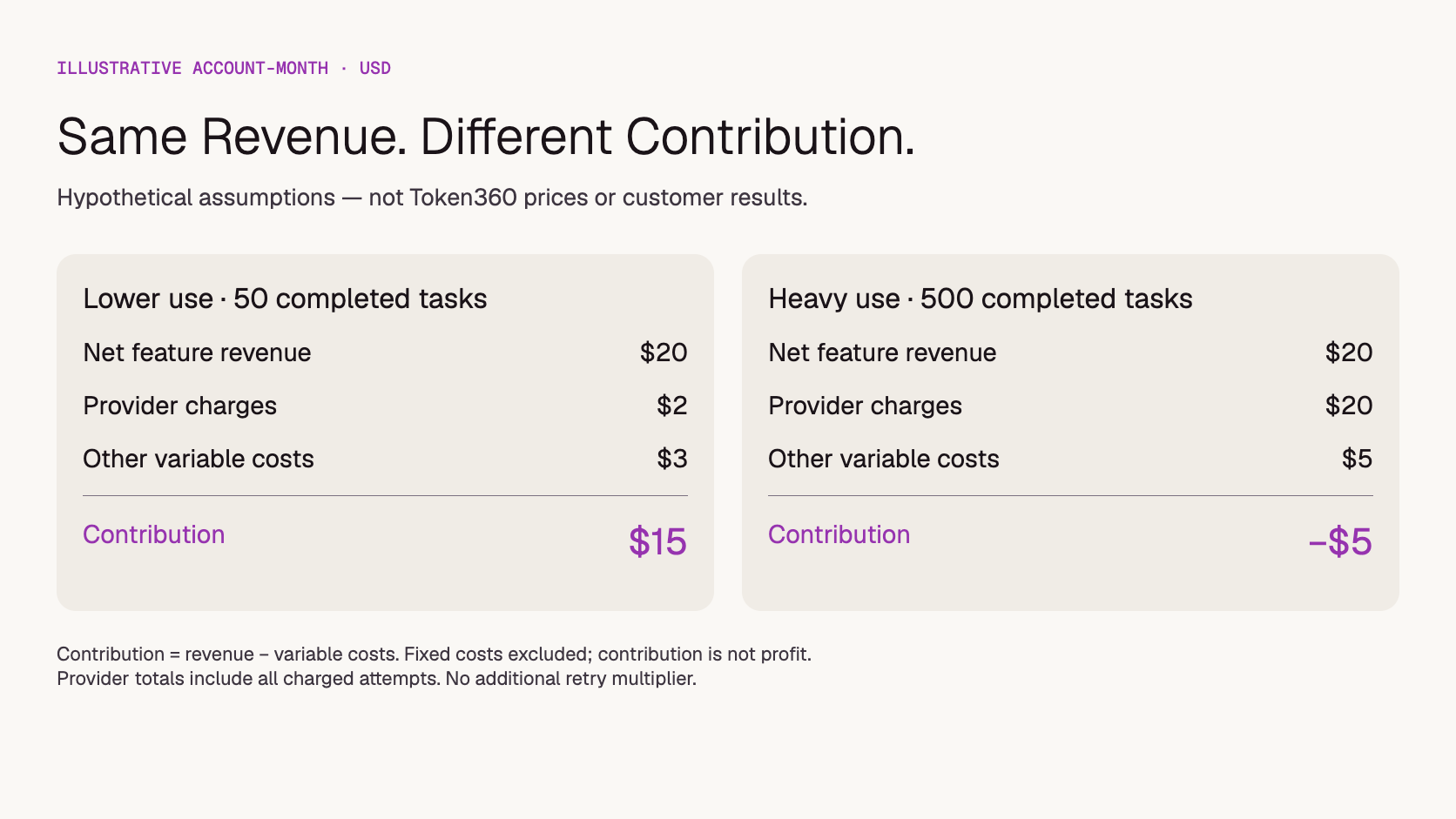
Two accounts can pay the same amount while consuming very different quantities of inference. A useful comparison holds the commercial package constant and changes actual usage. The example below isolates that effect; every number is an invented planning assumption, not a model quote, benchmark or observation from Token360 customers.
Assume a separately priced AI add-on produces $20 in net revenue per account-month. “Completed tasks” means completed customer jobs, not API calls. Provider charges include all charged attempts associated with those jobs, including retries; no additional retry multiplier is applied.
Illustrative monthly economics in USD — not actual prices
Measure
Lower-use account
Heavy-use account
Net AI add-on revenue
$20
$20
Completed business tasks
50
500
Total provider charges
$2
$20
Other attributable variable costs
$3
$5
Total variable cost
$5
$25
Contribution before fixed costs
$15
−$5
The implied provider average is $0.04 per completed task in both cases. That is an arithmetic assumption, not a Token360 price. The second account is negative because total variable cost exceeds attributable revenue, even though model efficiency per task has not deteriorated.
Same revenue, different consumption. All values are hypothetical and exclude fixed costs.
With 90 lower-use accounts and 10 heavy-use accounts, this example produces $2,000 revenue and $700 variable cost, leaving $1,300 contribution. The portfolio is positive, yet ten accounts have negative contribution. That can be an intentional commercial choice, but the average alone cannot tell you whether it is sustainable if the mix changes.
Nor should one expensive month automatically trigger a price increase. An onboarding burst, a one-off migration or an unusually large customer project may explain it. Compare successive periods and the reasons for the activity before treating an account as permanently costly.
What must you measure behind each customer action?
Connect the paying account, the business job and its provider requests. Record settled charges against that chain, including unsuccessful charged attempts, then separate completed jobs from failed or abandoned work. This makes customer economics explainable without assuming that one click equals one model call or that every request has the same cost.
A report feature might retrieve context, draft an answer, validate it and retry a failed step. A media feature might generate several candidates for one selected deliverable. These are proposed workflow examples, not claims that every system behaves this way. The business task remains the denominator; the requests explain its cost.
A practical internal record includes account ID, plan, feature, job ID, provider request IDs, model or SKU, timestamp, completion status and reconciled charge. Use internal identifiers rather than copying customer prompts or personal data into the commercial worksheet. Keep provisional estimates identifiable until billing settles.
AWS's SaaS expenditure-awareness guidance distinguishes tenant consumption from the bill and recommends relating the two. It also notes that request frequency may only approximate resource consumption. For AI features, use recorded charges where available rather than assuming equal cost per request.
Keep an “unallocated” bucket for charges you cannot yet associate with an account. If the per-account totals do not reconcile to the relevant provider statement, investigate that difference instead of distributing it invisibly across customers. Internal experiments, free trials and background maintenance may need separate business owners.
Which costs belong in the customer-level calculation?
Include costs that vary with delivering the feature, using a consistent definition across accounts and periods. Model charges are one component. Storage, delivery, external tools and usage-linked service work may also matter. Treat shared or fixed commitments separately so that an allocated cost does not get confused with the cost of serving one additional customer.
Cost or activity
Customer-level treatment
Decision it informs
Metered inference
Assign actual charges to jobs and accounts
Which usage drives the bill?
Variable storage, delivery or external tools
Use measured consumption or a documented approximation
Does inference explain the full variable cost?
Usage-linked manual review
Include a stated variable labor basis where appropriate
Does automation still require costly delivery work?
Reserved capacity or minimum commitment
Show committed spending and its allocation separately
Are sufficient customers absorbing the commitment?
Fixed engineering and central overhead
Include in TCO and the broader business case
Will total contribution cover the investment?
A prepaid credit purchase is not automatically the feature's usage cost for that month. Likewise, an allocated portion of a fixed capacity contract is not necessarily avoidable if one customer leaves. Finance should choose the recognition and allocation rules; product teams should preserve the distinction when presenting their analysis.
Use one currency and aligned period boundaries. Record refunds and adjustments consistently. Report any material shared-cost assumption beside the result, so the reader can distinguish an observed provider charge from an allocation decision.
What should you change if heavy users have negative contribution?
First identify whether the problem is wasted work, expensive legitimate usage or a commercial package that no longer fits consumption. Those explanations require different responses. Improve redundant processing before restricting useful activity; review packaging when genuine customer demand exceeds what the price was designed to cover.
Consider these choices against customer value and delivery quality:
Reduce avoidable work: investigate duplicate submissions, unnecessary regeneration and repeated processing. Validate that changes preserve the promised result.
Separate expensive capabilities: an optional media workflow may need a different allowance from a lightweight text feature. Do not equate a video second with a text token.
Clarify included usage: transparent allowances, an agreed overage mechanism or an enterprise package can make expectations explicit. The suitable choice depends on the customer and contract.
Revisit supplier terms: negotiate against a credible model and usage mix. A lower unit price helps only to the extent that the relevant workload receives it.
Do not silently lower output quality to make a spreadsheet work. If a cheaper model fails the customer's acceptance requirements, it is not an equivalent delivery option. Track usable outcomes and customer impact alongside cost. For operational spending controls, the separate AI API budget and attribution guide explains the implementation boundary.
There is no universal “good” contribution target in this article. Establish the required contribution with finance, considering the fixed costs and commercial strategy of the product. Then test whether the proposed package meets it under realistic usage, rather than borrowing an unrelated benchmark.
What should you bring to a Token360 pricing discussion?
Bring the workload that sits behind your customer economics: model mix, request sizes, expected account counts, usage distribution and required quality. Token360 can discuss enterprise commercial terms, but supplier pricing is only one part of your product's contribution. Your team still owns the customer package, revenue assumptions and non-inference delivery costs.
Token360's approved positioning covers enterprise access to text, image, audio and video models, with negotiated pricing, capacity, contracts and compliance requirements scoped to the engagement. Review the enterprise procurement options with the actual workload rather than assuming one rate or commitment applies to every model.
As checked on November 10, 2026, the Token360 billing and usage documentation distinguishes model-specific meters and planning estimates from final measured charges. It also describes request-level reconciliation. Use that evidence to populate your cost model; the article does not claim Token360 automatically calculates your SaaS revenue or contribution per customer.
Share an aggregate profile: typical and high-use account scenarios, the model/SKU mix, expected growth, forecast uncertainty and any capacity requirement. Customer content is unnecessary for this initial commercial discussion. Ask the proposal to make applicable rates, meters and commitments explicit, then rerun the account calculation using those terms.
What should the first review deliver?
Produce one reconciled account-month view and a small set of usage scenarios, not only a blended cost number. The review should show what was measured, what was allocated and what remains uncertain. Its purpose is to decide whether to keep the package, change delivery, gather more evidence or revisit commercial terms.
Use the customer-level AI economics worksheet to record the period, account, attributed revenue, provider charges, other variable costs, contribution, completed jobs and allocation notes. The CSV is a blank worksheet, not an automated calculator or a source of benchmark prices.
Review it after a meaningful change in usage, model selection or commercial terms. Keep previous assumptions so that a margin change can be explained: more jobs, a different model mix, longer outputs and a revised supplier rate are different causes. Choose the next action based on that cause.
Which supplier terms can undermine a seat-based plan?
Before setting a seat price, compare light, typical and heavy usage under the proposed model rates. Record any commitment, eligible model mix and price-change terms. A predictable seat count does not establish predictable inference cost; an account-level contribution calculation should include the expensive customers rather than only the average.
Keep this supplier-exposure check within the customer unit-economics review. Token360’s lack of a separate service fee does not cap model usage charges. A negotiated rate is useful only when its scope matches the workload being priced.
What else do enterprise product teams ask?
Is cost per customer the same as cost per token?
No. A token price measures one billing unit. Customer cost adds the units and other variable resources used to deliver a feature over a defined period. Multiple calls, media generation and external processing can sit behind a single customer action.
Should free-trial users be excluded?
Keep them separate from paying-account contribution, but retain their cost in the overall business view. Dividing only paid-user costs by paid accounts while omitting trial spending understates the resources required to acquire and serve the customer base.
Does a lower negotiated API rate make unlimited usage safe?
No. A lower rate changes the cost curve; it does not bound consumption. Evaluate the actual distribution of usage and the terms promised to customers before offering an unlimited package. This article has not tested any unlimited plan.
Can this method evaluate an internal employee assistant?
The usage attribution method can help, but the revenue calculation does not transfer directly. For an internal tool, compare delivery cost with a separately evidenced business benefit, such as usable time saved. Do not label a hypothetical productivity benefit as subscription revenue.
Read next: Use the enterprise AI TCO worksheet to add fixed investment and ongoing ownership costs before approving the full project.
Evidence note: Original editorial calculation and hypothetical scenarios by Yuki Yu. No customer dataset, measured pricing advantage or profitability claim is presented. Public documentation checked November 10, 2026. Learn more about Token360 and its resources.
Period,Account ID,Plan,Feature,Attributed net revenue USD,Provider charges USD,Other variable costs USD,Contribution USD,Completed business jobs,Allocation assumptions,Unallocated charges,Settlement status,Next action
,,,,,,,,,,,,
Enterprise AI
API
Bring your next idea to life.
Create a video scene in Creator, or explore models for images, audio, and text to find the right capabilities for your project.



 Guides
 Guides
 Guides