AI APIs for Travel Platforms: From Intent to Itinerary
Use AI APIs to clarify travel preferences and explain sourced options. Keep live prices, availability and booking confirmation with supplier systems.
INDUSTRY USE CASES · TRAVEL TECHNOLOGY
AI APIs for travel platforms can turn a traveler's preferences into search inputs, explain retrieved options and draft an itinerary. The model should not be the source of live prices, availability or booking status. Keep the traveler's intent, supplier evidence and transaction state separate so a useful recommendation does not become an unsupported promise.
For online travel agencies, tour operators and travel-software teams, this separation is a product decision. A conversational planner can make options easier to understand, but it still needs the inventory, pricing and reservation systems that make those options actionable. Token360 can provide model access within that architecture; it is not presented here as a travel inventory or booking provider.
Read first: Choose AI models by business use case. This article focuses on the travel planning-to-booking boundary, rather than a general model benchmark or destination guide.
Where can an AI model help in a travel product?
A model can help translate informal preferences into structured constraints, explain trade-offs among retrieved options and organize a readable plan. These tasks reduce the gap between what a traveler says and what a search system needs. The application must still validate constraints and retrieve the facts used in the answer.
A traveler might ask for “a relaxed weekend with one museum, little walking and a hotel near the station.” That request contains preferences, but lacks dates, party size and a clear walking limit. The assistant can identify what is missing and ask a useful follow-up instead of inventing a complete trip.
Distinguish requirements from preferences. A required arrival date should not be traded away to produce a more attractive itinerary. A preference for a particular neighborhood might be negotiable if the user agrees. Preserve the distinction when the model turns the conversation into search parameters, and show material assumptions before using them.
What belongs to the model, the travel supplier and the application?
The model interprets and explains; supplier systems provide the relevant inventory and transaction responses; the application enforces the workflow between them. Assign these responsibilities explicitly. A fluent response should not override a supplier's unavailable result, and a model-generated confirmation sentence should never create a reservation state.
Question
Authoritative input
Appropriate model role
What does the traveler want?
Traveler's confirmed preferences and constraints
Extract, clarify and summarize
Which options are available?
Relevant inventory or supplier search
Explain returned options without adding unsupported ones
What does this offer cost?
Current supplier pricing response for that offer
Explain the amount, currency and supplied conditions
Has the reservation succeeded?
Booking-system response and retrievable reservation state
Communicate the recorded outcome accurately
Does the plan fit together?
Dates, locations, transport data and applicable constraints
Propose an order for application or human validation
This separation is visible in Amadeus Quick-Connect's documented flight flow: search, confirm availability and final price, then complete booking. That is one supplier's flow, not a universal API contract. Its relevance is that finding an option and confirming a transaction are separate operations.
For a product that only supports inspiration, make that boundary visible. It can offer a draft schedule without pretending to quote or reserve anything. A product that supports transactions needs additional supplier integration, authorization, failure handling and post-booking support.
How should a suggested itinerary become a bookable proposal?
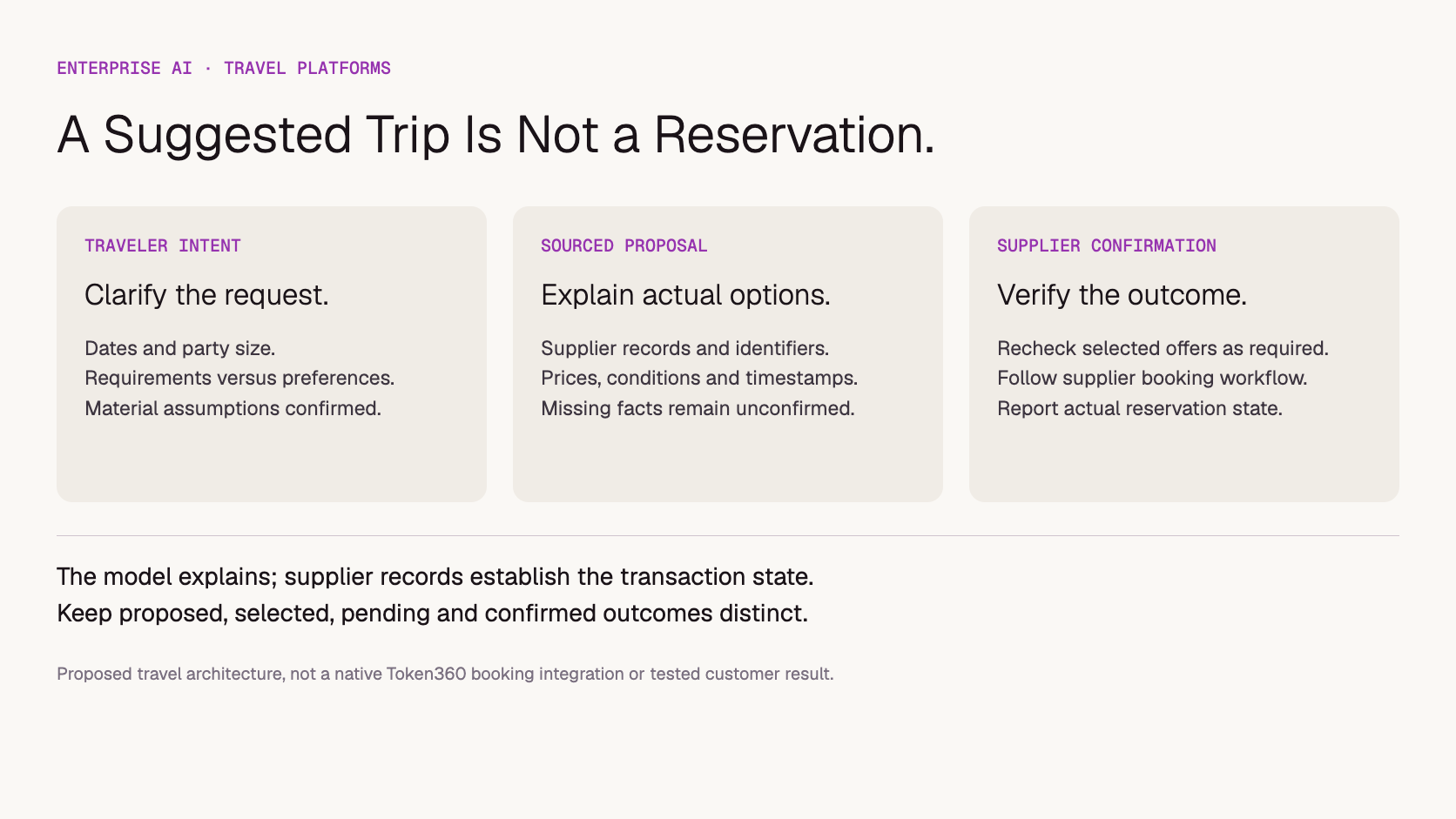
Convert the traveler's confirmed constraints into supplier searches, attach the resulting identifiers and conditions to candidate options, and validate the assembled plan before asking the traveler to select. Recheck the selected offer when the supplier workflow requires it. Keep proposal, selected offer and confirmed booking as distinct states.
Suggested application stages. Exact repricing and booking steps depend on the supplier integration.
In a hypothetical city-break planner, the first result might contain a hotel option and two activities. Before presenting a coherent schedule, the application needs to check dates, locations and whether the proposed order is feasible. A well-written paragraph does not establish that the museum is open, the transfer time is adequate or the room accommodates the party.
Keep offer identifiers and source timestamps outside free-form prose in the application's records. Display the relevant conditions with the choice. If a price or availability changes at confirmation, explain the change and obtain the required new decision. Do not silently substitute a different room, fare or cancellation condition to keep the conversation moving.
The downloadable travel proposal evidence register lists fields for constraints, sources, selected offers and confirmation status. It is a planning template, not a booking integration or a record of completed travel.
How can teams prevent invented details in travel answers?
Restrict factual descriptions to the evidence retrieved for the current proposal, and represent missing facts explicitly. Ask the model to explain known attributes rather than complete a persuasive story. Then validate high-impact fields against the source record before showing them as facts to the traveler.
A hotel description may say “near the station” without supplying a walking distance. The assistant should not convert that into “a five-minute walk.” Likewise, a general property description does not prove that a particular room has an accessible bathroom or that breakfast is included in a selected rate.
Use targeted checks for the fields that determine the purchase: dates, occupancy, inclusions, refund conditions, currency and total price. Keep the underlying evidence available to staff who handle questions. If an important attribute is absent, ask the supplier or tell the traveler it is unconfirmed.
Source grounding also has limits. An accurate summary of stale or incomplete data can still mislead. The system needs a freshness policy appropriate to each source and field; a destination description and a live fare do not have the same update requirements. This is a workflow design requirement, not a guarantee that prompting eliminates hallucinations.
What should happen when a search or booking step fails?
Preserve the actual state and give the traveler a next action that matches it. A failed search means options could not be retrieved; a timeout during a booking request may leave the outcome uncertain. Neither situation justifies inventing availability or declaring success. Resolve uncertain transactions through the supplier's supported mechanisms.
For example, if a booking request times out after submission, the application should check the supported reservation or request-status path before deciding whether another attempt is appropriate. Retry behavior depends on the supplier contract and duplicate-prevention support. The language model should not make that transaction decision from conversational context alone.
Give support staff a concise handoff: confirmed traveler constraints, selected offer, the last completed step and the unresolved question. Avoid requiring the traveler to repeat the whole planning conversation. Keep sensitive booking details restricted to the people and systems that need them.
A useful pilot includes unavailable offers and supplier errors, not only an attractive successful itinerary. Those cases reveal whether the product preserves trust when it cannot complete the requested action.
Where do image, audio and video models fit?
Use media models for clearly identified inspiration, explanations or narration when they add value to the travel experience. Keep generated illustrations separate from evidence of a specific room, property or attraction. Multimodal presentation should help the traveler understand the proposal without changing what the available source material actually establishes.
An illustrative destination mood board can support exploration if its status is clear. A synthetic image presented as a photograph of the booked hotel room can create a false expectation. Use verified supplier assets when the image is supposed to show the exact accommodation or amenity being sold.
Audio can read an approved itinerary summary; video can explain a travel concept or present clearly labeled promotional material. Verify dates, place names and conditions in the final output, not only in its script. Avoid embedding changeable prices into expensive media assets unless the production and update process can keep them current.
Choose models by task rather than forcing every part of the experience through one model. Language understanding, source-based comparison and media creation require different evaluations. Token360's multimodal access can be considered for those inference tasks, while travel facts remain with the appropriate data providers.
What should travel teams test before choosing an API supplier?
Test the full planning task with representative constraints, ambiguous requests, missing data and changed offers. Measure whether the system preserves requirements and communicates evidence correctly. Response speed and model cost matter, but they should be evaluated alongside the supplier lookups and application checks required to produce a usable proposal.
Constraint preservation: Does the answer keep confirmed dates, party size and non-negotiable requirements?
Evidence fidelity: Are prices, inclusions and descriptions supported by the records supplied?
Unknown handling: Does missing information remain unconfirmed instead of becoming a confident claim?
State accuracy: Can the application distinguish proposed, selected, pending and confirmed outcomes?
Recovery: Does the experience provide a useful next step after a supplier error?
Keep deterministic checks separate from subjective review. Exact dates and amounts can be compared with source fields; the helpfulness of a trade-off explanation needs a different rubric. Record application latency, supplier lookup latency and inference latency separately so a slow itinerary is not automatically blamed on the model.
For commercial evaluation, describe the expected number of conversation turns, retrieved-context size, optional media tasks and traffic peaks. Budget for travel-data services and application operations as well as inference. A cost per model response is not the total cost of a completed traveler task.
What does Token360 supply in this architecture?
Token360 supplies access to AI models that a travel company can evaluate for interpretation, explanation and media tasks. The travel company still needs supplier data, booking integrations and application controls. Scope model mix, volume, capacity and contractual requirements to the actual product rather than assuming a generic AI endpoint covers the travel workflow.
As checked November 11, 2026, Token360's enterprise page describes text, image, audio and video access, custom enterprise pricing and tenant-wide key audit. Higher throughput is a contact-sales item, while priority support and SLAs are marked coming soon. Confirm the applicable engagement terms; no native Amadeus connection or standard travel-booking capability is claimed.
A sensible first scope is a bounded, non-transactional comparison assistant using approved data, followed by evaluation of its limitations. Adding booking actions is a separate product decision with supplier-specific requirements. This article proposes that division of responsibility; it does not report a deployed travel product or measured business gains.
Frequently asked questions
Is an AI model API the same as a travel booking API?
No. A model API generates or interprets content. A travel booking API exposes inventory and transaction functions under its own rules. A travel platform may use both, with application logic connecting them.
Can a model provide live hotel prices from its own knowledge?
Do not treat model knowledge as a live price source. Retrieve the relevant offer from an authorized source and follow the supplier's confirmation flow. Preserve the currency, conditions and source status with the displayed price.
Does every travel assistant need booking functionality?
No. A planning or inspiration product can stop at suggestions and link to the next step. Make its scope explicit so travelers do not mistake a generated itinerary for a reservation.
Can generated destination images be used in travel marketing?
They can serve as clearly identified illustrations where appropriate to the use and applicable permissions. They should not be presented as verified depictions of a specific room or property. Review the publishing channel's requirements and the claims the image implies.
How should a travel platform evaluate success?
Define the completed task first, such as a source-supported shortlist or a confirmed booking through the supplier system. Track factual errors, unresolved cases, review effort, latency and cost against that task. Do not equate an engaging conversation with a completed transaction.
Evidence scope: editorial architecture analysis with hypothetical examples. Official sources checked November 11, 2026. No customer deployment, booking-success rate, cost saving or tested native travel integration is claimed.
Enterprise AI
API
Bring your next idea to life.
Create a video scene in Creator, or explore models for images, audio, and text to find the right capabilities for your project.



 Guides
 Guides
 Guides