AI API data residency needs a defined scope. Check inference, files, logs and delivery separately before approving an enterprise workflow.
ENTERPRISE AI · BLOG 153
By Token360 · Editorial review: November 5, 2026
AI API data residency needs a defined geographic scope for each part of a request. Regional inference does not automatically establish where input files, generated media, application logs or webhook records are stored. Before approval, map the workflow, identify the covered data and locations, and document what happens when an allowed route is unavailable.
A team can select a regional inference route and still have unanswered questions about its finished workflow. The input may come from a separate upload service; the result may be copied to a media library; a monitoring system may receive request content. “Which region?” needs a subject: which data, at which stage, under which configuration?
This article provides a procurement and engineering review method, not a legal determination of where your data must remain. The video example and acceptance checks are proposed exercises, not results from a geographic-routing experiment. There are no measured residency outcomes or customer deployments in this article.
Read first: Token360’s security and data-handling documentation defines the layers to include in the review. Keep the geographic question separate from retention duration, training permission and file-access authorization.
What is the difference between inference location and storage location?
Inference location describes where the model processes the request. Storage location describes where particular data is kept, whether that is an uploaded asset, a generated result or another recorded copy. Review both. An answer about compute does not establish the location of every stored artifact, and a regional bucket does not establish the model’s execution location.
Question
Subject to identify
Evidence to request
Do not infer it from
Where is the request processed?
Gateway processing and eligible model execution locations.
Applicable route definition and configured geographic scope.
The customer’s office location.
Where are files kept?
Inputs, outputs and any applicable replicas or backups.
Storage configuration or a scoped supplier statement.
The inference-region label.
Where do records go?
Content-bearing logs, diagnostics and operational metadata.
Field-level destinations and handling policy.
A general “regional service” description.
Where is the result delivered?
Webhook receiver, download destination and downstream systems.
The receiving service’s configuration and workflow map.
The location of the API endpoint alone.
The distinction is visible in cloud routing documentation. Amazon Bedrock’s cross-Region inference guide, checked November 5, 2026, distinguishes geography-bound profiles from global profiles: the former select processing locations within the specified geography, while the latter can use supported commercial regions worldwide. A profile therefore needs its scope read explicitly; “regional” is not a sufficiently precise architecture description.
For a review record, use separate fields for the required geography and the confirmed geography. “Requested: approved country list” and “Confirmed: not yet established” is more useful than one ambiguous cell saying “regional.” It keeps the procurement requirement from being mistaken for an implemented control.
Does an “EU” endpoint label tell you the exact permitted countries?
Read the detailed geographic definition and applicable agreement rather than relying on an endpoint abbreviation. A country requirement, an EU requirement and a broader European service region are not interchangeable specifications. Record the allowed locations in a form the technical and procurement teams can compare with the supplier’s actual scope.
The OpenRouter pricing FAQ includes a question about sending API requests to specific regions. As checked November 5, 2026, it describes regional routing on Business and Enterprise plans. The more detailed OpenRouter EU routing page identifies shared-provider processing across Europe—the EU/EEA, the UK and Switzerland—and distinguishes account and operational records from API payloads. That detailed scope is more precise than the FAQ’s shorthand.
For procurement purposes, do not translate that broader description into a country-specific or EU-only guarantee. The same discipline applies to any vendor: identify the current definition, exceptions and account-specific commitments. If a brief says “France only,” a response saying “Europe” leaves a question open even if both teams initially describe the service as regional.
Company headquarters and processing locations also answer different questions. A legal entity’s address may be relevant to a separate contractual review, but it is not documentation of where a particular model request executes. Ask for evidence that addresses the workload rather than substituting a country-of-origin label.
Which parts of a multimodal workflow belong in the region map?
Map the actual path taken by each data category, not just the main model call. Start with upload and submission, follow processing and result delivery, then inspect the destinations your application adds. For each stage, record whether location is confirmed, excluded by an agreed scope, or still unresolved. Do not silently omit unknown stages.
The following inventory is a proposed review aid. Include a row only when that component exists in your workflow, and ask the responsible party to confirm its contents. It is not a claim that every model service uses every component.
Stage
Example data
Specific geographic question
Review owner
Input preparation
Reference image, script, audio sample.
Where does the upload or source service keep the submitted file?
Application/storage owner.
Submission and execution
Prompt, input references, request body.
Which gateway and model-processing locations are covered?
Platform and supplier contacts.
Job state
Queued work and temporary artifacts, if used.
What location commitments apply to this asynchronous feature?
Supplier and integration owner.
Output storage
Generated video, image or audio.
Where is the object kept before and after download?
Supplier plus destination owner.
Notification
Webhook body and receiver records.
Where does the receiver process and record that event?
Webhook application owner.
Operations
Traces, error samples and support attachments.
Which fields travel to which systems?
Observability/support owner.
Be precise about “logs.” A timing counter and a captured request body are different data. Record what the destination actually receives before deciding whether it falls within the geographic requirement. If you have not inspected a logging configuration, mark its contents unknown rather than assuming it contains no customer material.
A media download deserves its own row. Ask separately about origin storage, any delivery or cache layer, and the final destination controlled by your team. A signed link describes an access mechanism; it does not by itself document that entire location chain.
What does Token360 document about residency?
Token360 documents enterprise residency as a constraint on eligible inference routing where supported, with availability depending on the model and configured routes. That provides a starting point for the account review. It does not establish a universal geographic commitment for every model, media artifact or downstream application component.
As checked November 5, 2026, the data-residency section explicitly separates inference routing from application logs, webhook destinations, asset storage and retention or training behavior. It directs customers to the agreement and privacy documentation applicable to their account for binding commitments.
The routing documentation also says a public model name can resolve to multiple eligible routes, with account policy among the selection factors. Session affinity is not a substitute for a geographic policy. Do not invent a region parameter or copy a competing platform’s routing fields into a Token360 request without documented support.
Send the Token360 enterprise team a scoped requirement: the selected models, text/image/audio/video tasks, permitted locations and features that need coverage. Ask which are supported for the proposed account configuration and which remain outside the offer. Keep the written answer attached to that scope rather than summarizing it as “all Token360 data is local.”
What should happen if no allowed route is available?
If geography is a hard requirement, define a failure response that does not silently relax it. The application might stop, queue approved work or offer a reduced function, depending on its design. Establish which alternatives remain within scope before an outage; an automatic retry should not become an undocumented change to the requirement.
OpenRouter’s in-region routing documentation provides one concrete provider example: regional requests are filtered to eligible endpoints, and a request fails rather than using an out-of-region endpoint when no eligible regional endpoint is available. Its feature availability and exclusions must still be checked for the actual request. This is OpenRouter’s documented behavior, not a statement about every gateway.
For your application, write down whether a backup endpoint, retry worker or manual recovery script can select a different destination. A tightly configured main service is not the whole workflow if an operator can resend the same payload through an unreviewed fallback.
Use a synthetic payload to test the approved failure path with the account team when feasible. Record the expected response, actual response and evidence provided about route eligibility. This article has not performed that test and does not supply a universal HTTP status code for residency failures.
How can a regional video job still have an incomplete review?
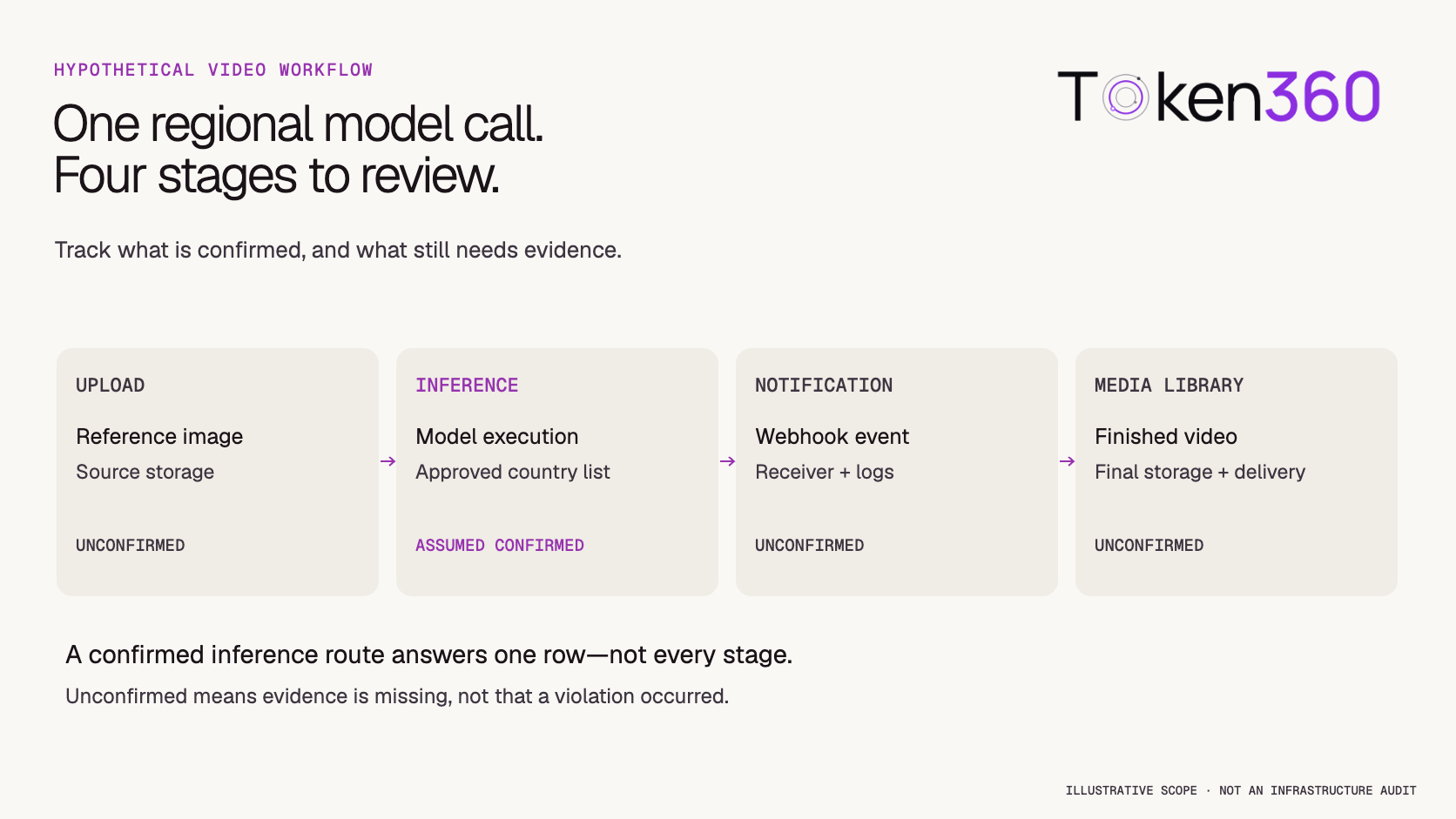
A video workflow is only as well documented as its unresolved stages. Confirming inference location completes one row, not the whole review. A hypothetical image-to-video job illustrates how an otherwise successful API integration can leave important geographic questions unanswered without proving that any actual out-of-region processing occurred.
Hypothetical example: a retailer asks that project content stay within an approved country list. It uploads a product photograph, submits a video job, receives a webhook and copies the finished clip into its marketing library. Assume only that the inference route’s scope has been confirmed; no specific vendor configuration is represented.
Observation in this example
What it establishes
What remains to resolve
Inference route matches the approved list.
The scoped execution requirement has an answer.
Whether the other workflow stages have matching coverage.
The upload service returns a usable image URL.
The image can be referenced.
Its storage, replication and applicable processing locations.
The webhook reaches the application.
Notification delivery works.
The receiver and logging destinations for the event.
The finished video plays in the marketing library.
The output was delivered successfully.
The library’s location and any additional delivery/copying scope.
Hypothetical scope review. “Unconfirmed” means evidence is missing, not that a geographic violation has been observed.
The correct conclusion is “review incomplete,” not “the workflow is compliant” and not “the supplier exported our data.” Both stronger conclusions would require additional evidence. Assign the open rows to their owners, obtain the relevant configurations or commitments, and revisit the decision before using content subject to the requirement.
This example also shows why one successful generation cannot validate residency. The visible output answers a functional question. A geographic review needs evidence about how the service and your surrounding systems handled that request.
What evidence should you collect before approval?
Combine a precise requirement, the applicable supplier commitments, observable configuration and a record of any scoped tests. No single screenshot proves the full data path. Use the evidence to identify what is confirmed and what is not, then have the appropriate technical and privacy owners resolve the remaining questions.
Copy the worksheet below into a local CSV file. Blank fields are for your own review:
Workflow stage,Covered data/fields,Model/feature/endpoint,Required geography,Confirmed geography,Evidence reference/date,Scope exclusions,Failure behavior,Owner,Status,Open question
Input preparation/upload,,,,,,,,,,
Gateway processing,,,,,,,,,,
Model inference,,,,,,,,,,
Job state/temporary artifacts if used,,,,,,,,,,
Generated-output storage,,,,,,,,,,
Replicas/backups if used,,,,,,,,,,
Webhook receiver,,,,,,,,,,
Application logs/traces,,,,,,,,,,
Download/delivery layer,,,,,,,,,,
Customer media library,,,,,,,,,,
Support attachments if shared,,,,,,,,,,
Fallback/manual recovery,,,,,,,,,,
. It contains separate fields for required and confirmed locations, evidence, scope exclusions, failure behavior and ownership. Its rows are blank prompts for a review, not pre-approved findings.
Define the requirement. Name the covered content, permitted geography and stages. Have the responsible owner clarify ambiguous terms such as “local” or “EU.”
Identify the implementation. Record model, endpoint, account configuration, optional features and downstream destinations.
Attach scoped evidence. Link the applicable agreement, dated documentation, configuration export or written clarification to the row it actually supports.
Check a non-sensitive workflow. Where feasible, use synthetic content to inspect your own upload, webhook, logging and output destinations. Obtain supplier evidence for stages you cannot observe.
Review the failure case. Confirm what happens when a required regional option is unavailable, including manual recovery paths.
Record the decision and changes. Keep unresolved rows visible. Recheck affected rows after adding a model, feature, storage service or fallback destination.
Client-observed latency, an endpoint’s name or its public IP location should not be used as proof of the complete internal processing path. They describe observations at the client boundary. Ask the supplier what evidence it can provide for infrastructure beyond that boundary, and state the limits of what was verified.
These questions clarify common scope mistakes. They do not establish the configuration of a particular account. Use the model, feature and agreement actually selected for the workload, and keep location, retention, access and legal approval as separately documented decisions. A short platform label cannot replace those answers.
Is zero data retention the same as data residency?
No. Retention concerns what is kept and for how long; residency concerns location. Confirm both when both matter. A retention answer does not identify the processing geography.
Does a regional inference route include generated video storage?
Do not assume it does. Ask for the output-storage scope and its evidence separately, including the destination to which your application copies the file.
Does a signed download URL establish the file’s region?
No. Treat the access mechanism and the geographic handling of the object as separate questions. Obtain the relevant storage and delivery information.
Can I add a region field to any compatible API request?
Only use controls supported by the selected service and model schema. Protocol compatibility does not establish that another platform’s region controls exist or have the same meaning.
Does choosing a region certify legal compliance?
No. A geographic configuration can address a specified location requirement, but it is not a legal compliance certificate. The responsible privacy or legal reviewer must determine the applicable obligations and acceptable scope.
Enterprise AI
API
Build faster with one AI API.
Use Token360 to call video, image, audio, and text models with one key and one bill.



 Insights
 Guides
 Guides