ENTERPRISE IMAGES · SKETCH TO IMAGE
A polished concept is useful only if it still communicates the design you drew.
A sketch-to-image API can be evaluated for concept visualization, but visual polish should not substitute for preserving the design. Define which shapes, parts and spatial relationships must survive, then compare the generated image with the supplied sketch. Treat exact dimensions, editable geometry and manufacturing readiness as separate deliverables that an attractive image does not establish.
For a product team, creative agency or design-software company, the practical question is whether an image model can turn an approved drawing into a useful visual without quietly redesigning it. A brand may want to explore materials for a new package; a designer may want a presentation image of a proposed object. Both need a clear boundary between interpretation and alteration.
This article provides a documentation-based buying framework. It does not report a sketch-to-image experiment or claim that a specific Token360 model has passed the proposed checks.
What does it mean to preserve a sketch?
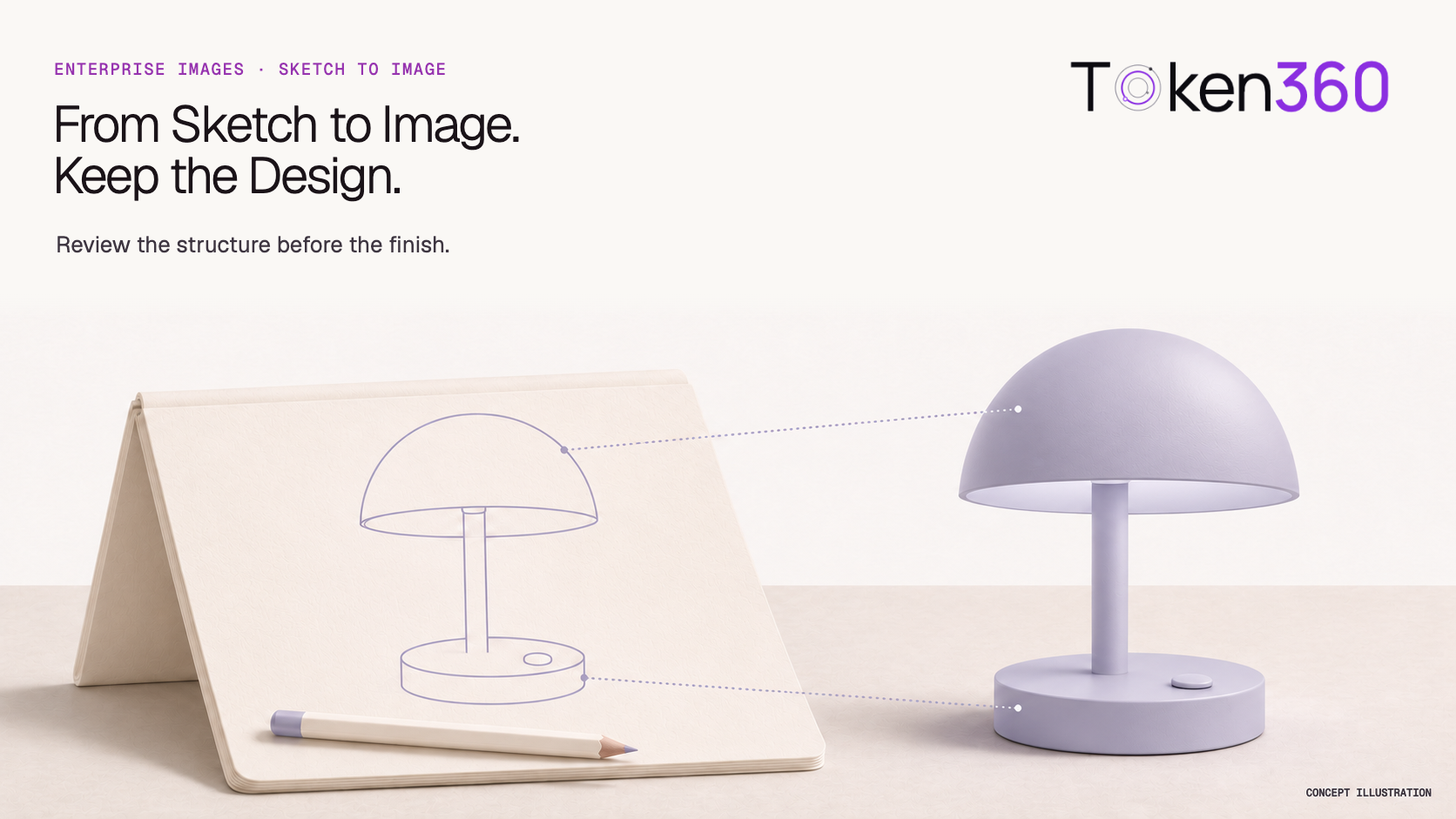
Preserving a sketch means retaining the design relationships the team has marked as important, while allowing explicitly requested interpretation of materials, lighting or finish. It does not necessarily mean copying every pencil mark. Separate intentional structure from construction lines and annotations before judging whether an output follows or changes the design.
Consider a desk-lamp sketch with a dome shade, one straight stem and a circular base. A glossy output with a second support, an angled stem or a different base may be attractive but answer a different brief. Conversely, replacing rough pencil shading with a plausible matte surface can be desirable if the structure stays faithful.
Define design constraints before comparing image models
| Sketch information | Example requirement | How to review it |
|---|
| Part structure | One stem connects the shade to the base | Check count, attachment and continuity |
| Silhouette | Preserve the dome profile and base outline | Compare corresponding contours at the same view |
| Relative placement | The button sits on the front of the base | Compare its position relative to the base and stem |
| Appearance | Explore a matte purple finish | Assess material and lighting separately from structure |
| Exact specification | A required physical dimension or editable solid | Verify in the authoritative design file, not a raster preview |
The distinction prevents two different failures: accepting a redesign because it looks finished, or rejecting a useful concept because it no longer looks hand-drawn. Write the intended level of fidelity into the brief. “Keep the design” is too vague when one reviewer means overall composition and another means every component relationship.
Which sketch-to-image workflow are you actually buying?
Confirm whether the route uses a sketch as a general image reference or provides a dedicated structural control. These are different input contracts, even when both produce an image from a drawing. Ask what the selected model accepts and what its controls mean; do not infer a geometry constraint from an upload field.
The official fal Blender extension distinguishes sketch-based image generation from edge- and depth-guided workflows. Its sketch path uses a line drawing as input, while its edge path uses detected edges as structural guidance. Higgsfield's Ideogram introduction presents turning rough sketches into finished imagery. These are useful examples of the category, not independent evidence of design accuracy.
As reviewed on November 24, 2026, Token360's Create image documentation describes text-plus-image creation and editing, including an images reference array. That provides a documented starting point for discussing a sketch-input evaluation. It does not establish a dedicated sketch-control model, edge-map route, Blender integration or guaranteed geometry preservation.
Ask Token360 to confirm a named model, the accepted reference types and how to submit the proposed assets. If a parameter is described as strength or guidance, ask for the selected model's definition rather than assuming it locks the outline. A field appearing on a common API page does not prove identical behavior across models.
The broader image generation versus editing decision remains separate. This purchase concerns how a supplied drawing constrains a concept image—not whether the platform can generate attractive images in general.
How should you prepare a drawing and appearance references?
Give each input a clear role: the drawing supplies the required structure, while separate references may supply material, color or presentation style. Remove contradictory views and explain ambiguous marks. Keep exact design specifications in an authoritative source rather than expecting the model to interpret every annotation correctly inside an image.
Start with the drawing revision the team wants to evaluate. Crop it consistently, retain the complete object and use a legible export. If multiple concepts share one sheet, isolate the selected concept or explicitly identify it. Do not accidentally ask the model to blend alternatives that the designer intended as different options.
Explain whether dashed lines indicate hidden edges, a movement path or construction guides. Identify labels that are instructions rather than text to reproduce on the product. If exact wording belongs on packaging, provide the approved copy separately and plan a controlled composition step when necessary. A readable generated label is not automatically the approved label.
A style photograph can introduce a competing shape. For example, a material reference might show a lamp with two supports while the sketch has one. State that only the surface finish should transfer, and test whether the chosen route respects that separation. If it does not, simplify the reference set before escalating prompt complexity.
Illustrative brief, not a validated prompt: Use drawing A for the lamp's silhouette, single stem and component placement. Use reference B only for the matte finish. Keep the illustrated viewpoint. Do not add parts or turn construction lines into physical features. Produce a concept visualization, not an engineering drawing.
Retain the original drawing and a separate annotated review copy. This keeps the production input traceable and prevents reviewers from judging against a newer revision than the model received.
How can you compare results without rewarding redesign?
Score structural fidelity and presentation quality separately, using the same drawing revision and requested view for every candidate. Review component count, attachments, silhouette and placement before judging finish. A beautiful but structurally incorrect image should not outrank a faithful concept unless the brief explicitly allows redesign and the team records that decision.
Use a small set of representative drawings chosen for the actual work: a simple silhouette, an object with several connected parts, and a drawing containing relevant ambiguous marks. These are proposed test categories, not a claim that a particular number of samples establishes reliability. Repeat trials as needed to understand variation rather than selecting one attractive result and declaring the route stable.
For each output, compare the drawing and result side by side at a matched orientation. An overlay may help locate contour changes when the view aligns, but line weight, shading and perspective make a raw pixel-difference score an incomplete measure. Record the specific design requirement that changed.
Test a meaningful revision too. Move the button in the source drawing, for example, while keeping the rest of the design fixed. Check whether the new image reflects the intended revision without moving unrelated parts. This examines whether the workflow can support an ordinary design iteration rather than just one persuasive first presentation.
The blank sketch-to-image review sheet (template below) separates structural observations, appearance judgments, revision response and acceptance. Mark the reviewer and source revision. The sheet contains no benchmark scores or fabricated results.
Do not borrow conclusions from the text-based storyboard layout test. Following a written arrangement and interpreting an uploaded sketch are different tasks. Likewise, an image that preserves a visible front outline does not prove that an unshown rear surface or internal assembly is correct.
What should the pilot deliver before you buy production volume?
Ask the pilot to deliver reviewed concept images, a record of the inputs and settings, and a clear account of the corrections still required. Define whether the output is for ideation, client presentation or further design work. Do not buy a raster-image workflow expecting editable CAD, verified dimensions or manufacturing-ready files without separate evidence.
Agree on the output format and resolution, how revisions will be handled, who judges design fidelity and what constitutes an accepted concept. If downstream designers need editable layers or geometry, make those file requirements explicit. A rendered appearance alone does not establish that the underlying objects, materials or dimensions are editable.
Record generation spending alongside preparation, review and correction time. Compare the result with the current illustration or rendering workflow using the same deliverable. A lower price per image may not reduce project cost if each image needs a designer to restore the structure. No cost advantage or production speed has been measured for this article.
Token360 serves enterprise model procurement across text, image, audio and video. Its confirmed enterprise approach uses tiered quotes, with higher usage receiving lower quoted rates, and no separate service fee. The specific image model, eligible volume and commercial terms need to be established in the quote. General image access does not guarantee a dedicated sketch-to-image feature.
A focused inquiry is: “We want to visualize these approved drawings while preserving these component relationships. Which currently available model route can accept the inputs, what controls are supported, and what evidence will the pilot return?” That connects model procurement to a design task the team can actually review.
Evidence boundary: official product documentation supports the category descriptions and the documented input route. The lamp example, review matrix and pilot procedure are illustrative. No Token360 sketch-fidelity benchmark, CAD capability or guaranteed design preservation is asserted.
Frequently asked questions
Does sketch-to-image output validate the design’s dimensions?
No. A visually convincing rendering is not evidence of dimensional accuracy or manufacturability. Compare it against the drawing for the intended creative review, and keep technical validation in the appropriate engineering or design process.
Should style references override the sketch?
Only when the brief permits a design change. State which lines, proportions and components are fixed and which appearance choices are flexible. Review design preservation separately from how closely the output matches the desired visual style.
What should we do if the output looks better but changes the design?
Record it as a redesign rather than a faithful rendering. It may be useful as a separate concept, but it should not pass an acceptance test that requires the original design to remain intact.
Review worksheet template
drawing_id,revision,model,settings_record,output_file,part_count,connections,silhouette,placement,appearance,revision_response,decision,reviewer,correction_notes
,,,,,,,,,,,,,
About the author
Yuki Yu is Marketing Manager at Token360.


 Guides
 Guides
 Guides