The Open-Weight AI Adoption Gap: Why Releases and Rollouts Move at Different Speeds
Explore the open-weight AI adoption gap: why model releases, API access, serving readiness, and enterprise rollout are different decisions for product teams.
An open-weight model release can expand a company’s deployment options without making self-hosting its best immediate decision. Access to model files, a supported runtime, usable capacity, and an accountable operating team are separate milestones. Treating them as one event creates unrealistic launch plans.
The commercial opportunity is real: a company may gain more choice over how it serves a model. The practical question is when that option becomes usable, and whether exercising it solves a problem important enough to justify the work.
This is a market perspective, checked October 30, 2026, rather than a deployment tutorial or a ranking of open models. The release examples are dated evidence. The adoption framework and scenarios are Token360’s editorial analysis; we have not performed the self-hosting tests described below.
Recent releases show why availability needs a precise label
Mistral’s October 6 announcement offered a public preview API for Mistral Large 4 while scheduling weights for later that month. Its model documentation currently labels the model “Public Preview.” The announcement and documentation demonstrate distinct release states; they do not, by themselves, confirm an organization’s production readiness. See the Mistral launch post and model documentation.
Artificial Analysis’ October 23 Kimi K3.1 Pro report similarly made its open-weight leadership claim conditional on publication of the weights. That is a dated statement about the launch, not proof of today’s download status. We do not treat a promised release or an inaccessible download page as confirmation that weights are currently available or unavailable. See the dated Kimi analysis.
These examples illustrate the same procurement issue: “launched” can mean that a model is usable through one channel while another channel remains a separate delivery. A buyer who needs an API trial can move at a different pace from a buyer who needs a reproducible private deployment.
The question for a project meeting becomes concrete: which access path is ready, for which version, and with what evidence? A calendar date alone cannot answer all three.
Openness creates options; operating capability makes them usable
There are at least three different things a team might mean by control. It might want to keep a chosen checkpoint rather than follow an endpoint update. It might want to choose where inference runs. Or it might want to modify model behavior. Those goals lead to different technical and organizational commitments.
A company evaluating open weights should name the control it needs before comparing model scores. Otherwise, it risks purchasing infrastructure for a requirement that could have been met another way—or choosing a convenient service that cannot satisfy the actual requirement.
Terminology also matters. The Open Source Initiative’s AI definition includes freedoms and requirements covering data information, code, and parameters. The availability of weights alone is not enough to establish compliance with that definition. We use “open-weight” here as a description of weight access, not as a blanket judgment about a model’s license or openness. See the Open Source AI Definition 1.0.
The business implication is straightforward: evaluate the specific release and its applicable terms. Avoid carrying assumptions from a previous model generation into a new release. This article does not make a license determination for either launch example.
Four milestones separate an announcement from an adopted service
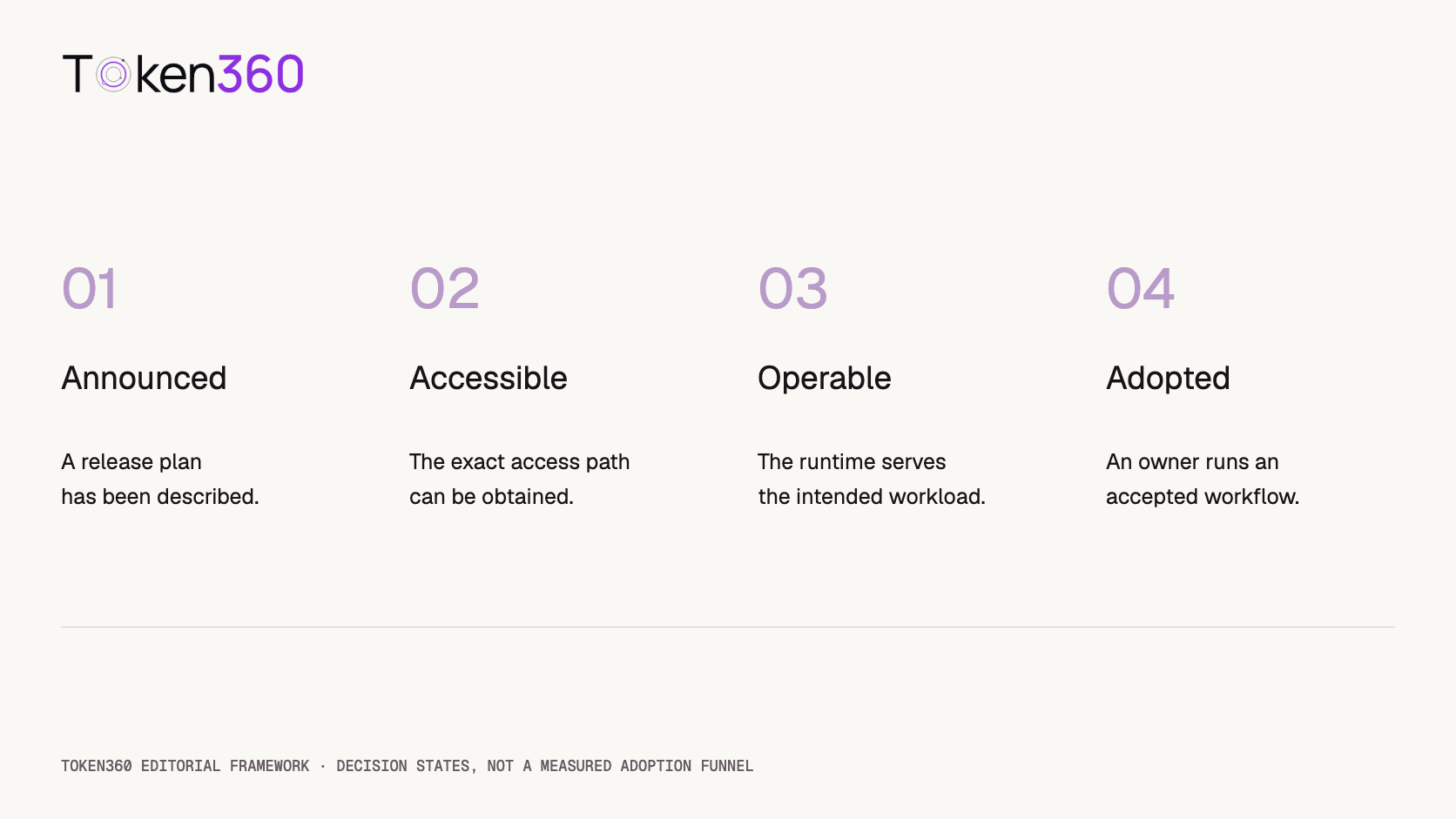
Our adoption framework uses four milestones. They are decision states, not a maturity score or a claim that every organization must follow the same schedule.
Milestone
What the team can substantiate
What remains unproven
Announced
A vendor has described a model and release plan
Access through every intended channel
Accessible
The exact endpoint or release files can be obtained
Reliable execution in the target environment
Operable
The chosen runtime serves the required workload
Ownership and resilience under production conditions
Adopted
An accountable team runs an accepted business workflow
Continued suitability after workload or release changes
These states prevent one kind of evidence from standing in for another. A successful download supports access. A successful short request supports a narrow execution claim. Neither establishes that a service can meet the organization’s concurrency, recovery, and support needs.
Token360 editorial framework; no measured adoption funnel is implied.
The distinction also protects a useful early trial from being judged against the wrong goal. An API evaluation can answer whether the model is worth further investment even when a private deployment is not ready. Conversely, an infrastructure proof of concept may establish that the model runs without showing that its outputs are useful.
The operating model changes the economics
Self-hosting shifts responsibilities into the team’s operating environment. Capacity planning, runtime updates, monitoring, and recovery become part of the decision. The question is not only whether hardware can load the model, but whether the service remains useful under the workload that the business expects.
For a concrete technical reference, vLLM documents multiple scaling approaches, including tensor and pipeline parallelism. Its guidance connects serving configuration with available hardware and model requirements. That is evidence of deployment work beyond acquiring weights, not a hardware prescription for the models discussed here. See the vLLM scaling documentation.
It is tempting to compare a hosted token price with a server rental price and call the cheaper-looking number the winner. That omits utilization and ownership. A reserved machine can spend time idle; an overloaded service can impose waiting or retries. A valid comparison needs the same workload and acceptance standard on both sides.
We propose comparing the total cost of operating a defined service over a defined period: serving capacity, supporting infrastructure, engineering time, and incident handling, alongside accepted outputs and observed latency. This is a measurement proposal, not a claim that hosted or self-hosted inference always costs less.
Three buyer situations lead to different timing decisions
A product team still discovering its workload
Imagine a small team developing a document assistant. It has not settled its typical document length, traffic pattern, or acceptable error rate. Reserving a serving environment immediately might commit it to assumptions that will change next week.
For this hypothetical team, an available hosted endpoint may be a practical evaluation channel, subject to its data requirements. The team can learn what it needs before deciding whether a separate deployment is worthwhile. Open weights still have strategic value because they preserve a possible future path; they do not require an immediate infrastructure commitment.
An organization with a specific infrastructure requirement
Now consider a team whose approved architecture requires inference in an environment it operates. API availability can support some preliminary research, but it does not satisfy the deployment requirement by itself.
This team’s critical evidence is different: the exact release artifacts, compatible runtime, acceptable terms, capacity, and operational owner. Waiting for those pieces is part of the work, rather than a failure to react quickly to a launch. The launch announcement can trigger preparation without triggering a promise to ship.
A platform team serving several applications
A third hypothetical organization already operates inference infrastructure and supports multiple internal products. Its question may be whether a new model fits an existing service, not whether to create a serving capability from scratch.
That team may be able to evaluate a new checkpoint quickly, but it still needs application-level acceptance. A shared endpoint can magnify the impact of an update. The relevant decision is which workloads should move, which should remain on the existing version, and how the team will identify a regression.
These are editorial scenarios, not customer case studies. Their value is to show why the same model announcement can reasonably produce three different rollout schedules.
Portability is evidence that a move works
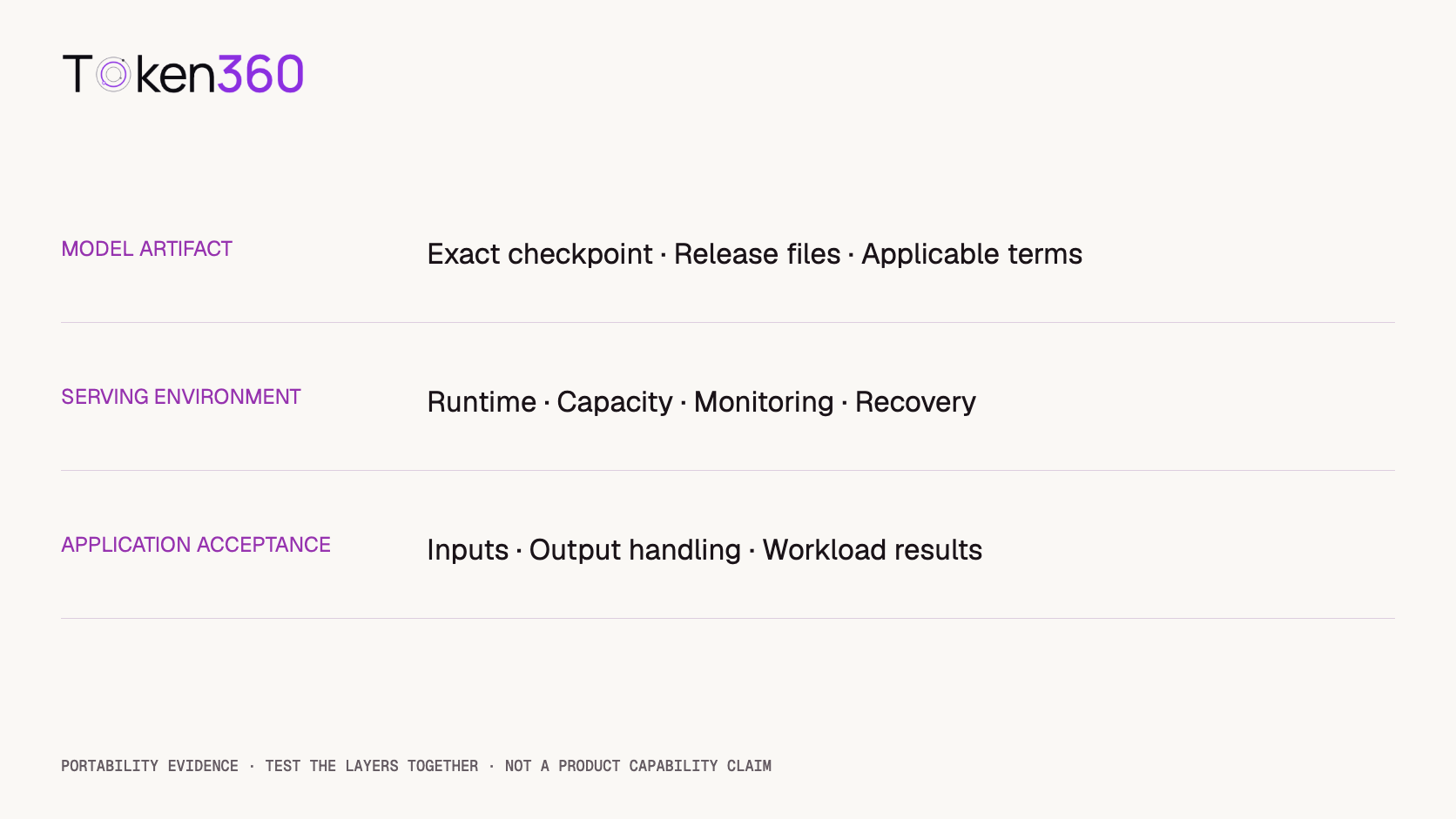
Downloadable weights can support portability, but a credible exit plan requires more than knowing that files exist. The destination needs to reproduce the application behavior that matters: inputs, output handling, tool interactions, and operational performance.
An application can depend on a serving implementation as well as a model. Moving the checkpoint does not automatically carry every feature of the original service with it. A migration decision should therefore distinguish the model artifact from the endpoint contract and the application’s own orchestration.
For procurement, a practical artifact is a short evidence record: the release identifier, the tested access path, the workload, the acceptance criteria, the known gaps, and the owner of the next decision. It makes uncertainty visible without inventing a numerical readiness score.
A portability claim becomes stronger when all three layers have been tested together.
What API platforms contribute to this decision
A hosted API platform can be one way to evaluate and integrate available models. That does not mean the platform supplies every deployment form a buyer may need. Model access, private serving, custom weights, and reproducible runtime behavior should each be verified as separate capabilities.
Token360’s model capability documentation directs users to the exact model page and public schema for supported behavior. That is the appropriate starting point for checking a hosted integration. This article does not establish that Token360 serves either launch example or offers a self-hosting product.
For teams considering open-weight adoption, our position is to evaluate early and commit according to evidence. A strong release can justify a trial. A deployment commitment needs an operating plan and a business reason. Keeping those decisions separate makes it easier to act quickly where the evidence is sufficient.
FAQ
Does open-weight mean ready to self-host?
No. Access to weights is one requirement. The exact release also needs a compatible serving environment, suitable resources, and validation for the intended workload.
Is open-weight the same as open-source AI?
Not automatically. Weight access alone does not establish that a system meets the OSI definition. Check the actual release materials and applicable terms.
Can an API launch happen before weights are released?
Yes. The dated Mistral announcement above explicitly separated those milestones. Confirm the current state of the access channel you intend to use.
Does this article confirm current download availability?
No. The examples illustrate dated launch sequencing. They are not a comprehensive inventory of downloadable weights as of publication.
Is self-hosting always cheaper than an API?
No universal answer follows from weight access. Compare the same workload, including utilization, operating effort, accepted outputs, and service requirements.
Can a team evaluate through an API before deciding on deployment?
Yes, when that evaluation fits its requirements. Treat the findings as evidence for that access path, and separately validate any later deployment.


 Tutorial
 Tutorial
 Comparison