When Does Serverless Inference Make Sense for a Business?
Serverless inference can suit intermittent demand. Check idle gaps, startup tolerance, burst deadlines and complete costs before choosing a service.
Serverless inference is worth evaluating for intermittent workloads when its idle policy, scaling limits and response behavior fit the task. It is less compelling when continuous readiness or predictable reserved capacity is the primary requirement. Compare the offered configuration against your traffic pattern; the serverless label alone does not establish suitability.
A business with a weekly content job has a different buying problem from a customer assistant that must respond immediately after an overnight lull. Both can have a modest monthly volume. The useful distinction is when requests arrive, what happens while resources become available and how much delay the workflow can accept.
This is a workload-fit guide, not a performance benchmark or a claim that Token360 runs every endpoint on serverless infrastructure. Sources were checked November 17, 2026. The scenarios and readiness worksheet are proposed evaluation tools; no cold-start times or savings were measured.
What does serverless inference mean for the buyer?
Serverless inference generally shifts infrastructure provisioning and scaling work to the service operator. It does not remove servers, eliminate operating limits or define one universal billing model. Buyers still need to verify supported models, response behavior and charges, including whether the service keeps resources ready or starts them in response to demand.
AWS's SageMaker Serverless Inference documentation describes on-demand operation for intermittent workloads that tolerate cold starts. It also documents a provisioned-concurrency option that keeps allocated resources initialized, with additional charges. This illustrates why the configuration matters as much as the category name; it does not describe every serverless product.
Likewise, Hugging Face's autoscaling documentation discusses model initialization and the cold-start implications of scaling endpoints to zero. Scale-to-zero is a behavior to investigate, not a synonym for every managed API.
For the broader purchase boundary, see what an inference provider actually supplies. This article addresses the narrower decision of whether demand-driven operation suits your workload.
Which business workloads are plausible candidates?
Workloads with meaningful idle periods and flexible completion times are plausible candidates, provided the service supports their model and input requirements. Separate background jobs from customer-blocking interactions. Neither low volume nor unpredictable demand alone establishes suitability; both must be considered alongside startup tolerance, burst size and the consequences of delay.
Illustrative workload
Why investigate serverless?
What could change the decision?
Occasional internal document processing
Long gaps between jobs; users may accept asynchronous completion
Large documents or model requirements outside the service limits
Periodic product-description drafts
Work can run in a controlled window
A publication deadline that cannot tolerate startup or queueing
A new feature with uncertain adoption
Demand is not yet stable enough for a confident capacity forecast
First-use responsiveness is essential to activation
Always-active customer interactions
Managed operations may still be useful
Little idle time, strict response budgets or insufficient tested headroom
These are hypothetical business patterns, not recommendations for specific model endpoints. A background task can still be urgent. A customer-facing feature can sometimes show progress and deliver results later. Describe what the user experiences instead of assuming the workload category determines the answer.
What traffic information matters beyond the monthly total?
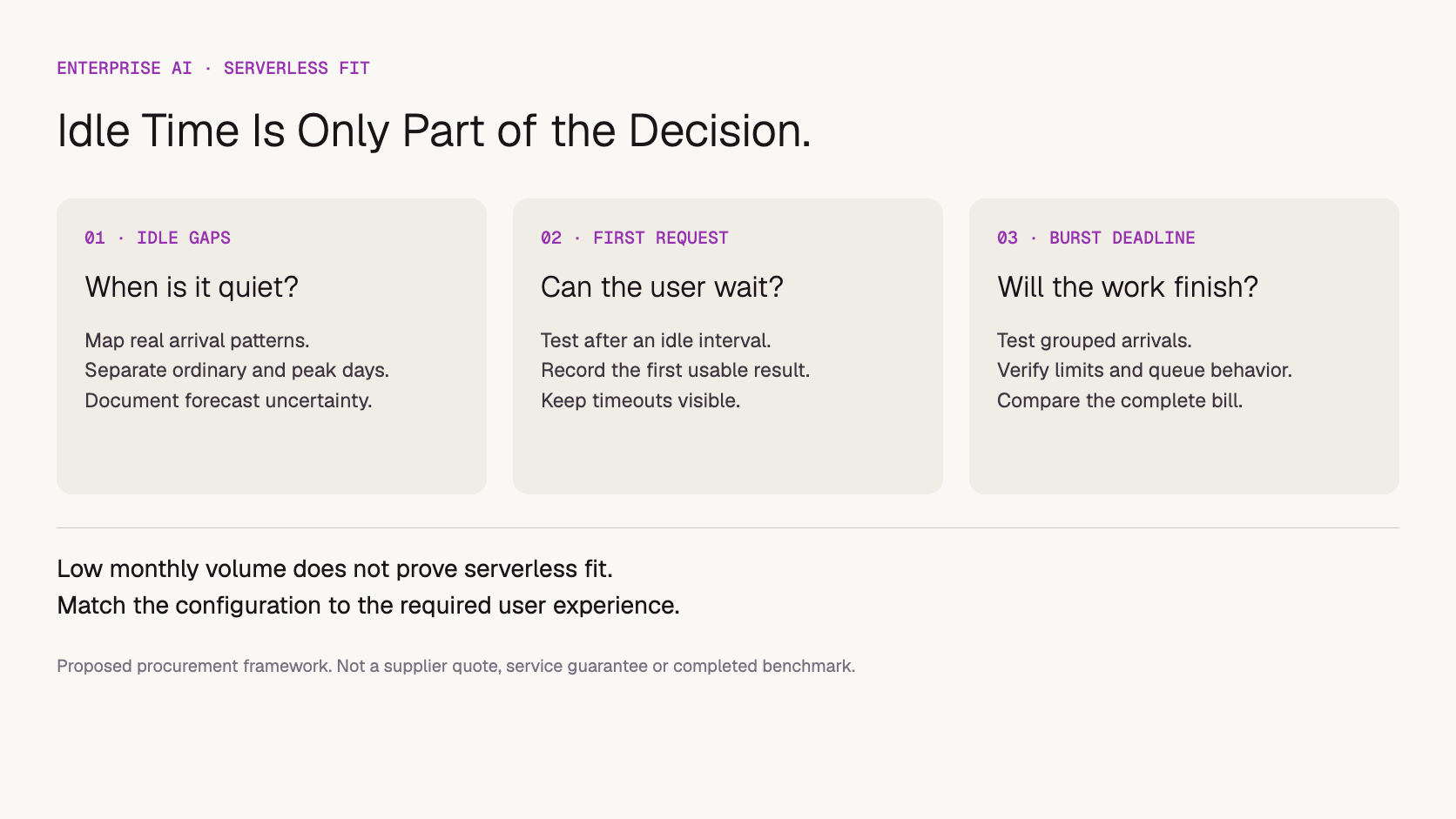
Collect arrival patterns, idle gaps, burst duration and request size. A monthly count hides whether demand is spread evenly or concentrated into a short window. Those differences affect startup frequency, queueing and the capacity required to meet a deadline, so they should appear in the evaluation brief.
Use representative business periods: an ordinary day, a scheduled import, an opening-time spike or a campaign launch if those events are relevant. Record simultaneous work and the amount of input or output per request. A handful of long-running generations is not interchangeable with the same number of short text calls.
If the feature is new, document scenarios rather than inventing a precise forecast. State which assumptions are uncertain and what early usage will resolve. Do not turn a prototype's low traffic into a permanent claim about production economics.
The distinction from API versus self-hosting is important: the question here is not who runs the servers, but which ready-state and scaling behavior fits the buying requirement.
Does automatic scaling guarantee a burst will finish on time?
No. Scaling is a mechanism, not an unlimited capacity promise or a deadline guarantee. Ask about the configured limits and what happens when arrivals exceed immediately available resources. The application must know whether requests wait, fail or require another documented handling path, and whether that behavior fits the business deadline.
For a scheduled campaign, include both the buildup and the peak in the proposed test. For unpredictable requests, define the largest credible burst from available evidence and preserve uncertainty where it is unknown. A service that succeeds at steady traffic may behave differently during a rapid increase.
If the workload requires a contractual allocation, use the dedicated inference capacity guide. That article covers the commitment itself; this one helps identify whether idle periods and startup tolerance make an on-demand arrangement worth evaluating.
Three workload questions to resolve before comparing offers.
How should buyers compare costs without assuming savings?
Compare complete bills for the same accepted workload and response requirements. Use each offer's actual billing basis and include any charge for keeping capacity ready. A lower idle-resource bill may be attractive, but it does not establish lower total cost if the service needs additional provisioned capacity or the workload changes.
Prepare three scenarios: a quiet period, ordinary operation and a busy period. Apply the supplier's pricing rules to each. Separate variable processing charges, readiness or minimum-capacity charges, and other applicable fees. Do not substitute a GPU-hour rate for a per-token quote without explaining the different purchased units.
Keep implementation and retry assumptions visible. A forecast that assumes every request succeeds immediately can understate the work needed to meet the deadline. Conversely, do not assume serverless necessarily causes retries; that must come from the selected service and your observations.
The AI API total cost of ownership guide covers the wider budget. Here the specific comparison is what the business pays to achieve acceptable availability across idle and busy periods. There is no universal traffic threshold at which one arrangement becomes cheaper.
What should be checked before approving a serverless option?
Approve a defined configuration only after checking model fit, idle-to-active behavior, burst handling and the complete commercial terms. Keep unresolved requirements explicit. A supplier's general serverless description is not evidence that the intended model, data path and workload have passed your company's acceptance criteria.
Download the serverless-fit worksheet to record idle periods, demand scenarios, response deadlines, supported features, evidence and decision owners. It is a blank planning template, not a preset score or proof of suitability.
For Token360, discuss the actual model and workload through the enterprise channel. As of November 19, 2026, its public page lists Serverless GPU Infrastructure in the contact-sales section. Confirm availability, architecture, startup behavior and billing for the specific engagement; do not apply that label to all catalog APIs or assume a blanket latency guarantee.
Token360's enterprise focus spans text, image, audio and video model access. The model catalog and pricing page are starting points for identifying the operation and buying unit. See About Token360 for company context. No Token360 serverless deployment was tested for this guide.
Frequently asked questions
Does serverless mean the endpoint always scales to zero?
No universal behavior follows from the label. Confirm the selected product's minimum resources, idle policy and any warm-capacity setting. Managed infrastructure and scale-to-zero are related concepts, not interchangeable promises.
Is low monthly usage enough to choose serverless?
No. A low-volume application can still require immediate responses or a large short-lived burst. Examine arrival patterns and deadlines before using total volume as the deciding factor.
Should we keep sending requests to prevent cold starts?
Do not rely on artificial traffic as an undocumented readiness guarantee. It can incur charges and may not establish the capacity you need. Ask for a supported readiness configuration and evaluate its price and behavior.
Can we use different arrangements for different workloads?
Yes, where the services and application support it. A flexible background job and a deadline-sensitive interaction can have different requirements. Record each workload's service scope rather than forcing a company-wide choice from one test.
Decision area,Workload requirement,Service configuration,Evidence,Unresolved question,Owner
Model and operation fit,,,,,
Idle gaps,,,,,
First request after idle,,,,,
Burst size and duration,,,,,
Completion deadline,,,,,
Ready capacity charges,,,,,
Usage charges,,,,,
Data and contract scope,,,,,
Enterprise AI
API
Bring your next idea to life.
Create a video scene in Creator, or explore models for images, audio, and text to find the right capabilities for your project.



 Guides
 Guides
 Guides