BYOK connects provider credentials; it does not automatically replace gateway authentication. Map each key to its host, role and account.
CREDENTIALS · INTEGRATION · BLOG 168
By Yuki Yu · Editorial update: November 6, 2026
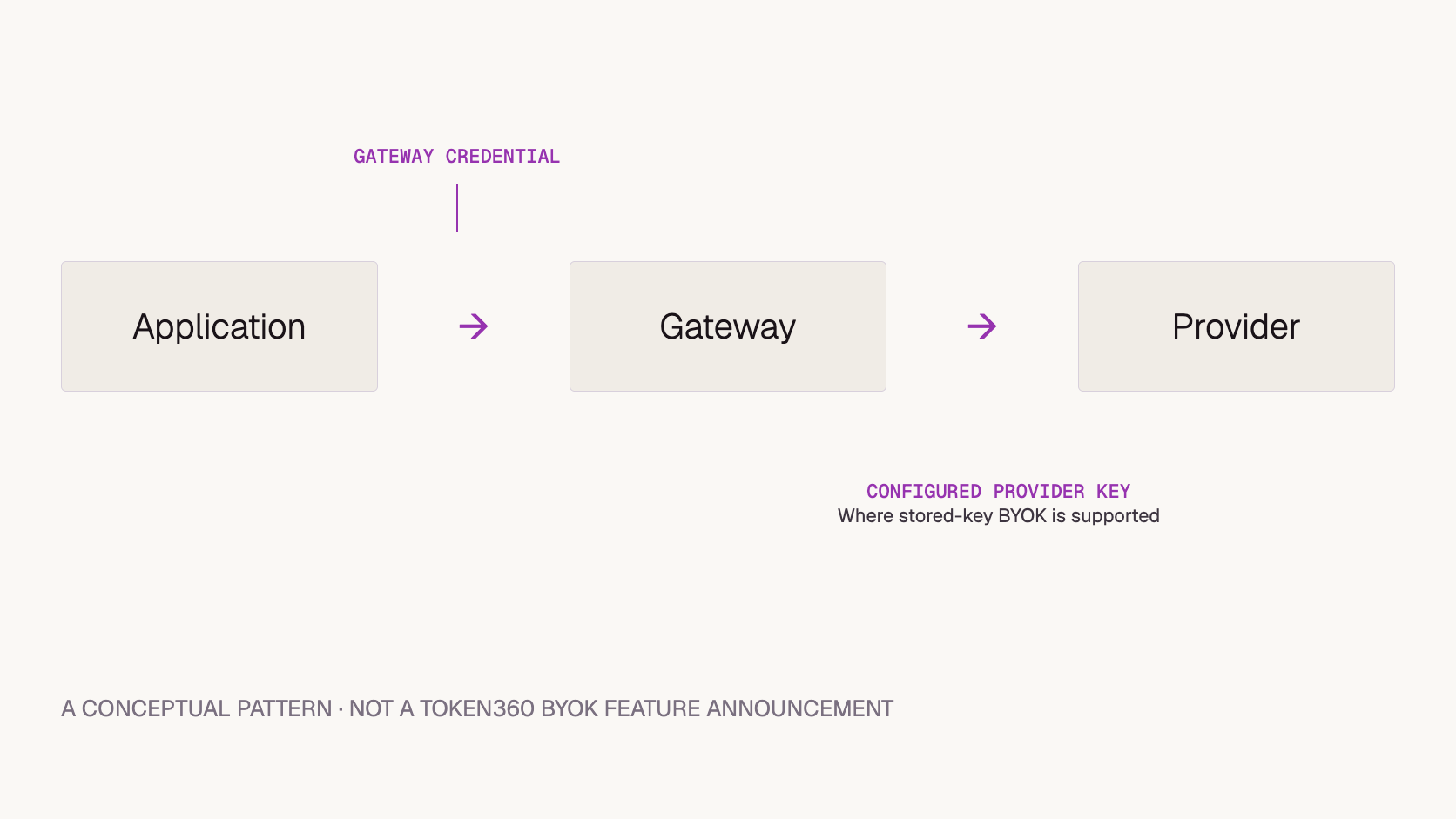
BYOK does not automatically replace the API key your application uses to authenticate to an AI gateway. In a stored-provider-key setup, the gateway credential identifies your application to the gateway, while the provider credential authorizes the gateway’s upstream request. Follow the specific service’s instructions for both connections.
This is a credential-placement guide based on official documentation and a reusable configuration worksheet. It is not a Token360 BYOK launch announcement, a security assessment or a live authentication test. The diagrams and examples describe roles; they contain no real credentials.
Read first: Token360’s authentication guide documents the credential accepted by the Token360 API. Match the destination and its authentication contract before copying an SDK example.
What does BYOK mean in an AI gateway?
In this context, BYOK means supplying your own inference-provider credentials to a service that can use them for upstream model requests. It describes how that upstream connection is authorized. It does not, by itself, specify how the application authenticates to the gateway or where a credential must be placed.
OpenRouter’s BYOK documentation describes adding provider keys through its workspace settings and using the associated provider account for access and limits. Its separate API authentication documentation describes authenticating calls to OpenRouter. Those are different configuration responsibilities.
The term can also appear in other contexts, including encryption-key management. In this article it refers only to inference-provider API credentials. Confirm that meaning when a vendor or internal team says “we support BYOK”; otherwise, two people may be discussing different systems.
Credential role
Connection it authorizes
Configuration question
Gateway API credential
Application → gateway
Which gateway account, workspace and permissions does this request use?
Provider credential in a stored-key BYOK setup
Gateway → inference provider
Which provider account and deployment can the gateway access?
Direct provider API credential
Application → provider, without that gateway
Is the application intentionally calling the provider’s own endpoint?
The second and third roles may involve credentials from the same provider, but the storage location and caller differ. Treat them as separate configuration entries rather than assuming that a single generic API_KEY variable tells the whole story.
Which key belongs in the Authorization header?
Use the credential required by the host and endpoint receiving the request. In a gateway API-key flow, that is normally the gateway credential. Provider keys belong in the gateway’s documented BYOK mechanism when one exists. Some gateways support other arrangements, so a familiar header name alone is not enough evidence.
For example, Vercel’s authentication and BYOK guide separately documents gateway authentication and team-level provider credentials. Its compatible-client example sets the gateway URL and gateway API key together. This is a documented example of the two-role arrangement, not a universal header specification for every gateway.
Before sending a request, record three non-secret facts: the resolved destination host, the endpoint path and the secret reference selected by the application. “OpenAI-compatible” describes an interface, not which organization issued the credential. A model name likewise does not identify the key required by the service receiving the request.
A stored-provider-key BYOK pattern. This conceptual route map does not assert that Token360 exposes this configuration.
What should a Token360 application configure?
For the documented Token360 API flow, use a Token360-issued API key with the Token360 API destination. Keep the credential source explicit in application configuration. Do not substitute a key issued by a model publisher merely because the request selects that publisher’s model or uses a compatible request format.
As checked on November 6, 2026, Token360’s documentation specifies an Authorization: Bearer header and key creation in its console. The following configuration sketch illustrates that pairing; it does not submit a request:
# Illustrative configuration; no secret values included
API_BASE_URL=https://api.token360.ai/v1
API_KEY_SECRET_REF=production/token360/inference
MODEL_ID=<public model ID verified in the Token360 catalog>
API_KEY_SECRET_REF is a proposed application setting naming a secret-manager entry. It is not a Token360 parameter, an SDK environment variable or the secret itself. Your deployment code must resolve it through your own approved mechanism.
The reviewed Token360 authentication material does not establish a customer-facing BYOK setup. If a project requires customer-owned upstream accounts, confirm supported providers, setup procedures and responsibility boundaries with Token360 before designing around that requirement. The absence of a setup description here should not be converted into an unsupported claim that the capability is either available or impossible.
How do you diagnose a rejected key without exposing it?
Begin with configuration provenance, not with the secret’s characters. Verify who issued the key, which host receives it, which workspace owns it and which deployment version loaded it. Then inspect the sanitized error response. Changing random keys obscures the boundary that failed and can redirect requests to an unintended account.
Observation
First check
Avoid concluding
Authentication fails immediately
Destination, required header and credential issuer.
The selected model is unavailable.
Gateway accepts the call but reports a provider credential problem
Documented upstream credential configuration and permissions.
The application’s gateway key must be replaced.
Local execution works, deployed execution fails
Secret reference, environment and deployment version.
The same secret was loaded in both places.
Request succeeds but account attribution is unexpected
Actual route and applicable fallback policy.
The intended BYOK account necessarily served the request.
These are investigation paths, not a decoder for every service’s HTTP status codes. Keep the actual error code and request correlation ID. A status alone may not identify whether rejection occurred at the gateway boundary or upstream.
A useful internal report says “deployment release R-12 resolved secret reference production/router/inference for host example.invalid.” It does not paste the key. Use console metadata or your secret manager to establish ownership; do not classify keys solely by their prefix or length.
Can fallback change which account serves the request?
Yes, where the gateway supports fallback between customer credentials and shared capacity, the eventual request may use a different account path from the one first attempted. The exact behavior is service-specific. A successful response proves that some permitted route completed the request, not that a particular credential was used.
OpenRouter’s BYOK guide documents shared-capacity fallback controls and explains that shared capacity consumes OpenRouter credits. Review provider restrictions as well as the individual key’s setting when account selection matters. This behavior must not be assumed for Token360 or any other gateway.
For an enterprise integration, write the intended rule in plain language: “This workflow must use the approved provider account,” or “Shared capacity is allowed when the preferred account cannot serve the request.” Have the platform owner map that rule to supported controls and verify the resulting attribution.
Do not treat a provider key as evidence of reserved capacity, a particular retention policy or an agreed commercial rate. Those properties need separate confirmation for the actual account, deployment and request path. This article does not compare BYOK prices or promise cost savings.
What belongs in a credential handoff worksheet?
A useful handoff names the key’s role, issuer, allowed destination, secret reference and accountable owner without including its value. For BYOK integrations, add the upstream account and fallback policy. The worksheet should let a second engineer explain the request path before they attempt a production configuration change.
The following example is constructed for this article. It is not an export from a customer environment. Copy the
Copy credential-map-template.csv:
field,example_or_instruction
record_type,Illustrative template - no live credentials
application_connection,Production inference service to Token360 API
credential_issuer,Token360
credential_role,Application-to-platform inference credential
destination,Verify API host and endpoint
secret_reference,production/token360/inference (illustrative reference only)
secret_value,DO NOT STORE HERE
owner,Fill from verified records
workspace,Fill from console
upstream_customer_credential,Not assumed - confirm requirement and support
fallback_policy,Document approved behavior
attribution_check,Document where actual route or usage is verified
deployment_version,Fill from deployment record
and replace the illustrative entries with verified non-secret metadata.
Verified API host and endpoint, not a model publisher’s name.
Secret reference
production/token360/inference — illustrative, no value stored here.
Owner and workspace
Fill from the actual console and deployment records.
Upstream customer credential
Not assumed; confirm whether the integration requires and supports it.
Fallback and attribution
Document the approved policy and where actual usage can be checked.
Use the worksheet during deployment review, not as a second secret store. When the base URL changes, recheck credential issuer and request contract together. When a secret reference changes, verify that the new entry still belongs to the intended account and environment.
Does an OpenAI-compatible SDK require an OpenAI-issued key?
Not necessarily. Follow the authentication requirements of the destination configured in that client. A compatible interface does not make credentials issued by different services interchangeable.
Can a gateway key be used directly with the provider?
Do not assume so. A gateway credential identifies an account to that gateway. A direct provider request needs the provider’s documented authentication mechanism and an appropriately authorized credential.
Does BYOK mean the gateway never sees request content?
No. Credential ownership alone does not establish the data path or retention behavior. Review the actual architecture and applicable data-handling documentation separately.
Read next: use Token360’s authentication instructions to verify the application-facing configuration, then use key and workspace controls to confirm its intended scope. Keep provider-specific BYOK procedures separate when that arrangement is explicitly supported.
Developer Guide
API
Build faster with one AI API.
Use Token360 to call video, image, audio, and text models with one key and one bill.


 Prompt Library
 Guides
 Guides