Enterprise Video API Pricing: What Is Actually Included?
Compare enterprise video API quotes by access, credit eligibility, usage rates and commitments, with a reproducible cost worksheet and vendor examples.
By Yuki Yu
Compare enterprise video API quotes by entitlement, credit eligibility, usage rates and minimum commitment—not by the word “included.” API access can be available while generation remains metered. A shared credit balance can cover several products while a discount applies to only some of them. The useful comparison is what your planned workload will cost under the specific agreement.
Read first: Use the video API pricing guide to understand model billing units. This article focuses on enterprise quote structure, rather than ranking models by public price.
What does “API included” need to specify?
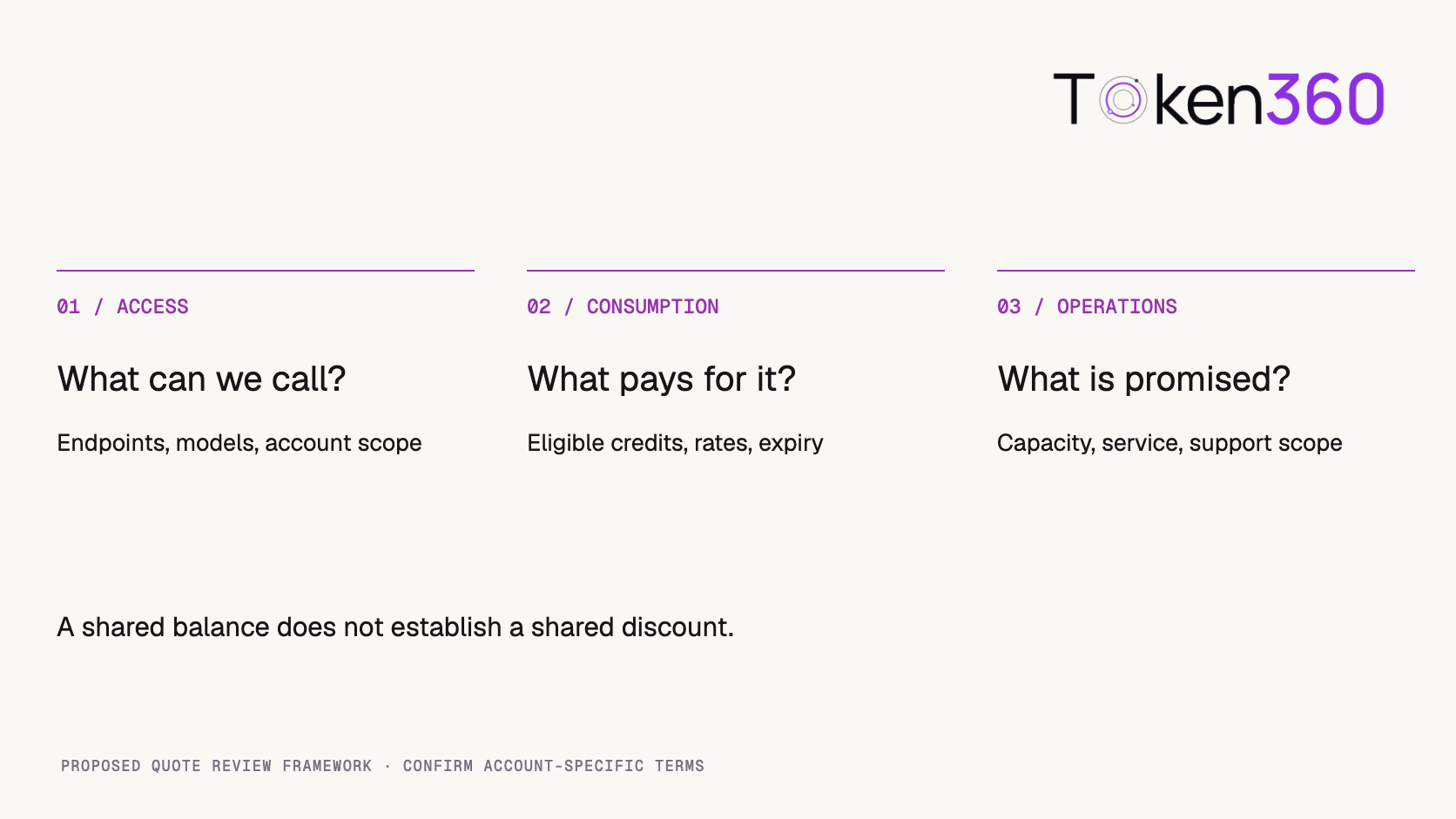
It needs to identify the actual entitlement and the costs that remain. Ask for a written breakdown before treating an enterprise package as prepaid production capacity.
Quote component
Question to resolve
Evidence to request
API access
Which endpoints and models can this account call?
Enabled model list and account scope
Credits
Which balances can pay for those calls?
Credit eligibility and expiration schedule
Usage rates
Which exact meter and discount apply?
SKU rate card and effective date
Capacity
What workload can run concurrently?
Documented limits and capacity terms
Service
Which support or onboarding is covered?
Service scope, response target and exclusions
A seat for a creative user, a service credential for an application and a balance for inference answer different purchasing questions. Do not combine them into one “price per user” when the production application generates most of the usage. Conversely, do not assume a consumption quote covers the people who need access to the creative interface.
Can shared credits still have different API discounts?
Yes. Credit portability and price eligibility are independent. Public vendor pages provide useful examples, but they do not replace an account-specific offer.
The fal Agent plan page says credits can be used across fal, including the API. Its accompanying terms distinguish discounts on eligible Agent, UI, Sandbox, Playground and CLI usage from API usage at standard rates. It also offers custom enterprise credit pricing. The procurement lesson is to ask which rate applies to your actual API workload, rather than extending an interface discount to every endpoint.
Runway's September 18, 2026 unified-pricing announcement describes shared credit commitments across its web app and Runway Dev, with enterprise administration features. However, the API FAQ still describes separate web-app and API credits when checked for this article. These pages present conflicting guidance; do not assume either statement applies universally to every account. Request confirmation of migration status, eligible balances and the applicable agreement.
Source check: November 3, 2026. These observations concern published plan wording, not a test of either vendor's billing system or a claim about negotiated prices.
Which workload should you put into the quote request?
Specify the output configuration and expected billable workload, including revisions. “Ten thousand videos” leaves too many variables unresolved to compare offers.
Describe model or permitted model family, output duration, resolution, audio requirements and expected monthly range. Separate planned production from experimentation. Include the busiest submission window, since a monthly volume forecast does not describe a deadline-driven batch. The video concurrency planning article covers that operational dimension.
Ask how failed, cancelled or retried jobs are charged and when settlement becomes final. Record the answer per service, rather than assuming that every unsuccessful creative result is a technically failed request. A completed clip that misses the brief may still have consumed billable generation.
Keep the acceptance brief stable across quotes. A cheaper configuration with a different resolution, duration or allowed use is a different purchase. Compare it separately instead of silently mixing it into the same unit-cost column.
When can a discounted commitment cost more?
A commitment can cost more when actual usage is too low to absorb its minimum payment. The following original worksheet demonstrates that arithmetic; all prices are invented assumptions, not vendor offers or measured production costs.
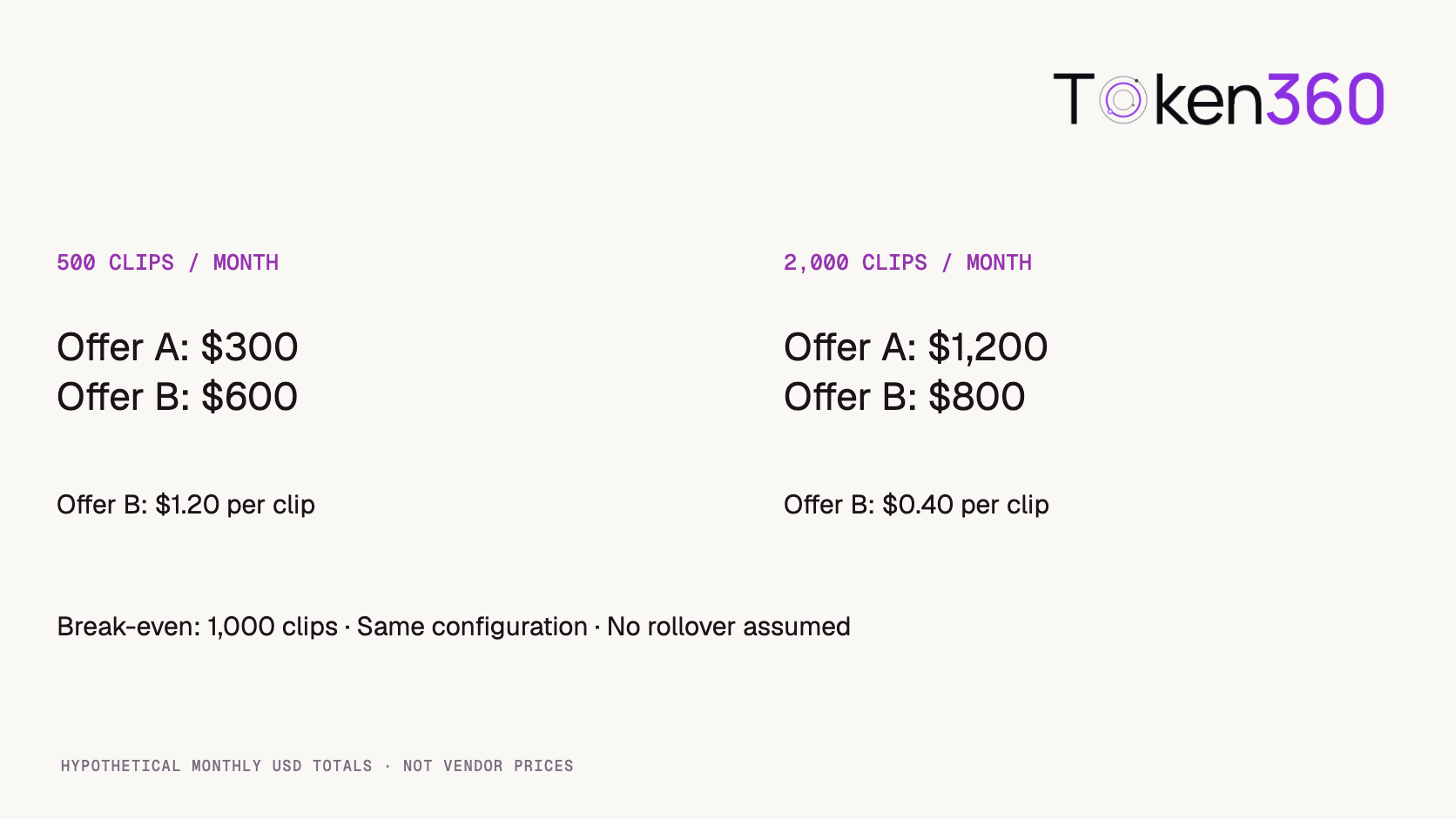
Assume a one-month comparison in USD. Offer A has no fixed fee and charges $0.60 per identical billable clip. Offer B requires $600 for that month, includes 1,500 such clips and charges $0.40 for each additional clip. Included capacity cannot roll over in this example. Both offers deliver the same configuration; taxes, support extras, storage, delivery and quality differences are excluded.
Billable clips
Offer A total
Offer B total
B effective cost / clip
500
$300
$600
$1.20
1,000
$600
$600
$0.60
1,500
$900
$600
$0.40
2,000
$1,200
$800
$0.40
The included-capacity rate looks like $0.40, but at 500 clips only one-third of the allowance is used, and effective cost is $1.20. The offers break even at 1,000 clips under these assumptions. Above that level, B is cheaper in this simplified model. At zero usage, B still costs $600 and cost per clip is undefined.
A = 0.60 × billable_clips
B = 600 + 0.40 × max(billable_clips − 1500, 0)
effective_cost = total / billable_clips  # only when clips > 0
Example image fixtures: . Run python3 calculate.py locally; no API key or external package is required.
Copy calculate.py:
"""Hypothetical monthly USD quote scenarios, not vendor prices."""
import csv
from decimal import Decimal as D
from pathlib import Path
rows=[]
for clips in [0,500,1000,1500,2000]:
 a=D('0.60')*clips;b=D('600')+D('0.40')*max(clips-1500,0)
 rows.append({'billable_clips':clips,'offer_a_usd':str(a),'offer_b_usd':str(b),'b_effective_usd_per_clip':str(b/clips) if clips else 'undefined'})
with (Path(__file__).parent/'scenarios.csv').open('w',newline='') as f:
 w=csv.DictWriter(f,fieldnames=rows[0].keys());w.writeheader();w.writerows(rows)
print(rows)
Original scenario calculation, not a price comparison between named providers.
Rollover, transferable balances or an annual pooling period would change the analysis. So would different retry behavior. Replace the assumptions with the written offer and your workload range before using the worksheet for a decision.
What belongs in a comparable enterprise quote?
A useful quote separates access, consumption, commitment and service charges. Ask each vendor to fill the same fields, leaving unknowns explicit.
Scope: account, workspace, endpoints, model IDs and permitted environments.
Meter: duration, resolution, input charges and any minimum charge per request.
Commitment: payment period, included value, expiry, rollover and transfer rules.
Overage: rate after allowance, required authorization and behavior at a spending limit.
Operations: concurrency, support coverage, onboarding charges and production-readiness requirements.
Reconciliation: usage export, request identifiers, invoice timing and treatment of adjustments.
Keep technical support targets separate from performance guarantees. An answer within a stated support window does not itself promise a generation completion time. Similarly, a wallet balance is funding, not a reservation of concurrent processing capacity.
Use separate fields so an attractive headline cannot hide an unresolved cost.
How should a Token360 quote be verified?
Match the selected route’s pricing meter to the enterprise quote. Company-confirmed November 4, 2026: Token360 can negotiate model/token unit prices by volume, potentially below the relevant provider list price, subject to a specific quote. Record the model/version, volume tier, commitment period, overage rate and whether a capacity charge is separate. Reconcile an approved test before treating the quote as an effective delivered-video cost.
Token360’s billing documentation separates estimates, recorded charges, key budgets and account funding. Keep those distinctions in the invoice review. A negotiated enterprise rate is not a promise of one discount for every model or automatic sharing of subscription credits; the contract must identify the applicable workloads and allowances. Token360's billing documentation.
For a pilot, retain the model ID, configuration, request ID, completion status and settled charge. Ask the account team to explain any difference between the quote and observed billing before increasing volume. The request-level billing reconciliation guide explains the evidence to keep.
A filled quote worksheet exposes the unanswered terms
Use the hypothetical Offer B above to see what a comparable quote still needs. Its arithmetic specifies a $600 monthly commitment for up to 1,500 clips, but arithmetic alone does not define a purchasable production service. The following is an authored procurement example, not a Token360 offer.
Field
Example entry
Commitment
$600 per month; the worksheet assumes unused value expires
Included workload
1,500 clips; exact model, duration, resolution and audio still must be named
Overage
Unspecified: do not extend the worksheet beyond its included volume
Capacity
Unspecified: no concurrent-job reservation follows from the allowance
Settlement
Specify currency, invoice period and treatment of adjustments
Approval
Buyer accepts only after missing fields are resolved in writing
Unknown terms are decision inputs, not empty cells to fill optimistically. At 500 clips, the worksheet’s $1.20 effective cost remains valid only for its defined cost boundary. A capacity fee or non-equivalent output configuration would change the comparison. Save the final quote version with the calculation so a later rate change does not silently rewrite the original buying decision.
Frequently asked questions
Does enterprise API access mean free generation?
No. Access may be included while requests remain metered. Confirm included consumption and the rate for additional usage.
Do credits usable through the API automatically receive a discount?
No. The balance may be eligible for API charges while a plan discount applies only to another product surface. Ask for the API-specific rate.
Is the lowest quoted unit rate always the cheapest offer?
No. Minimum commitments, unused allowances and additional fees can outweigh a lower nominal rate. Compare totals at low, expected and high usage.
Are the worksheet prices actual Token360 prices?
No. They are hypothetical inputs for a reproducible arithmetic example. Use live route pricing and the applicable written offer for procurement.
Can a billing balance prove that concurrency is reserved?
No. Funding and processing capacity are different. Verify concurrency and any capacity commitment separately.
What should we do when vendor pages disagree?
Preserve the URLs and check date, then ask the vendor which terms apply to the account. Resolve the discrepancy before treating a feature or credit rule as included.
Commercial scope reviewed November 4, 2026. Token360 pricing and engagement scope are company-confirmed; individual discounts, capacity commitments and compliance evidence require a written proposal. fal pricing and enterprise scope. Token360 enterprise page. Historical test charges remain dated observations, not current universal quotes.
Editorial revision: November 4, 2026. Test dates and dated source snapshots remain as stated in the article.
Video
API
Enterprise Pricing
Cost Management
Build faster with one AI API.
Use Token360 to call video, image, audio, and text models with one key and one bill.



 Comparison
 Guides
 Guides