Separate API minimum spend from top-ups and credit limits. Check eligible usage, billing periods and low-demand exposure before committing.
ENTERPRISE AI · SPEND COMMITMENTS
There is no universal minimum spend for enterprise AI API access. A pay-as-you-go account, a negotiated usage commitment and reserved capacity are different purchases. Ask whether the proposal contains a billing floor, which usage counts toward it, when it starts and what happens if your actual demand is lower.
A company can need enterprise procurement without having predictable consumption. It may require an invoice, a contract review or approved data terms before a new application has launched. Those needs do not tell you whether the supplier requires a spending commitment. The proposal must answer that question directly.
Scope: This is a commercial comparison guide, not a statement of standard Token360 minimums or contract terms. Public sources were checked November 17, 2026. The numerical example below is fictional and is not a supplier quote.
Which kinds of minimums can appear in an API proposal?
Separate a minimum payment transaction from a minimum ongoing bill, a usage threshold for a discount and a reserved-capacity charge. They may all involve a number, but they create different obligations. Ask the supplier to name the mechanism and show how it appears on an invoice at low usage.
Term
Question to resolve
What it does not establish
Minimum credit purchase
What is the smallest permitted top-up?
A recurring monthly spending obligation
Minimum spend commitment
What amount is owed over the stated period?
That unused value automatically carries forward
Discount eligibility threshold
Does a rate depend on actual or promised usage?
That falling short has no financial consequence
Reserved-capacity charge
What resource or availability is being purchased?
That every model usage charge is included
Credit or account limit
What is the maximum permitted exposure or spend?
A minimum that the buyer must consume
“Enterprise minimum” is too vague to compare. Request the actual payment rule, period, eligible usage and treatment of shortfalls. If these details are absent, a quoted unit price alone is not enough to assess the offer.
Does an enterprise customer always need a committed plan?
No. Company size and procurement requirements do not automatically determine the billing model. Some offerings permit usage-based access without an ongoing minimum, while negotiated arrangements may add commitments. Compare the exact plan and agreement, not the word “enterprise” or an assumption based on another customer's purchase.
As of November 17, 2026, OpenRouter's public pricing FAQ states that its Standard and Business plans have no minimum spend. That is a plan-specific statement. It should not be extrapolated into a promise about every individually negotiated agreement or a different supplier.
For Token360, ask for a proposal that explicitly states whether a minimum applies. Its enterprise positioning and ability to discuss commercial terms do not establish either a universal minimum or a universal exemption. An answer such as “custom pricing available” leaves the question unresolved.
Why might a supplier request a minimum commitment?
A proposal may exchange a defined spending commitment for commercial or operational concessions. The important question is what your company receives in return, and whether that benefit is written down. A commitment should be evaluated against a comparable flexible option, including the possibility that demand arrives later or in a different model mix.
Ask the supplier to identify the consideration: a particular rate, an agreed capacity arrangement, or another specified deliverable. Do not infer dedicated capacity from spend alone. The dedicated capacity versus higher rate limits guide covers that separate distinction.
If the only visible benefit is a discount, use the existing API volume discount comparison to inspect which rate changes. This article addresses the earlier buying question: are you accepting a payment floor, and is your workload predictable enough for it?
How can a low-usage month change the decision?
Compare total payable amounts at conservative, expected and higher demand, not only the unit rate at full utilization. A commitment can cost more than flexible access when eligible usage falls below its floor. The outcome depends on the exact charging mechanism; do not assume every agreement uses the same minimum-bill formula.
Consider a fictional monthly minimum-bill arrangement: the invoice is the greater of eligible usage charges or a $1,000 floor. Excess usage is charged at the same quoted rates. There is no rollover, refund, additional capacity fee or tax in this simplified example.
Usage at the quoted rates
Payable under this example
Amount above usage charges
$400
$1,000
$600
$800
$1,000
$200
$1,200
$1,200
$0
The calculation is simply max(eligible usage charges, monthly floor). It illustrates this one hypothetical mechanism, not Token360 billing. A prepaid drawdown, annual true-up or capacity reservation could behave differently. Ask for an invoice illustration based on the supplier's actual rule.
Also compare the flexible alternative's rates. The table alone cannot prove whether the committed offer saves money: it contains only one offer. Use the same workload quantities for both proposals and include any charges that sit outside the commitment.
Which details should be clear before agreeing?
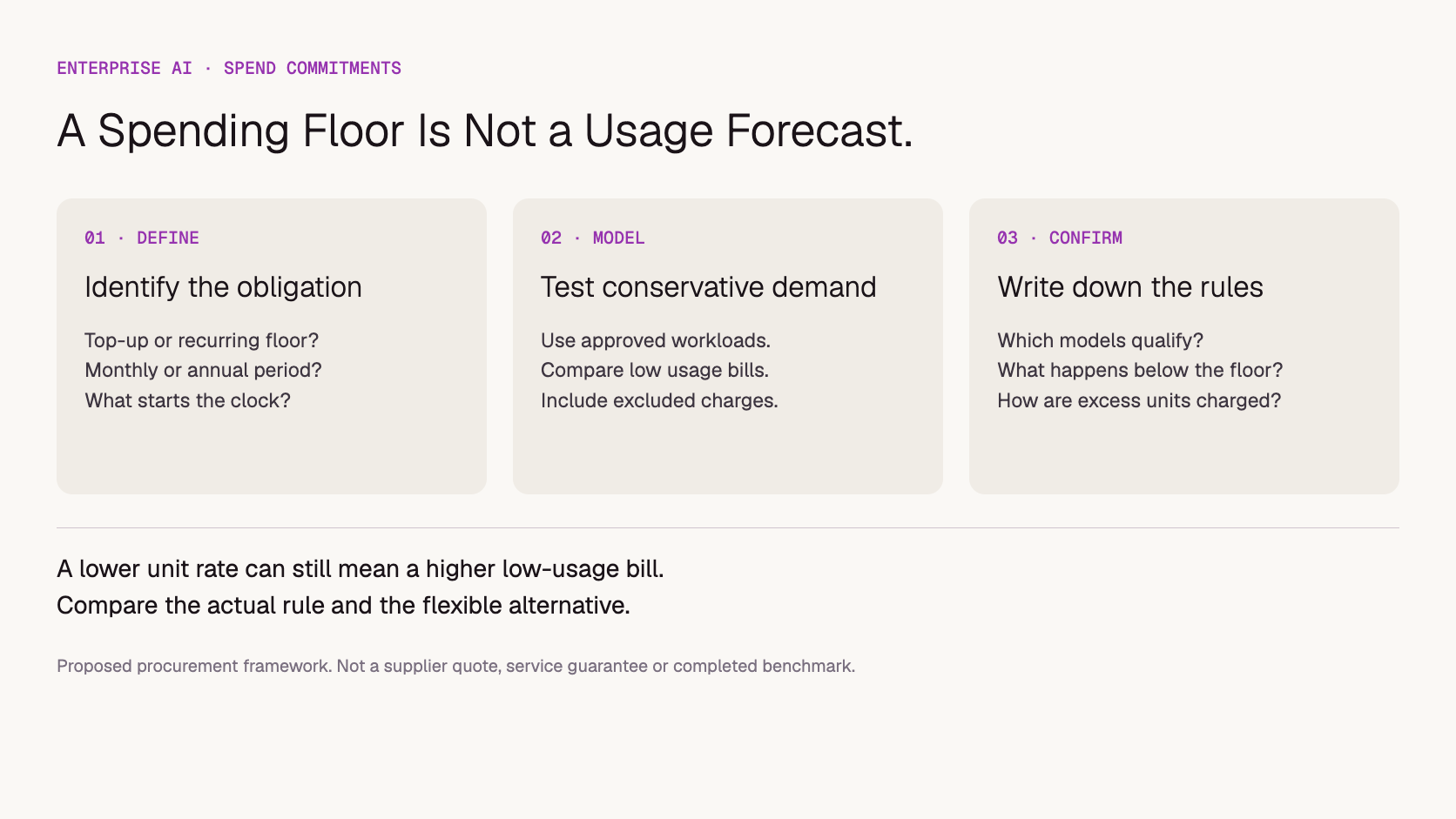
Confirm the period, start trigger, eligible usage, shortfall treatment and excess-use rate. Check whether different models or entities can share the commitment and whether a delayed launch changes the obligation. These details determine financial exposure more directly than a headline discount percentage or an optimistic annual consumption forecast.
Question
Why it matters
When does the period start?
Signature, account activation and production launch may be different dates
Which usage qualifies?
Excluded models, projects or entities may create separate charges
Is the minimum monthly or annual?
Seasonal demand may fit one period differently from another
How is a shortfall handled?
Billing, credit expiry and carry-forward should not be guessed
What happens above the floor?
The overage rate or capacity limit may change the comparison
Can the commitment be adjusted?
Launch delays and model changes need an agreed response
A proposed purchase review, not a representation of a particular supplier's contract.
What if your usage is uncertain or your launch is delayed?
Use a conservative forecast and ask for alternatives that match the uncertainty. A flexible evaluation, a smaller initial scope or a staged commitment may be worth discussing. These are negotiation options, not guaranteed entitlements. Do not treat an unapproved roadmap or several teams' informal interest as committed demand.
Separate usage already operating from planned launches. Identify which owner can authorize each workload, when it could start and which models it will use. A large total forecast can be misleading if much of it depends on projects that have not passed approval.
For a delayed launch, ask which date starts billing and whether any adjustment requires advance notice or a new agreement. Resolve that before the start date. “We have not used it yet” is not evidence that no payment obligation exists under the agreed arrangement.
What should you ask Token360 to quote?
Request an explicit comparison between the available flexible and committed arrangements for your workload. State your conservative demand, expected demand, model mix and launch uncertainty. Ask the quote to identify any spending floor and its treatment, rather than assuming that negotiated pricing necessarily requires a minimum.
Token360 focuses on enterprise access across text, image, audio and video models. Its enterprise offering includes a route to discuss custom pricing. The minimum, if any, must be confirmed for the engagement.
A useful request is: “Please show whether this proposal has a minimum spend, when it begins, what usage qualifies, and what we owe if actual usage is below forecast.” Add a low-demand example so both sides are discussing the same scenario.
Frequently asked questions
Is a minimum top-up the same as a minimum monthly spend?
No. A top-up minimum is a transaction condition. A monthly minimum creates an obligation over a period. Ask which one the proposal contains.
Does a spend limit mean we must spend that amount?
No. A limit generally describes a ceiling or control. Confirm how it is enforced, but do not confuse it with a purchasing floor.
Does a minimum commitment reserve capacity?
Not unless the agreement specifies that arrangement. Payment commitments and capacity guarantees must be checked separately.
Can unused value always be carried into the next period?
No automatic right should be assumed. The proposal must state the applicable rollover, expiry, adjustment or shortfall treatment.
Enterprise AI
API
Bring your next idea to life.
Create a video scene in Creator, or explore models for images, audio, and text to find the right capabilities for your project.


 Guides
 Guides
 Guides