AI API Volume Discounts: What Actually Gets Cheaper?
Compare AI API volume discounts by model rates, platform fees and commitments. Use worked examples and a quote worksheet to assess actual savings.
ENTERPRISE PROCUREMENT · BLOG 148
By Token360 · Editorial review: November 5, 2026
An AI API volume discount can reduce model usage rates, platform fees or another part of the commercial package. The percentage alone does not tell you how much you save. Identify the discounted charge, eligible workloads and required commitment, then compare total spend for the same usage scenario.
A substantial discount on a small fee may save less than a modest reduction in the underlying inference rate. A lower unit price can also come with a minimum spend that your team does not use. Neither arrangement is automatically better: the useful question is what changes on your bill under the proposed conditions.
This article compares discount mechanics, not suppliers’ overall value. Its numerical examples are hypothetical and are not quotes from Token360, fal or OpenRouter. They deliberately keep workload and service scope constant to make the arithmetic inspectable.
Read first: check the model’s supported settings and billing meter. A discount comparison cannot be reliable if the two quotes price different models, resolutions or output lengths.
Which part of an AI API quote is discounted?
Start by identifying the charge that changes. A model-rate discount reduces the price applied to eligible inference units. A platform-fee discount reduces a separate fee, which may be charged on credit purchases or another defined base. A credit bonus or minimum-spend arrangement has different economics and should be calculated separately.
Offer
What changes
What to verify
Model unit-rate discount
Price per eligible token, image, second or other billed unit.
Models, input/output rates, settings and baseline date.
Platform-fee discount
A separate fee or its percentage.
The fee base, billing event and excluded charges.
Bonus credits
Purchasing power added to a payment.
Expiry, model eligibility, spend order and refunds.
Committed-spend rate
A rate tied to a spending obligation.
Minimum, period, unused value, overages and renewal.
Capacity/package discount
A reserved-service or bundled charge.
What usage is included and which costs remain separate.
Ask the supplier to show the baseline, the new rate and the exact discount base together. “Twenty percent off” is incomplete if it does not say whether it applies to inference, fees, selected models or a fixed service package.
Also distinguish a percentage reduction from a percentage-point reduction. Moving a fee from 5% to 3% reduces that fee rate by two percentage points, or 40% relative to its original rate. It does not reduce the whole bill by 40%.
What do official provider FAQs actually say?
Official FAQs show that enterprise discounts can operate on different components and have eligibility limits. Read the current pricing page alongside the proposed contract. Do not infer that a supplier has no enterprise offer because it preserves model list prices, or that every model receives a discount because custom pricing is available.
As checked on November 5, 2026, OpenRouter’s pricing FAQ says enterprise customers can receive discounted OpenRouter fees, while inference itself is not discounted by OpenRouter. It describes fees on credit purchases separately from model usage. BYOK is another arrangement: the upstream provider bills inference directly, so its negotiated rates must be distinguished from router charges.
The fal Model APIs FAQ explicitly offers discussions of custom pricing based on expected volume. It also gives different discount rules for Partner API models and certain subscription access channels. A UI subscription benefit therefore should not be assumed to apply to direct API use.
These statements explain questions to ask, not which supplier will be cheapest for your application. A fair comparison still needs the same model configuration, traffic requirements and service scope, along with the actual offer available to your company.
How much does a platform-fee discount save?
A discount on a fee saves money only on that fee’s base; it does not automatically reduce underlying inference charges. Calculate the original and discounted totals explicitly. The worked example below assumes a fee added to usage value for illustration. Real credit-purchase or contract mechanics may use a different base or timing.
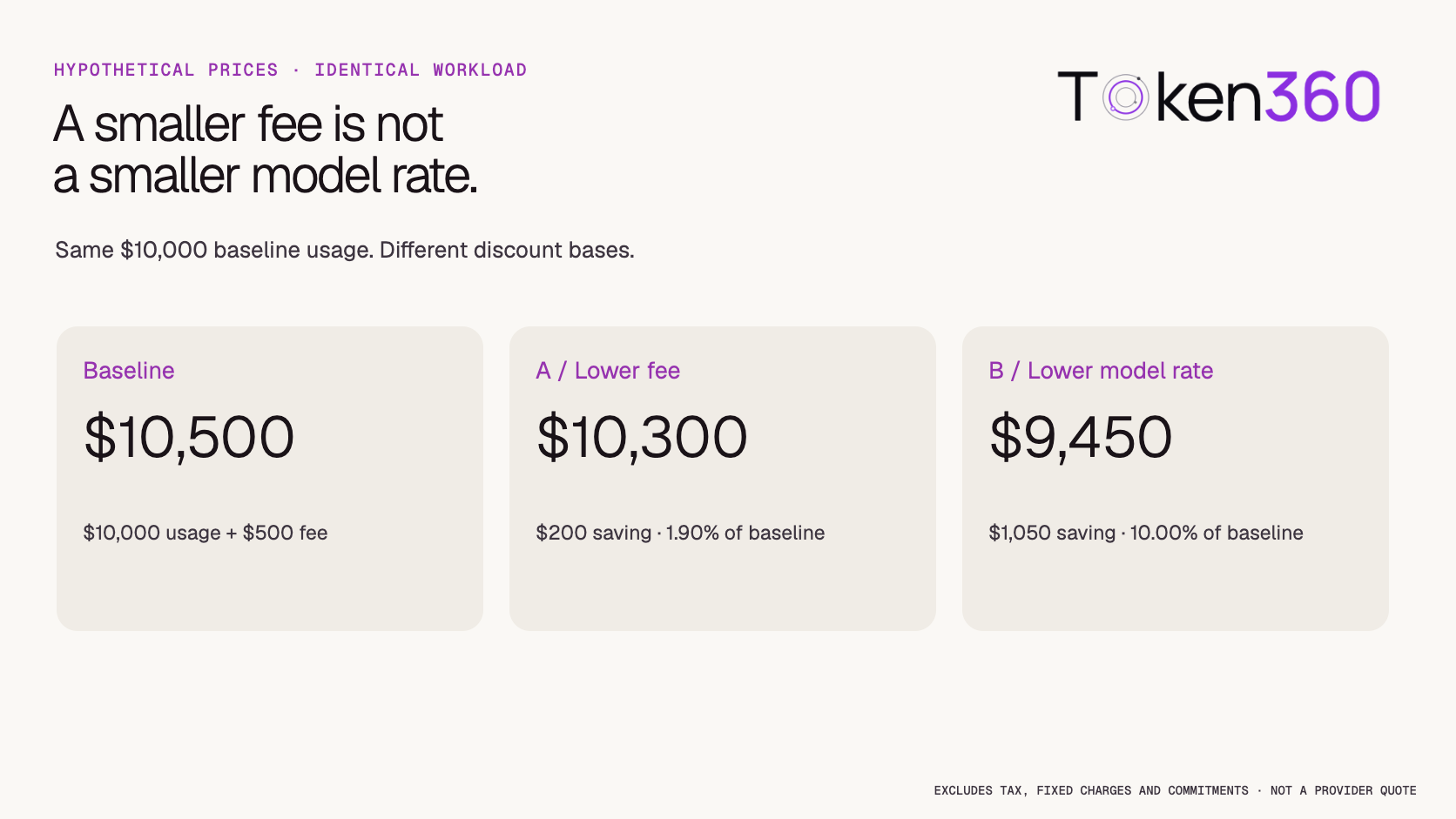
Hypothetical assumptions: one month of identical inference costs $10,000 before a separate 5% fee. There are no taxes, fixed charges, minimums or unused credits. Offer A lowers the fee to 3%. Offer B instead lowers inference rates by 10%, retaining a 5% fee on the discounted usage amount. Neither is a real provider offer.
Scenario
Inference
Fee
Total
Saving vs baseline
Baseline
$10,000
5% × $10,000 = $500
$10,500
—
A: lower fee
$10,000
3% × $10,000 = $300
$10,300
$200 / 1.90%
B: lower model rate
$9,000
5% × $9,000 = $450
$9,450
$1,050 / 10.00%
Illustrative arithmetic only. All scenarios use the same workload, and the fee base is explicitly defined in the text.
Offer A cuts the fee rate by 40%, but reduces the total bill by approximately 1.90%. Offer B reduces the whole illustrative bill by 10% because both the usage charge and the percentage fee calculated on it fall. Different fee bases would produce different results.
The example is not evidence that model-rate discounts always beat fee discounts. Their size, eligible spend and conditions determine the outcome. It shows why comparing two advertised percentages without their denominators is misleading.
How does a mixed-model workload change the saving?
Calculate savings across eligible spend rather than averaging model discount percentages. A large reduction on a rarely used model may have little effect on your total. Keep excluded models and separately priced operations in the forecast, and show how the result changes if your production model mix shifts.
Suppose a second hypothetical workload has $10,000 of baseline inference spend, of which $3,000 is eligible for a 20% reduction. The remaining $7,000 is unchanged. The inference saving is $600, or 6% of the total baseline inference spend—not 20%. This example excludes fees and commitments to isolate eligibility.
For text, check input and output rates separately, plus any applicable cached or reasoning usage categories. For media, preserve duration, resolution, audio and output-count settings. Do not compare a discounted low-resolution output with a full-price high-resolution output and describe the difference as a pure commercial saving.
For tiered offers, ask whether crossing a threshold changes the rate for all eligible usage or only for usage above the threshold. Also ask whether spend is aggregated across models, workspaces and modalities. The written rule determines the calculation; the phrase “volume tier” does not.
Can a minimum commitment erase a unit-price discount?
Yes, if the amount you are obligated to pay exceeds the value you actually consume under the discounted rate. Compare low, base and high usage cases over the commitment period. A monthly minimum, an expiring prepaid balance and an annual commitment are different arrangements; apply the rule that is actually offered.
Consider a separate hypothetical monthly offer: 10% off usage rates, with a $9,000 monthly minimum, no rollover and no extra fee. If actual usage would have cost $6,000 at the baseline rate, discounted usage is $5,400, but the assumed minimum still makes the payment $9,000. In that month it costs $3,000 more than the $6,000 pay-as-you-go alternative.
If actual baseline usage is $10,000, discounted usage reaches $9,000 and fully uses the assumed minimum. Both examples use the same contract rule; utilization changes the outcome. They do not model taxes, financing or any additional service value.
A prepaid balance that remains usable in future months should not automatically be treated as wasted spend in its purchase month. Track cash paid, value consumed and remaining usable credit separately. Only then can you assess expiry or commitment risk without confusing payment timing with consumption cost.
What should a comparable quote record contain?
Record the workload, baseline date, eligible rates, fee base, commitment and exclusions for each offer. Then evaluate identical usage scenarios across the offers. Keep contractual service differences visible instead of forcing unequal packages into a single “cheapest” ranking. A blank field should remain an open question, not become an assumed zero charge.
Copy the worksheet below into a local CSV file. Blank fields are for your own review:
Field,Offer A,Offer B,Reviewer notes
Quote date and validity,,,
Currency and tax treatment,,,
Models / versions / settings,,,
Usage window and low/base/high scenarios,,,
Baseline rate and date,,,
Discounted rate and units,,,
Eligible and excluded models,,,
Input / output / cached / reasoning rates,,,
Fee rate and fee base,,,
Fee billing event,,,
Tier threshold and marginal/retroactive rule,,,
Minimum spend and period,,,
Credit expiry and rollover,,,
Overage treatment,,,
Unused balance treatment,,,
Capacity/support scope and charges,,,
Low-scenario total,,,
Base-scenario total,,,
High-scenario total,,,
Open questions and evidence,,,
. It contains fields for two offers and reviewer notes. It is a blank procurement worksheet, not an automated pricing calculator or a supplier rate card.
Fix the comparison scope. Use the same models, settings, time window, currency and workload assumptions.
Identify the discount base. Record list rate, negotiated rate, effective date and eligible billing units.
Separate fee mechanics. Note whether a fee applies to usage, purchases, list-price equivalents or another base.
Model commitments. Evaluate low, base and high demand; record rollover, expiry and overage rules.
Keep service differences explicit. Capacity, support or contractual requirements may make two offers materially different.
Recheck the actual invoice. Compare billed units and charge rules with the accepted quote after usage begins.
Do not send API keys or raw customer prompts to obtain a price comparison. Aggregate workload data and sanitized configuration details are usually enough to begin the commercial discussion. Additional validation data should have an agreed handling process.
What should enterprise buyers ask Token360 to quote?
Ask Token360 for the model unit rates and commercial conditions applicable to your stated workload, with platform or service charges identified separately where applicable. Token360’s enterprise positioning includes negotiated pricing across text, image, audio and video access. The resulting offer must be evaluated against its exact scope rather than an assumed universal discount.
The Token360 enterprise page, checked November 5, 2026, describes custom rates based on volume, model mix and production requirements. Company-provided positioning allows model-unit pricing itself to be negotiated for an engagement; it does not establish a fixed discount percentage, automatic qualification threshold or lowest-price guarantee.
Request a written comparison of the baseline and proposed rates, eligible models and effective period. If dedicated capacity or support is part of the proposal, ask whether it is separately charged and what is confirmed. Do not assume pricing negotiations establish availability of every enterprise feature.
No. A supplier can preserve underlying model prices and charge separately. Read the fee base and billing event rather than inferring the total from the phrase.
Is a 20% credit bonus the same as a 20% price discount?
No. In a simplified fully usable-credit example, paying $100 for $120 of equivalent usage value saves $20 relative to that $120 baseline, or 16.67%. Expiry and eligibility can change the realized value.
Can I average discounts across models?
An unweighted average can be misleading. Calculate the saving on each eligible spend component, then compare the summed saving with the appropriate total baseline.
Does a large forecast guarantee negotiated pricing?
No. The actual offer depends on the supplier and agreed terms. A forecast is neither a confirmed discount nor an accepted spend commitment.
Are the dollar examples real Token360 prices?
No. They are explicitly hypothetical calculations designed to explain different discount bases. Obtain a current, workload-specific quote for a purchasing decision.
Enterprise AI
API
Build faster with one AI API.
Use Token360 to call video, image, audio, and text models with one key and one bill.


 Insights
 Guides
 Guides