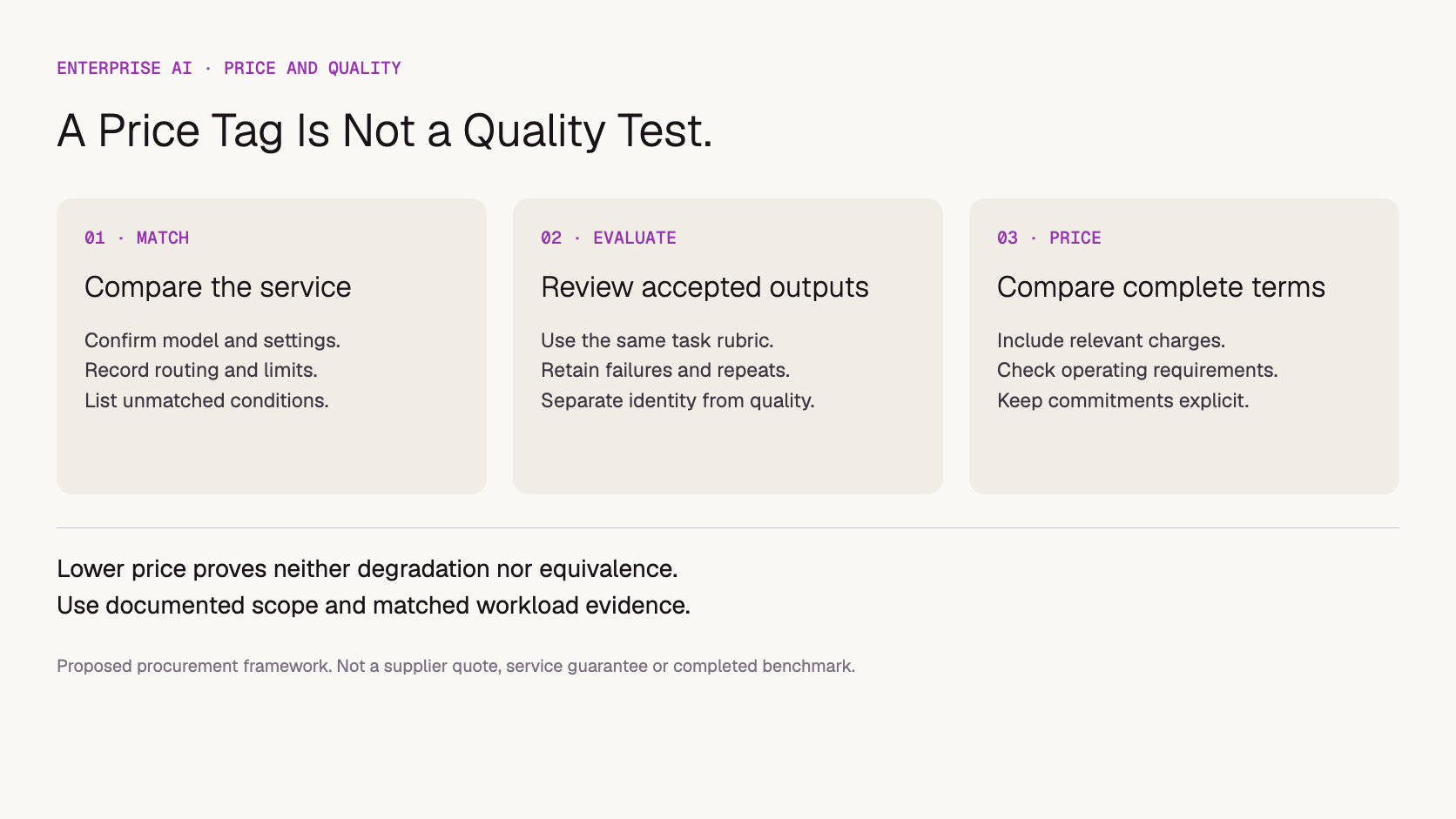
A lower AI API price does not prove lower quality. Match model settings, test accepted outputs and compare operating terms before choosing a supplier.
ENTERPRISE AI · PRICE AND QUALITY
A lower API price does not, by itself, prove lower model quality—or equivalent quality. Compare the exact model service, supported settings, routing and output limits, then evaluate matched workloads. Commercial pricing and technical configuration are separate questions. Ask what explains the quote and verify the service rather than judging either from price alone.
For enterprise buyers, this concern is reasonable: if two suppliers use the same model name, why are their prices different? The answer must be specific to the proposals. One may involve different commercial terms; another may expose a different configuration or service scope. Neither should be assumed without evidence.
Evidence boundary: This article is a comparison method, not a claim that Token360 matches or exceeds another provider's output. Public sources were checked November 17, 2026. No matched provider benchmark or savings experiment was performed for this article.
Why can two API quotes for the same model differ?
Quotes can differ in commercial terms, billing units and service configuration. First establish that the prices describe the same workload and scope. A negotiated rate, platform fee, usage commitment or separate capacity charge can change the total without proving anything about answer quality. Configuration differences require their own investigation.
Possible difference
What to ask
What it does not prove
Negotiated unit rate
What volume, period or commitment supports the price?
That the model has changed
Separate fees
Which charges sit outside model usage?
That the highest headline rate has the highest total cost
Billing basis
Are input, output, cached usage or media settings comparable?
That two advertised numbers are interchangeable
Technical configuration
Are version, precision where relevant, parameters and limits equivalent?
That a shared display name guarantees identical behavior
Operating arrangement
Are routing, capacity and support conditions the same?
That output quality alone settles procurement suitability
As of November 17, 2026, OpenRouter's pricing FAQ distinguishes enterprise fee discounts from inference pricing and states that it does not discount inference. This is an example of why buyers must identify which part of a quote changes; it is not evidence that another supplier's model output is better or worse.
Match the input and the relevant service configuration, not merely the prompt text. Record model identifiers, versions where available, system instructions, output limits and feature settings. If a field cannot be matched or verified, state that limitation. A comparison can still be useful, but it is not a controlled equivalence test.
For text, inspect reasoning settings if supported, maximum output, tools, response format and the full conversation. For images and video, compare resolution, duration, reference assets and generation mode. For audio, verify the requested task, duration and output format. Do not compare a lower-cost reduced configuration with a higher-specification result while calling them the same service.
Hosting details can matter for some open-weight models. OpenRouter's provider routing documentation exposes quantization filters and notes that quantized configurations can behave differently on certain prompts. That does not mean every discounted API is quantized or that every quantized deployment fails a business task. Ask what is known about the actual service.
If the concern is whether the named model was executed at all, use the separate model identity verification guide. A visually similar output or a clever test question cannot independently prove identity. Configuration records and output evaluation answer different questions.
How should you compare a cheaper option fairly?
Run the same representative cases under documented conditions, apply a predefined acceptance rubric and retain all results. Review outputs without supplier labels where practical. Include repeated runs when variability matters, and keep failures visible. One excellent result from either supplier is not enough to establish a reliable quality difference.
Begin with mandatory requirements: correct facts, required fields, usable media or another task-specific criterion. Then assess preferences such as tone or visual style separately. Otherwise, reviewers may reward a polished answer that violates a business rule.
Use the model evaluation framework for dataset construction and scoring. The price-specific requirement is to keep the comparison honest: do not select only one provider's best generation, tune only one candidate, or quietly exclude failed requests from its reported cost.
If you want to compare each supplier's best supported setup rather than identical parameters, that is a valid but different experiment. Label it as a comparison of optimized service configurations. Record the extra tuning effort and settings so the buyer knows what would need to be maintained in production.
Should you compare token price or cost per accepted result?
Use both. Unit prices explain how charges accrue; cost per accepted result explains what the workload actually delivers. Track total relevant charges and how many outputs pass the same acceptance rule. Keep that measure separate from review labor and other operating costs unless you explicitly include them in the calculation.
The basic measure is total relevant generation charges / accepted results. If no result is accepted, report that outcome instead of presenting a misleading finite cost. Repeated generations and billable auxiliary work should not disappear from the numerator.
In a fictional illustration, service A costs $80 for 100 attempts and produces 80 accepted results, while service B costs $100 for 100 attempts and produces 95 accepted results. Generation cost per accepted result is $1.00 for A and about $1.05 for B. These invented figures show the arithmetic only; they do not describe any provider.
The cheaper service still has more rejected work in that example. If each rejection creates operational delay or review effort, the procurement decision may change. Conversely, a higher price does not automatically buy better outcomes. Preserve the underlying counts and error types instead of reducing the decision to one ratio.
Price, output quality and operating terms are separate evidence categories.
Can latency or reliability differ even if quality is acceptable?
Yes. Output acceptance does not establish completion time, availability or performance under load. Evaluate the operating requirements your application depends on alongside quality. A cheaper service that passes offline review may still need additional capacity validation; a slower service may be acceptable for work that is not time-sensitive.
Record client-observed completion times under a stated workload, distinguish failures from slow successes, and avoid comparing an idle test with a loaded production window. For streaming, initial response timing and full completion answer different user-experience questions. For asynchronous media, submission acknowledgment is not delivery time.
Keep the measurement method in the API latency guide. In this procurement comparison, the practical decision is whether each candidate meets the same required service conditions. Do not present a cheaper unit price as compensation for failing a mandatory requirement.
What should a lower-price proposal explain in writing?
Ask the proposal to specify the model service, rates, eligibility conditions and permitted changes. Confirm the output limits and operating arrangement you tested. If the supplier cannot explain an important difference, record it as unresolved rather than assuming either hidden degradation or guaranteed equivalence.
A useful request is: “Please confirm the model/version and configuration covered by this quote, whether routing or fallback can change them, which charges are separate, and whether the evaluated settings apply to production.” Pair that response with your test evidence.
Also identify what happens when the quoted arrangement changes. The buyer needs a way to assess the impact of a changed model, configuration or commercial condition. That does not require identical wording across suppliers, but it does require a reviewable record of what was purchased.
How should you assess a Token360 quote?
Ask Token360 for the exact service and commercial scope, then evaluate it against the same acceptance requirements as any alternative. Do not infer equal quality merely from a lower quote, or infer a substituted model from price alone. Compare documented identity, actual outputs and agreed operating conditions separately.
Token360 provides enterprise model access across text, image, audio and video. Its enterprise offering supports custom pricing discussions. Negotiated price is a commercial fact, not a quality benchmark.
Token360 does not charge a separate service fee, as explained in the service-fee article. Model usage still costs money. That policy does not prove lowest total cost, upstream list-price pass-through or identical performance. Request the applicable rates and test the actual workload before deciding.
Frequently asked questions
Does the same model name guarantee identical outputs?
No. Configuration, context and generation variability can affect outputs. Match what can be controlled and evaluate task acceptance rather than requiring word-for-word identity.
Does a lower rate mean a different model is being used?
Price alone cannot establish that. Review identity and routing evidence separately, then test whether the service meets your requirements.
Can one poor answer prove a cheaper supplier is worse?
It proves a problem with that result, not a general ranking. Preserve the failure and investigate it within a representative, documented comparison.
Should the cheapest passing supplier always win?
Only if it also meets the required operating, data-handling and commercial conditions. Quality acceptance is one purchase gate, not the entire procurement decision.
Enterprise AI
API
Bring your next idea to life.
Create a video scene in Creator, or explore models for images, audio, and text to find the right capabilities for your project.



 Guides
 Guides
 Guides