AI API Key Offboarding Checklist: Audit, Revoke, and Verify Access
Use an AI API key offboarding checklist to audit ownership, replace service credentials, revoke old access, and verify applications still work.
When a team member leaves, identify the AI API keys they own or could retrieve, map the services using them, and remove their access at the agreed cutoff. Replace credentials needed by continuing services, revoke the old credentials, and verify both outcomes: the old access is rejected and the application still works.
Closing a user account is only one part of this process. A copied credential, a deployment secret, and an active background worker can have different lifetimes. An offboarding checklist needs to follow those dependencies through to evidence of closure.
Prepared by Token360. Public documentation checked October 23, 2026. This is an operational checklist with a fictional worked example, not a report of a completed customer offboarding. No member account or production credential was modified to prepare this article.
Define the access cutoff and the person responsible
Assign an offboarding owner, the application owners who must validate service health, and a clear cutoff time with a timezone. The owner coordinates identity access, secret access, and inference credentials; those tasks may belong to different administrators.
For a planned departure, prepare replacement service credentials before the cutoff when feasible. At the cutoff, remove the person's ability to retrieve replacements or create new credentials. An incomplete deployment should be escalated, not silently used to extend personal access.
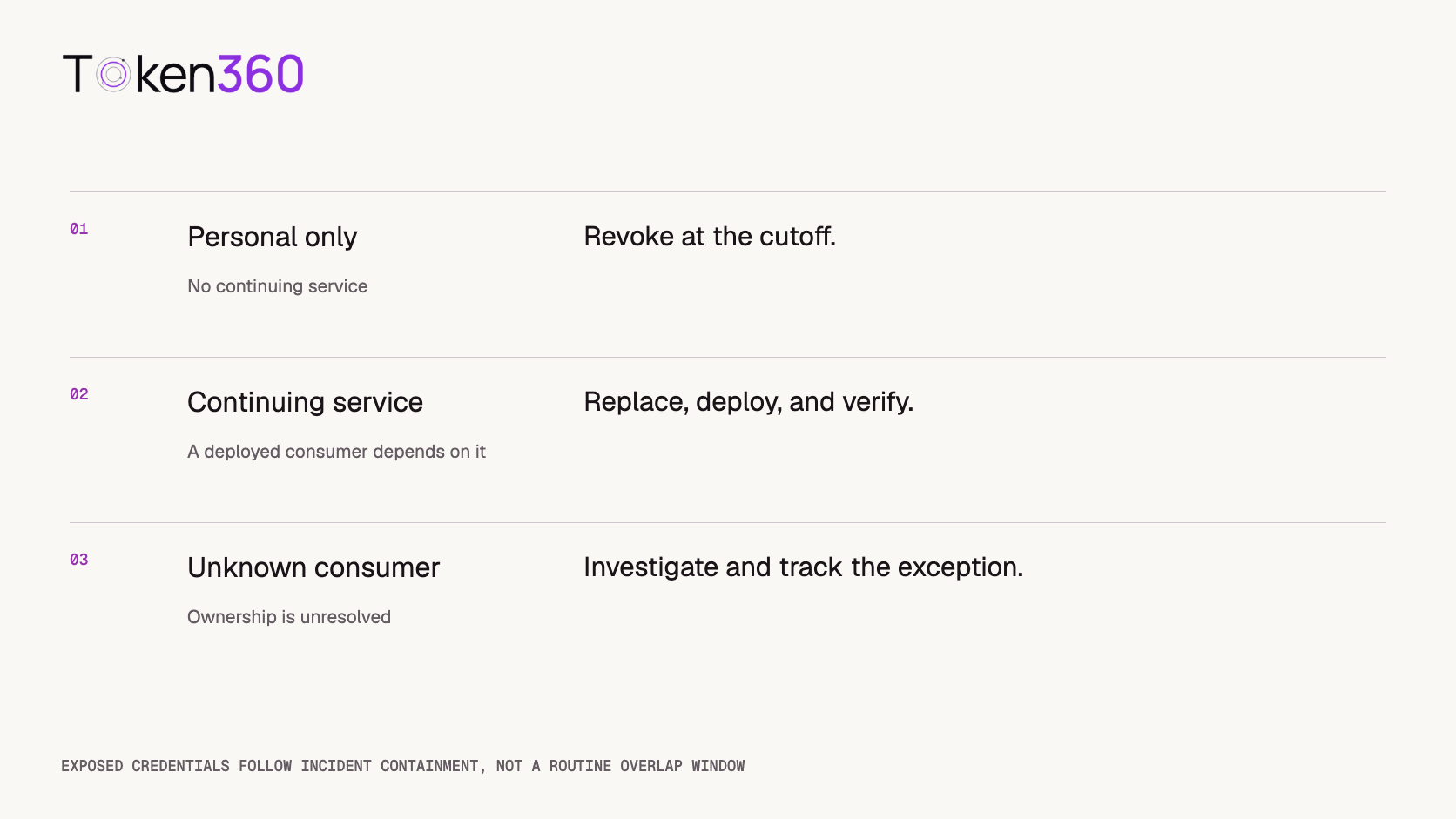
A suspected exposed key is a different situation. Follow the incident process and revoke the affected access promptly rather than leaving it usable through a routine observation period. OWASP's Secrets Management guidance treats revocation as part of the secret lifecycle and calls for audit records of use and administrative changes. Keep the urgency of containment distinct from a planned service transition.
Inventory ownership and access, not just key names
Start with keys associated with the departing member. Then inspect credentials the person could obtain through secret stores, CI systems, shared developer tools, or deployment permissions. A service key created by someone else may still be in scope if the departing member could read it.
Use metadata rather than secret values in the inventory. Record a display identifier, owner, workspace, environment, consumer, secret-store reference, last observed use, and proposed action. A label such as “production” is not enough to identify the application that would fail if the key stopped working.
Token360's Enterprise page describes tenant-wide key auditing: administrators can review metadata and ownership and revoke keys. That capability supports the inventory step. It does not establish that removing a member automatically revokes every credential they ever accessed.
Use an authorized administrator for the tenant-wide review. The personal API Keys page can help inspect individual credentials, but a personal view should not be treated as a complete organization-wide inventory. In the current site navigation, personal API Keys is available from the user menu; the model Dashboard is a usage view.
Map dependencies before changing continuing services
For each key, identify the processes that consume it: interactive applications, workers, scheduled tasks, CI jobs, and local developer utilities. Record where each process loads the secret and whether it needs a restart or deployment to pick up a replacement.
A quiet usage graph is weak evidence of no dependency. A weekly report may not run today. An autoscaled worker may start tomorrow from an old template. Include scheduled workloads and dormant deployment configurations in the review instead of checking only current traffic.
The following is a fictional example created for this checklist. Its identifiers are inventory labels, not real keys or customer records.
Inventory label
Dependency
Proposed action
Required evidence
KEY-A · personal sandbox
Departing member's experiments only
Remove access at cutoff.
Disabled/deleted state and an authorized rejection check where feasible.
KEY-B · support assistant
Production service; member could retrieve the secret
Replace under continuing team ownership.
New credential works in the deployed service; old credential is rejected.
KEY-C · weekly digest
Scheduled worker with a secret-store reference
Update both the secret and worker configuration.
Controlled job execution or the next scheduled run uses the replacement.
KEY-D · unknown staging key
Consumer not identified
Assign an investigator and resolve before closure.
Documented disposition; “no recent usage” alone is insufficient.
This example has four inventory entries, but it does not imply four automatic revocations in a safe sequence. KEY-B and KEY-C have continuing consumers; KEY-D has unresolved ownership. The decision depends on those dependencies and the access cutoff.
Classify each credential by its consumer before choosing an action.
Use the key lifecycle deliberately
Token360's API Keys and Workspaces documentation distinguishes active, disabled, expired, and deleted keys. Disabled access can be re-enabled; deletion is permanent. The document describes a planned rotation sequence: provision a replacement, deploy it, verify traffic, disable the old key, then delete it after observation.
Apply that sequence to the service dependency, not to the departing person's continued access. Provision replacements through a secret-delivery path the person will no longer control. Verify the replacement's required policies and environment rather than copying an old credential's overly broad permissions without review.
In the fictional example, the support assistant owner updates KEY-B's secret reference, deploys the change, and runs an agreed application check. The weekly digest owner updates KEY-C's scheduled worker and proves that the next execution will use the new reference. A successful request from an administrator's laptop alone does not demonstrate either deployment.
For a compromised credential, do not treat re-enabling the old key as the normal recovery plan. Restore the service using a trusted replacement. For a planned transition, document any permitted rollback path in advance and ensure it does not restore the former member's access.
Verify denial and service health as separate checks
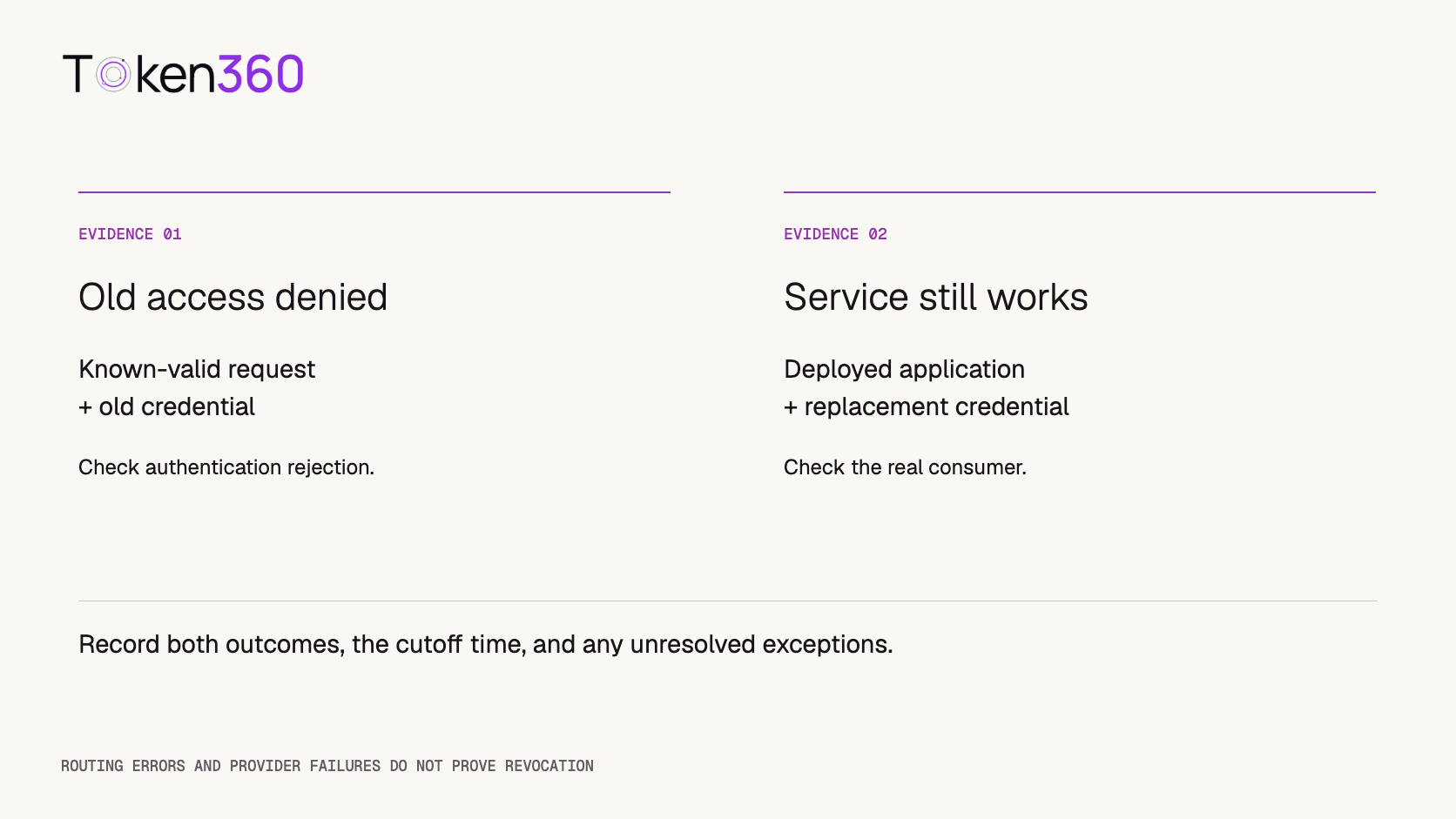
The strongest closure record combines a management action with observed behavior. A disabled badge documents the requested state. A carefully controlled request checks whether the old credential can still authenticate. A separate application check establishes that the replacement serves the continuing workload.
Check
What to hold constant
What qualifies as evidence
Old credential denied
Known-valid route, endpoint, request, and test environment
Authentication-specific rejection attributable to the old credential.
Replacement accepted
Same relevant route and valid request
Successful response using the replacement.
Application healthy
Actual deployed consumer and its normal workload
Successful app/job behavior with the new secret reference.
Former member cannot recover access
Account, roles, secret-store access, and credential-creation rights
Identity and access review completed by the responsible administrators.
Token360's authentication documentation describes HTTP 401 for authentication failures. Do not treat every failed request as proof of revocation: “model not found,” rate limiting, insufficient balance, or an upstream outage can fail for unrelated reasons. Examine the error meaning and retain the request identifier when available.
For example, if both old and new credentials return a model-routing error, the test is inconclusive. If a known-valid request succeeds with the replacement and the old credential receives an authentication rejection, the evidence is more specific. Even then, it demonstrates the tested path at the recorded time, not every endpoint or an unmeasured propagation guarantee.
Use a non-production rehearsal before standardizing this procedure. If the old secret is not available to an authorized operator, do not retrieve it from the departing person just to complete a checklist. Record the management-state evidence, the missing negative test, and any approved alternative verification. Do not report an unperformed test as passed.
Access removal and service continuity require their own evidence.
Check queued work and delayed consumers
Revoking a credential addresses future authentication. It does not, by itself, prove that already accepted video jobs, open streams, stored results, or downloaded assets have been cancelled or erased. Confirm the lifecycle of those resources separately when the offboarding scope requires it.
For KEY-C, a controlled execution should exercise the real scheduling configuration. Testing an edited local copy of the worker could miss a stale deployed secret. Observe the consumers over a window appropriate to their execution schedule; there is no universal number of minutes that proves a weekly job is covered.
Review unexpected errors and attempts to use old identifiers. Assign ownership to any unexplained caller instead of repeatedly replacing credentials without locating the deployment that still uses them. Late usage should be investigated with timestamps and request context, not automatically labeled malicious.
Keep a closure record without storing secrets
Use the following compact record for each inventory entry. It is a proposed format, not an actual audit result.
Inventory label / key display identifier:
Departing member's relationship: owner | could retrieve | unknown
Workspace / environment / consumer:
Continuing service owner:
Access cutoff (UTC):
Replacement secret reference (no value):
Management action and timestamp:
Old-credential check: passed | failed | inconclusive | not performed
Replacement/app check: passed | failed | not performed
Evidence references / request IDs:
Queued or scheduled work disposition:
Remaining exception / owner / deadline:
Reviewer and closure decision:
Keep full secrets out of tickets, screenshots, and the public article. Store evidence in the organization's authorized system and reference it from the record. Preserve enough detail to explain the decision without turning an audit log into another credential repository.
For the four-key example, closure depends on four dispositions and the continuing services' checks—not on how many Delete buttons were clicked. KEY-D remains an open exception until a named owner resolves it. A summary should expose that exception rather than averaging it into an apparent completion percentage.
Next step: review Token360's tenant-wide key governance with the administrator who owns your offboarding process. Confirm the controls available to your account, rehearse with a dedicated test credential, and agree on the evidence needed before the next team change.
FAQ
Does deleting a user automatically revoke every API key?
Do not assume that. Verify the platform's member-removal behavior and separately review credentials the person could access. This guide has not tested automatic revocation on member deletion.
Should every service key be rotated when someone leaves?
Review whether the person owned, knew, or could retrieve it, and apply the organization's access policy. A service key needs continuing ownership; transferring a label alone does not invalidate a copied secret.
Should I disable or delete the old key?
Use the documented lifecycle and your required cutoff. Disabling can support controlled verification; deletion makes the removal permanent. Suspected exposure calls for prompt containment rather than a prolonged overlap.
Is any failed API request proof that the key was revoked?
No. A routing error, provider failure, or billing restriction is not an authentication test. Use a known-valid request and inspect the reason for rejection.
Does revoking the key cancel a running video job?
Not necessarily. Check the job's own lifecycle and cancellation behavior. Do not infer cancellation, refunds, or deletion of existing results from key status alone.
What evidence should an offboarding audit retain?
Keep identifiers, ownership, dependencies, action timestamps, verification results, and unresolved exceptions. Reference protected evidence; do not include full credential values.



 Tutorial
 Tutorial
 Tutorial