Choose an AI video API polling interval from your acceptable completion-detection delay, active-job count, and documented status-request limits. Faster polling can reveal a finished job sooner; it does not make the video generate faster.
Read first: understand the job lifecycle in AI video API architecture and the notification alternative in AI video API webhooks.
Start with the delay your workflow can tolerate
A video can finish between two status checks. Your application only learns that it finished when a later response reports completion. That gap is the completion-detection delay. Keep it separate from generation time, status-request latency, and the time required to download the final file.
An editor waiting for one preview may value a short gap. An overnight batch exporter may tolerate a longer gap to reduce status traffic. Neither workload needs a universal one-second loop. Define the experience first: how much additional waiting after actual completion is acceptable, and how many jobs may be watched simultaneously?
A practical starting policy is a fixed interval selected against those requirements, then adjusted using measured status traffic and observed completion times. Treat every number in the worked example below as an illustrative candidate, not a recommended Token360 default. Check the model’s current workflow documentation and the limits applicable to your account before selecting a production value.
A 93-second example: four intervals, four different tradeoffs
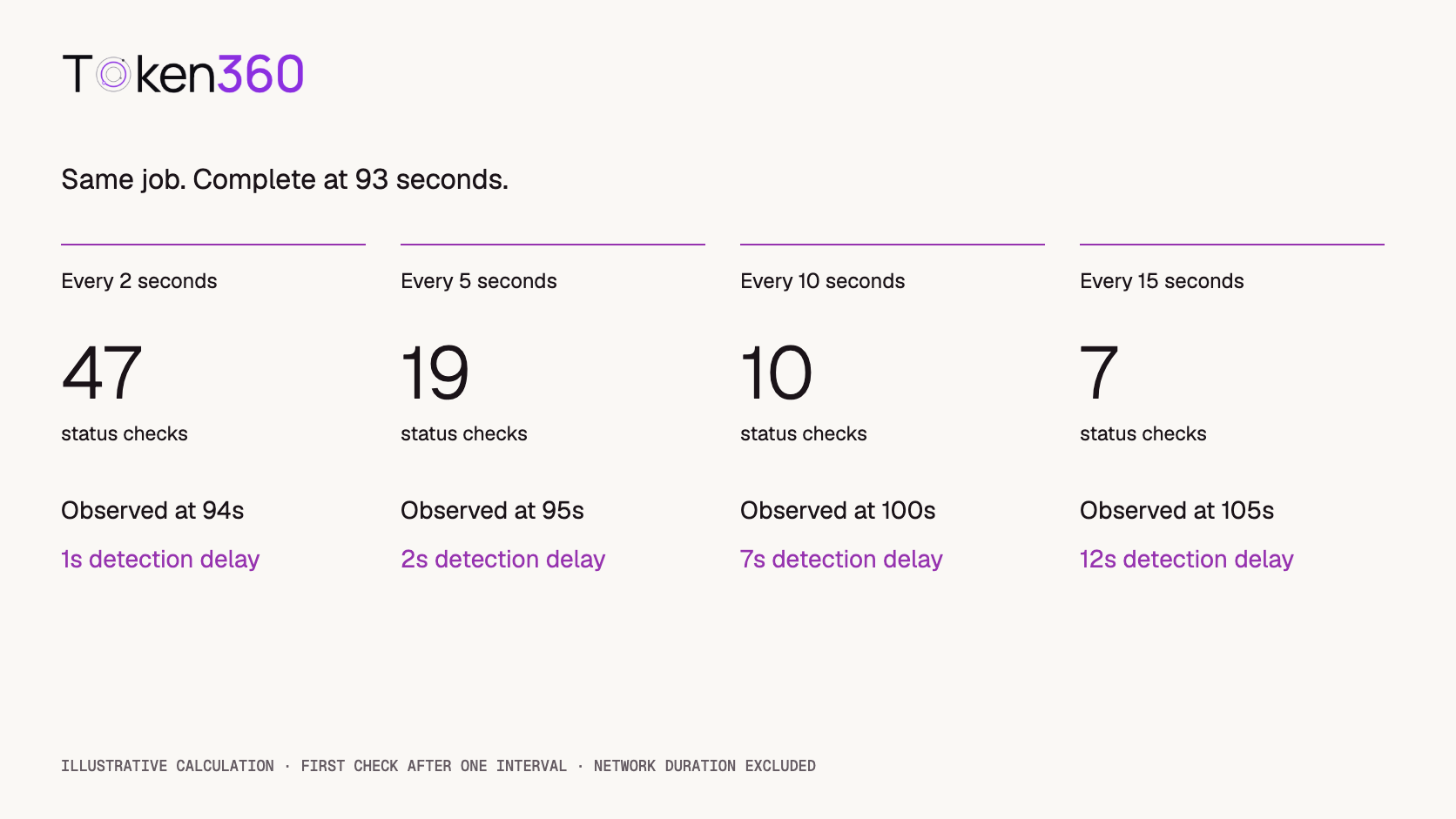
Assume a job is accepted at time zero and reaches a terminal success state at exactly 93 seconds. Polling begins after one interval, follows an ideal fixed schedule, and stops at the first successful observation. Ignore network duration, scheduling jitter, retries, and status propagation delay for this calculation.
If the interval is Δ and completion time is T, the number of checks is ceil(T / Δ). The observation time is ceil(T / Δ) × Δ, and detection delay is observation time minus T. These formulas describe the stated schedule; they are not measurements of a provider.
| Interval | Status checks | Completion observed | Detection delay |
|---|
| 2 seconds | 47 | 94 seconds | 1 second |
| 5 seconds | 19 | 95 seconds | 2 seconds |
| 10 seconds | 10 | 100 seconds | 7 seconds |
| 15 seconds | 7 | 105 seconds | 12 seconds |
Moving from a two-second interval to ten seconds removes 37 checks in this example, while adding six seconds of detection delay. Generation still finishes at 93 seconds. Calling this a slower generation would mix two different stages of the workflow.
The result also depends on the completion phase. A job finishing exactly on a scheduled check can have zero ideal detection delay, assuming the terminal state is already visible. Under a uniform completion-phase assumption, average delay is approximately half the interval. That is a mathematical assumption, not a measured average or a latency guarantee.
Convert active jobs into a status-request budget
One job is rarely the operational problem. A hundred workers waking together can produce a burst even when each worker follows an apparently modest interval. Estimate aggregate status traffic before choosing a polling frequency.
For N continuously active jobs on an ideal fixed schedule, the average rate is approximately N / Δ status requests per second. With 100 active jobs, two-second polling produces 3,000 requests per minute; five-second polling produces 1,200; ten-second polling produces 600; and fifteen-second polling produces 400. These figures assume all 100 remain active throughout the minute and exclude retries.
They are not Token360 limits or billable request counts. Determine whether status reads share a limit with submissions, whether limits apply per key or account, and whether the service exposes a separate read quota. If documentation does not specify that distinction, confirm it before building a capacity plan around an assumed exemption.
Token360’s rate-limit and retry guidance distinguishes request rate, concurrency, budgets, and provider capacity. For this workflow, keep a separate client-side budget for observation traffic so status checks do not consume all available request capacity. Stagger initial checks across jobs; adding jitter without an overall rate budget does not by itself prevent overload.
Keep normal polling separate from error retries
A successful response saying “still running” is not a failed request. Schedule the next ordinary observation. A timeout, a transient server error, or a capacity response is a different event and needs its own retry policy. Mixing both into one unbounded exponential loop makes behavior difficult to explain and test.
Use two pieces of state: the job’s lifecycle state and the observer’s transport state. A job may still be running while the last status request failed. Conversely, a successful HTTP response can report a terminal generation failure. Log both dimensions instead of treating every HTTP success as a usable video.
| Observation | Next action |
|---|
| Successful status response; job pending | Schedule the next ordinary status check. |
| Terminal success | Stop polling and hand the result to retrieval. |
| Terminal generation failure | Stop polling and record the job failure. |
| Transient transport or capacity problem | Apply a bounded retry policy to the status read. |
| Authentication, permission, or exhausted budget problem | Surface the actionable issue instead of retrying indefinitely. |
| Observation deadline reached | Stop this observer and preserve the resource identity for reconciliation. |
Where supplied and applicable, respect Retry-After. The header accepts either a delay in seconds or an HTTP date; do not parse every value as an integer. A delay in seconds starts from receipt of the response. An absolute date requires date parsing and a sensible approach to client clock differences.
A longer server-directed wait can invalidate the detection-delay target you originally chose. Report that condition rather than claiming the normal interval still guarantees timely discovery. A budget-related rejection also needs a different resolution from temporary capacity pressure.
Design one observer per job, with explicit stopping rules
Store the returned job or resource identifier as soon as submission succeeds. A status worker should observe that identity, not create a fresh generation whenever it cannot obtain an answer. After an ambiguous submission timeout, reconcile the original operation before deciding whether another submission is appropriate.
Within one observer, allow only one status request in flight. If each check takes longer than the configured interval, a naive repeating timer can accumulate overlapping reads. Scheduling the next check after the previous response avoids that overlap, but changes the effective interval: a five-second wait plus a two-second status request creates a seven-second cycle. The ideal arithmetic above does not include that request duration.
Across processes, use a lease or another ownership mechanism appropriate to your system so duplicate workers do not independently watch the same job without coordination. Keep ownership separate from the job itself: a worker crash must not erase the durable resource record.
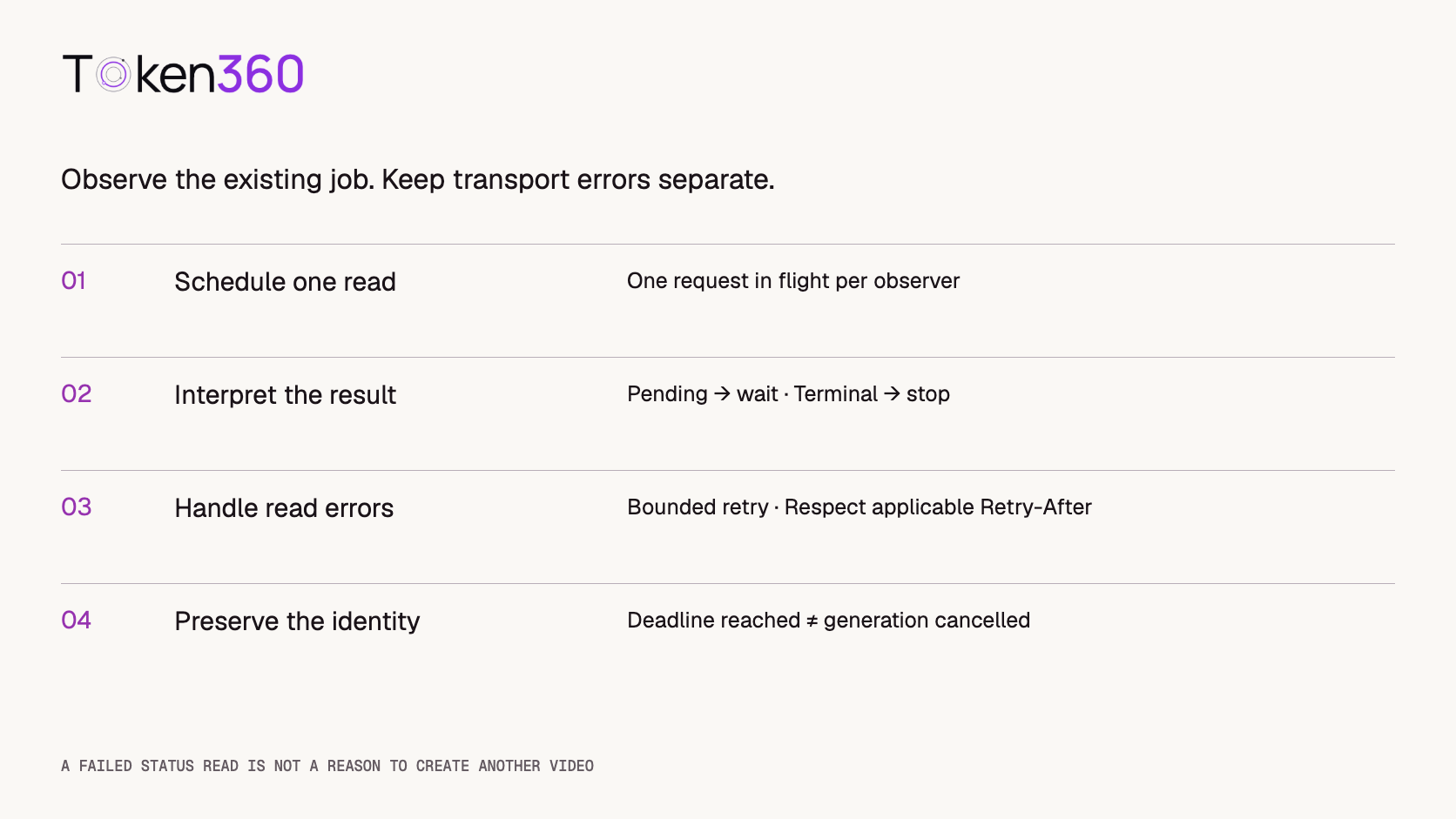
Give the observer an elapsed-time deadline and a bounded error-retry allowance. Reaching that deadline means the application stopped watching; it does not establish that the provider cancelled generation. Preserve the last known state and identifier, then let a recovery process reconcile the outcome using supported operations.
Keep the user-facing status honest as well. “Still generating” should reflect a recent successful observation, while “Unable to refresh status” should describe a transport problem. When the observer stops at its deadline, offer a way to revisit the existing job rather than immediately presenting a new Generate button as the only recovery path. This distinction preserves both the user’s understanding and the resource identity needed for later reconciliation.
For example, a worker can persist the next eligible check time alongside its ownership lease. On restart, it can resume from that record instead of issuing an immediate burst of checks for every unfinished job. The storage and coordination mechanism is application-specific; the important requirement is a recoverable schedule, not a particular database.
Use adaptive schedules and webhooks for a stated reason
A capped adaptive schedule can reduce early checks for jobs that usually take longer. For example, increasing waits while a job remains pending may fit a background export. But a job completing just after a long wait begins will stay undiscovered until that wait ends. Set the cap from tolerated delay, not simply from the number of previous polls.
Only use stage-specific schedules when the API actually exposes meaningful stages. Do not invent a percentage-complete field or infer remaining time from a generic “processing” label. Historical completion distributions can inform a schedule, but queue changes, model changes, and different inputs can shift those distributions.
Where a provider supports webhooks, notifications can reduce routine polling. Retain a reconciliation path for missed or delayed notifications, and make terminal-state processing idempotent so a webhook and a status response do not trigger duplicate downstream work. This article does not assume every Token360 model supports the same callback fields or delivery behavior.
Validate the policy without pretending it is a benchmark
Before a paid generation test, exercise the observer against a local fake status service. Return pending responses followed by success; repeat with terminal failure, a slow response, a transient error, and a deadline expiry. Add a duplicate terminal notification to check that retrieval is scheduled only once.
Record poll count, overlapping requests, selected waits, terminal transition, and total observation duration. For real runs, retain submission time, resource ID, status-response timestamps, and retrieval-start time. Measure true detection delay only if you have a reliable completion timestamp with compatible clock semantics. Otherwise report “time until completion was observed,” not an invented provider completion time.
The calculations here were checked locally. No provider polling experiment was performed, and no quota, billing saving, or production reliability improvement was measured. Use the worked example to choose a testable policy, then replace assumptions with evidence from your own workload.
FAQ
What is the best AI video API polling interval?
There is no universal best interval. Select one from acceptable detection delay, concurrent active jobs, documented limits, and status-request duration. Validate it against your workload rather than copying an arbitrary one-second loop.
Does polling more often make generation faster?
No. It can reduce the time between completion and your application discovering completion. It does not shorten the underlying generation process.
Should every pending response increase the polling interval?
Not necessarily. Pending is a normal lifecycle state. A fixed interval is easier to reason about; a capped adaptive schedule is useful when reduced traffic justifies a potentially longer discovery delay.
Should I resubmit when a status request times out?
Do not treat a failed status read as evidence that generation failed. Continue or recover observation of the existing resource under a bounded policy before considering a new submission.
Do webhooks remove the need for polling completely?
They can replace most routine checks where supported, but a reconciliation mechanism remains useful for missed notifications and interrupted processing. Coordinate both paths around the same resource identity.
Is a polling timeout the same as cancelling a video job?
No. An observer deadline stops local waiting. Cancellation requires an explicitly supported operation and a confirmed outcome; the job may continue after your application stops checking.
Read next: handle recovery decisions with AI video API error handling, then connect status reads to the wider request history with AI API observability.



 Tutorial
 Tutorial
 Tutorial