Reuse AI answers only when permissions, context and source versions still match. Compare response caching options, risks and real cost savings.
ENTERPRISE AI · RESPONSE CACHING
Cache an AI response only when the stored answer is still valid for the current request, audience, permissions, and source version. Repeated wording alone is insufficient. Start with approved, stable information; bypass reuse for changing account data and business actions. Measure accepted answers and avoided inference costs alongside stale-answer and access failures.
For an enterprise buying model access, the practical question is simple: should the application pay to generate this answer again? Sometimes a previously approved answer is the better product experience. Sometimes reusing it would repeat an old policy, reveal another customer's information, or falsely imply that an action happened.
Evidence and scope: This is an application-design and procurement guide, not a Token360 cache benchmark. Examples and the worksheet are proposed designs. Official documentation was checked November 15, 2026. No measured savings, universal similarity threshold, or built-in Token360 response-cache feature is claimed.
How is response caching different from prompt caching?
Response caching returns a stored output instead of asking the model to generate that output again. Prompt caching reuses eligible input processing while a model still produces a response. An approved answer library is another option: the business maintains the answer directly, rather than automatically storing whatever the model last produced.
Approach
What is reused?
Main enterprise decision
Prompt caching
Eligible repeated input processing
Does the selected provider and request pattern qualify?
Exact response caching
A previous output for a matching cache key
Does the key capture everything that can change the answer?
Semantic response caching
A previous output selected by meaning similarity
Can similar questions legitimately share one answer?
Approved answer library
Maintained business content
Who approves, updates, and retires the content?
Cloudflare's caching documentation provides one exact-match implementation: its default key includes provider, endpoint, model, authentication header, and full request body. That is a vendor-specific design, not a portable guarantee across gateways. For input-token economics, use the separate prompt caching cost guide; this article concerns reusing the answer itself.
Which business answers are good candidates for reuse?
Good candidates have stable source material, a clearly defined audience, and a reason for identical output to be acceptable. A reviewed explanation of a published feature can fit. An answer about an individual customer's entitlement usually requires fresh context. Classify the business task before choosing a cache technology or duration.
Request
Proposed starting policy
Reason
Explain a versioned public setup guide
Reuse an approved explanation within its version and language
Source and audience can be fixed
Summarize an unchanged internal document
Consider reuse within the authorized document audience
Content may be stable; access still matters
Can this customer receive a refund?
Retrieve current transaction and policy facts
Eligibility depends on more than question wording
Is this product in stock now?
Consult the inventory source under an explicit freshness rule
A fluent old answer can be commercially wrong
Cancel this order
Use the authorized action workflow
A cached sentence cannot perform a cancellation
Create a different campaign concept
Bypass answer reuse when novelty is required
Returning the previous output defeats the request
These are proposed defaults, not categorical technical prohibitions. A business could deliberately publish inventory with a stated update delay, or maintain reusable refund-policy explanations without caching individual eligibility decisions. Make that product promise explicit. Do not silently replace a request for current facts with an older approximation.
Why can two similar questions need different answers?
Similar wording does not establish equal meaning in a business workflow. Customer plan, jurisdiction, product version, order date, and conversation history can change the answer. Semantic matching is therefore a candidate-selection mechanism. It needs eligibility and authorization checks around it, particularly when the response contains customer-specific facts or commitments.
Consider an illustrative pair: “Can I return this item after 30 days?” and “Can I return this faulty item after 30 days?” A small textual difference changes the decision. Even the identical sentence can need different answers for two sellers with different policies. A numerical similarity score cannot prove that those differences are irrelevant.
Microsoft's semantic-cache policy reference explicitly warns that similarity-based reuse can return incorrect, outdated, or unsafe responses. It also documents partitioning with vary-by to control cross-user access. Treat those as evidence that matching and access boundaries require design, not as settings to copy blindly into a different platform.
Start with exact matches for a bounded set of approved tasks. Add semantic matching only if testing shows that meaningful variations are handled correctly. Build negative examples that differ in a single decisive fact. Include changed quantities, negation, dates, account rights, and follow-up questions; do not test only convenient paraphrases.
What should an enterprise cache key protect?
A cache key should distinguish the conditions under which an answer is valid, while authorization independently controls who may receive it. For a private document answer, that may include tenant, authorized audience, source version, task, language, prompt version, model policy, and relevant conversation context. The exact fields depend on the application.
An application team could define the following conceptual namespace. It is a design sketch, not an API parameter or complete security implementation:
Use trusted server-side identity and permission information. Do not let an untrusted request select another tenant's namespace. Recheck authorization before serving private content: a user may have lost access since the answer was stored. Hashing a key does not encrypt the cached response or make its contents anonymous.
The account-aware SaaS assistant guide covers the broader permission problem. Here the added risk is persistence: an old authorized response can outlive the permissions or sources that justified it. Separate tenant or audience partitions also reduce reuse opportunities, which belongs in the savings estimate.
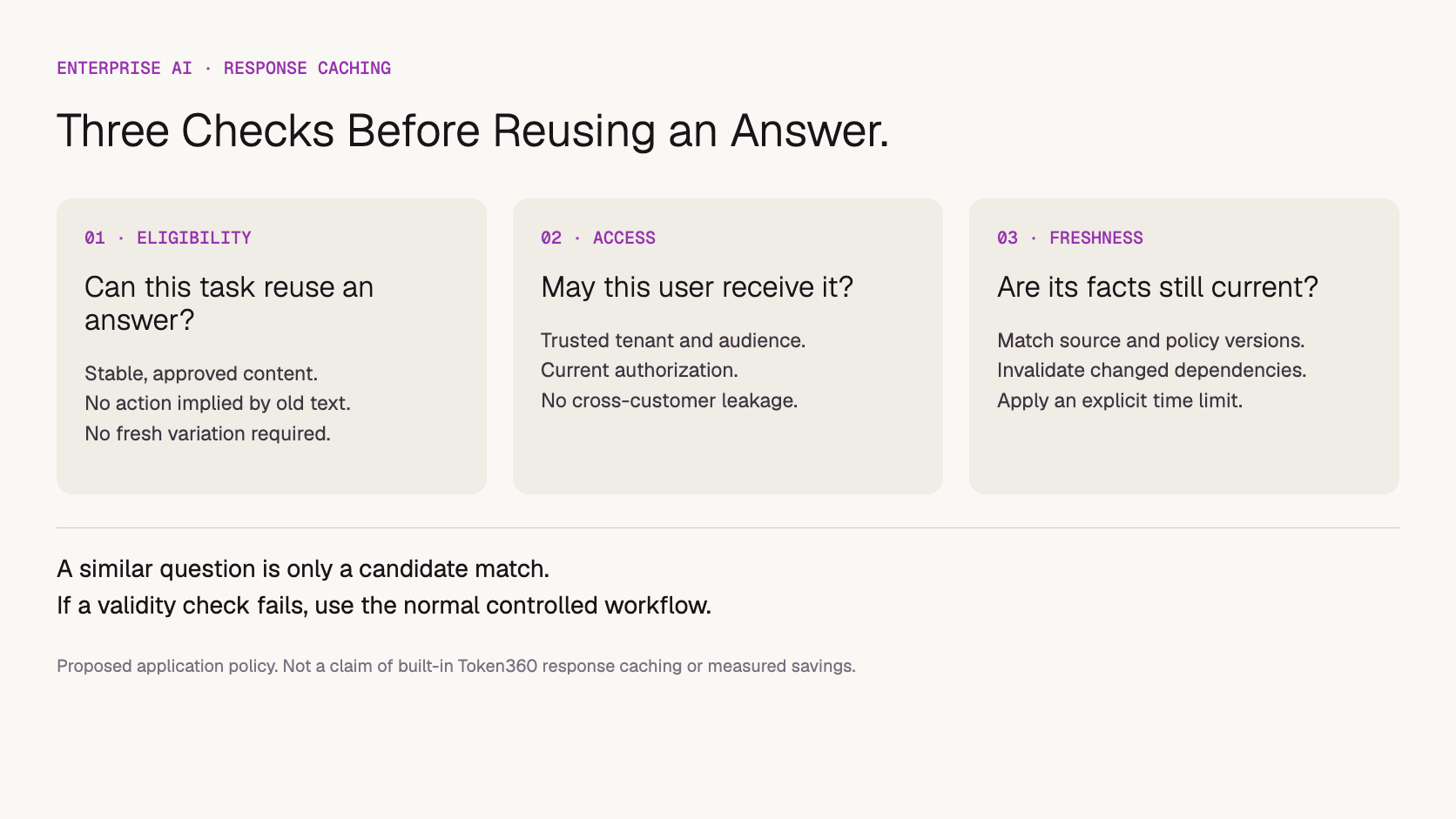
Proposed reuse gate. A matching question alone is not enough.
When should a stored answer expire or be removed?
Give cached answers both a time limit and a way to become invalid when their supporting facts change. Time-to-live limits age; it does not detect a policy revision or revoked permission. Define an owner, a source version, and an invalidation trigger before allowing business-critical answers to be reused.
For example, publishing a new returns policy should prevent answers derived from the previous policy from being served under the new version. A corrected source document should invalidate dependent summaries. Where dependency tracking is unreliable, bypass caching for those tasks rather than pretending a short timer guarantees correctness.
Removal must cover stored outputs as well as keys and indexes. The organization should know where the cache lives, who operates it, what backups exist, and how deletion works. Adding a cache introduces another stored copy; provider retention terms do not automatically describe that copy. Review it alongside retention and training policies.
Only admit outputs that meet the task's quality criteria. Do not turn a transient error, incomplete stream, unsupported statement, or exposed secret into a reusable answer. Preserve source provenance and the reason for admission so that a later correction can find affected entries.
How do you know whether caching actually saves money?
Estimate savings from eligible requests that become valid cache hits, not from the total traffic count or a headline hit rate. Subtract lookup, embedding, storage, maintenance, and review costs. Compare the same accepted business outcome with and without caching, including the work caused by stale or incorrectly reused answers.
A planning equation is:
Net avoided cost = model cost of valid hits avoided
                 - cache lookup and storage costs
                 - embedding and validation costs
                 - operating and correction costs
This is a framework, not a forecast. Some requests may already benefit from prompt caching, negotiated prices, or lower-cost models; use that actual alternative as the baseline. Semantic lookups can cost money even when no answer is reused. Track hit and miss latency separately because a lookup can add time before a miss reaches inference.
Record valid-hit rate, stale-answer incidents, permission failures, correction work, and total cost per accepted task. A high hit rate accompanied by wrong commitments is not a business improvement. The AI API total cost of ownership guide covers the wider operating budget.
How should a team pilot response caching with Token360?
Begin with one stable, low-risk task and a cache outside the model-call path that can be bypassed immediately. Define admission, access, freshness, and measurement rules before rollout. Token360 can supply model inference for cache misses; confirm the actual integration and commercial scope rather than assuming a managed cache is included.
Token360's enterprise offering covers text, image, audio, and video model access with custom enterprise pricing. A response-reuse layer is a separate design question. Ask who owns it, how hits appear in usage records, and how cache misses affect expected volume and capacity. Do not count every application request as a new inference request when estimating procurement needs.
Choose the task: for example, approved explanations of one versioned public guide.
Define the boundary: accepted source, audience, language, and situations that require a fresh call.
Test counterexamples: changed policy, revoked access, similar wording with different intent, and incomplete source data.
Exercise failure paths: unavailable cache, invalidation failure, and a surge of misses after clearing entries. Apply normal inference limits; do not assume the cache will always absorb load.
Review and decide: expand only after observing useful cost and latency outcomes without unacceptable reuse errors.
Copy the blank response-cache review worksheet to assign the task owner, source version, expiry rule, invalidation event, bypass conditions, and acceptance criteria. It contains no fabricated test results.
When a cache serves stale material, the guide to outdated company information explains how to trace the source version.
Frequently asked questions
Can a cached answer prove an order was updated?
No. An answer saying an order was updated is not a transaction receipt. Query the authoritative system and use the authorized action workflow. The tool-call execution guide explains why generated instructions and completed actions are separate events.
Should every repeated customer question be cached?
No. Cacheability depends on the answer's scope, not just repetition. A public feature explanation may be reusable, while an identical question about a customer's balance requires current account facts. Maintain an explicit list of eligible tasks and default uncertain cases to the normal controlled workflow.
Is there one safe semantic similarity threshold?
No universal value establishes business equivalence. Scoring conventions and workload risks differ. Evaluate paraphrases alongside deliberately similar questions that require different answers, then judge wrong reuse and missed reuse separately. Do not adopt another vendor's example threshold as a validated policy.
Can a company reuse generated images or videos?
It can reuse an approved asset when its rights, audience, creative brief, and product facts still fit. That is asset reuse, not proof that every generation API supports response caching. Preserve the approved file and provenance; a temporary generation download URL is not a durable asset-management plan.
About this guide: Written by Yuki Yu for Token360. The decision tables and worksheet are editorial frameworks, not measured customer results. Publication should preserve the distinction between model inference, provider prompt caching, and application-managed response reuse.
Enterprise AI
API
Bring your next idea to life.
Create a video scene in Creator, or explore models for images, audio, and text to find the right capabilities for your project.


 Guides
 Guides
 Guides