Why Does AI Still Use Outdated Company Information?
Find why AI repeats outdated company information. Check source versions, indexing, caches and existing chats, then verify that updates reach the answer.
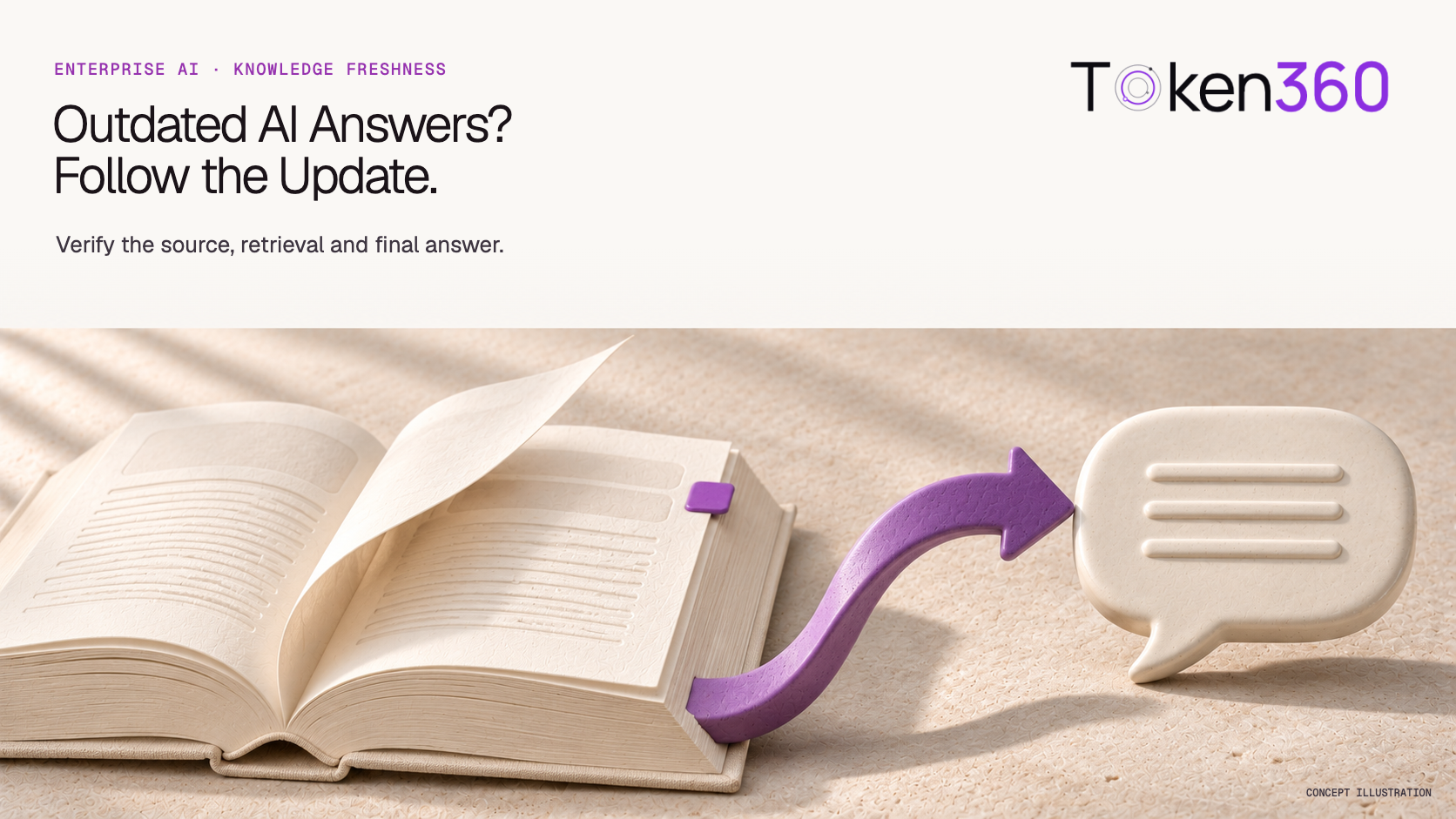
ENTERPRISE AI · KNOWLEDGE FRESHNESS
AI may still use outdated company information because a source update has not reached the material used to answer the question. Check the approved source, ingestion job, searchable passages, retrieval filters, cached responses and conversation context. Updating a document is only the beginning; verify that the next relevant answer actually uses the correct version.
For an enterprise assistant, a recent model release is not the same as current company knowledge. A new model cannot infer an unpublished policy change that the application never supplies. Conversely, an existing model may answer correctly when it receives the current, authoritative information. Diagnose the information path before assuming that changing models will solve the problem.
Scope: This article proposes an operational review for document-grounded AI applications. It is not a Token360 knowledge-base feature announcement, measured synchronization benchmark or customer incident report. Examples are fictional; official sources were checked November 16, 2026.
Where can old information remain after a document changes?
Old information can remain in any derived copy: extracted text, search passages, summaries, cached answers, saved prompts or chat history. Inspect the actual material supplied to the model for the failing request. A current file in the repository does not prove that the application retrieved that file's current content.
Layer
Possible stale state
Useful evidence
Source
The edited file is a draft; an older published copy remains authoritative
Publication status, version and effective date
Ingestion
The update was not detected or processing failed
Per-document processing status and source version
Search index
Old passages remain or new passages are incomplete
Retrieved text with document/version identifiers
Application
A filter points to the wrong collection or a cached answer survives
Query configuration and cache provenance
Conversation
A previous answer or summary repeats the old rule
The request context used for the new response
Final answer
Current evidence was supplied but the answer contradicts it
Comparison of evidence and final claims
These layers require different fixes. Rewording the prompt will not repair a failed connector. Rebuilding an index will not necessarily remove an old answer from a conversation summary. Start with the observed request and trace backward until you find where the current version stops appearing.
Does uploading a new file automatically update the AI?
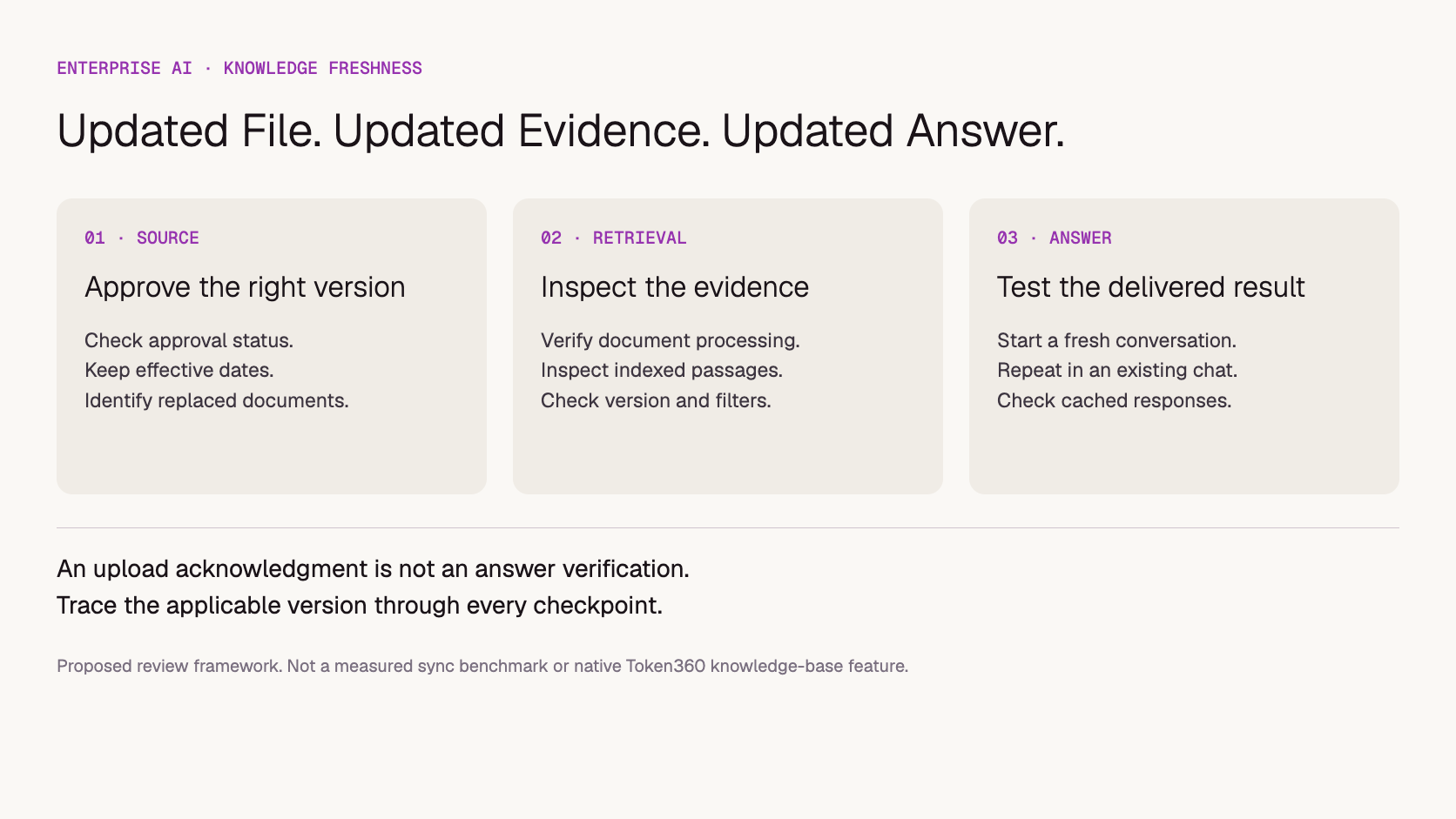
Only if the application's update process detects, processes and makes that file available to the answering workflow. The exact behavior depends on the connector and knowledge system. Confirm completion for the relevant document and inspect retrieval results instead of treating an upload acknowledgment as proof that the answer has changed.
AWS documents this distinction in Amazon Bedrock knowledge-base synchronization: source additions, modifications and removals require synchronization to update the knowledge base. Its documented incremental process handles changed documents and can include parsing, chunking, embedding and indexing. These are AWS-specific behaviors, not a promise about every retrieval system.
Microsoft's Azure AI Search indexer scheduling documentation similarly describes scheduled processing and change-detection prerequisites. A configured schedule describes when work is attempted; your application still needs to check whether the relevant content became queryable.
For procurement and implementation reviews, ask for a demonstration: change an approved test document, run the update path, retrieve its new passage and ask the affected question. Have the team show where a failed document is reported. A dashboard reporting a recent job start is weaker evidence than a successful document-specific check.
How do you separate publication time from effective time?
Store when content was published, when it becomes applicable and which version it replaces. A newly uploaded policy can describe a future change; an older contract can remain applicable to a particular customer. Freshness means using the version valid for the question, not simply choosing the newest timestamp.
Consider a fictional service policy published on November 16 that takes effect on December 1. A question about today's service should not automatically receive the future rule. A question about next month's service may need it. The document owner must define the scope, while the application must preserve enough metadata to select the relevant version.
Useful fields include a stable document identifier, revision, approval state, effective-from date, optional expiry or replacement reference, audience and market. Do not let a file's upload time stand in for all of them. Where the source lacks those distinctions, route the ambiguity to its owner.
This is different from resolving two competing sources. Our article on which company source AI should trust covers authority and disagreement. Here, the question is whether the applicable version has propagated through the answering system.
What should happen to replaced or deleted documents?
Define replacement and removal behavior explicitly, including derived passages and cached material. Verify that retired content no longer appears in retrieval for current questions. Keep any required archival copy outside the active answering path unless the user is authorized and intentionally asking about historical information.
A replacement uploaded under a new filename may be treated as an additional document rather than a new version of the old one. Both copies can then remain searchable. Use stable identity and replacement metadata, or a reviewed removal process, so the application knows that one supersedes the other.
Deletion also needs testing. A source file disappearing does not by itself demonstrate that every derived copy was removed. Connector deletion detection, index updates and application behavior must work together. Test the affected query after the removal rather than checking only the storage location.
Permission changes are a related but distinct requirement. A current document can still be unauthorized for a particular user. Follow the separate controls for keeping AI answers within user permissions; freshness never overrides access restrictions.
Proposed update verification: source status, retrieval and answer behavior are separate checkpoints.
When the answer depends on external information, the LLM API and live web search guide explains what the application must retrieve and verify.
How often should a company refresh AI knowledge?
Set the refresh requirement according to how quickly the information changes and the consequence of an outdated answer. Stable reference material and rapidly changing operational facts need different approaches. Specify a maximum acceptable age or propagation delay for each class, and define what the application does when it cannot meet that requirement.
An employee handbook may follow a controlled publication process. Available inventory or a shipment status may require a live system lookup rather than a periodically indexed document. Do not promise “real time” unless the complete path has a defined, verified freshness behavior.
Information class
Proposed approach
Failure behavior to define
Stable reference material
Refresh on approved change, with periodic reconciliation
Flag missing or failed revisions
Time-sensitive policy or offer
Track effective dates and prioritize update verification
Withhold unsupported current claims or refer to the owner
Live operational state
Query the authorized system of record where required
Report lookup failure instead of substituting an old snapshot
Historical material
Keep versioned access separate from current guidance
Label historical scope explicitly
Measure the time from approved publication to verified availability in answers, with ingestion and retrieval checkpoints recorded separately. This is a proposed operational metric, not a measured Token360 service level. Shortening the polling interval alone may not solve processing backlogs, failures or cached results.
Can caches and existing chats undo a successful update?
Yes. A fresh index can coexist with an old cached answer or a conversation summary that repeats a retired rule. Include these paths in the update design. For affected questions, invalidate or bypass incompatible cached responses and obtain current evidence instead of assuming that previous conversational statements remain authoritative.
Keep enough provenance to connect reusable answers to their source versions. When an important source changes, the application should be able to identify which derived answers may be affected. Avoid simply giving every cached answer an unlimited lifetime because its wording looks generally useful.
Test both a new conversation and an existing one that previously received the old answer. If only the old conversation fails, inspect its retained context before rebuilding the search system again. The article on when it is safe to cache AI responses covers cache eligibility; this update workflow must account for those caches without duplicating their full design.
How do you verify that an update actually worked?
Use a controlled test that records the source version, retrieved evidence and final answer before and after the change. Include replacement, deletion and future-effective content, not just a new document. A successful update should preserve both the new information and the correct treatment of retired or not-yet-effective information.
For a fictional test, let version A specify an internal approval contact named Team North, then replace it with version B specifying Team East. Ask who handles the request, inspect the retrieved passage, and verify the answer. The names are deliberately invented; the exercise tests propagation, not whether either team exists.
Proposed test
Expected observation
Replace a fact in the same document
Retrieval and answer use the applicable new version
Upload the replacement under a new filename
The retired copy does not compete as current guidance
Remove the active source
The answer does not confidently reproduce its retired fact without valid evidence
Publish a future-effective revision
Current and future questions select the appropriate rule
Simulate an ingestion failure
The failure is visible and the freshness policy is enforced
Repeat in an existing chat
Old context does not override verified current evidence
These are proposed tests, not completed experiments. Record the document owner, application version and model identifier alongside results. If retrieval contains the right evidence but the answer is wrong, investigate generation and instruction handling. If retrieval is already wrong, fix that layer first.
What should you confirm with Token360 and your application team?
Separate model access from knowledge-update ownership. Confirm which system stores company documents, which process updates searchable content, who monitors failures and how the application supplies evidence to the model. Model inference availability does not establish that a document connector, freshness monitor or cache-invalidation mechanism is included.
Token360 provides access across text, image, audio and video models. Its enterprise offering supports discussions about model mix, capacity, pricing and contractual requirements. This article does not assert that Token360 supplies the knowledge synchronization infrastructure described here.
Before rollout, ask the implementation owner to demonstrate one approved update and one failed update in your intended environment. Agree who can retire information, who restores a failed connector and what customers see when current evidence is unavailable. Those responsibilities make “uses our latest knowledge” a reviewable claim.
Frequently asked questions
Will switching to a newer model fix stale company answers?
Not necessarily. If the application supplies old evidence or no current evidence, a model change does not repair the information path. Inspect retrieval and request context first.
Does RAG guarantee current information?
No. Retrieval-augmented generation depends on the content available to retrieve and the application's selection process. Updates, removals, effective dates and caches still need controls.
Does a recent synchronization timestamp prove the answer is fresh?
No. Check whether the specific document was processed successfully, whether the relevant passage is retrievable and whether the final answer uses it. A job-level timestamp alone is insufficient.
Should old versions always be deleted?
Not necessarily. Historical versions may be needed for authorized historical questions or recordkeeping. Separate them from current-answer selection and preserve version context so they are not presented as current guidance.
Enterprise AI
API
Bring your next idea to life.
Create a video scene in Creator, or explore models for images, audio, and text to find the right capabilities for your project.


 Guides
 Guides
 Guides