Why Consolidate AI Model Procurement Across Teams?
Coordinate AI model procurement across teams while preserving model choice. Compare business benefits, total costs and reasons to keep direct suppliers.
ENTERPRISE AI · PROCUREMENT STRATEGY
By Yuki Yu · Enterprise procurement analysis · Reviewed November 7, 2026
Consolidate AI model procurement when separate team purchases create duplicated vendor work, unclear spending ownership or fragmented commercial negotiations. The goal is a shared buying process across text, image, audio and video—not forcing every team onto one model. Keep direct arrangements where their capabilities, economics or contractual requirements justify an exception.
A product team may need language models for customer support, while marketing buys image and video generation and a localization team purchases audio. Each choice can make sense individually. The enterprise decision appears when finance, security and procurement must understand those purchases together.
This article is for technology leaders, procurement teams and finance owners deciding whether to coordinate that spending. It provides an original decision framework and an illustrative workload example, not a customer case study or measured savings claim. Product statements were reviewed on November 7, 2026; specific commercial commitments require a written agreement.
Read first: Token360’s enterprise offering for the services under discussion. This article addresses whether to consolidate purchasing; detailed quote preparation and spend-commitment terms are separate decisions.
What business problem should consolidation solve?
Consolidation should solve a recurring organizational problem, not merely reduce the number of supplier logos on a slide. Look for repeated onboarding, scattered commercial terms, unassigned costs or difficulty coordinating production needs. If those problems are minor, moving existing integrations may create more work than the purchasing change removes.
Start with a recent purchasing cycle. Who requested the model? Who approved the data use? Who paid the invoice? Who could explain a usage increase? If each team has to reconstruct those answers independently, a common purchasing process may be useful even before a technical migration.
The FinOps Foundation’s AI framework describes AI spending across diverse buying channels and teams, with allocation, forecasting and governance connected to business value. That supports evaluating the whole purchasing workflow rather than judging the decision only by a model’s advertised rate.
Observed business problem
Potential benefit to evaluate
Evidence needed
Several teams repeat supplier onboarding
A shared review and commercial owner
Actual approval steps, staff time and remaining model-specific reviews
Finance cannot assign spending
Consistent ownership and reporting
Usage records mapped to teams or products
Production requirements are negotiated separately
A coordinated discussion of demand
Model-specific peaks, capacity scope and written commitments
Teams already have effective direct agreements
Possibly little benefit from moving them
Existing terms, integration value and switching cost
Choose the problem you will measure before asking suppliers for a proposal. “Fewer invoices” is a different objective from “better production capacity,” and neither alone proves lower total cost.
What can you centralize without limiting model choice?
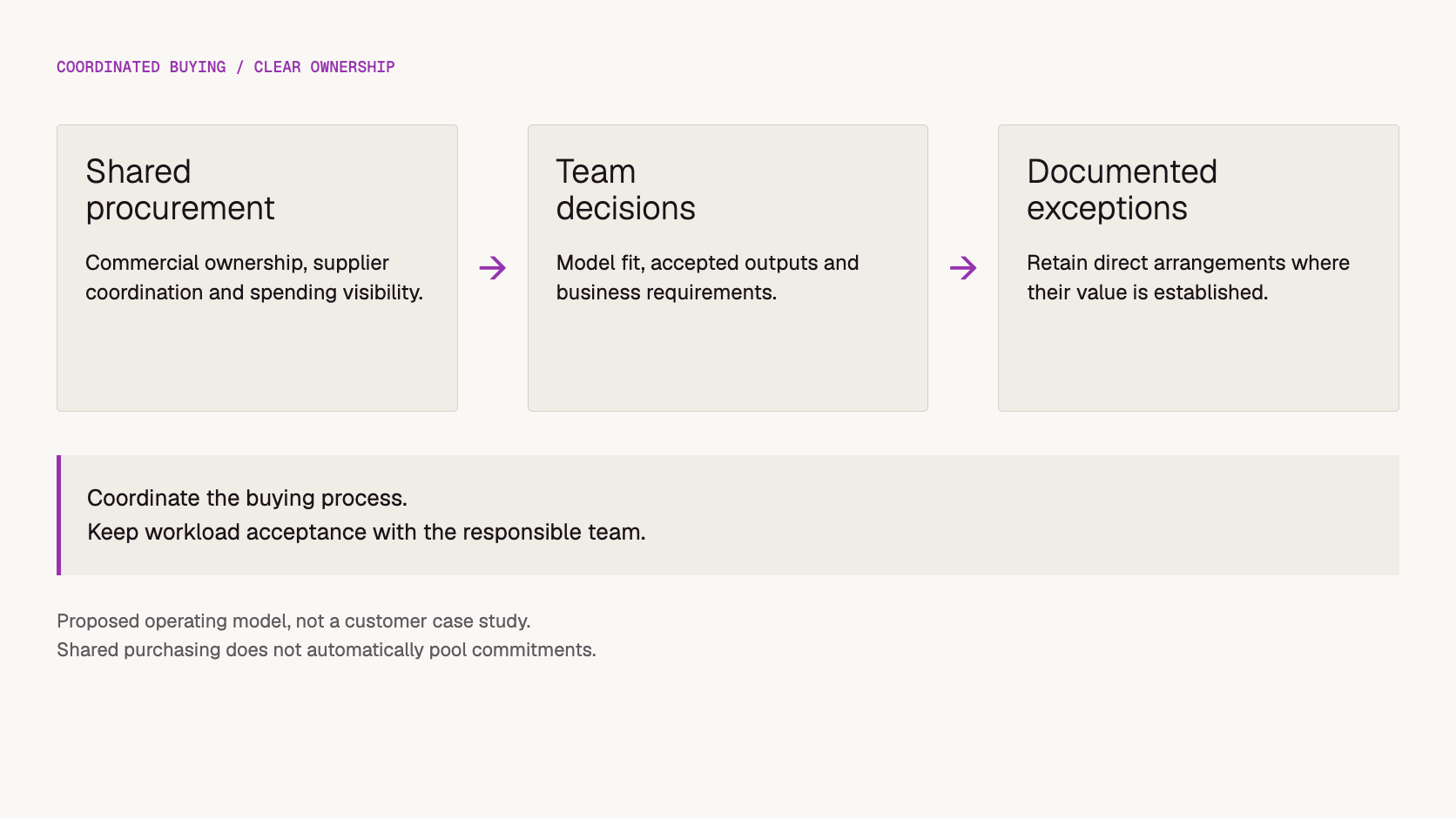
You can centralize commercial ownership, purchasing rules and spending visibility while allowing teams to choose different approved models. Procurement consolidation does not require one model, one upstream provider or identical technical workflows. Define which decisions belong to the shared buying function and which remain with the team responsible for the business result.
A practical division is to centralize supplier coordination and retain workload acceptance with the relevant team. The customer-support team should still decide whether an answer meets its quality requirements. Marketing should still decide whether a generated video is usable. Procurement can coordinate the agreement without becoming the judge of every output.
Proposed operating model: coordinate buying while preserving workload accountability.
For example, an enterprise might review text and media spending together but keep a specialist production workflow on its current supplier. This is a hypothetical structure, not a claim that any particular contract automatically permits pooled commitments, shared credits or interchangeable usage units.
Document the boundary in plain language: which teams are included, which workloads move, which remain direct and who approves a new exception. A shared supplier relationship is useful only if employees can understand how to use it.
When should you keep direct supplier relationships?
Keep a direct relationship when it provides a material advantage that consolidation would remove or has not demonstrated it can preserve. Examples include a required feature, an existing negotiated arrangement, a specific data-processing condition or a well-established production dependency. A hybrid approach can be a deliberate procurement choice rather than an unfinished migration.
Approach
Worth considering when
Main tradeoff to examine
Separate direct purchases
Requirements differ substantially and existing arrangements work
More supplier coordination and potentially inconsistent reporting
Consolidated purchasing
Several teams share recurring commercial and operational needs
Dependency on the intermediary and its actual model coverage
Shared procurement with direct exceptions
Most workloads can share a process, but some need specialist terms
Clear exception ownership and visibility across both channels
Do not count a second commercial interface as independent underlying supply without checking the actual route. Conversely, do not assume that using an intermediary necessarily removes access to a capability. Require evidence for the models, settings and workload that matter to your business.
Compare the cost of delivering the same accepted work under each purchasing arrangement. Include model usage, internal coordination, migration effort and any contractual commitments that affect the decision. A lower unit price can help, but it is not a complete business case if quality, feature coverage or operational responsibilities change.
Use the same period and workload assumptions on both sides. Separate recurring costs from one-time transition work. Record which estimates come from actual spending, which come from supplier quotes and which remain assumptions. Avoid turning a sales estimate into a reported saving.
Compare two totals for the same evaluation period: current recurring costs, and proposed recurring costs plus one-time transition work. Count staff time only where you have a defensible estimate. If the proposal costs more, identify the specific operational benefit that would justify the difference; do not label the change a saving.
Different modalities also need different volume measures. Text usage, generated images, audio duration and video outputs cannot be added as though they were the same unit. Compare the financial totals while keeping the underlying workload quantities and acceptance criteria separate.
One invoice does not automatically provide team accountability. The FinOps Foundation’s allocation guidance emphasizes assigning costs through organizational groupings and metadata. Ask how your chosen arrangement will identify the owner of spending, including shared costs, before treating consolidated billing as a reporting solution.
What would consolidation look like across three teams?
Start with a workload map rather than a promise to move everything. Identify the business owner, accepted output and reason for changing each purchase. The following fictional example shows how one enterprise could coordinate several buying decisions while retaining different acceptance criteria. It contains no customer results, prices or estimated savings.
Team and workload
What must remain intact
Candidate purchasing decision
Product: text-based customer assistance
Approved answer quality and response-time requirements
Evaluate a shared contract for a defined production workload
Marketing: image and video production
Creative acceptance, output formats and campaign deadlines
Compare the proposed supply against existing media purchases
Localization: audio generation
Language coverage and editorial acceptance
Include supported work; retain exceptions for unmet requirements
The shared procurement owner coordinates the supplier discussion. Each team signs off on its own acceptance criteria. Finance checks whether the proposed records can explain spending by workload. Security reviews the data paths relevant to the work being moved, rather than assuming a commercial consolidation has made all processing identical.
A possible decision in this fictional example is to evaluate the support workload first, retain the existing video arrangement until its reference controls are verified, and leave an unsupported audio language with its current supplier. Each workload gets its own decision; the enterprise does not need to move everything to gain a shared purchasing process.
Where does Token360 fit in this decision?
Token360 is relevant when an enterprise wants to discuss text, image, audio and video model supply within a coordinated purchasing relationship. Its positioning includes negotiated pricing and engagement-specific discussions of capacity, contracts and compliance requirements. Buyers should translate those discussions into an explicit scope rather than assume every requirement is included by default.
As reviewed on November 7, 2026, the Token360 enterprise page lists custom enterprise pricing and organizational billing capabilities. It also distinguishes available capabilities from roadmap or contact-sales items. Do not read a general enterprise description as confirmation of a standard SLA, certification or dedicated capacity reservation for your account.
Token360 has confirmed that it does not charge a separate service fee. Model usage still has a cost, and the quoted economics must be compared against the buyer’s actual workload. That distinction does not establish the lowest total price or eliminate migration and internal operating costs.
A useful first conversation is: “These teams currently purchase these model categories. We want to coordinate buying, preserve these capabilities and retain these exceptions. Which parts can Token360 supply, and what would the commercial and operating scope be?” This establishes fit before negotiating every detail of a rate schedule.
Check the required models in the live model catalog, then discuss requirements not established by the public documentation. Company context is available on About Token360.
How can you make the decision without a large migration?
Use a limited, reversible evaluation with agreed decision criteria. Select representative work, retain the existing path during evaluation and compare the purchasing process as well as the outputs. Expand only when the evidence supports doing so. This staged approach is a recommendation, not a reported Token360 customer implementation.
Before starting, agree on who can approve the change. Engineering owns compatibility and production behavior; business teams own output acceptance; finance owns the cost comparison; procurement and security own the applicable commercial and review requirements. One person should assemble the decision record so unresolved questions do not disappear between departments.
Business fit: Which recurring purchasing problem became easier to manage?
Workload fit: Which required outputs and operating conditions were verified?
Financial fit: What changes after including transition work and commitments?
Organizational fit: Can each team still explain its spending and responsibilities?
Exit readiness: Which direct arrangements or fallback paths must remain available?
Record a decision for each workload: move, retain, or investigate further. Avoid a company-wide approval that hides an unresolved requirement for one team. Consolidation should make ownership clearer; it should not replace several understandable arrangements with one opaque dependency.
Frequently asked questions
Does unified procurement mean using only one AI model?
No. It can coordinate purchasing across different models and modalities. Model selection and output acceptance can remain with the teams responsible for the workloads.
Will combining purchases automatically reduce our bill?
No. Savings depend on the quote, workload mix, commitments and transition costs. Compare the same accepted work and identify assumptions before claiming a reduction.
Can we keep an existing direct contract?
A hybrid purchasing strategy can retain direct relationships. Whether it works commercially depends on the relevant agreements and obligations; confirm the scope rather than assuming every commitment can transfer.
Does one supplier mean one data-processing policy?
Not necessarily. Different models and routes may involve different processing arrangements. Review the requirements for the actual workloads and agreed service scope.
What should we bring to a Token360 procurement discussion?
Bring the teams and workloads in scope, required models and modalities, usage expectations, production constraints and direct relationships you want to retain. Start with the business problem and the capabilities that must not be lost.


 Guides
 Guides
 Guides