Which Company Source Should AI Trust When They Disagree?
Resolve conflicting company information with source authority, scope and effective dates. Know when AI should answer, clarify or escalate.
ENTERPRISE AI · SOURCE CONFLICTS
When company sources disagree, AI should use an approved rule for source authority, applicable scope, and effective date—not simply choose the newest file or blend both answers. If the rule cannot resolve the conflict, the application should identify the uncertainty and route the decision to the responsible business owner before making a commitment.
This matters when a sales assistant reads a price sheet and an account exception, a support assistant finds two policy versions, or an internal copilot retrieves a draft alongside an approved procedure. More context can expose a disagreement without settling it. A stronger model cannot supply authority that the organization has never defined.
Scope: This guide proposes a source-conflict policy for enterprise AI applications. Examples and the worksheet are illustrative, not Token360 customer cases or tested model results. Official sources were checked November 15, 2026. No built-in Token360 document-governance or conflict-resolution feature is asserted.
Why can an answer with citations still be wrong?
A citation shows where a statement came from; it does not establish that the source governs this customer's situation. A retrieved passage may be accurate for a different date, product, region, or account. Evaluate whether the evidence applies before checking whether the model summarized it faithfully.
Microsoft's enterprise AI search overview distinguishes retrieval from answer generation and emphasizes source quality, freshness, permissions, and evaluation. For a business application, that distinction creates two review questions: did the system retrieve the right evidence, and did it produce a justified answer from that evidence?
Consider a fictional customer-support question: “What onboarding package does our account include?” A public product page describes the standard package. An approved account record includes a different package. Both may be valid, but only one answers the account-specific question. Treating this as a contest between two plausible sentences misses the scope issue.
The RAG versus fine-tuning guide covers how company knowledge reaches the application. This article addresses the next decision: what to do when that knowledge contains incompatible claims.
What kinds of source disagreement should you distinguish?
First determine whether the sources truly contradict each other or apply to different conditions. A draft, a future policy, a customer exception, and an outdated duplicate require different handling. Label the conflict type before choosing a response, because a blanket “use the latest document” rule can discard a valid exception or activate a policy too early.
Situation
Why the answers differ
Proposed handling
Approved policy versus draft
Approval status differs
Use the approved source for current operational answers; keep the draft out of that answer path
Current policy versus announced future policy
Effective dates differ
Resolve the date the question concerns; distinguish present and future rules
Standard offer versus approved account exception
Customer scope differs
Apply the organization's documented exception rule for the identified account
Two copies of one document
Version or synchronization state differs
Trace the canonical source and supersession record
Two approved sources for the same scope and date
Authority is unresolved or records are inconsistent
Escalate to the owner; do not silently average or select one
Summary versus original
A qualification may have been omitted
Inspect the underlying source and preserve applicable qualifications
This is a proposed classification, not a legal order of precedence. Contract interpretation and regulated decisions require the appropriate business or legal owner. The application should execute an approved policy rather than let the model invent one from document tone, length, or apparent professionalism.
How do you define a source-of-truth policy?
Define which source governs each type of fact, who can approve exceptions, and which conditions make a source applicable. Avoid one global ranking for every department. The finance system may own invoice status, while a product release record owns feature availability and an approved account record owns a customer-specific commercial condition.
For each decision, document the source owner, approval state, scope fields, effective period, and escalation route. “The latest spreadsheet” is not sufficient if several teams maintain copies. A source-of-truth policy needs an identifiable maintained record and a way to recognize superseded versions.
A useful rule can be written without choosing a retrieval technology:
For the current onboarding entitlement, use the approved account record for the identified customer and service period. Use the standard offer only where the account record explicitly refers to it. If two approved account records disagree for that period, withhold the entitlement commitment and route the discrepancy to the account owner.
This is an illustrative company policy, not Token360's commercial policy. Its value is that a reviewer can test it. The policy identifies the decision, authority, scope, and unresolved case. It does not ask the model to “be accurate” while leaving the governing rule unstated.
The broader AI data readiness guide addresses preparing inputs. A source-conflict policy narrows that work to facts capable of changing a customer answer or business action; you do not have to resolve every old document in the company before starting a bounded pilot.
Why is the newest document not always the right one?
File modification time, publication date, and effective date answer different questions. A formatting edit can make an old policy look new. A recently published policy may not apply until next month. A historical question may require a superseded version. Select the relevant time period before using recency as a ranking signal.
Microsoft's freshness-aware retrieval documentation, marked preview when checked, explicitly describes freshness as a ranking bias rather than a hard filter. That is a useful implementation distinction: preferring newer results does not guarantee that only applicable versions reach the answer.
Store dates separately when they are known: publication, effective start, effective end or supersession, and last synchronization. Do not infer an effective date from the date a file was uploaded. If the date is missing and changes the decision, ask for clarification or route the case for review.
For a question such as “What applied when this customer signed up?”, preserve the original event date and relevant version. For “What applies today?”, use the current business date and applicable scope. Both questions can be answered correctly from different versions of the same source.
What information should travel with each retrieved passage?
Carry enough metadata to establish identity, applicability, and provenance alongside the content. At minimum, consider a stable source identifier, version, approval state, owner, effective period, scope, and access rules. A passage without its surrounding qualifications can be misleading even when its text was extracted perfectly.
Field
Decision it supports
Failure if missing
Source ID and version
Which maintained record is this?
Duplicates appear to be independent support
Approval state and owner
May it govern this answer?
A draft becomes an apparent commitment
Effective period
When does it apply?
A future rule is applied today
Account, product, region, or service scope
Who or what does it cover?
A valid exception is generalized
Parent section and qualifications
What conditions belong with this claim?
A short passage drops an exclusion
Access boundary
May this caller receive the evidence?
A private exception appears in a public answer
Enforce access before evidence reaches an unauthorized model context or user. An answer that merely says “there is a confidential exception” can itself reveal sensitive information. Public and internal audiences may require different explanations and escalation routes, even when the underlying conflict is the same.
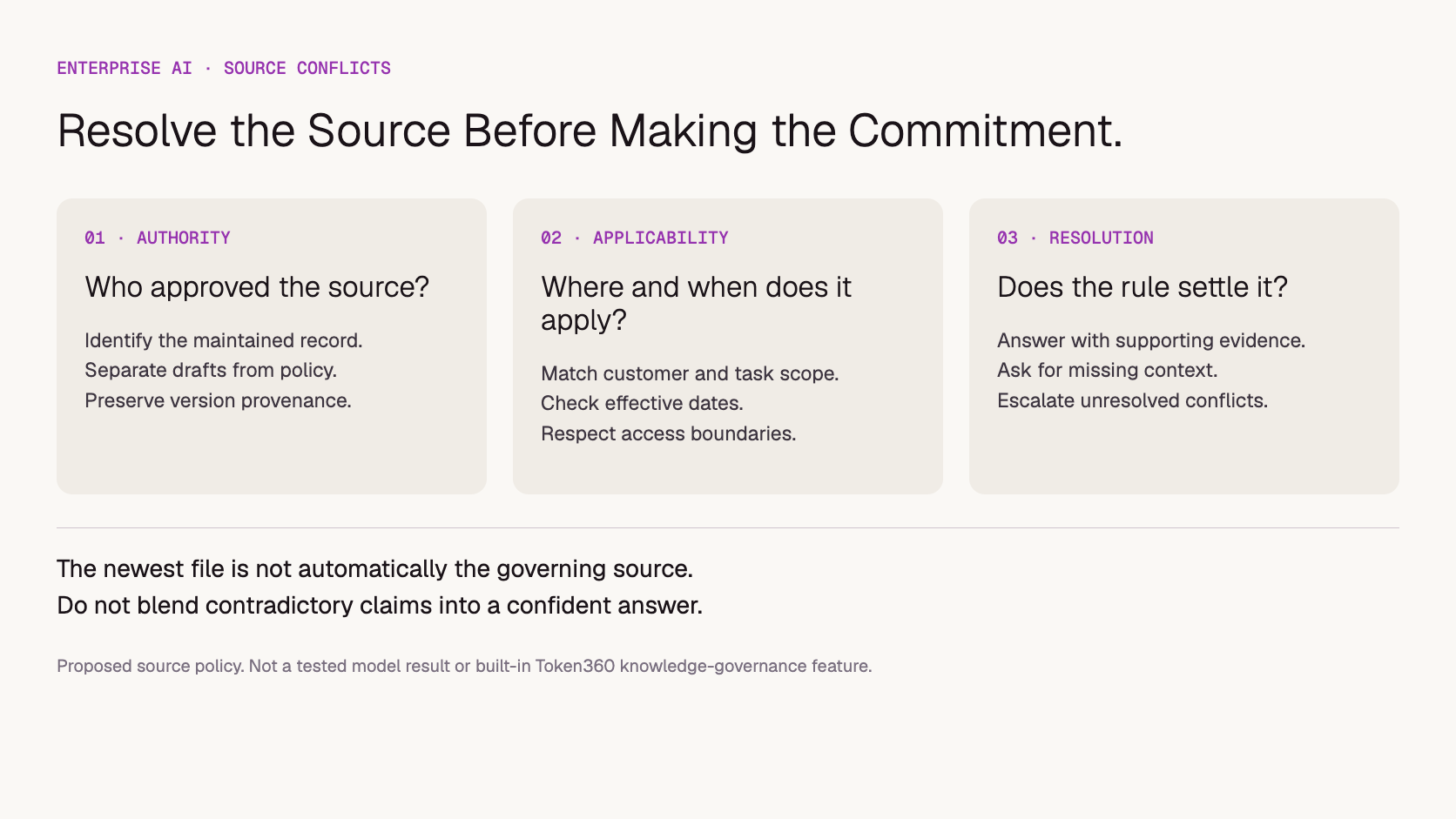
Proposed decision gate: authority, applicability, then resolution.
What should the AI say when it cannot resolve the conflict?
The response should identify the decision it cannot support, describe the authorized evidence at an appropriate level, and specify the next step. It should not fabricate a compromise or present one source as settled fact. Where the disputed detail affects a commitment or action, pause that part of the workflow.
An internal assistant could say: “The two approved onboarding records show different package limits for this account and period. I cannot confirm the entitlement from these records. Please ask the account owner to identify the governing version.” A customer-facing assistant might instead say: “I need to confirm the package included in your account before giving a final answer.”
Neither message should be used automatically without checking the user's access and the actual evidence. If a simple missing field resolves the issue, ask a targeted question—such as which service period the customer means—instead of sending every case to a human.
A case routed for review should include source identifiers, disputed claims, applicable dates, and the rule that could not resolve them. The enterprise human review guide covers reviewer authority and workload. Here the review must establish which source governs, not merely select the most fluent AI answer.
How do you test whether the workflow handles conflicts?
Create a small set of controlled source pairs with known expected outcomes, including cases where the right response is to ask or escalate. Evaluate source selection and answer wording separately. A correct final sentence does not prove the system chose the right evidence, and one successful example does not establish production reliability.
The following is a proposed test pack, not completed testing:
Newer draft, older approved source: the draft must not become the current policy.
Future change: the answer must distinguish announcement from effective date.
Account exception: the exception must apply only within its authorized scope.
Unresolved approved conflict: the response must avoid making the disputed commitment.
Missing source: the system must not claim it checked a record retrieval failed to supply.
Restricted evidence: the public response must not reveal a private source or its contents.
Corrected source: new answers and reused answers must stop relying on the retired version.
Review whether necessary evidence was retrieved, the business rule was followed, qualifications survived, and the next action was appropriate. Test a clean case too: excessive escalation can make a useful assistant unusable. Define acceptable outcomes with the source owner before comparing models.
When a source is corrected, update its indexed copies and dependent summaries. If the application reuses old answers, include cache invalidation in the correction path. The AI response caching guide covers why a previously valid answer can become invalid without its question changing.
Where does Token360 fit in this workflow?
Token360 can provide model access for extraction, comparison, and answer generation, while the enterprise application and its source owners define the governing information. Supplier selection should test whether the chosen model follows the approved conflict policy. Buying a more capable model does not replace source ownership, permissions, or version management.
Token360's enterprise offering covers text, image, audio, and video model access with custom enterprise pricing. For this use case, bring representative authorized document pairs, the expected decision for each, and the required review behavior. Confirm processing and commercial requirements for the engagement without assuming a managed knowledge base or automatic source governance is included.
Copy the blank source-conflict review worksheet to record the question, competing claims, approval states, scope, effective dates, governing rule, expected response, and resolution owner. This creates an auditable test specification without pretending the examples are real company records.
Will a larger context window solve conflicting information?
It may let the model read more evidence, but it does not establish which source has authority. Additional documents can also introduce more versions and exceptions. Evaluate whether the workflow follows the approved source policy rather than whether it can fit every document into one request.
Should the AI vote for the answer found in more documents?
No general majority rule is reliable. Several documents may repeat the same outdated source, while one approved record contains the current rule. Trace provenance and applicability instead of counting repeated statements as independent authority.
Does every discrepancy require stopping the whole workflow?
No. Pause the decision affected by the conflict. Other supported work may continue if it does not depend on that decision. For example, the system can organize a customer's request while withholding an unconfirmed commercial entitlement.
Can prompting alone enforce the policy?
A prompt can describe the rule, but access controls, source metadata, retrieval behavior, and action permissions also need implementation. Treat prompting as one layer and test the complete path. Do not describe an instruction in the prompt as proof that the rule is enforced.
About this guide: Written by Yuki Yu for Token360. The source hierarchy example, tables, and tests are editorial proposals. No model accuracy result or customer case is claimed.
Enterprise AI
API
Bring your next idea to life.
Create a video scene in Creator, or explore models for images, audio, and text to find the right capabilities for your project.



 Guides
 Guides
 Guides