AI APIs for Staffing: From Client Brief to Job Draft
Use AI APIs to turn staffing client briefs into job drafts, preserving required vs preferred skills, open questions and recruiter approval.
INDUSTRY USE CASES · STAFFING & RECRUITMENT
AI APIs for staffing agencies can turn client intake notes into structured role requirements, clarification questions and draft job descriptions. The useful output preserves what the client confirmed, separates requirements from preferences and leaves unresolved details open. Recruiters and clients still approve the role before it becomes a published vacancy or a downstream hiring criterion.
A client asks for a “senior operations person,” sends an old job description and adds changes during a call. The documents disagree about location, responsibilities and experience. Writing a polished advertisement is easy to request; establishing which requirements actually apply is the more valuable task.
This article describes a proposed workflow for staffing agencies, recruitment process outsourcing teams and recruiting-software vendors. It covers client intake and job-order preparation, not candidate ranking or automated hiring decisions. Examples are hypothetical, with no claim of a Token360 customer deployment or measured recruiting outcome.
Read first: choose AI models by business use case. This staffing workflow focuses on agreeing the job itself before producing candidate-facing content.
Which staffing task should an AI API handle first?
Start with a reviewable intake pack: a structured summary of the role, a list of conflicting or missing details and a draft based only on approved requirements. This gives recruiters something specific to verify. It also makes omissions visible before fluent prose hides uncertainty inside a seemingly complete job description.
The intake pack should answer what the person will do, which capabilities are necessary for that work, which preferences are optional and which employment details still need confirmation. A recruiter should be able to trace a material requirement back to the client source rather than ask the model to justify its own wording.
Keep the first workflow narrow enough to inspect. A staffing firm could begin with job-order preparation for one recurring role family. Its existing application retrieves the authorized client material; the model proposes a structured interpretation; the recruiter resolves discrepancies. Sending messages to candidates or publishing a vacancy can remain separate, approved steps.
A fixed form may already handle a consistent, complete brief. Model assistance is more relevant when sources arrive as varied prose, several languages or contradictory revisions. The business case should depend on useful intake work rather than generating more versions of an advertisement.
What belongs in the client intake package?
Supply the current job-order identifier, authorized source material, source dates and an explicit status for each requirement. Identify obsolete documents and distinguish client-confirmed facts from recruiter notes. Do not mix candidate records into the intake package when the task is only to define the vacancy; they are unnecessary for that purpose.
Input
What to preserve
What should remain unresolved
Role purpose and work
Actual tasks, reporting line and expected scope
Duties inferred only from a similar job title
Required capabilities
Client wording, rationale and confirmation state
Unapproved years of experience, degrees or certifications
Preferences
Optional status and accepted alternatives
Any conversion into mandatory screening criteria
Location and schedule
Worksite, working pattern and relevant conditions
Remote-work or shift promises absent from the brief
Pay and employment terms
Approved range, units, currency and arrangement
Estimated compensation presented as an offer
Client updates
Author, date, changed field and approval
Which conflicting statement wins without confirmation
An old description can be useful background without being the source of truth. Label it accordingly. If an email changes the work location but does not discuss compensation, do not assume that it approves every field from the old file. Resolve precedence at the field level where necessary.
If intake calls are used, work from recordings or transcripts the organization is authorized to process. Verify consequential details against the source: a missing “not,” an incorrectly transcribed number or a misunderstood place name can alter the job. Retain the source reference for review rather than treating a cleaned transcript as infallible.
How do you stop preferences becoming requirements?
Represent each criterion with its original wording, its status and its approved interpretation before drafting the advertisement. Require unresolved status when the source is ambiguous. Then compare the generated wording with that record: a more polished sentence must not change an optional capability into a prerequisite or silently remove an acceptable alternative.
Consider this illustrative client note: “They need to maintain our stock reports. Excel is essential; Python would be useful, but we can train that. Two days on site. We haven't agreed the salary yet.” An old description also asks for a degree and five years of experience, neither reconfirmed in this intake.
Draft statement
Review decision
Reason
“Python proficiency required.”
Reject
The client described it as optional and trainable.
“Fully remote operations role.”
Reject
The brief specifies two days on site.
“Competitive salary of [invented range].”
Hold
The pay range is unconfirmed; the model cannot supply the offer.
“A degree and five years' experience are mandatory.”
Clarify
These appear only in an old, unconfirmed description.
“Excel skills are required; Python is useful, with training available.”
Supported by this note
It preserves the essential/optional distinction; client approval is still needed.
This is an editorial acceptance example, not a model test. It shows why a draft can be grammatical and still define the wrong vacancy. The recruiter should resolve the degree and experience questions before they become filters elsewhere in the recruitment process.
Keep a separate clarification list. Ask the client for the worksite, agreed pay details and any genuinely required qualification. Avoid bundling those uncertainties into one broad question such as “Is this description okay?” Explicit questions make it easier to identify what was actually approved.
Can occupational taxonomies fill gaps in a brief?
Occupational taxonomies can help standardize terminology and suggest questions to ask, but they cannot establish an employer's requirements for a particular vacancy. Treat a taxonomy match as reference information. Keep client-confirmed criteria separate from general occupation descriptions so a useful vocabulary aid does not become an unauthorized specification.
The O*NET Content Model organizes information about occupations, including tasks, skills, knowledge and work context. That structure can help an intake designer distinguish the work to be performed from the capabilities being requested. It does not prove that every commonly associated qualification is essential for this client's job.
The European Commission's ESCO classification provides shared terminology for occupations and skills across languages. A staffing platform might use a controlled term to connect equivalent labels in its own records. The client must still confirm what the term means in the actual role and whether it is required or preferred.
For example, mapping an informal job title to an occupation can generate a useful follow-up: “Does this role include supervising staff?” It should not automatically add line-management duties to the advertisement. If a reference introduces a capability the client never mentioned, mark it as a question, not a requirement.
How should client approval and revisions work?
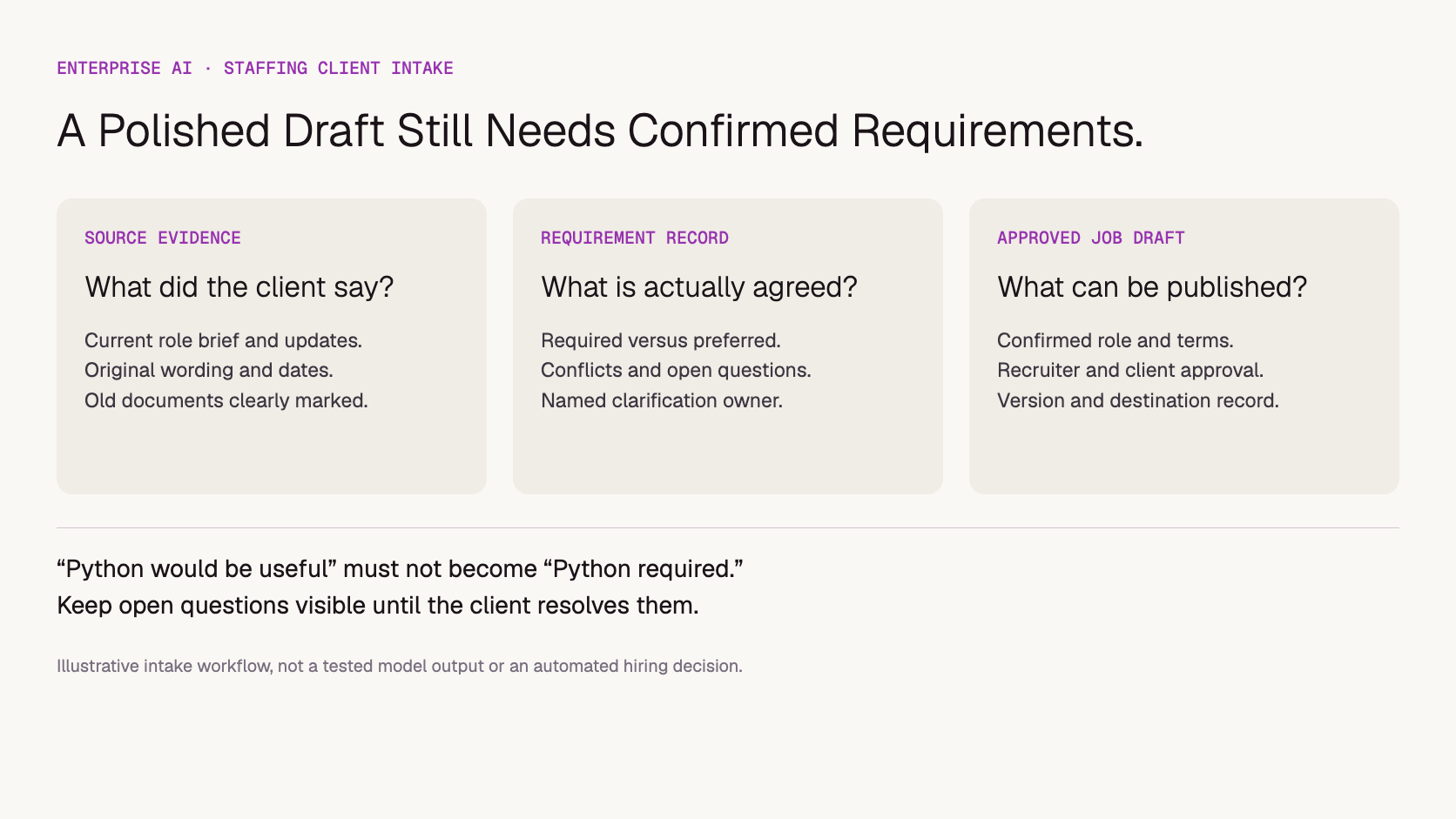
Approve a specific version of the requirement record and its candidate-facing wording, with a named owner and unresolved items visible. A general approval message should not silently authorize later changes. When the client revises a field, identify the affected draft and published destinations so the team can review and update them deliberately.
Proposed intake process. Source extraction, requirement confirmation and publication approval are distinct decisions.
In the illustrative role, the client might later change two on-site days to three. Record the new instruction and obtain the necessary approval for the revised wording. A recruiter should be able to see that the location pattern changed without rereading every sentence of the advertisement.
Maintain separate internal and external text. Internal notes may include unconfirmed options, commercial discussion or information not intended for a vacancy page. The advertisement should draw from approved fields rather than a raw dump of the client conversation. Any required wording or publication review should follow the organization's process for the relevant market.
The job intake review register provides blank fields for source references, requirement status, clarification owners, approved versions and publication destinations. It is a planning template; it does not synchronize an applicant tracking system (ATS) or update job boards.
Begin with a read-only intake workflow outside automatic publication. Your application retrieves one authorized job order, calls the selected model and stores the proposed interpretation for recruiter review. After approval, write back only through the ATS's supported integration or an explicit manual step, preserving the job-order identifier and version.
Select the record. Verify the client, job order and staff member's access before collecting documents.
Prepare the evidence. Label each source, its date and its approval status. Remove unrelated material.
Generate a draft pack. Request confirmed facts, preferences, conflicts, open questions and proposed wording as separate outputs.
Validate and review. Check required fields and source references, then have the recruiter resolve substantive issues with the client.
Commit the approved version. Record the real write result and any subsequent publication status; a generated confirmation is not evidence of a successful update.
Keep ATS credentials on the application side. The model needs relevant role information, not the system's secret keys. Verify that the job order has not changed while review was underway; if it has, compare the new source version before overwriting a record.
Structured output can make downstream handling easier, but a valid object can still label Python as mandatory incorrectly. Use the structured-output validation guide for the distinction between valid format and correct content. The staffing-specific acceptance criteria remain the client's approved requirements.
Candidate matching, scoring and selection are separate use cases with additional evaluation and governance needs. A successful job-drafting pilot is not evidence that a model can make those decisions appropriately. Keep that scope boundary explicit when discussing an expansion.
What should a staffing team measure?
Measure the quality and effort required to reach an approved intake pack, rather than counting drafts generated. Track unsupported requirements, missing qualifications, unresolved conflicts and recruiter correction work. Compare the proposed workflow with the team's existing process using the same source material, and separate drafting speed from the time needed for client decisions.
Create a small authorized evaluation set with agreed expected outcomes: a clean brief, an optional skill, a conflicting old description, an unspecified salary, a changed worksite and a multilingual note. For each case, define what must be preserved, what must remain open and what would make the draft unacceptable.
Requirement fidelity: Did the output preserve required, preferred and unconfirmed status?
Source traceability: Can the recruiter find the passage supporting each material criterion?
Clarification usefulness: Are open questions specific enough for the client to answer?
Revision control: Does the current draft reflect the approved source version?
Review effort: What checking and rewriting was needed before approval?
Record inference, transcription if used, retrieval, retries and staff review separately. An inexpensive draft that repeatedly changes requirements can cost more to approve. This article supplies no measured time saving, placement improvement or cost reduction. For a broader rollout decision, see when to move an AI pilot into production.
Where does Token360 fit in a staffing platform?
Token360 provides enterprise access to models that staffing firms and software vendors can evaluate for text extraction, structured drafting and other supported inputs. The recruiting application owns client records, access control, ATS integration and approvals. Choose model capabilities for the intake task rather than assuming that model access supplies a complete recruitment system.
As checked November 13, 2026, Token360's enterprise offering describes access across text, image, audio and video, with custom enterprise pricing. Capacity, contracts and compliance requirements can be scoped for an engagement. No native ATS connector, recruitment certification or automatic client-approval capability is claimed here.
For a first version based on emails and approved notes, start by evaluating text models. Scanned documents require suitable document or vision handling; intake-call audio requires a verified transcription path. Do not add media generation merely because it is available. The input formats and review process should determine the model mix.
For procurement, provide expected job-order volume, typical source size, languages, peak periods and whether the workflow is interactive or queued. Compare the cost per approved intake pack alongside review effort. Token360 does not charge a separate service fee according to company-confirmed information; model usage remains chargeable and the applicable rates depend on the offer. See Token360's service-fee policy for the commercial distinction.
For the downstream training handoff, the corporate training content workflow shows how to track reviewed source material and lesson revisions.
Frequently asked questions
Can an AI API write a job description from a client call?
It can draft from an authorized transcript or supported audio workflow. The recruiter should verify consequential details and confirm unresolved requirements with the client before approving the description. A confident transcript or draft does not establish that every detail was heard correctly.
Should the model add common requirements for the job title?
It can suggest clarification questions, but should not present general occupational assumptions as client-approved requirements. Preserve the source and approval status of degrees, experience, skills and responsibilities.
Can the same workflow produce multilingual job drafts?
Yes, subject to evaluation of the selected model and review in the target language. Preserve required versus preferred status, location, hours and employment terms. Fluent wording alone does not prove that the meaning stayed the same.
Does Token360 include an ATS integration?
No native ATS integration is established in this article. Your application or integration partner must connect the source system, handle authorization and verify writes. Token360 supplies model access for the tasks you evaluate.
Does this workflow decide which candidates qualify?
No. It prepares a role specification for recruiter and client approval. Using the resulting criteria for candidate assessment is a separate process and should not be treated as validated by a successful drafting demonstration.
Evidence scope: proposed intake workflow informed by O*NET, ESCO and Token360 official sources, checked November 13, 2026. The operations-role example is illustrative, not a generated sample or a client case. No model benchmark, hiring outcome or legal-compliance assessment is claimed.
Enterprise AI
API
Bring your next idea to life.
Create a video scene in Creator, or explore models for images, audio, and text to find the right capabilities for your project.



 Guides
 Guides
 Guides