AI APIs for Publishers: One Story, Reviewed Adaptations
Use AI APIs to adapt approved stories into briefs and audio while preserving sources, editorial review and a clear correction process.
INDUSTRY USE CASES · MEDIA & PUBLISHING
AI APIs for publishers can turn an approved source story into draft summaries, newsletter copy and audio scripts, while leaving factual verification and publication decisions with the editorial team. A useful workflow keeps each adaptation linked to the source version, its permissions and its reviewer. It also identifies which outputs need updating when the source changes.
For a trade publisher, specialist magazine or digital media company, producing another version is only part of the work. A short summary must preserve qualifications. A narrated article must pronounce names correctly. A corrected report must not leave its old claims circulating in a newsletter archive or audio edition. These are publishing decisions, not simply generation tasks.
Read first: choose AI models by business use case. This article focuses on editorial adaptations and corrections, rather than advertising campaigns or a general translation tutorial.
Where can AI APIs help a publishing team?
Start with a bounded transformation of material the team is authorized to use: a source-based abstract, headline options, newsletter introduction or narration script. Define the permitted changes and the intended reader before generating. The first deliverable should be an editable draft with evidence attached, not an item silently pushed into a publishing queue.
A specialist publisher might adapt a reviewed industry interview into a brief for subscribers. The model can propose a concise structure, but an editor still checks whether the interviewee's claims are distinguished from independently established facts. Another task might create an audio script from an approved explanatory article without adding new examples or turning tentative language into certainty.
There is a concrete industry reference for this distinction. In its July 23, 2026 newsroom standards update, AP describes AI assistance for tasks including transcription, translation, summaries and headline suggestions, while retaining journalist review and responsibility. These are AP's rules, not a universal permission for every publisher or a claim about Token360 customers.
Choose a task with a clear reference answer and manageable review effort. “Produce a draft subscriber brief from this approved report” is easier to evaluate than “run our newsroom.” Keep original reporting, source verification, editorial positioning and release authority explicit in the workflow.
What belongs in the source package?
Provide the approved article version, the relevant supporting material and an adaptation brief that states what must survive the rewrite. Identify protected wording, attribution, uncertainty and exclusions. Separate source facts from instructions, so the model is not asked to infer editorial policy from a mixture of comments, old drafts and final copy.
At minimum, keep a source identifier and version, the approved text, any approved quotations, image captions and credits, the intended channel, and the review owner. Add a clear instruction for unresolved information: flag it rather than supplying a plausible detail. For confidential or embargoed material, check the selected service and access arrangements before submission.
Imagine a hypothetical trade article about a manufacturer planning a pilot facility. The source says the project is proposed, subject to approval, with no confirmed opening date. The brief should preserve all three limits. A generated headline announcing that the facility “opens next year” fails even if it is more engaging and fits the character limit.
That example illustrates why a polished article alone may not be enough input. Record the facts and qualifications that matter to the adaptation. Editors should be able to inspect the passages behind a claim without searching an entire shared drive. This is a suggested workflow, not an assertion that Token360 supplies a publisher's source repository.
How should summaries and headlines be reviewed?
Review meaning before style: check whether the draft preserves who said what, the scope of the evidence and the uncertainty of the original. Then judge length, tone and channel fit. A summary can omit background, but it should not remove the qualification that changes the meaning of the central claim.
Adaptation
What may change
What needs explicit review
Headline
Order, phrasing and length
Attribution, certainty and implied conclusion
Subscriber brief
Structure and level of detail
Essential caveats, figures and source links
Audio script
Sentence rhythm and spoken explanations
Names, numbers, quotations and added context
Translated edition
Language and local explanation
Meaning, terminology and culturally ambiguous wording
Social excerpt
Length and opening sentence
Whether the excerpt still makes sense without the full article
Keep exact quotations separate from paraphrases. A model should not improve a quotation's fluency and leave quotation marks around the changed words. When a shorter passage is needed, an editor can choose a faithful excerpt or approve an attributed paraphrase under the publication's own standards.
A practical review record can identify the source passage, the generated sentence and the reason an editor accepted or changed it. This makes recurring errors visible: omitted qualifiers, merged speakers, mistaken dates or exaggerated causal language. Checking only grammar would miss those problems.
Do not use the model's own assurance that it “preserved all facts” as the acceptance test. Compare the output with the source. For a recurring brief format, build examples that contain the difficult cases the publication actually encounters, rather than evaluating only straightforward announcements.
What changes when an article becomes audio or video?
Audio and video introduce checks that a text-only review cannot complete. Review the final rendered asset for pronunciation, pacing, omissions and the relationship between narration and visuals. Approval of a script does not establish approval of the resulting recording, captions or visual sequence; each can introduce a separate discrepancy.
For narration, prepare a pronunciation list for unfamiliar names and acronyms and verify it against the actual output. Check numerical expressions in context: a range, a percentage change and an absolute amount should remain distinguishable when spoken. Listen through the result rather than relying only on a transcript generated from the audio.
If a short video is appropriate, the visual plan should state which images are documentary evidence and which are explanatory illustrations. A generated factory scene could misleadingly suggest that a proposed facility already exists. A clearly identified conceptual diagram may serve a different editorial purpose, subject to the publisher's policy.
AP's same 2026 update continues its prohibition on using generative AI to create, alter or enhance news photography. That is a useful example of a newsroom-specific visual boundary. A model platform offering image generation does not override the publication's standards for documentary material.
For translated narration, the video localization guide covers the separate language and dubbing decisions. Here the publishing requirement is to link the translated or spoken version to the approved story, and to review the output in its actual delivery format.
How should credits, permissions and source identity travel?
Keep usage information attached to assets and records throughout adaptation, including the final delivery path. A file being available in the editorial library does not by itself establish permission for every new format or service. Preserve creator, credit and rights information, and have the appropriate owner resolve any uncertain reuse scope.
The IPTC Photo Metadata User Guide explains fields for creator information, credit lines and rights, along with metadata for AI-generated imagery. It also identifies preservation of embedded metadata as a workflow concern. These fields help carry information; they are not proof that a particular reuse is authorized or that an image's content is true.
Test the complete asset path. A source image may carry useful metadata locally while a resizing or delivery step produces a derivative without it. Compare the original with the actual file delivered to readers, and keep an internal asset record where information cannot be preserved in the same form.
Define reader-facing disclosure according to the publication's policy and the nature of the work. Distinguish an AI-assisted spelling check from synthetic narration or a conceptual illustration. Keep a production record even when a minor internal assistance step does not require the same visible treatment as a generated visual.
What happens when the source story is corrected?
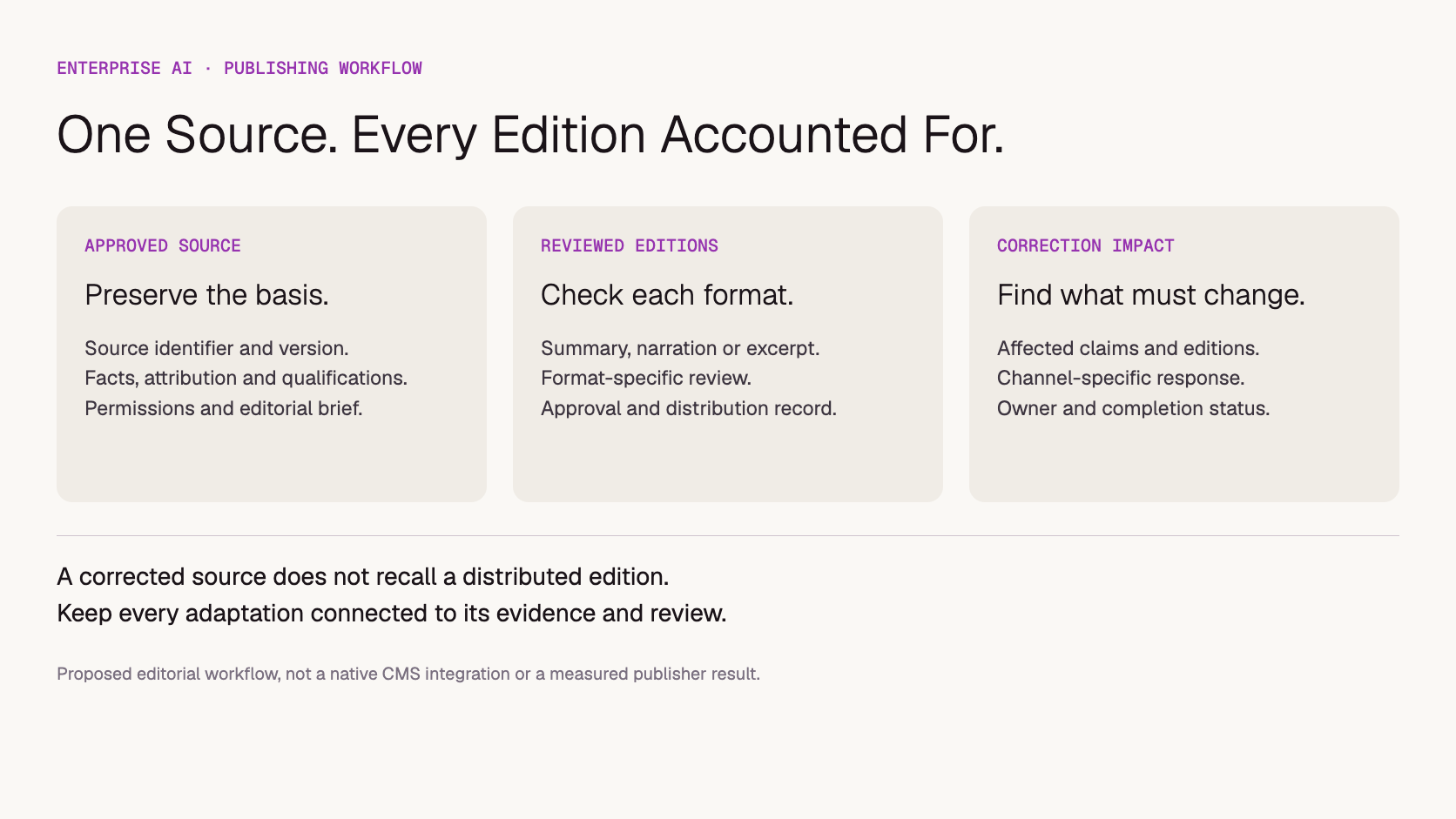
A correction should trigger a review of linked adaptations, not just an edit to the main article. Record which versions used the affected fact, whether they have already been distributed and who owns the response. Updating a source file cannot automatically change a sent newsletter, a downloaded audio file or an independently hosted excerpt.
Suggested editorial record: source version, adaptation review and correction impact. This is not a native Token360 CMS feature.
In the hypothetical facility story, suppose the reported location is corrected. The editor needs a list of outputs that used the location: perhaps the brief text, audio script and social excerpt, but not a general topic illustration. This dependency record is more useful than rerunning every asset indiscriminately.
Use clear states such as draft, approved, distributed, superseded and correction required. Preserve the previous version as part of the editorial record while making the current intended version unambiguous. Decide separately whether a channel needs replacement, a correction notice or another response under the publication's policy.
The edition review register is a blank planning template for source version, channel, reviewer, distribution location and correction status. It does not send updates or recall content. Your CMS, newsletter platform and asset systems need their own implementation and ownership.
Evaluate accepted adaptations and the editing work required to reach them. Track factual changes, missed qualifications and correction handling alongside generation cost and turnaround. If a cheaper draft requires extensive checking, its lower model bill may not translate into a better publishing process. Establish the comparison using your own reviewed examples.
Start with authorized historical articles that contain varied editorial challenges: multiple speakers, uncertain outcomes, revised figures, specialist terminology and unusual names. Define expected facts and prohibited changes before comparing outputs. Include formats the team will actually publish, rather than treating a good text summary as evidence that audio will work equally well.
Fidelity: Did the adaptation preserve the essential facts, attribution and qualifications?
Editorial effort: What required checking, rewriting or regeneration?
Format quality: Was the final audio, text or visual asset acceptable in its intended channel?
Traceability: Could a reviewer find the source and the approval record?
Correction readiness: Could the team identify affected editions after a source change?
For costing, add model usage, preprocessing, retries, review, editing and distribution-related work. Keep those components visible rather than claiming that token price alone describes the cost of a published edition. This article supplies no tested accuracy percentage, newsroom productivity gain or guaranteed saving.
A reasonable initial pilot produces drafts for one recurring format with a named editor. Expand to another format only when its distinct acceptance checks are defined. Read the pilot-to-production guide for the broader rollout decision.
Where does Token360 fit in a publisher's stack?
Token360 supplies enterprise access to text, image, audio and video models that a publisher can evaluate for permitted editorial tasks. The publisher still owns source management, review policy, publishing integrations and corrections. Select services around the required formats and data arrangements rather than assuming one model or API request handles the entire editorial operation.
As checked November 12, 2026, Token360's enterprise page describes multimodal model access and custom enterprise pricing. Capacity, contracts and compliance requirements should be scoped for the engagement. This article does not claim a native newsroom system, automatic rights verification, a CMS connector or a blanket service guarantee.
When discussing procurement, describe the types and sizes of source material, expected adaptation volume, deadlines, review process and required model capabilities. Explain which work can wait for a scheduled production window and which requires a faster response. Request a quote for that workload rather than selecting a supplier from a single demonstration.
How do you connect the first editorial pilot?
Start with a read-only export of approved text from the CMS or editorial repository. Your application attaches the source identifier, version and adaptation brief, calls a selected text model, and saves the returned draft beside those inputs. An editor reviews it before the publishing system accepts it. No CMS write permission is needed for this initial drafting workflow.
For the proposed facility example, the review must reject “opens next year” and preserve “proposed, subject to approval; opening date unconfirmed.” Store that expected meaning with the test case. Add narration only after the text review works, using a separately checked audio output and a source-to-edition record. This staged setup makes a bad summary distinguishable from a narration or publishing failure.
Teams adapting published material into lessons can use the corporate training content workflow to track which sources support each teaching point.
Frequently asked questions
Can an AI API publish articles without an editor?
An API can generate text; that does not establish that the text meets a publication's standards. This proposed workflow requires review before release and keeps publication authority in the publisher's own systems.
Should publishers use generative images for news stories?
Follow the publication's visual standards and distinguish documentary evidence from illustration. AP, for example, prohibits generative changes to news photography. A synthetic image should not be presented as proof of an event it did not record.
Is an approved article enough to approve its audio version?
No. Check the actual audio for names, numbers, omissions and delivery. A correct script does not guarantee a correct or usable recording.
Does Token360 automatically update every edition after a correction?
No such capability is claimed here. The publisher needs source-to-edition records and channel-specific actions for updates, replacement or correction notices.
Which publishing task should a team pilot first?
Choose a recurring, bounded transformation of authorized material with a clear editor and acceptance criteria, such as a draft subscriber brief. Measure factual fidelity and review effort before adding more formats.
Evidence scope: editorial workflow analysis based on AP's July 23, 2026 announcement, the IPTC user guide and Token360's enterprise page, checked November 12, 2026. The facility story is hypothetical. No publisher deployment, controlled model test or measured business outcome is claimed.
Enterprise AI
API
Bring your next idea to life.
Create a video scene in Creator, or explore models for images, audio, and text to find the right capabilities for your project.



 Guides
 Guides
 Guides