Enterprise AI ROI: Do Saved Hours Become Business Value?
Measure enterprise AI ROI by separating saved time, useful capacity and realized financial benefits. Include full costs and avoid double counting.
ENTERPRISE AI · BUSINESS VALUE
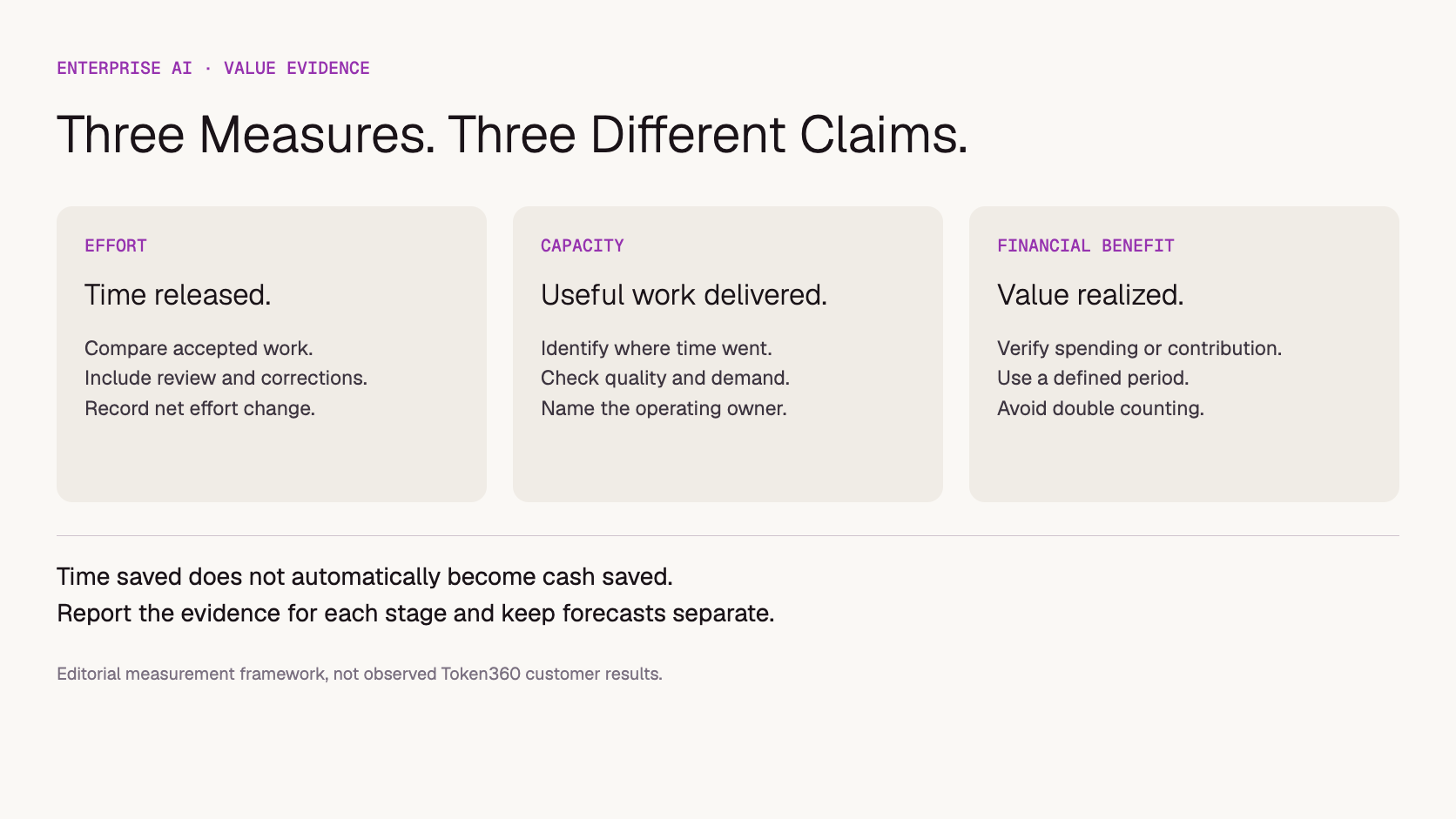
Enterprise AI ROI measures the financial return from an AI initiative against its cost over a defined period. Hours saved are useful evidence of efficiency, but they are not automatically cash savings. Establish what changed in the workflow, where the released time went and which business benefit can reasonably be attributed to that change.
Report three things separately: the operational improvement, the realized financial benefit and the cost of delivering it. A faster drafting process can create valuable capacity without reducing payroll. A lower model bill can improve economics without proving that customers received better outcomes.
Read first: AI API total cost of ownership. This article focuses on the benefit side and the evidence needed to connect spending to realized value.
Why is time saved different from money saved?
Time saved describes a change in effort. Money saved requires an actual reduction or defensible avoidance of spending. If employees finish a task sooner but payroll and purchased services remain unchanged, the immediate result is available capacity. Its business value depends on what the organization can do with that capacity.
Released time may help reduce a backlog, improve service or support more customers. Those outcomes can justify an investment. They should still be named accurately: “additional cases handled with the same team” is stronger evidence than multiplying every minute saved by a salary rate and calling the result cash savings.
The Australian National AI Centre’s guidance on measuring AI return connects time savings with useful redeployment and describes benefits beyond direct financial returns. Use those operational benefits in a broader value report, while keeping a financial ROI calculation explicit about which benefits have been monetized.
Which benefits belong in an enterprise AI value report?
Classify benefits by the change they represent: reduced spending, useful capacity, incremental contribution or improved quality and service. Each category needs different evidence. Keep unverified opportunities outside the realized-benefit total, and do not count the same improvement twice merely because it can be described in more than one way.
Benefit category
Evidence to look for
Common overstatement
Cash spending reduced or avoided
A comparable invoice, approved budget or documented expense that changed because of the workflow
Salary-value estimates presented as payroll savings
Capacity released and used
Useful work completed with the available time, with quality maintained
All theoretical saved hours treated as utilized capacity
Incremental business contribution
Attributable additional business, less the relevant variable costs
All new revenue assigned to AI, regardless of other changes
Quality or service improvement
Comparable error, rework, turnaround or customer outcome measures
An attractive output or faster response treated as a business outcome
The FinOps Foundation’s Quantify Business Value domain connects technology usage and spending to stakeholder outcomes and objective measures. That is a useful distinction for model procurement: token volume describes consumption, while the business case must explain what that consumption achieves.
Use nonfinancial measures when monetization would be speculative. A measured improvement in turnaround time can be reported directly without inventing a dollar value. Conversely, a financial benefit should have an accountable business owner who can explain its basis.
How should you establish a fair baseline?
Compare the same business task at a similar difficulty and quality standard, and measure the whole workflow rather than only model generation. Include input preparation, review, corrections and failed attempts. Record changes in staffing, demand and process design so that improvements from those changes are not automatically attributed to AI.
For document work, the baseline might be time per accepted case, including exceptions. For a creative team, it might be effort per approved deliverable, including discarded versions and editing. For customer service, it might include resolution quality and repeat contacts as well as handling time.
Keep the denominator clear. If employees use the feature on only some eligible tasks, do not apply the measured time reduction to every task in the department. Separate eligible volume, actual use and acceptable completed work. Include difficult cases rather than reporting only the easiest examples.
Where practical, compare similar groups or matched tasks during the same period. If you only have a before-and-after observation, state that limitation. A seasonal decline in workload, a better knowledge base or a revised process may explain part of the result.
This measurement question is narrower than deciding whether a pilot is ready to scale. A scale decision also needs operational and ownership evidence; this article asks whether a benefit claim is economically defensible.
What does a worked AI ROI example look like?
A useful calculation begins with accepted work and net effort, then identifies the portion of improvement that changes a financial outcome. The example below is entirely hypothetical. It illustrates how a project can release capacity and show positive ongoing economics while still having a negative return during its initial investment period.
Hypothetical monthly input
Assumption
Comparable accepted cases
1,200
Effort without AI, including normal review
15 minutes per case
Effort with AI, including review, correction and allocated failed-attempt effort
10 minutes per case
Net capacity released
1,200 × 5 ÷ 60 = 100 hours
Released hours put to useful work
60 hours; 40 hours not yet assigned to a verified benefit
External spending avoided through that redeployed work
$1,200, assumed verified by the business owner
Incremental recurring cash cost for the AI workflow
$900, including model usage and incremental paid operating services
One-time implementation cash cost
$3,600
For a simple cash-basis view, assume payroll is unchanged, internal time is reported separately, and no other incremental cash costs or financial benefits occur. The ongoing monthly net benefit is $1,200 − $900 = $300. Relative to recurring cost, that is 33.3%, but it excludes the initial implementation investment.
Over the first three months, assuming the same result each month:
These are different time horizons, not contradictory conclusions. Neither calculation is a forecast of Token360 customer performance. A broader economic appraisal would also value internal implementation and oversight effort consistently; it should be labeled separately from this cash-basis example.
Do not add a salary-value estimate for the same 60 redeployed hours on top of the $1,200 avoided spending. That would count the same underlying benefit twice. Report the 100 hours of released capacity and its utilization alongside the financial result, without summing them into a second benefit.
What can make an apparently positive ROI disappear?
A positive estimate can reverse when adoption is lower, review effort is higher, the expected expense does not disappear or implementation costs are omitted. Test the assumptions that connect model output to realized benefit. Sensitivity analysis should change those assumptions explicitly rather than conceal uncertainty inside a single optimistic percentage.
In the hypothetical example, if avoided monthly spending were only $600 while recurring cost stayed at $900, the workflow would have a recurring net cash loss of $300 before implementation cost. It might still provide valuable service or capacity benefits, but the cash-savings claim would no longer hold.
Three questions often expose the weak link:
Did the work actually move? Time released in scattered small intervals may not be usable for the planned activity.
Did quality stay acceptable? More corrections or repeated customer contacts may offset the initial time gain.
Did the financial event occur? A proposed reduction in outside spending remains a forecast until the comparable expense is actually avoided or reduced.
Model price is only one variable. For a detailed cost comparison, use the TCO worksheet approach. For a customer-facing paid feature, assess customer-level unit economics separately; a company-wide productivity report is not a substitute for contribution analysis.
What should leadership see in the recurring review?
Show the expected benefit, observed workflow change, realized outcome, cost basis and remaining uncertainty together. Name who owns each claim and what evidence supports it. This allows leadership to distinguish a promising initiative that needs process changes from one whose apparent success rests on an unverified assumption.
A proposed reporting framework. Progress through one stage does not automatically establish the next.
A useful review record says, for example, “handling effort fell on the measured cases, quality stayed within the agreed threshold, and the operations owner used part of the released capacity to reduce external work.” Each clause requires its own evidence. An API dashboard can support the usage and cost record; it cannot establish all of these business outcomes by itself.
Revisit the baseline when the task, model or workflow changes materially. Keep the earlier result tied to the conditions under which it was observed. Also distinguish forecast benefits from realized benefits in different columns so that delayed results do not quietly become reported savings.
Download the blank AI benefit evidence register. It includes baseline scope, adoption, effort, quality, benefit category, realization evidence, period, cost basis and owner. It contains no customer results or recommended return target.
Model procurement contributes to the cost and capability of an AI workflow; the customer’s operating process determines how that capability becomes business value. Bring Token360 a defined workload, acceptable quality requirements and expected usage. Evaluate a quote against those requirements rather than treating a lower unit price as proof of higher ROI.
Token360 works with enterprise buyers across text, image, audio and video models. Pricing, capacity, contracts and compliance requirements can be scoped to an engagement. Discuss the relevant requirements through the Token360 enterprise page; learn more about Token360.
For a useful commercial discussion, separate the supplier’s usage estimate from your own adoption and business-benefit assumptions. Procurement can negotiate the former; the application and business owners need evidence for the latter. No model-access supplier can establish your realized return solely from the number of API calls billed.
Frequently asked questions
What is the basic enterprise AI ROI formula?
For a defined period and consistent basis, use (attributable financial benefits − initiative costs) ÷ initiative costs × 100. State which costs and benefits are included. Report nonfinancial outcomes separately rather than assigning unsupported dollar values to them.
Can we count employee time at an hourly rate?
Yes, as a clearly labeled estimate of capacity or economic value, with an explained valuation method. It is not automatically cash saved. Do not also count a financial benefit produced by the same hours without checking for double counting.
Does negative short-term ROI mean the project should stop?
Not necessarily. Initial costs, timing and nonfinancial objectives matter. Explain the remaining investment case and evidence needed for future benefits. A negative result should prompt review, not be concealed by changing the denominator or relabeling forecasts as realized savings.
Should token usage be a success metric?
Token usage is a consumption measure. It helps explain costs and adoption patterns, but higher usage can also reflect longer inputs, retries or inefficient work. Link usage to accepted work and business outcomes before describing it as value.
Evidence note: editorial measurement guidance based on the official sources linked above. Every dollar amount, workload count and time assumption in the worked example is hypothetical. No customer results, measured savings or guaranteed returns are claimed.
Enterprise AI
API
Bring your next idea to life.
Create a video scene in Creator, or explore models for images, audio, and text to find the right capabilities for your project.



 Guides
 Guides
 Guides