Do You Need to Train a Model Before Using an AI API?
You can use a pretrained model API without training it yourself. Learn what to prepare first and when a separate customization project is justified.
No—if you buy API access to an existing pretrained model, you do not normally need to train it yourself. You send supported inputs and receive results through inference. You still need to define the task, supply necessary business information and check the outputs. Custom training is a separate decision, not an automatic prerequisite for model access.
That distinction matters when an enterprise project stalls because someone believes the company must first label its entire document archive or hire a model-training team. A request to summarize a supplied document is different from a request to create a new model. Before approving either budget, ask what the supplier is actually selling and what work your use case requires.
This guide covers the starting decision for buyers of existing generative models. It is not a training tutorial or evidence that an unmodified model will meet every business requirement. Official sources were checked November 17, 2026. The example and worksheet below are proposed planning tools, not customer results.
What is the difference between training and using a model?
Training changes a model through a learning process. Inference uses a trained model to produce an output from an input. An API is an access mechanism: it can expose inference, training or other operations. The important purchasing question is whether your chosen service already supplies a callable model or expects you to provide one.
AWS describes inference as using a trained model and distinguishes services that serve pretrained or custom models. The word “inference” therefore does not mean your company must perform the original training. Someone trained the model; that someone need not be the API customer.
What you purchase
What it means for getting started
What to confirm
Access to a listed pretrained model
You can evaluate supported requests without creating model weights.
Exact model ID, permissions, input requirements and charges.
Hosting for your own model
You may need to supply compatible model artifacts.
Who supplies, validates and deploys the artifacts.
A customization project
Additional data preparation and model adaptation may be included.
Deliverables, evaluation criteria and separate costs.
What can you try without creating a training dataset?
You can test whether an existing model performs a supported task using instructions and representative inputs. Examples include summarizing a supplied document, drafting text from approved facts or generating media from a brief. This establishes a baseline. It does not prove that the output is accurate, safe to publish or suitable for every production case.
Google Cloud’s application-development guidance explains that foundation models can perform varied tasks from prompts without explicit training for each task. It also treats model selection, customization, evaluation and deployment as distinct activities. Capability without task-specific training is the starting opportunity; evaluation determines whether it is useful for your workflow.
For a proposed product-description workflow, provide an approved product record and ask for a short draft. Check whether specifications stay correct, unsupported claims are omitted and the style is usable. Do not ask the model to invent missing specifications. This example could reveal useful performance—or a reason to stop—before funding a customization project.
The same principle applies to media, although supported inputs differ. A reference image in a generation request may guide that output; it is not, by itself, evidence that a supplier has trained a dedicated product model.
What information do you still need before the first request?
You need a defined input, an expected result and someone who can judge the difference. You also need permission to send the chosen data and an integration that can submit a valid request. None of these requires a full training dataset, but skipping them makes a successful API response difficult to interpret.
Prepare a small task brief with the following items. Its purpose is to make the first evaluation meaningful, not to prescribe a universal sample count.
Task: the specific work the model should perform, such as drafting rather than publishing.
Input: the approved document, record, image or other supported material it should use.
Acceptance criteria: required facts, prohibited claims, format and review conditions.
Failure examples: missing information, conflicting facts and inputs the application should reject or escalate.
Owner: the person authorized to accept the result or ask for another approach.
Download the first-request brief to record these decisions. Keep evaluation examples separate from any later training set so that a customization can be assessed on cases it was not explicitly taught. If preparing the inputs is the blocker, use the business data-readiness checklist rather than treating all data preparation as model training.
Does sending company information train the model?
Including information in a request is not the same operation as running a training job. Context can influence the current answer without becoming a permanent model update. However, that technical distinction does not establish a supplier’s retention or future data-use policy. Those questions require the applicable terms and configuration to be checked separately.
A model may correctly answer from a policy document included with one request and lack that policy on a later request. Whether the application retains conversation state, retrieves documents or resends context is an implementation question. Do not promise employees that the model “now knows our company” merely because one demonstration worked.
For procurement, separate three statements: “the request contained company data,” “the service retained that data,” and “the data was used for training.” One does not establish the others. Our article on data retention versus training covers the policy review in more detail.
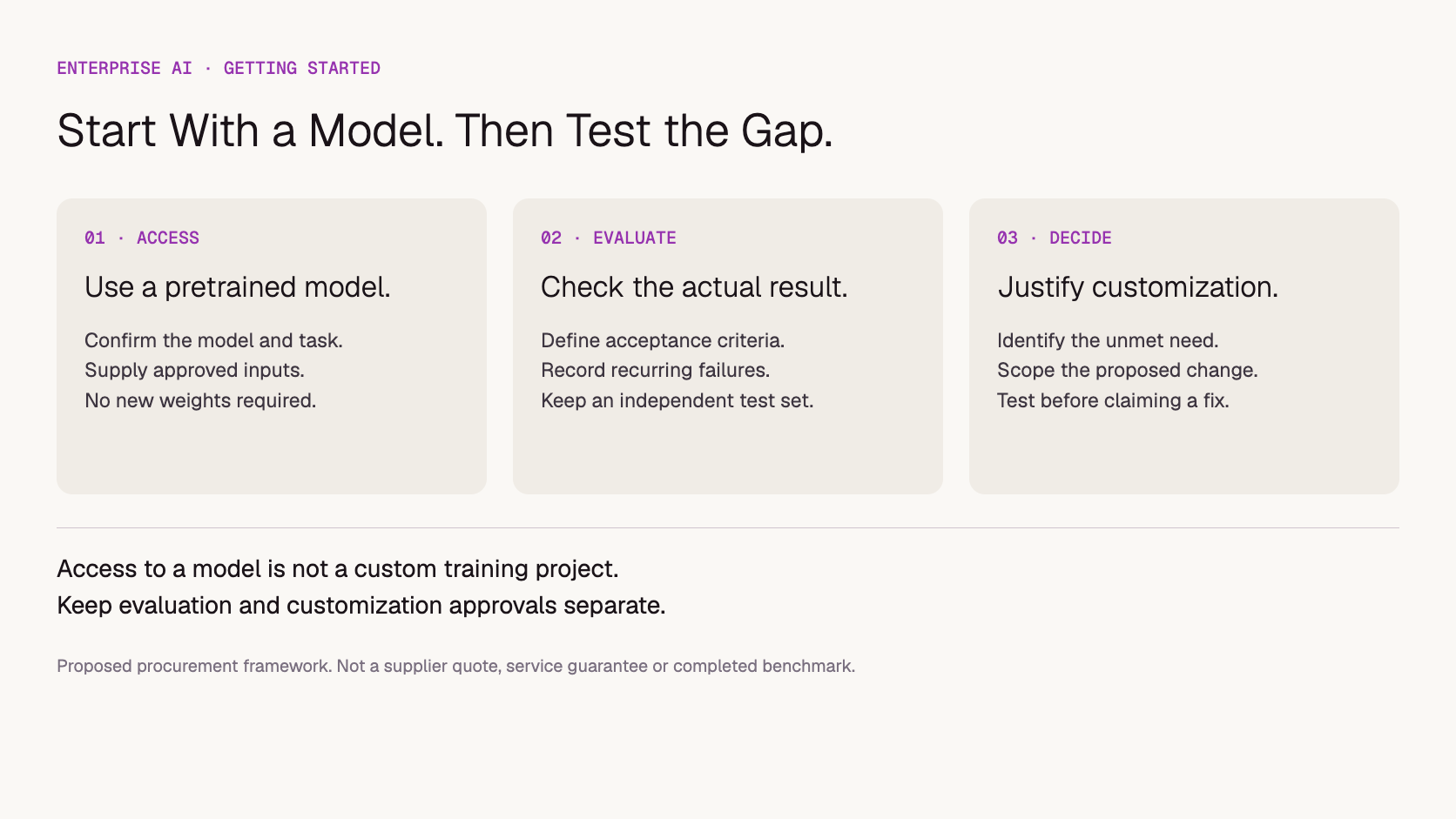
A proposed buying sequence, not a guarantee that a baseline model will pass.
When is a separate training project worth discussing?
Discuss training or customization when you can describe a recurring performance gap and have evidence that the current approach does not satisfy it. First identify whether the failure comes from missing facts, unclear instructions, an unsupported capability or model behavior. A poor answer alone does not show that additional training is the appropriate remedy.
Return to the product-description example. If the product record omits dimensions, a training project is not a reliable substitute for the missing source. If the record is complete but outputs repeatedly violate a specialized requirement, investigate that gap with controlled examples. Depending on the problem, changes to the prompt, application or model choice may be enough; none should be declared a verified fix before testing.
At that point, the next question becomes whether RAG, fine-tuning or neither fits the problem. That is a different decision from whether training is required to start using a listed model API. Keep the two approvals separate: access for evaluation first, then a justified customization scope if needed.
What should the supplier quote include?
Ask the supplier to distinguish inference access from application integration and optional customization. The quote should identify the model being supplied, how usage is charged and what help is included. If training appears as a required line item, ask which demonstrated requirement makes it necessary and how the resulting improvement will be accepted.
Useful questions include: Is this access to an existing model? Must we provide weights or labeled examples? Is the proposed fee for integration, data preparation or training? What happens if the baseline already meets our needs? Who owns evaluation and ongoing maintenance? These questions prevent a broad “AI setup” description from hiding different deliverables.
Token360’s enterprise offering covers access across text, image, audio and video models, with engagement-specific commercial discussions. That does not establish that every model supports customer fine-tuning or that custom training is included. Start with the required task and model access; confirm any adaptation project separately. The model catalog and pricing page help identify the candidate service, while the pre-contract evaluation guide covers test arrangements.
Frequently asked questions
Can a business start using AI without its own training data?
Yes, when evaluating an existing pretrained model for a supported task. It still needs representative inputs and a way to judge the result. Having no training dataset does not mean having no data responsibilities or no evaluation work.
Is adding examples to a prompt the same as fine-tuning?
No. Examples in a prompt guide that request; fine-tuning is a separate model-adaptation process. Confirm the actual operation being purchased instead of relying on a supplier’s informal use of “teach” or “train.”
Does avoiding training mean there are no setup costs?
No. Integration, data preparation, evaluation and operational controls can still require work. Ask for these costs to be separated from inference usage and any optional customization. This article does not estimate savings or promise free onboarding.
Should we buy a training project before testing an API?
For a use case that an existing model might support, first establish what that model can and cannot do. A separate training project should address a documented need, unless requirements already rule out that baseline. Production acceptance remains necessary in either case.
About the publisher: Token360. Written by Yuki Yu. This article explains a procurement distinction; it does not report a model benchmark, guarantee output quality or confirm custom-training availability for a particular model.
Field,Your decision,Evidence or owner
Task,,
Model ID and supported inputs,,
Approved input material,,
Required facts and prohibited claims,,
Acceptance criteria,,
Failure and missing-information cases,,
Reviewer,,
Observed gap after baseline,,
Separate customization decision,,
Enterprise AI
API
Bring your next idea to life.
Create a video scene in Creator, or explore models for images, audio, and text to find the right capabilities for your project.


 Guides
 Guides
 Guides