Plan an AI API evaluation before committing: agree access, budget, data terms, acceptance checks and what the trial does not prove.
ENTERPRISE AI · BEFORE YOU COMMIT
Ask for a bounded API evaluation before making a long-term purchase commitment. Confirm which models, configuration, budget, data terms and supplier support apply to the test. Self-service access may let you start quickly, but it does not establish free usage, production capacity or approval to send confidential information.
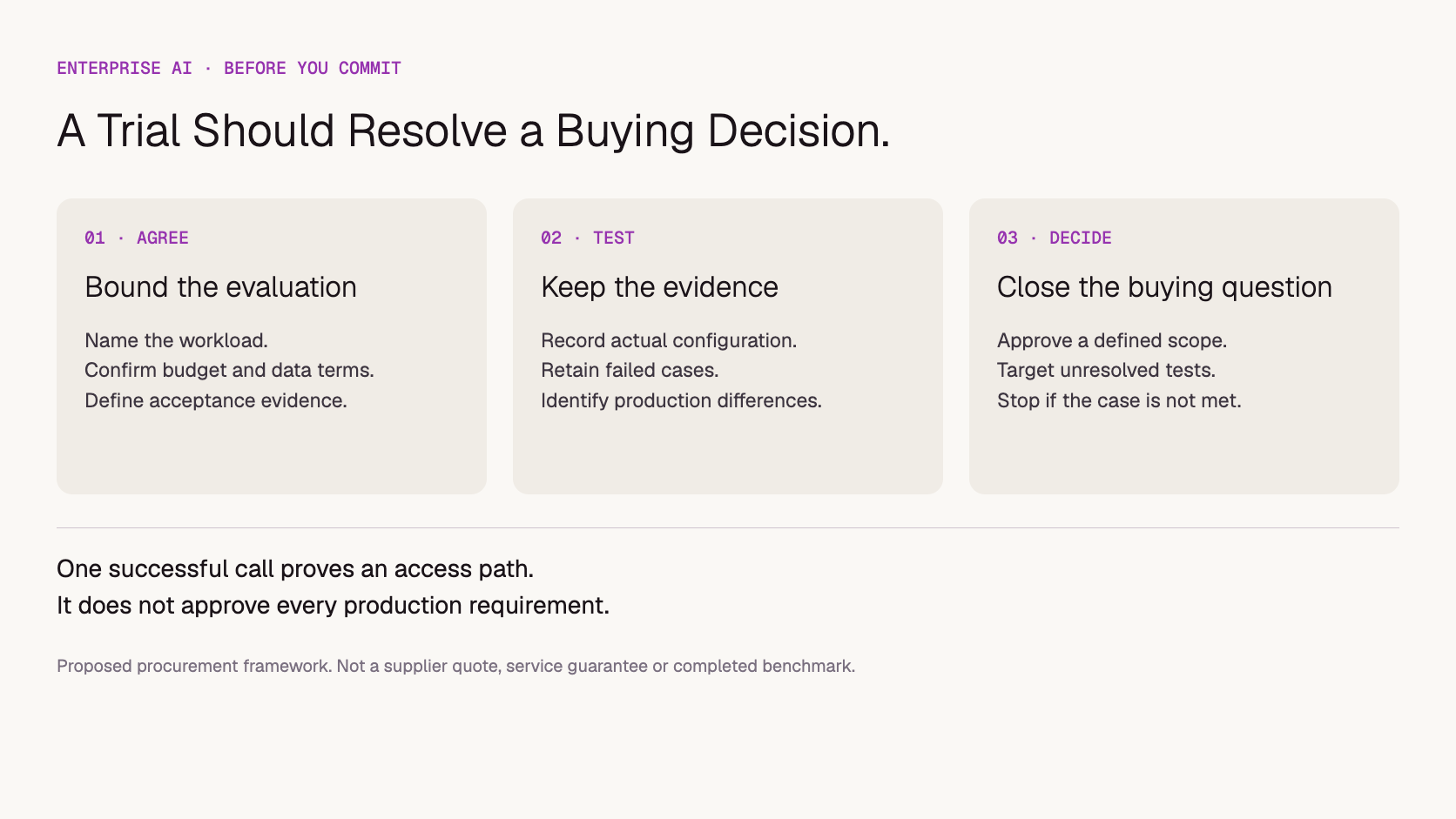
The purpose of an AI API proof of concept is to resolve a buying decision. It should answer whether the proposed service can handle a defined business workload under conditions that matter to your company. A successful demo or a single response is useful first evidence, but neither is enough to approve an ongoing commitment.
Evidence and scope: This is a procurement evaluation plan, not a completed performance test. Public sources were reviewed November 17, 2026. Token360 trial credits, trial duration, minimum spend and dedicated pilot support are not assumed; request written confirmation for your proposal.
What does “test before signing” actually mean?
It usually means evaluating access before signing a negotiated production agreement, not using a service without terms. Separate ordinary account access, a paid evaluation and a supplier-assisted proof of concept. Each can have different limits, obligations and support. Confirm the applicable terms before starting rather than treating “trial” as a complete specification.
Evaluation route
What it can establish
What still needs confirmation
Self-service account
Initial API access and basic workflow behavior
Usage charges, account limits and suitability for company data
Bounded paid evaluation
Results for an agreed workload and budget
Whether configuration and rates match the production proposal
Supplier-assisted pilot
Joint investigation of specified requirements
Deliverables, responsibilities, charges and exit conditions
For context, fal's quickstart describes obtaining an API key and calling a model. That documents an access path; it is not, by itself, a negotiated evaluation agreement. Ask the same distinction of any supplier: what can the account do today, and what additional conditions must be agreed for your test?
What should the evaluation brief contain?
Define the purchasing question, the workload, the acceptance criteria and the evidence needed to decide. Name the exact service configuration rather than only a model family. Assign one business reviewer and one technical owner, with a clear end date and spend boundary, so a trial does not become an open-ended experiment.
A useful brief is short enough to approve but specific enough to execute. It should include the following fields:
Field
What to record
Buying decision
Which workload could move to this supplier if the test passes?
Service identity
Model ID/version, endpoint, relevant parameters and permitted routing
Input set
Representative examples, difficult cases and authorized data sources
Acceptance
Mandatory failures, quality rubric, timing requirements and cost evidence
Operating scope
Concurrency, test window, quota and any supplier-approved load testing
Commercial boundary
Budget, rates, credits if explicitly provided, and what happens at the limit
Closeout
Decision owner, retained evidence, account/data cleanup and next agreement
Use the enterprise API quote brief for detailed usage estimates. This evaluation brief adds a different requirement: which uncertainty must the trial remove before procurement can approve the purchase?
Which tests should come before a larger commitment?
Check access, application compatibility, business output and operating behavior separately. Start with a small end-to-end request, then run representative cases and the agreed workload profile. Record failures as well as successes. Do not let an attractive output substitute for testing the response format, job completion or downstream delivery your application requires.
For a text workflow, relevant checks may include required fields, source fidelity, streaming behavior or tool-call handling. For media, confirm the actual file, duration, dimensions and required audio behavior. The right checks come from the deliverable, not from using every API feature.
Keep the evaluation method in the existing model evaluation framework. Here, the procurement requirement is to agree that method before the supplier or buyer sees the outcome. Otherwise, a disappointing test can be explained away by changing the target after the fact.
A small trial may establish that integration works and reveal specific failures. It cannot prove long-term availability, future capacity or performance for every language and document type. Record those limits in the decision instead of converting “no failures observed” into a service guarantee.
Must the trial configuration match production?
Match the intended configuration wherever possible, and record every material difference. Model version, routing policy, output limits, concurrency and account restrictions can affect what the trial demonstrates. If production will use a different arrangement, mark the affected requirement as unverified and agree a confirmation test before moving that workload.
For example, a demonstration on a low-traffic account does not verify a negotiated peak-load requirement. Likewise, a media example generated at a lower resolution does not establish cost or completion time for the production resolution. Neither result is useless; its scope is simply narrower.
Ask who controls changes during the pilot. A model alias or revised default should not silently alter the conditions midway through a comparison. Retain request parameters and dates alongside the outputs so reviewers know what was actually tested.
A proposed pilot process. Passing the test approves its defined scope, not every future workload.
How should you handle test charges and company data?
Agree the spend boundary and data permission before making calls. Clarify whether credits are supplied, which requests are billable and whether any limit actively stops further usage. Use authorized test data and check its handling requirements. A test account should not become an informal exception to company procurement or data policy.
Include retries and repeated generations in the budget. If the trial uses discounted or credited calls, preserve both the amount paid and the rate basis needed to estimate production cost. Free test usage, when explicitly granted, does not mean ongoing usage will be free.
Where real customer material is unnecessary, begin with controlled examples. Our guide to testing AI without real customer data explains the limits of that approach: safer fixtures can test workflow behavior, but may not represent production difficulty. If your chosen data cannot support a purchase decision, identify the remaining evidence needed rather than overstating the pilot.
What should happen when the evaluation ends?
Close with a documented decision: approve a specified scope, run one targeted follow-up, or stop. Preserve unresolved issues and production differences. Confirm account access, remaining funds and data handling separately. Completing the evaluation should not silently activate a larger spend commitment or authorize a rollout that nobody reviewed.
A hypothetical decision might read: “The request format and selected document cases passed review. Peak-hour performance was not tested. Proceed only with the defined low-volume workload while the capacity requirement remains open.” This is an example of bounded approval, not a test result.
Do not keep extending a pilot without a decision question. If the remaining uncertainty is a contract term, resolve it commercially. If it is one failed workflow, scope a retest around that failure. The separate pilot-to-production guide covers whether an accepted workflow is ready to expand.
What should you ask Token360 before a pilot?
Send the proposed workload and ask which evaluation arrangement is available for it. Confirm model access, budget, configuration, test limits and support in writing. Do not assume that an enterprise discussion automatically includes free credits, reserved capacity or implementation services. The agreed scope should say what each side will provide.
Token360 serves enterprise model procurement across text, image, audio and video. Its enterprise page provides a route to discuss pricing and production requirements. For a pilot, request a specific scope rather than inferring an entitlement from that positioning.
A practical opening request is: “We want to evaluate this model for this workload before a production commitment. Can you confirm access, charging, limits, support and any differences from the proposed production service?” Attach the brief and nominate the person who can accept the results.
Frequently asked questions
Does testing before a contract mean there are no terms?
No. Account and service terms can apply before a negotiated enterprise agreement exists. Confirm the applicable terms and data permissions for the evaluation.
Should an AI API pilot always be free?
No universal rule applies. Ask whether credits or a paid evaluation are available, and compare the evidence you will obtain with the cost and obligations involved.
Is one successful API request enough?
It can establish basic connectivity for that request. It does not establish application compatibility, workload quality or operating readiness for a production purchase.
Can a small pilot prove the supplier's SLA?
No. Observations during a short test and contractual service commitments are different forms of evidence. Review the proposed terms and separately document what your test measured.
Enterprise AI
API
Bring your next idea to life.
Create a video scene in Creator, or explore models for images, audio, and text to find the right capabilities for your project.



 Guides
 Guides
 Guides