Compare prepaid AI API credits with postpaid billing. Separate invoices, credit limits and payment timing before agreeing to enterprise terms.
ENTERPRISE PROCUREMENT · BLOG 151
By Token360 · Editorial review: November 5, 2026
Prepaid AI API credits fund usage before it occurs. Postpaid billing lets approved usage create an obligation paid under agreed terms. An invoice can accompany either arrangement, so “invoice-based” does not by itself establish payment timing. Enterprise buyers should confirm the funding model, approved credit, payment deadlines and interruption rules separately.
An enterprise can have a negotiated model rate and still need to pre-fund its account. It can also receive a purchase invoice for that prepayment. Conversely, an approved postpaid arrangement can still have a credit ceiling that matters before the payment due date. These are different commercial dimensions.
This article helps engineering and procurement describe the arrangement they need. It does not recommend an amount to borrow, establish tax treatment or promise payment terms from any supplier. The worked timeline is hypothetical; no customer invoice or payment experiment is used.
Read first: Token360’s billing and usage documentation distinguishes charges, wallet funds and enterprise credit. Use those distinctions when asking what will fund the next production request.
What is the difference between prepaid credits and postpaid billing?
Prepayment puts funds or eligible credits into the service before consumption. Postpayment allows usage against an approved arrangement and settles it later under the applicable terms. Neither determines the model’s unit price, available throughput or contract length on its own. Compare those conditions separately rather than inferring them from the payment label.
Dimension
Prepaid arrangement
Postpaid arrangement
Funding sequence
Fund eligible usage before consuming it.
Consume within approved terms, then settle the obligation.
What to confirm
Credit activation, eligibility, expiry and replenishment.
Approval, credit ceiling, billing period and due date.
Operational question
What happens if usable funding runs low?
What happens if credit or payment conditions are breached?
Document question
What purchase invoice or receipt is available?
What usage invoice and supporting detail are available?
Not implied
A discount, refundable balance or unlimited validity.
Unlimited usage, unlimited credit or automatic eligibility.
Keep purchased service credits separate from a credit facility. The first can represent usage value already funded; the second describes an approved ability to incur charges before payment. A supplier may use the word “credit” for both, so ask which meaning a field or contract clause uses.
Hybrid arrangements need explicit treatment too. An account may have both wallet funds and approved credit. Document which is consumed first and which condition can stop new work. Do not reduce a mixed arrangement to “we have a balance, therefore production will continue.”
Does receiving an invoice mean you can pay after using the API?
No. An invoice describes a billing document, not necessarily a right to consume before payment. A supplier can invoice a prepaid credit purchase, a fixed commitment or usage already incurred. Ask what period and charge the invoice covers, when payment is due, and whether service activation depends on that payment.
A procurement team asking only “Can you invoice us?” may receive an answer that solves document handling but leaves production funding unresolved. A more useful request is: “We need the invoice to cover actual usage after the billing period, with the due date and approved credit limit specified. Is that arrangement available for our account?”
Do not treat a purchase order number as confirmation of supplier credit approval. Confirm whether the supplier has accepted the purchasing arrangement, which entity is being billed, and what happens before payment is received. This is a workflow check, not a substitute for the signed terms.
What do fal and OpenRouter say about enterprise billing?
Official provider pages show why invoice availability and funding structure should be read together. An enterprise option can involve prepaid credits, commitments or a separate invoice arrangement. The statements below were checked on November 5, 2026; they describe published options, not terms approved for a particular customer.
The fal Model APIs FAQ says invoice-based billing is available for higher-volume customers through sales. It separately explains credit-balance locking for standard accounts and an exception for enterprise customers on invoice-based billing. That documented exception should not be generalized into unlimited credit or immunity from every service restriction.
OpenRouter’s pricing FAQ describes Standard and Business as credit-purchase arrangements, with manual or automatic top-ups. Its enterprise billing description includes prepaid credits and annual commitments alongside invoicing. This provides a direct example of why invoicing should not automatically be read as postpayment.
These are procurement distinctions, not reasons to rank one provider as more enterprise-ready. Ask each supplier for the specific commercial structure offered to your company, rather than assigning a payment model based on a plan name.
What does Token360 document about POSTPAY?
Token360 documents a POSTPAY funding mode with enterprise credit, but the existence of that mode does not establish that your account is approved for it. Confirm the active arrangement and its terms. A quoted rate, a remaining API-key budget and an enterprise-credit approval answer different questions.
As checked November 5, 2026, Token360’s POSTPAY documentation says positive wallet top-up funds are used first, followed by enterprise credit; promotional credits are excluded in this mode. Remaining credit is based on the approved limit and current exposure. The documentation also warns that balances are snapshots rather than live reservations, and that exhausted credit blocks new POSTPAY calls even if wallet funds remain.
That means a funding discussion must cover the account’s operating rules as well as the visible total. Obtain the actual billing period, payment due date, credit-review process and payment-posting behavior from the applicable agreement or account team. This article does not supply a universal net-payment term, minimum eligibility threshold or credit limit.
Use the Token360 enterprise contact route to discuss those requirements alongside your text, image, audio and video workload. Keep requested terms distinct from accepted terms in the procurement record.
How can the same usage produce different payment timelines?
The same amount of API usage can have different funding and payment dates without changing its underlying unit cost. Build a timeline that separates consumption, document issuance, due date and payment posting. This makes the operational dependency visible and prevents a payment schedule from being mistaken for a price discount.
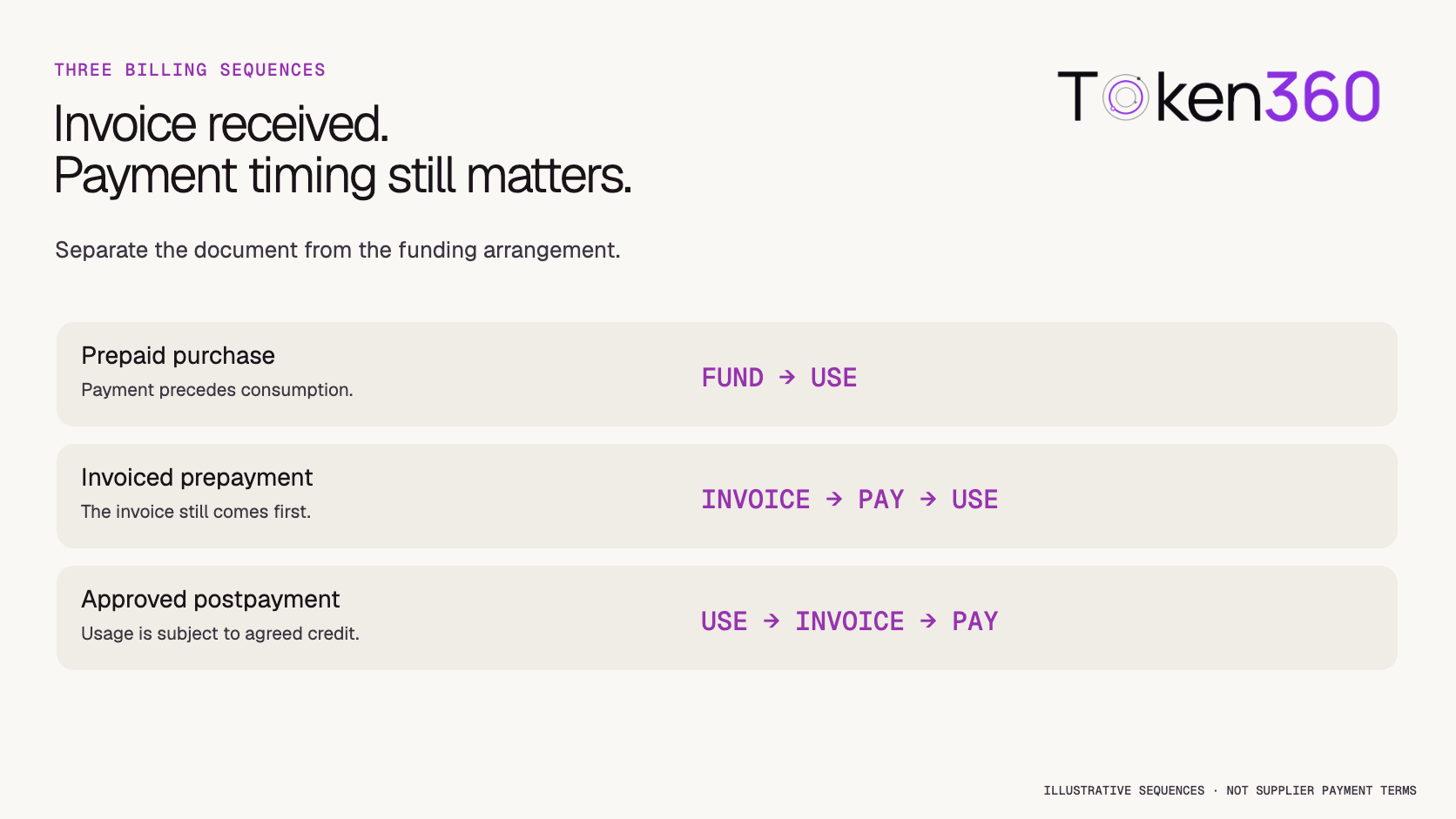
Hypothetical example only: a team incurs $4,000 of identical eligible usage during a 30-day period. Assume no fees, taxes, discounts, minimums or prior balances. The following arrangements are invented to explain timing; none is a Token360, fal or OpenRouter offer.
Illustrative arrangement
Before or during usage
After the period
Question still open
Prepaid purchase
Pay $4,000 before the first request; consume that value during the period.
No second payment for those same units.
How quickly can new funding become usable?
Invoiced prepayment
Receive a $4,000 purchase invoice, then pay before usage is enabled.
No second payment for those same units.
Who approves and pays the purchase invoice?
Approved postpayment
Incur $4,000 within the assumed approved arrangement.
Receive a $4,000 usage invoice on day 31, due on day 45 in this example.
What credit remains while payment is being processed?
Illustrative sequences, not contractual terms. An invoice can appear before or after consumption.
All three rows price the stated usage at $4,000. They differ in timing and approval workflow. The postpaid row does not imply that the team can continue consuming indefinitely until day 45: the assumed arrangement still needs an explicit credit ceiling and rules for new-period usage.
Ask whether settling an invoice changes available credit when payment is initiated, received or posted. Also ask how a new billing period interacts with outstanding invoices. Do not infer those mechanics from the due date; suppliers and agreements can define them differently.
Which questions belong in an enterprise payment brief?
A payment brief should specify how purchasing approval, service funding and invoice settlement connect. Include the people responsible and the evidence needed at each handoff. Keep the scope narrow: this document establishes payment operations, while model rates, capacity and request-level charge reconciliation remain separate parts of the commercial review.
Copy the worksheet below into a local CSV file. Blank fields are for your own review:
. It contains requested-term, confirmed-term, evidence and owner fields. It is a blank review aid, not a model contract or an approved credit application.
Name the billing entity and recipient. Record who purchases the service, which team receives invoices and who resolves missing information.
State the funding model. Distinguish prepaid purchase, invoiced prepayment, approved postpayment and any mixed arrangement.
Define the period and due-date rule. Confirm the usage cutoff, invoice timing, currency and payment deadline in the actual offer.
Confirm payment posting. Identify accepted payment methods and when a successful payment becomes reflected in service funding or credit.
Record credit and interruption conditions. Ask what stops new work and who can approve changes; do not treat a forecast as approval.
Document exceptions. Confirm the process for disputed charges, late documents, failed payment and unused prepaid value.
Assign ownership. Name the engineering operator, purchasing approver and accounts-payable contact, with an escalation path.
A useful handoff produces one agreed sentence for each unresolved item. “Invoice available” is insufficient if engineering still cannot tell whether it must wait for cleared funds before launch. “Payment sent” is insufficient if finance cannot confirm that the supplier has received or posted it.
How should teams prepare the first production billing cycle?
Rehearse the purchasing and funding workflow before production depends on it. Use an approved small scope where appropriate, confirm that the right people receive the documents, and record how payment status reaches the service operator. This is a proposed readiness procedure, not a payment test already performed for this article.
For prepayment, confirm who can add funds, who approves replenishment and how the team detects a failed top-up. For postpayment, confirm the approved arrangement, the credit-review contact and the owner who acts on utilization or payment notices. A finance inbox that nobody monitors is an avoidable handoff gap under either model.
Make the first-cycle review concrete: did the document name the expected billing entity, cover the agreed period and reach the correct recipient? Did the operator understand the funding status before scheduling new work? Record discrepancies and obtain clarification rather than silently changing the forecast to match the invoice.
No. Postpayment describes when charges are settled. A subscription describes a recurring commercial arrangement. Confirm the billing meter, included usage and payment terms separately.
Does an invoice imply a discount?
No. Document format and unit pricing are separate. Compare the rates and fees in the actual offer rather than inferring savings from how payment is requested.
Does an approved credit limit guarantee uninterrupted API access?
No. It addresses a funding boundary, not every service condition. Applicable account controls and technical availability still matter; do not treat credit approval as a capacity commitment.
Can unused prepaid value be refunded?
That depends on the applicable terms. Record refund, expiry and transfer rules before purchase. This article does not assume any provider grants a universal refund right.
Does Token360 automatically give enterprise accounts postpayment?
No automatic eligibility is established by the documentation cited here. Confirm the account’s approved mode and written terms with Token360.
Are the example’s day-31 invoice and day-45 due date real terms?
No. They are hypothetical dates used to separate document issuance from payment timing. They are not supplier commitments.
Enterprise AI
API
Build faster with one AI API.
Use Token360 to call video, image, audio, and text models with one key and one bill.


 Insights
 Guides
 Guides