Sonilo Sound Effects API: Prompts, Pricing, and a Nine-Run Test
Nine samples reveal a practical distinction: rain ambience met the tester’s criteria consistently, while exact event counts were unreliable.
Evidence and pricing checked October 19, 2026. A small exploratory test with original audio samples.
The Sonilo sound effects API generates audio from a written sound description. In this nine-run Token360 pilot, all three rain samples met the tester’s listening criteria, one of three cup-contact samples passed, and none of the three footstep samples matched the requested count. Each generation cost $0.018648. The useful distinction is between producing the right kind of sound and following an exact event count.
This guide includes every prompt and output, including rejected candidates. It explains what the test supports, how the costs were calculated, and what to check before using generated effects in an edit or application.
Use text-to-SFX when you can describe the sound independently: a contact, footsteps, rain, a mechanical action, or an ambient texture. The Token360 model ID is sonilo-text-to-sfx. Its listing describes one audio output and no streaming. This is sound-effect generation, even though the platform’s internal model family uses an audio speech category.
The Token360 model configuration inspected for this article lists a requested duration from 0.5 to 180 seconds, an 8-second default, and MP3 as the available output format. Check the current route before building around these values. Native Sonilo and other providers can expose different options.
Text-to-SFX does not receive the video in this workflow. It cannot inspect where a visible foot lands or a cup touches a table. Duration controls clip length; it does not by itself provide frame-level placement. Sonilo documents a separate text-to-SFX endpoint, while its sound-effects overview distinguishes text-driven generation from video-driven sound effects. Do not transfer the latter’s timing claims to a prompt-only request.
How we tested: three prompts, three runs each
The test used three deliberately different briefs: one isolated contact, continuous ambience, and a short sequence with a specific number of events. The requested settings were 8 seconds and MP3 for every run. Each prompt was repeated three times without intentional prompt changes.
The tester supplied nine original MP3s, per-run elapsed times, a USD charge for every run, and listening observations. File inspection found two channels, a 44.1 kHz sample rate, approximately 320 kbps, and the same metadata-estimated duration of 8.019592 seconds for each file. A separate browser decode at 44.1 kHz returned 352,256 audio frames, or approximately 7.988 seconds, for each file. Container estimates and decoded duration differ slightly; neither is the requested billing duration. These checks confirm file characteristics, not an independent listening review.
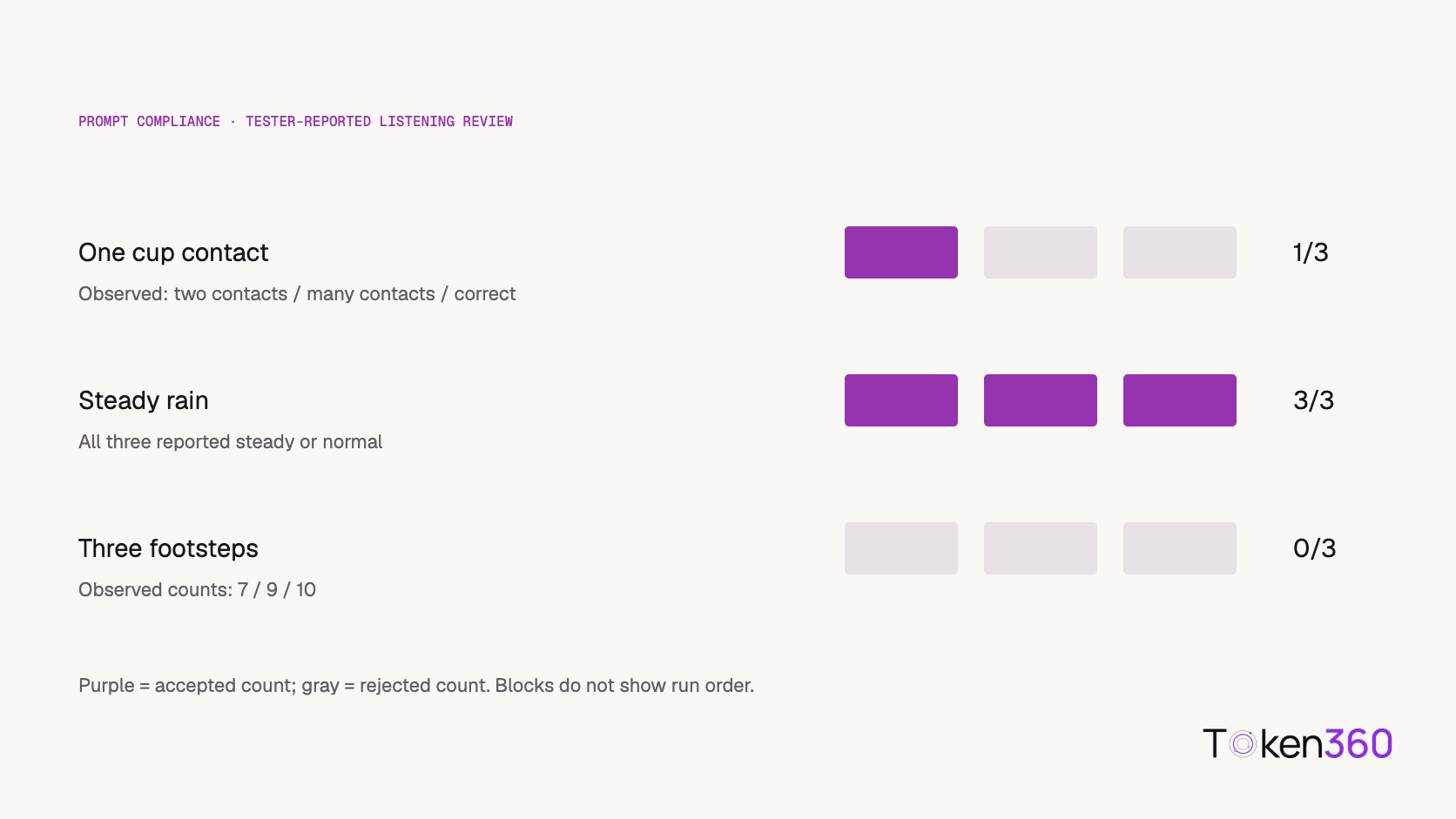
Acceptance here means the tester reported that the result met the prompt’s central requirement. Cup and footstep results were judged primarily on event count; rain was judged on continuity and unwanted interruptions. This is a practical first-pass screen, not a blind audio-quality study. We did not measure loudness, clipping, loop seams, or synchronization to a video.
Results: ambience passed; exact counts were unreliable
Task
Manually timed waiting times
Mean
Accepted
Listening observation
One cup contact
8.54 / 9.23 / 5.57 s
7.78 s
1/3
Two contacts; many ongoing contacts; then a correct result.
Steady rain
11.08 / 7.15 / 7.42 s
8.55 s
3/3
First sample steady without interruption; the other two reported normal.
Three footsteps
6.96 / 7.28 / 10.26 s
8.17 s
0/3
Seven, nine, and ten footsteps respectively.
Counts are specific to these prompts and this tester’s review. Three trials per task are insufficient for a general reliability estimate.
Across all nine attempts, the mean reported elapsed time was 8.17 seconds and the median was 7.42 seconds. Four outputs passed the task-specific listening screen. That combined 4/9 result describes this particular mixture of tasks; it should not be advertised as Sonilo’s overall success rate.
The footstep results are especially useful. All three outputs contained more steps than requested. A plausible “walking” sound therefore may still fail a brief that needs exactly three steps. The cup examples show the same distinction on a smaller scale: a recognizable material contact is not enough if the effect repeats when the brief asks for one event.
The rain results support a narrower positive finding: these three continuous-ambience candidates met this tester’s requirements. They do not establish that rain is always reliable, that the files loop seamlessly, or that Sonilo beats another audio model.
Listen to the prompts and all nine outputs
Prompt 1: one ceramic cup contact
One ceramic cup placed once on a wooden table, a soft dry contact and a short natural decay. Close perspective. No voices, no music.
Sonilo API pricing: generation cost versus accepted-output cost
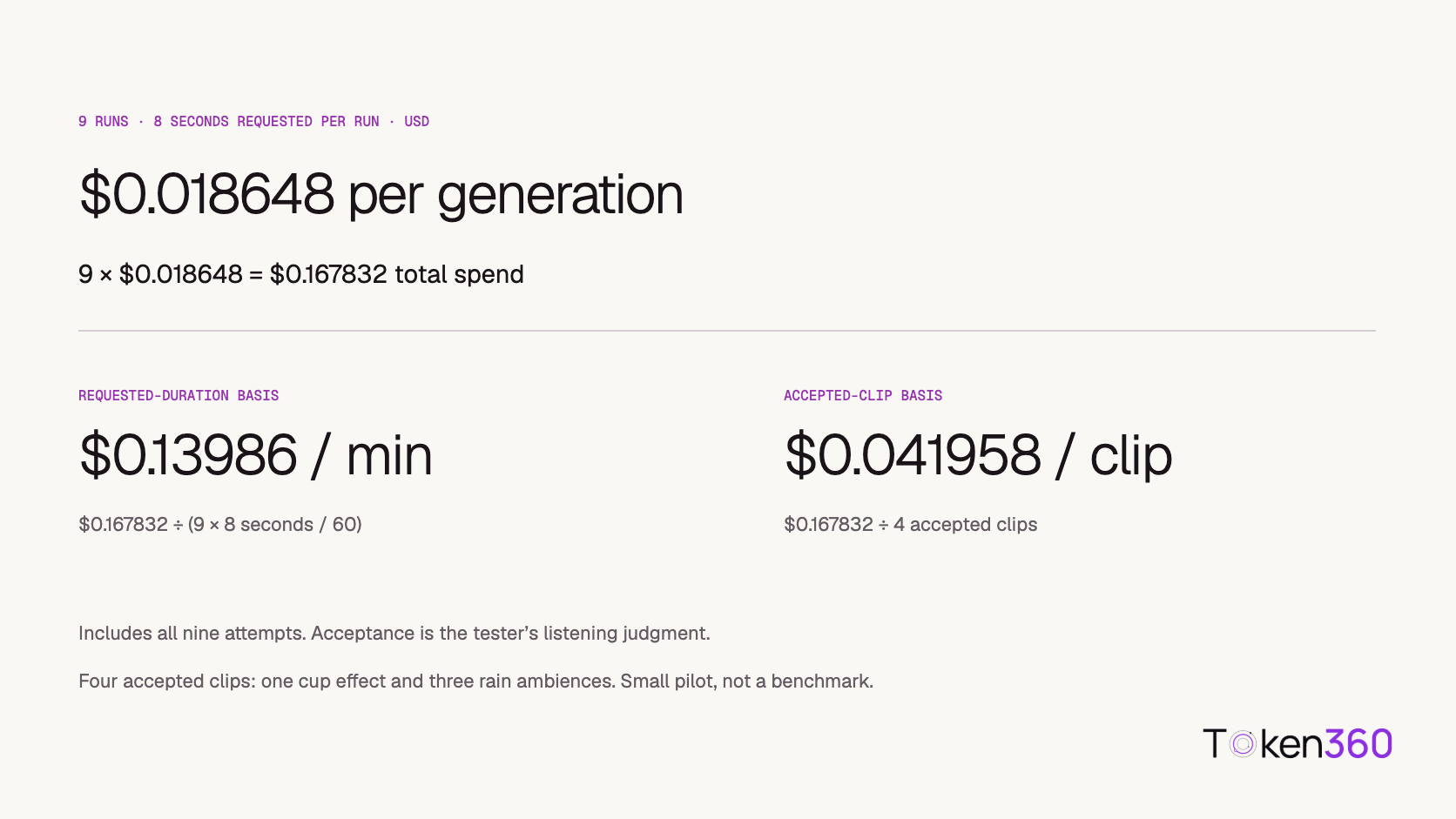
The public Token360 reference rate checked for this model was $0.002331 per second. All nine tester-reported charges were $0.018648 USD, exactly matching eight seconds at that rate:
8 × $0.002331 = $0.018648 per run
9 × $0.018648 = $0.167832 total spend
On a requested-duration basis, the nine attempts represent 72 seconds, or 1.2 minutes. Total spend divided by that duration gives $0.13986 per requested generated minute. This is a normalization of this test, not a claim about minimum charges, discounts, taxes, or every route’s billing rules. Using decoded file duration instead gives approximately $0.140076 per output minute; the requested-duration value is retained above because it exactly matches the reported charges.
A second calculation includes the cost of rejected attempts. Four clips passed the listening screen, so:
$0.167832 ÷ 4 = $0.041958 per accepted clip
For a broader application budget, use the AI API cost management guide to connect recorded attempts, accepted outputs, and total spending.
If each accepted clip is counted as an eight-second deliverable, the same spend divided by 32 seconds gives $0.314685 per accepted minute. That figure is meaningful only under the same acceptance definition. For one-shot effects, cost per usable event may be more useful than cost per minute because much of a clip can be silence or decay.
Task
Spend across three attempts
Accepted clips
Spend per accepted clip
Cup
$0.055944
1
$0.055944
Rain
$0.055944
3
$0.018648
Footsteps
$0.055944
0
Undefined: no accepted output
The footstep row must not be reported as zero cost per accepted clip. Money was spent, but there was no passing result to use as the denominator. Editing a rejected output into a usable asset would be a separate workflow with its own review and labor cost.
How to write a sound-effect prompt you can evaluate
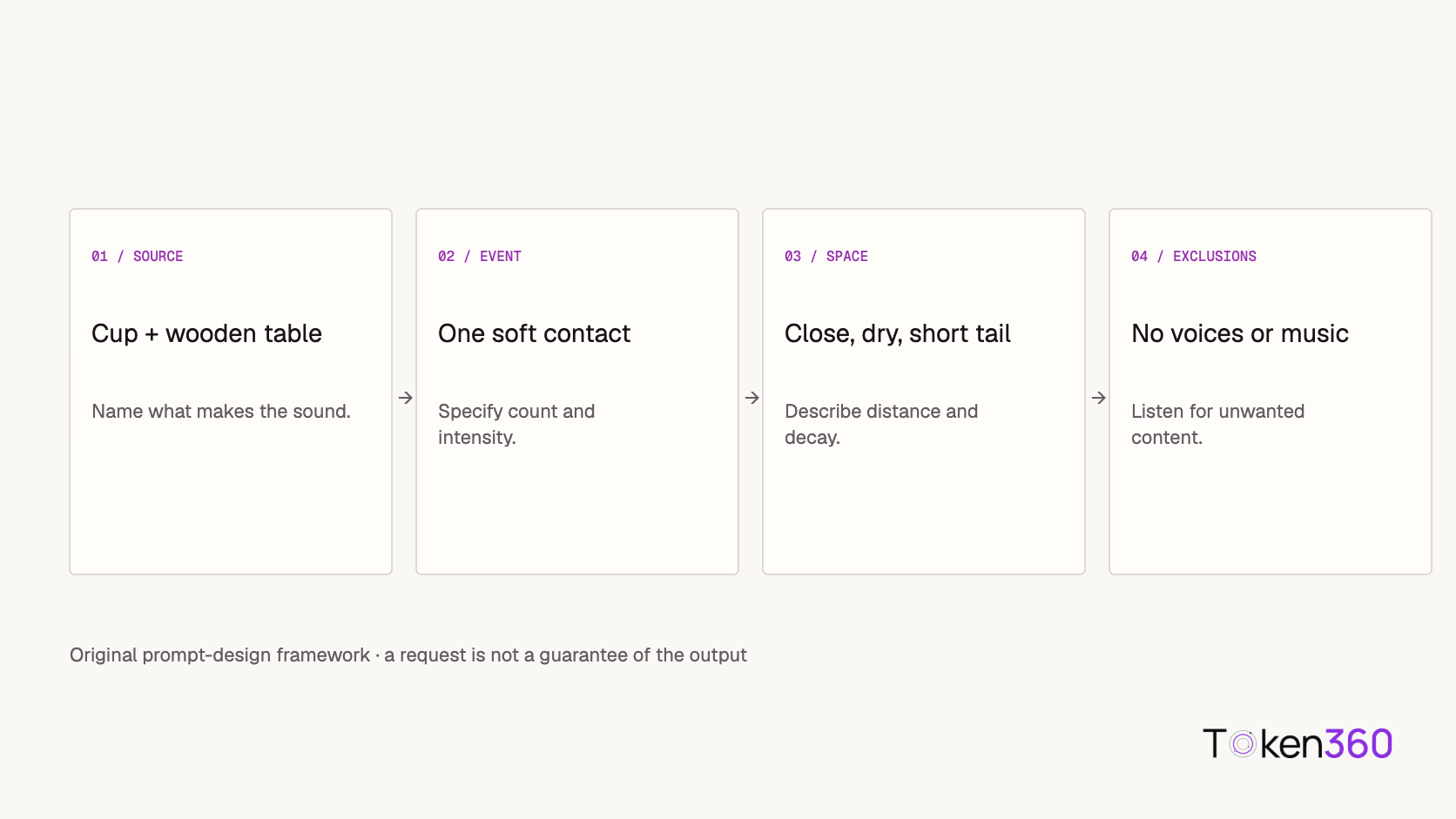
Define four things before generation: the sound source, the action and count, the acoustic space, and unwanted elements. A short, concrete brief makes it easier to explain why a candidate passed or failed. Adding adjectives without a review criterion makes evaluation less useful.
For an isolated contact, listen for the main impact, secondary contacts, the decay, and additional events later in the file. For ambience, listen to the whole duration for interruptions or unexpected foreground sounds. For counted events, count the events explicitly rather than accepting a generally plausible sequence.
A useful follow-up experiment would shorten the requested clip for the single cup contact and explicitly request silence after the decay. That is a proposed test, not a proven fix. Change only one factor at a time, retain the original brief as a baseline, and report how many candidates were rejected. This pilot cannot determine why repetitions occurred or whether a shorter duration would eliminate them.
What to check when using Token360 or fal
Provider interfaces are not interchangeable merely because they expose Sonilo. The inspected fal API schema uses a required prompt and lists WAV, MP3, AAC, and FLAC options. The Token360 configuration inspected here names input and exposes MP3 for this route. Confirm the live schema and defaults before copying a request between services.
Token360’s quick-reference page showed a chat/completions path during this review, but a successful request/response trace was not supplied for this pilot. This article therefore does not present an unverified executable request. Use the current playground or a verified example from the Token360 documentation, and keep the request ID if available so the resulting file can be matched to its charge.
We did not run these prompts on fal, so the results do not establish a price or quality advantage over fal. A fair comparison would fix the requested duration and format, disclose model versions and defaults, retain every attempt, and apply the same listening criteria to both services.
FAQ
What is the Sonilo sound effects API?
It generates sound-effect audio from a text description. On Token360, this article covers the model ID sonilo-text-to-sfx, rather than Sonilo’s separate music or video-driven workflows.
How much did an eight-second sound effect cost?
Every run in this pilot was reported at $0.018648 USD. Nine runs cost $0.167832. Check the current model page and your actual charge before estimating a larger workload.
Can it generate exactly three footsteps?
None of the three tested outputs matched that request. The tester counted seven, nine, and ten steps. This demonstrates a limitation in this small test, not that an exact-count result is impossible.
Which prompt worked most consistently?
The rain prompt passed all three listening checks. The sample is too small to establish general reliability, and the files were not assessed as seamless loops.
How long does generation take?
The tester manually measured from clicking Generate until the interface displayed completion. Across nine runs, reported waiting times ranged from 5.57 to 11.08 seconds, averaging approximately 8.17 seconds. Manual timing includes observation and reaction error; these results are not instrumented API latency or a performance guarantee.
Does text-to-SFX automatically synchronize sound to a video?
This tested workflow receives a written description, not a video. Review and position the resulting audio yourself, or evaluate a separately documented video-to-SFX workflow.
Can I use the generated audio commercially?
Check the terms covering the provider route and account used for generation. A commercial-use statement on another provider’s page should not be assumed to establish the terms of your Token360 request. This pilot does not verify licensing.
Should rejected generations count toward cost?
Yes, if they were billed. Include all paid attempts when calculating the cost of an accepted asset, and report when there were no accepted outputs rather than assigning a misleading zero.
Start with one concrete sound and a written acceptance rule. Keep each candidate, its prompt, elapsed time, charge, and review result. This pilot makes continuous rain ambience a reasonable first scenario to investigate; exact-count events need closer review and potentially a separate editing step.



 Launch
 Launch
 Tutorial