A free AI API can fit production only if its data terms, quotas and continuity meet your needs. Check the limits and plan what happens when access stops.
A free AI API can fit a production workload only when its permitted use, data terms, quotas and operating conditions meet that workload’s requirements. A zero usage price does not establish unlimited capacity or a service guarantee. Equally, being free does not prove poor model quality. Approve the specific service configuration, not the price label.
For an enterprise, the useful question is not simply whether an API costs nothing today. It is whether the business can continue operating when the allowance is exhausted, the model changes or a request cannot be served. A low-volume internal task with a manual alternative may tolerate conditions that a customer-facing checkout process cannot.
This is a production-fit guide, not a free-model ranking. Official documentation was checked November 17, 2026. The numerical example below is illustrative arithmetic, not a benchmark or a forecast of your traffic. No free production allowance from Token360 is assumed.
What does “free AI API” actually mean?
It can mean a recurring free quota, a temporary trial, promotional credits or a particular model variant with no usage charge. Those arrangements end or reset in different ways. Identify the exact model, account tier and allowance before deciding whether the service can support an ongoing business process.
Offer type
What to establish
Production question
Recurring free quota
Limit dimensions, reset period and exhaustion behavior.
Can the workflow wait until the allowance resets?
Trial or promotional credit
Expiry, eligible usage and what happens afterward.
Who approves continuation before the credit ends?
Zero-price model variant
Specific model ID, availability and applicable limits.
Does this variant meet the required operating conditions?
Open model weights
License and who pays to run the model.
Are you confusing access to weights with free hosted inference?
For example, OpenRouter identifies free model variants separately. Its current page lists a default daily cap and a per-minute cap, with a higher daily allowance for qualifying accounts. The practical point is to inspect the conditions attached to the selected route; “free” is not a capacity specification.
A temporary test is a different purchasing decision. The pre-contract API evaluation guide covers arranging a pilot. This article asks whether the free configuration itself can remain in an approved operating workflow.
How do you check whether the quota is enough?
Count API requests and other applicable units generated by the whole workflow, not just users or completed tasks. Include multiple model calls, retries and expected bursts. Check each limit independently: staying below a daily allowance does not establish that a busy minute fits, and a request allowance may coexist with token or concurrency limits.
Suppose an internal process runs 18 tasks a day and each task makes three model calls. That is 18 × 3 = 54 requests per day before retries. Against a hypothetical allowance of 50 daily requests, the workflow already exceeds the limit. Against a different service’s allowance, the conclusion could change. These numbers describe the example, not a tested business deployment.
As a dated real-world reference, OpenRouter’s free-model page listed 20 requests per minute and a default 50 requests per day when checked November 17, 2026; qualifying accounts can receive a higher daily cap. Verify your current account conditions rather than carrying those figures into a launch plan unchanged.
Document whether hitting a limit rejects work, queues it or requires an explicit paid transition. Do not assume automatic continuation. Also establish which activities share the allowance: development and production traffic may affect each other if they consume the same quota pool.
Can company or customer data use the same free tier?
Check the terms for the actual account, region, model and service tier before sending that data. Free and paid configurations can have different data-use conditions, but there is no single privacy rule for every free API. Your data approval must apply to the selected configuration rather than to the vendor’s brand in general.
Google’s Gemini API billing documentation distinguishes free and paid tiers and directs users to tier-specific data-use terms. Its additional terms also specify regional restrictions, including paid-service requirements when making API clients available to users in the EEA, Switzerland or the UK. These are Google-specific conditions, not rules for all providers.
A developer’s successful test with public text does not establish permission to send customer records through the same configuration. Record the applicable policy and approval before replacing test inputs with business data. For the underlying distinction, see data retention versus use for training.
Paying is not a substitute for this review either. The selected paid configuration must still meet the business’s requirements.
What should happen when free access stops working?
Define a business response before making the API a production dependency. Depending on the task, that response might be waiting, using an approved manual process or moving to an evaluated paid route. Assign an owner and communicate the interruption honestly. A free tier is suitable only if those consequences are acceptable for the workflow.
An optional internal drafting feature may pause without blocking the business. A time-sensitive customer process may not. This difference matters more than whether both applications make the same number of requests.
Specify which conditions trigger action: quota exhaustion, removal of a model, unacceptable delays or changed terms. Keep the response narrow and testable. Do not silently replace an approved model with an unreviewed alternative just to keep the feature appearing available. Our AI API outage guide covers the broader incident process; the free-tier decision should identify when that process begins.
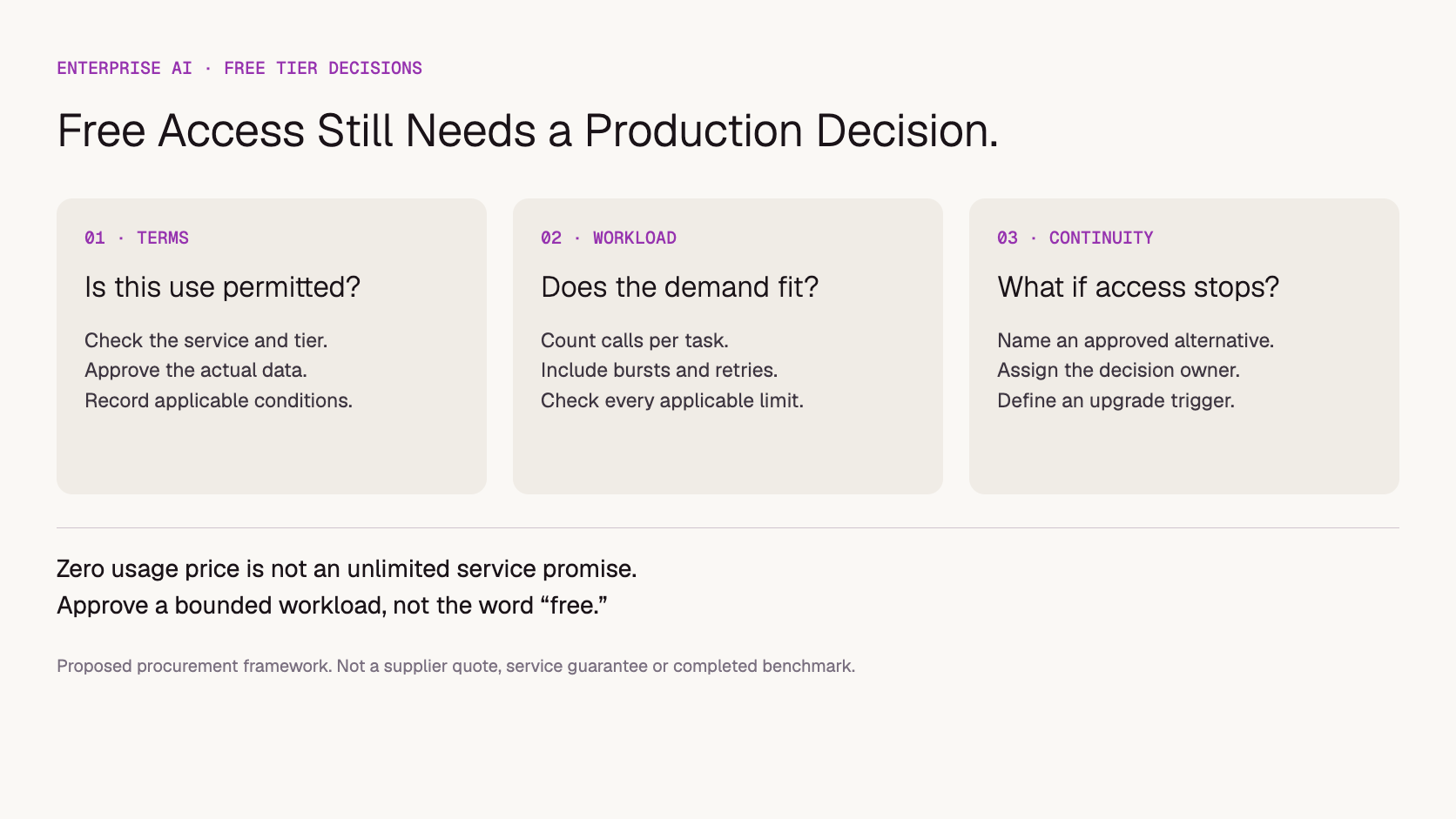
Proposed production-fit checks. A zero price does not answer any of these questions by itself.
When is a paid plan the more appropriate next step?
Consider a paid plan when the free configuration cannot meet a required condition: permissible data handling, capacity, model availability, support or continuity. Ask what the paid offer actually changes. An upgrade is useful when it closes a demonstrated gap; payment alone does not guarantee unlimited throughput, identical behavior or the service level your business needs.
Separate the decision from assumptions about quality. If the paid route uses a different model or configuration, evaluate the outputs again. If the model is unchanged, verify the operating terms rather than assuming that a higher price makes its answers better. The price-versus-model-quality guide covers matched comparisons.
Before switching, confirm budget ownership, activation steps and the conditions for stopping spend. Avoid designing the business case around a temporary free allowance that is expected to disappear. There is no measured cost-saving claim here: compare the actual proposals against the required workflow.
What should an enterprise record before approving free use?
Record the service identity, permitted workload, data approval, applicable limits and response when access is unavailable. Add a review date and a responsible owner. Approval should describe a bounded use case, not a company-wide declaration that an API is safe for every task because one team successfully tested it.
Download the free-tier production-fit worksheet. Use it to capture the current documentation and account configuration, along with the observed calls per task. Leave unverified conditions open instead of treating them as a pass.
A concise decision could be: “Approved for this optional internal draft workflow using these approved inputs, within the documented allowance, with manual completion if unavailable.” That is a proposed wording pattern, not a completed approval. A customer-critical use case may require a different arrangement.
For a paid alternative, Token360’s enterprise scope covers model access across text, image, audio and video, with requirements discussed for the engagement. Ask about the specific capacity and commercial terms your workload needs. The model catalog and pricing page are starting points; this article does not promise free credits, a standard trial or an automatic SLA.
Frequently asked questions
Does free mean noncommercial use only?
Not necessarily. Permitted use depends on the service terms and any applicable model license. Check the actual offer; neither free pricing nor paid pricing alone establishes permission for a particular application.
Is a free API always less accurate?
No. Price does not establish output quality. Evaluate the exact model and configuration. Limits, availability and service terms may still differ even when the output quality is acceptable.
Can we upgrade automatically when the quota runs out?
Only if the service supports that behavior and your organization has approved it. Confirm whether requests stop, billing activates or another action is required. Set an authorized budget before relying on any paid continuation.
Does Token360’s lack of a service fee mean free inference?
No. Token360’s company-confirmed position is that it does not charge a separate service fee. Model usage can still be charged. That statement does not establish free model access, a free allowance or zero total operating cost.
About the publisher: Token360. Written by Yuki Yu. This framework does not establish eligibility under a particular supplier agreement or report tested free-tier reliability.
Check,Recorded condition,Evidence and date,Owner,Open question
Model and tier,,,,
Permitted workload,,,,
Data approval,,,,
Calls per task,,,,
Daily and burst demand,,,,
Applicable quota dimensions,,,,
Exhaustion and reset behavior,,,,
Manual or paid continuation,,,,
Upgrade trigger and budget,,,,
Review date,,,,
Enterprise AI
API
Bring your next idea to life.
Create a video scene in Creator, or explore models for images, audio, and text to find the right capabilities for your project.


 Guides
 Guides
 Guides