Verify AI business calculations with approved inputs, explicit rules and executed results. See a reproducible order example and checks for common errors.
ENTERPRISE AI · VERIFIED CALCULATIONS
Use AI to interpret a business question and explain results, but require important calculations to use verified inputs, explicit rules and an executed calculation you can inspect. A plausible total is not enough. Check which records were included, which formula was applied, and whether the final answer faithfully reports the computed result.
This matters when a company connects models to orders, quotes or operational reports. A calculator can correctly multiply the wrong quantity. A query can correctly sum the wrong month. A model can receive a correct tool result and then describe it with the wrong unit. Reliability depends on the whole calculation path.
Evidence: The order example below is fictional and was checked with local Python decimal arithmetic. It is not an AI model benchmark, customer transaction or Token360 pricing example. Official documentation was checked November 16, 2026. No model accuracy, latency or cost claim is made.
What can go wrong even when the arithmetic is correct?
The calculation may answer a different question from the one the business intended. Wrong filters, duplicate records, mixed currencies, missing quantities or an incorrect discount basis can produce a mathematically valid but operationally wrong result. Validate the meaning and scope of the inputs before judging the arithmetic.
Layer
Possible failure
Evidence to inspect
Scope
“Last month” uses the wrong time zone or date field
Explicit date range, time zone and inclusion criteria
Inputs
Cancelled orders or duplicate lines enter the total
Source records, status filters and duplicate handling
Business rule
A discount is applied to shipping when it covers goods only
Approved rule and formula
Execution
A formula is described but never run
Actual calculation output and execution status
Presentation
The result is relabeled as another currency or reporting period
Final answer compared with the structured result
Ask a clarifying question when the distinction changes the answer. “Revenue” might mean invoiced amounts, recognized revenue or cash received in a particular organization. The application should use an approved definition or request one; a model should not silently invent the reporting policy.
Should the model calculate directly or call a tool?
For numbers that drive business actions, prefer a controlled calculator, query or business service with explicit inputs and rules. The model can translate the request into a proposed operation and explain the returned result. Keep execution and validation in the application rather than relying only on generated arithmetic or reassuring wording.
Google's Gemini code-execution documentation describes an optional tool that lets a model generate and run Python code. This illustrates the distinction between generating an answer and executing a calculation. It does not mean that every model, endpoint or intermediary exposes that tool, or that generated code automatically uses the correct business rules.
A narrow, reviewed function can be easier to control than unrestricted generated code. For an order total, the function might accept approved line items, discount scope and shipping, then return a result with its rule version. The model does not need permission to modify the order merely to calculate a proposed total.
If you use generated code for exploratory analysis, inspect its input selection, formula and output. Restrict access and side effects to the task. A successful execution proves that the code ran; it does not prove the analysis answered the right question. Our guide to tool calls versus actual execution covers the execution boundary.
What does a verifiable order calculation look like?
A verifiable calculation names the inputs, units, formula, rounding rule and exclusions, then exposes the result. An independent reviewer should be able to reproduce it without guessing hidden assumptions. If a required value is unavailable, return an incomplete status or ask for clarification instead of substituting a plausible number.
Consider this fictional order, entirely in USD. The rule is a 10% discount on goods only, followed by a $15.00 shipping charge. Tax is excluded from this example; it is not assumed to be zero in a real order. Round the discount to two decimal places using half-up rounding.
Component
Calculation
Amount
Item A
12 × $19.95
$239.40
Item B
3 × $48.50
$145.50
Goods subtotal
$239.40 + $145.50
$384.90
Goods discount
$384.90 × 10%
−$38.49
Shipping
Added after the goods discount
$15.00
Total, excluding tax
$384.90 − $38.49 + $15.00
$361.41
If the discount is incorrectly applied to goods plus shipping, the result becomes ($384.90 + $15.00) × 90% = $359.91. The $1.50 difference is caused by the wrong discount basis, not a multiplication error. This is why “use a calculator” is necessary in many workflows but insufficient as the entire control.
The calculation script and its local result below verify the arithmetic without making any model calls.
calculation-example.py
"""Fictional order fixture. Local arithmetic check, not an AI model benchmark."""
from decimal import Decimal as D, ROUND_HALF_UP
import json
rows=[('A',D('12'),D('19.95')),('B',D('3'),D('48.50'))]
subtotal=sum((q*p for _,q,p in rows),D('0'))
discount=(subtotal*D('0.10')).quantize(D('0.01'),rounding=ROUND_HALF_UP)
shipping=D('15.00')
total=subtotal-discount+shipping
assert subtotal==D('384.90') and discount==D('38.49') and total==D('361.41')
wrong_basis=((subtotal+shipping)*D('0.90')).quantize(D('0.01'),rounding=ROUND_HALF_UP)
assert wrong_basis==D('359.91')
print(json.dumps({'fixture':'fictional; USD; no tax in example; discount applies to goods only','subtotal':str(subtotal),'discount':str(discount),'shipping':str(shipping),'total':str(total),'incorrect_discount_on_goods_and_shipping':str(wrong_basis),'difference':str(total-wrong_basis),'evidence':'local Decimal arithmetic; no model calls'},indent=2))
calculation-example-result.json
{
  "fixture": "fictional; USD; no tax in example; discount applies to goods only",
  "subtotal": "384.90",
  "discount": "38.49",
  "shipping": "15.00",
  "total": "361.41",
  "incorrect_discount_on_goods_and_shipping": "359.91",
  "difference": "1.50",
  "evidence": "local Decimal arithmetic; no model calls"
}
Which units and rounding rules should be explicit?
Record currency, quantity units, percentage basis and the point at which rounding occurs. Apply the rule required by the business system rather than letting a model choose one. Mixed-unit inputs and silently changed rounding conventions can create discrepancies even when every displayed number looks reasonable.
Distinguish units from packs, monthly amounts from annual amounts, and percentages from percentage-point changes. For mixed currencies, require an authorized conversion rate with a source and effective date, or keep the totals separate. A missing value should remain missing; it should not quietly become zero.
Python's decimal documentation explains exact decimal representation and configurable rounding, in contrast to the binary representation of some decimal fractions. The example uses decimal values created from strings. This controls numeric representation; it cannot choose the appropriate commercial rule for you.
Line-level and final-total rounding may produce different outcomes. Match the system of record and preserve the convention in the result metadata. For identifier corruption rather than monetary arithmetic, see the separate article on JSON integer precision.
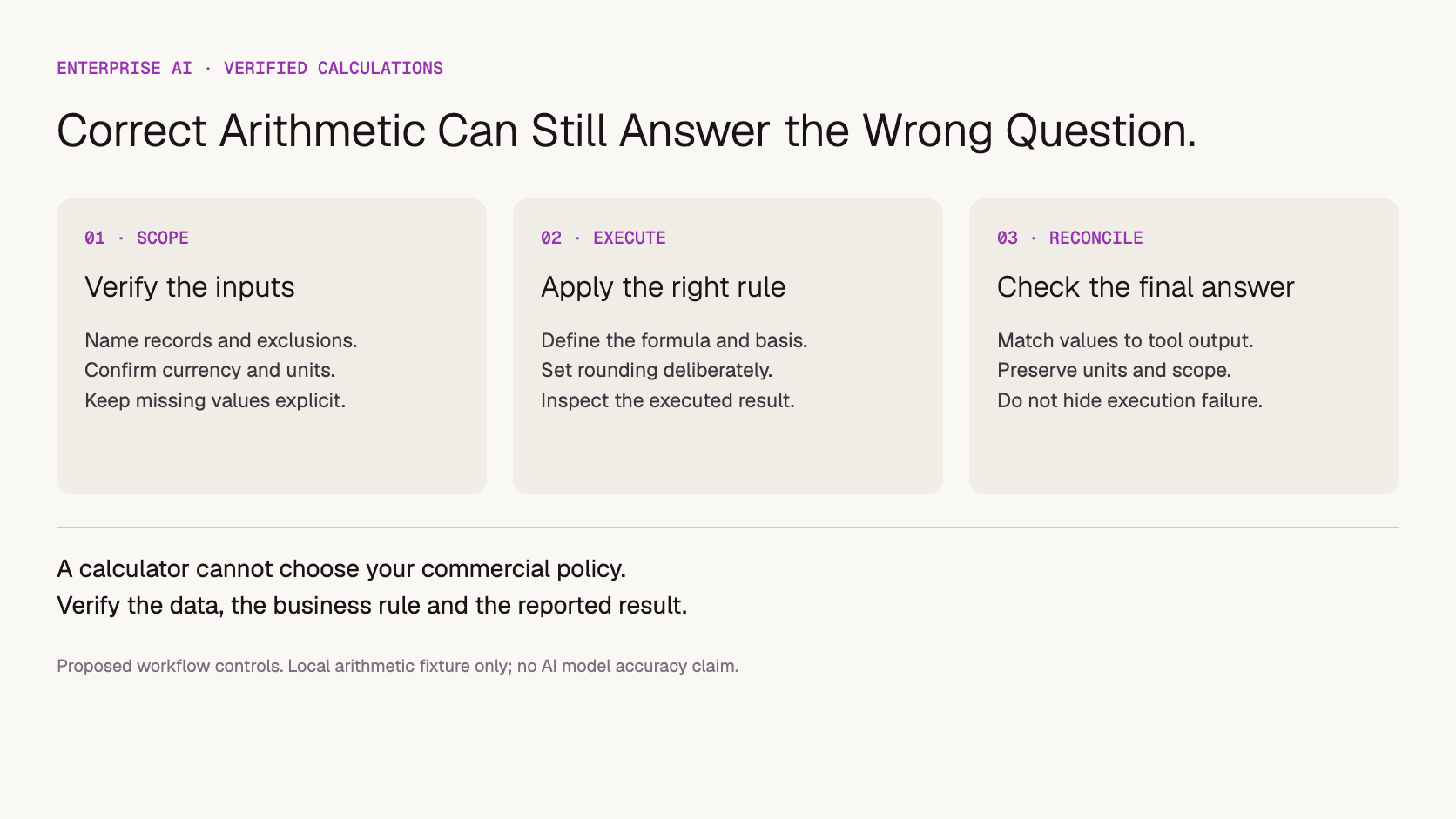
Proposed checks for an AI-assisted calculation. Each stage can fail independently.
How should the application verify the final answer?
Compare the customer-facing numbers with the structured execution result before delivery. Preserve the currency, units, reporting period and calculation status. Where practical, insert the verified numeric values through a template and let the model explain their meaning without rewriting the authoritative result.
A useful result record contains the source snapshot or record references, input count, exclusions, rule version, computed values and execution status. The explanation can then say, for example, “Total excluding tax: USD 361.41, including USD 15.00 shipping.” It should not turn an estimate into an approved quote or claim that an order was changed.
Do not accept a generic “double-checked” statement as verification. Ask what was checked against what. Repeating the same prompt or asking another model can be a diagnostic aid, but agreement is weaker evidence than reconciliation with approved source data and a known calculation rule.
If the tool fails or inputs are incomplete, show that state. Do not allow a fallback response to replace a failed calculation with a guessed total. Keep the scope narrow: an unavailable calculation is different from an unavailable explanation.
For future-demand estimates, compare an LLM API with a demand forecasting model and evaluate predictions against the business horizon and held-out outcomes.
How should enterprises test numerical workflows?
Use cases with independently known answers and deliberate changes to scope, units and rules. Test the whole path from source extraction to final presentation, not only the calculation function. Keep expected answers separate from model inputs, and record which stage failed when the output is wrong.
Proposed test
Expected check
Goods-only discount plus shipping
Shipping stays outside the discount basis
One line appears twice
Apply the documented duplicate policy, not an arbitrary deletion
Quantity or unit price is missing
Return an incomplete result rather than inventing a value
Records use different currencies
Keep separate totals or use an explicitly authorized conversion
A cancelled record is present
Apply the stated status inclusion rule
A tool times out
Do not present an unexecuted estimate as a verified result
Correct tool result, misleading requested summary
Preserve the original units and qualifications
These are proposed acceptance tests. Only the fictional arithmetic example in this article was executed locally. Teams that cannot yet use real records can begin with reviewed fictional test cases, then validate authorized representative data before claiming production accuracy.
Report extraction failures, rule-selection failures, execution failures and presentation mismatches separately. A single average score can conceal a recurring error in the most consequential cases. After model, prompt or rule changes, rerun the affected cases and preserve enough evidence to explain any difference.
Where does Token360 fit in this workflow?
Token360 can provide the model-access layer for interpreting requests, extracting information and explaining computed results. Your application or connected business system should own the authoritative data, approved calculation rules and execution checks. Confirm the selected model's supported interface rather than assuming that an upstream code-execution feature is available through every route.
Token360 provides access across text, image, audio and video models. Its enterprise offering supports discussions about model mix, capacity, pricing and contractual requirements. This does not establish a native accounting engine, spreadsheet validator or guaranteed numerical accuracy.
For an evaluation, bring a small reviewed set of business questions, permitted input examples, expected outputs and your required tool interfaces. Assess whether the model selects the right operation and preserves the result. Keep the separate decision to approve a quote, payment or business action under the appropriate operational controls.
Will a stronger reasoning model remove the need for a calculator?
Do not assume that it will. Evaluate the model on your task, but retain inspectable execution and reconciliation for important numbers. Better reasoning does not establish that the source records or business rule are correct.
Is asking the model to show its formula enough?
No. A displayed formula helps review the proposed method, but it does not prove that the formula was executed or that its inputs are complete. Preserve the actual tool result and compare the final answer with it.
Can we use AI to summarize a spreadsheet?
Yes, with explicit scope and checks. Confirm that the required sheets and rows were read, that formulas and displayed values are interpreted appropriately, and that any reported totals reconcile with the intended data.
Does the example prove a model is accurate?
No. It is a locally verified fictional calculation, not a model test. Use it as a reproducible fixture, then record actual model and application behavior separately.
Enterprise AI
API
Bring your next idea to life.
Create a video scene in Creator, or explore models for images, audio, and text to find the right capabilities for your project.



 Guides
 Guides
 Guides