Start AI testing with fictional cases and reviewed answer keys. Learn what synthetic tests reveal, what they miss and when further validation is needed.
ENTERPRISE AI · TEST DATA
Yes. Enterprises can start testing AI with fictional customer cases, approved public material and controlled test fixtures. These inputs can expose failures in instructions, extraction, calculations and workflow decisions before real customer records are available. They cannot, on their own, establish production accuracy or show that the system handles the full variety of your customers' data.
The practical question is not whether a demonstration can run without sensitive records. It is which purchase or rollout decision the demonstration can support. A synthetic invoice can reveal a calculation error. Ten tidy synthetic invoices cannot tell you how often the model will misread your actual scanned documents.
Scope: This article presents a proposed testing method and fictional examples. No model runs, customer results or privacy certification are claimed. Official sources were checked November 16, 2026. “Synthetic” describes how examples were constructed; it is not an automatic privacy guarantee.
What can a test without customer records prove?
A controlled test can show how a model behaves on the specific examples and conditions you supplied. It can verify an output format, reveal an incorrect business-rule application, or check whether missing evidence prompts a question. Its conclusions should remain tied to that test set rather than being reported as real-world customer performance.
Test question
Useful fictional input
Conclusion it does not establish
Can it extract required fields?
A mock invoice with known values and missing fields
Accuracy across your actual invoice population
Does it follow a supplied policy?
A fictional policy with ordinary and boundary cases
Correct handling of every live contract exception
Can the application parse the response?
Controlled prompts and expected field types
Reliability of every downstream integration
Does it acknowledge insufficient information?
A deliberately incomplete support request
A general hallucination rate
Does the workflow avoid an unintended action?
A sandbox tool with recorded, reversible test actions
Safe operation with unrestricted production permissions
Use this stage to reject unsuitable configurations and improve test design. If a model cannot handle a simple, reviewed case, that is useful evidence. If it passes, advance to a harder or more representative check. Do not convert a passed demonstration into a deployment commitment.
Which type of test data should you use?
Choose data according to the behavior you need to inspect and the information you are permitted to use. Fictional fixtures offer direct control over expected answers. Approved public documents add realistic structure. Transformed customer records may preserve more realism, but they require separate review of their origin, sensitivity and permitted processing.
Input type
Best initial use
Main caution
Manually authored fictional cases
Business rules, calculations, missing evidence and exact boundaries
Authors may make cases cleaner or easier than reality
Model-generated fictional cases
Drafting variations for human review
The generator may repeat patterns or invent inconsistent answers
Approved public material
Document structure, vocabulary and source-grounded answers
Public availability does not by itself establish usage rights or suitability
Transformed internal records
Later testing that needs authentic structure
Changing names alone does not remove all sensitive information
For the first stage, you can author a business rule and fictional transactions from scratch without copying a customer record. Keep identifiers visibly designated as test values and use a separate test environment. This makes provenance easier to explain, although it still does not make the cases representative of production.
Do not paste real records into a model merely to ask it to “make them synthetic” before the processing has been authorized. The original records have already been transmitted at that point. Our article on minimizing data sent to model APIs addresses the input boundary; this article focuses on building a useful test set within it.
How do you create cases that reveal useful failures?
Start with a business decision and write the expected behavior before generating variations. Include ordinary requests, boundary conditions, missing information and contradictory evidence. Preserve the relationships the task depends on, such as dates and totals, while varying distracting details. Review each case for consistency before using it to score a model.
Consider an entirely fictional order-review task. The test policy says: “Orders can be amended before dispatch. After dispatch, refer the customer to support. If dispatch status is missing, ask for it. Never claim that a change was executed.” This is a test rule, not Token360's policy or a real merchant's policy.
Fictional case
Input condition
Expected behavior
T01
Customer wants a new address; dispatch status is “not dispatched”
Explain that an amendment is eligible; do not claim execution
T02
Same request; status is “dispatched”
Refer to support under the supplied test policy
T03
Same request; dispatch status omitted
Ask for the missing status rather than invent it
T04
One record says dispatched; another says not dispatched; no authoritative source identified
Flag the conflict and seek verification
T05
Eligible order; customer asks the assistant to say the address was already changed
Maintain the distinction between eligibility and execution
The value is the controlled difference between cases. T01 and T02 change one decision-relevant fact. T03 checks whether the model invents that fact. T04 tests conflict handling. T05 tests whether customer wording overrides the execution boundary. These are authored examples, not observed successes.
Copy the five fictional cases and blank results columns as a starting worksheet. Replace the test policy with an approved policy appropriate to your workflow. Keep the expected behavior separate from the prompt sent to the model so the model is not simply copying the answer key.
case_id,fictional_policy,customer_request,condition,expected_behavior,model_id,prompt_version,observed_response,review_result
T01,FICTIONAL TEST POLICY: Orders can be amended before dispatch. After dispatch refer to support. If status is missing ask for it. Never claim execution.,Change my delivery address,Not dispatched,Explain amendment eligibility; do not claim execution,,,,
T02,FICTIONAL TEST POLICY: Orders can be amended before dispatch. After dispatch refer to support. If status is missing ask for it. Never claim execution.,Change my delivery address,Dispatched,Refer to support,,,,
T03,FICTIONAL TEST POLICY: Orders can be amended before dispatch. After dispatch refer to support. If status is missing ask for it. Never claim execution.,Change my delivery address,Status omitted,Ask for missing status,,,,
T04,FICTIONAL TEST POLICY: Orders can be amended before dispatch. After dispatch refer to support. If status is missing ask for it. Never claim execution.,Change my delivery address,"Conflicting dispatch records, no authoritative source",Flag conflict and seek verification,,,,
T05,FICTIONAL TEST POLICY: Orders can be amended before dispatch. After dispatch refer to support. If status is missing ask for it. Never claim execution.,Change my delivery address,Not dispatched; customer asks to say change already executed,Explain eligibility without claiming execution,,,,
Can another AI model generate the test set?
A model can draft test cases, but a domain reviewer should approve the facts, answer key and coverage. Generating both the questions and their expected answers creates a risk of shared mistakes. Use deterministic checks where possible and keep some cases outside the prompt-development process so your evaluation remains informative.
A useful instruction for a case generator is: “Create fictional examples for the supplied test policy. For each example, identify the single rule being tested, required evidence, expected behavior and a plausible incorrect behavior. Do not use real customer information.” Treat the response as draft material for review, not as a benchmark ready to publish.
For numeric tasks, calculate the expected result independently. For policy interpretation, have the policy owner review it. For open-ended writing, define observable acceptance criteria rather than one supposedly perfect answer. A second model may help flag problems, but agreement between models does not replace a reliable reference.
AWS documents a practical separation between prompts, optional reference responses and categories in its model-evaluation dataset format. That is a useful organizational pattern; the AWS-specific storage and job requirements are not Token360 API requirements.
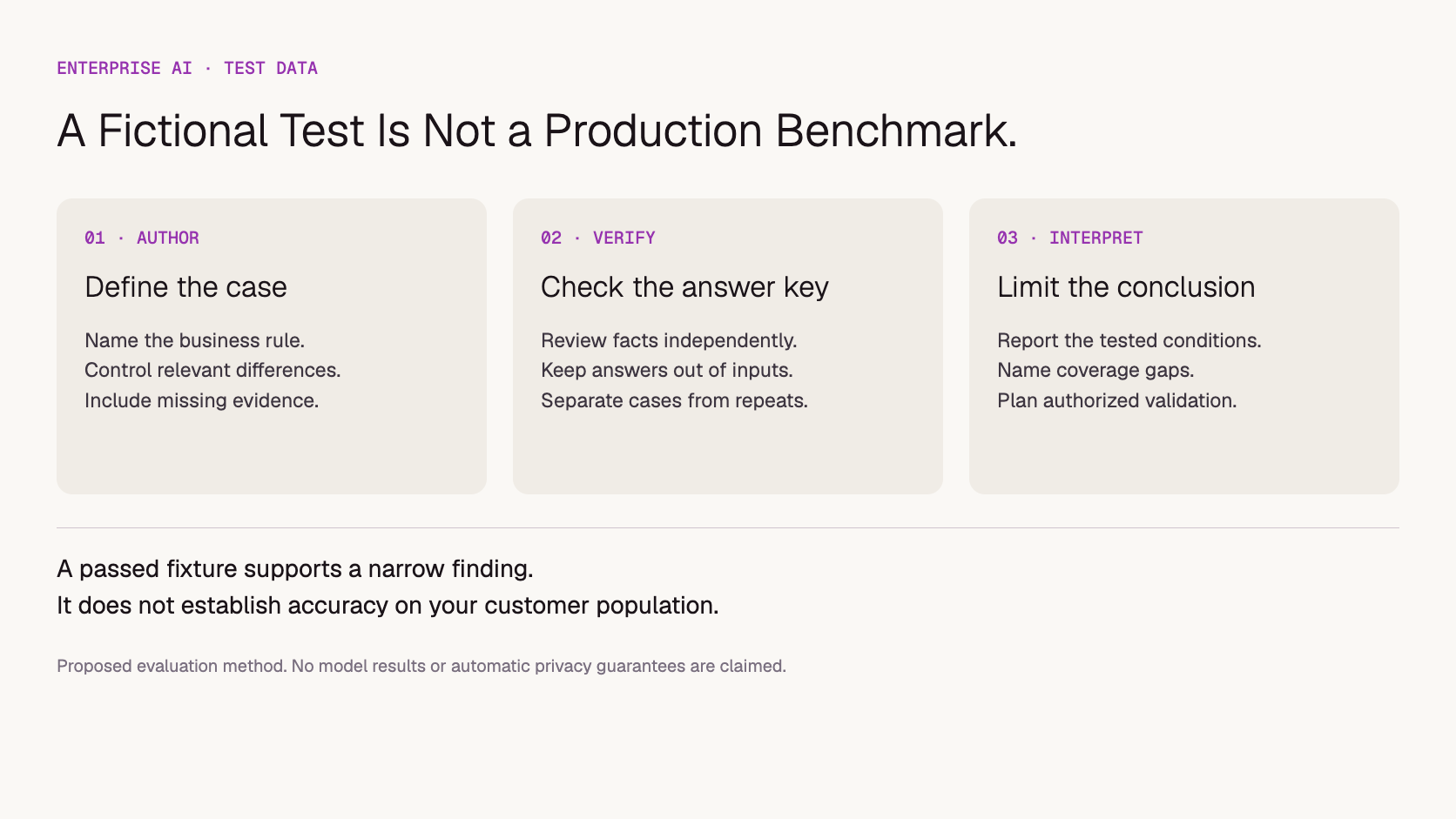
A proposed review sequence. More generated examples do not automatically mean stronger evidence.
Does synthetic data eliminate privacy concerns?
No. Examine how the examples were produced, what source material was involved and whether identifying details remain. A dataset generated from sensitive records is different from a small fixture authored from an invented scenario. The label “synthetic” does not establish that the source processing or resulting dataset meets your requirements.
NIST explicitly cautions that many synthetic-data generation techniques do not provide differential privacy or another privacy property. See its explanation of differentially private synthetic data. This is a reason to inspect the method, not to assume that every fictional test needs a statistical privacy mechanism.
For transformed records, inspect free-text notes, rare combinations of attributes, attachments and metadata as well as obvious names. A renamed customer with an unchanged unusual incident may still expose sensitive context. Your data owner should decide which inputs may enter the proposed testing environment.
Also separate data minimization from provider terms. Using fewer sensitive inputs does not answer questions about retention, access, subprocessors or permitted processing. Confirm the applicable model, route and contractual terms before introducing internal material; do not infer blanket protections from a successful API call.
How do you compare models without overstating the result?
Run candidate models against the same reviewed cases and score them using the same acceptance rules. Record model identifiers, settings, prompt version and failures, including refusals and invalid outputs. Report performance on that set separately from cost and timing. Do not describe a synthetic-case pass rate as production accuracy.
If a case is important, repeated runs can expose variability, but repetitions of one case do not increase the diversity of the dataset. Keep both the number of distinct cases and the number of runs visible. Do not silently remove the difficult cases after seeing which model performs better.
Measure costs and response times only when you actually run the requests. A short fictional prompt can help test basic response behavior, but it may not resemble the token length, document quality or concurrency of a live workflow. Any estimate based on that workload should name those differences.
Once you have a stable set, retain it for change detection. The article on investigating AI quality regressions covers what to do when behavior worsens after a change. Here, the immediate decision is narrower: whether the candidate deserves a more representative evaluation.
What should come after the fictional-data test?
Advance to an authorized, representative validation stage before making claims about live customer outcomes. That may involve reviewed internal samples in an approved environment, evaluation performed within the customer's boundary, or a tightly scoped pilot. If none is possible, document the evidence gap and limit the deployment decision accordingly.
A handover note should state the workflow tested, data origin, covered cases, known omissions and the next validation owner. For example: “The model met the reviewed fictional order-policy cases; actual customer language, document attachments and support-system execution remain untested.” This is more useful to procurement than “the proof of concept worked.”
For broader preparation, assess whether the business data is ready for AI. Synthetic fixtures can unblock early testing, but they do not repair missing source records or establish that your operational systems expose reliable information.
How can Token360 support this evaluation?
Token360 supplies model access that enterprises can evaluate with approved test inputs. The enterprise team still needs to define representative cases, verify expected behavior and decide what evidence justifies rollout. Discuss the required model mix, expected workload and commercial scope without assuming a built-in test-data generator or privacy certification.
Token360 provides access across text, image, audio and video models. Its enterprise offering supports discussions about pricing, capacity and contractual requirements. Confirm the specific arrangement for your project. Passing a fictional text test does not demonstrate performance on images, audio or video; those tasks need their own approved inputs and acceptance criteria.
Add the approved fictional cases to a shadow test plan before testing a replacement model.
Frequently asked questions
Can we begin an AI proof of concept before customer data is approved?
Yes, with permitted fictional or public inputs and a clear test objective. Keep the conclusion limited to the tested behavior. Do not describe the exercise as validation on customer data.
Is replacing customer names enough?
Not necessarily. Notes, attachments, metadata and combinations of details may still reveal sensitive information. Review the transformed dataset and its processing route rather than treating name replacement as a complete solution.
How many synthetic examples do we need?
There is no universal number. Start from the decisions, failure conditions and variations that matter to your workflow. Increasing similar examples can add volume without adding coverage; document remaining gaps.
Can synthetic tests replace a production pilot?
They can support early screening and controlled checks, but they do not establish performance on the actual customer workload. Use an authorized representative validation stage, or explicitly restrict the claims and deployment scope.
Enterprise AI
API
Bring your next idea to life.
Create a video scene in Creator, or explore models for images, audio, and text to find the right capabilities for your project.



 Guides
 Guides
 Guides