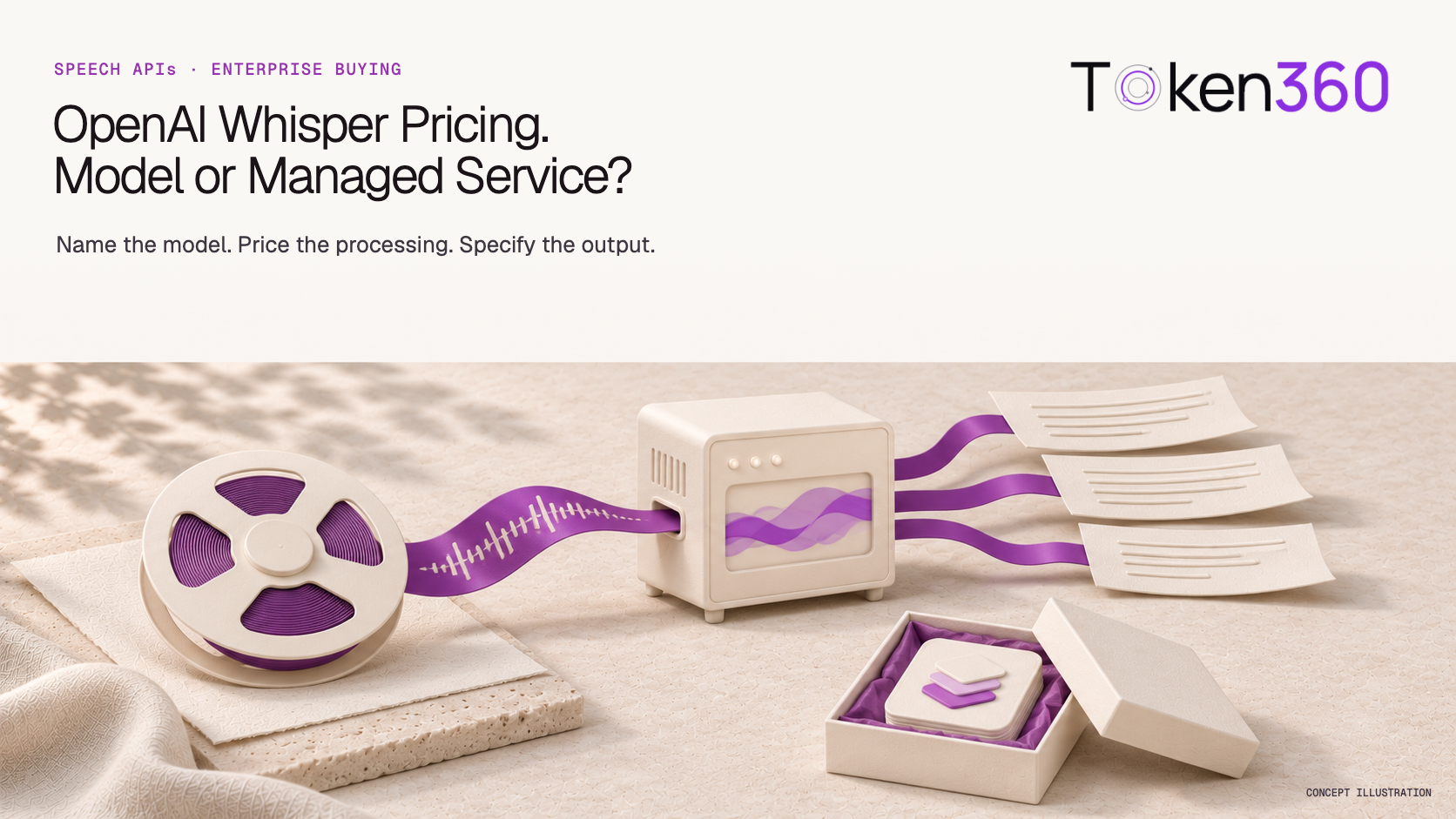
OpenAI Whisper pricing depends on what you mean by Whisper: downloadable model software, OpenAI’s hosted whisper-1 API, or another supplier’s transcription service. For an enterprise purchase, identify the exact service and model before estimating audio costs. Also check its lifecycle status; a published rate is not a promise of continued availability.
Current purchasing caveat: the official Whisper model page lists whisper-1 at $0.006 per minute and marks it Deprecated as of this review. Confirm the applicable retirement and replacement terms before committing to a new production contract. This article does not establish continuing availability through Token360 or any other supplier.
The question matters to teams transcribing recordings, preparing searchable archives or adding speech input to an application. A request for “Whisper access” can sound precise while leaving the operating service, response format and commercial responsibilities unspecified.
If Whisper is open source, why does API access cost money?
Access to model software and access to an operated service are different purchases. A company can obtain software without receiving a production endpoint, support arrangement or managed capacity. Procurement should identify who runs the workload and which responsibilities remain with the customer before treating a software license as a complete cost comparison.
OpenAI’s Whisper repository provides code, installation instructions and model choices under an MIT license. That is not the same artifact as a hosted API quote. A self-managed plan should therefore include the infrastructure and engineering responsibilities your team will actually take on, rather than assuming that downloadable code makes production operation free.
| What “Whisper” refers to | What to identify | What not to assume |
|---|
| Downloadable software | Model variant and the team operating it | A license includes hosting or support |
| OpenAI hosted API | Exact model ID, current rate and lifecycle status | An old price page guarantees future availability |
| Another supplier’s offer | Serving arrangement, model/version and contract scope | The same product nickname means the same implementation |
This article focuses on that Whisper-specific ambiguity. The broader economics of paying for open-model access are covered in why businesses pay for an open-source model API.
Which published OpenAI rate belongs in a Whisper estimate?
Use the rate associated with the exact model and service being evaluated, and retain the date of the reference. A transcription product name is not enough to identify a price. When the named model is deprecated, the budget also needs a confirmed supply plan rather than an assumption that the existing arrangement continues indefinitely.
The OpenAI Whisper reference above applies specifically to whisper-1. It should not be assigned to every model that transcribes speech. For example, the separate GPT-Transcribe model page currently lists $0.0045 per minute and describes its own supported transcription inputs. A different rate does not establish equivalent output or integration behavior.
For an existing application, ask engineering which model it actually calls today. For a new purchase, ask the proposed supplier what it will provide over the intended contract period. Keep any replacement proposal visible instead of quietly changing the model name in a spreadsheet.
Consult the official deprecation notices for lifecycle updates. The general replacement planning process remains in our model deprecation guide; this page does not invent a retirement deadline or a supplier’s continuity guarantee.
What does the per-minute reference mean for a budget?
Start with the amount of audio your application expects to submit, then apply the confirmed meter for the quoted service. Keep an initial archive migration separate from recurring recordings and any deliberate reprocessing. The resulting estimate should be reproducible from a workload inventory, not from the number of employees who might use the application.
Illustrative calculation: 1,000 audio hours equal 60,000 minutes. At the published Whisper reference of $0.006 per minute, that is $360 for the transcription line. This is hypothetical arithmetic, not a Token360 quote or a customer bill. It excludes taxes, additional application services, review work and any difference between assumed and actual billed usage.
Document why audio is sent again. An editorial correction, changed processing configuration or repeated archive job can alter the workload. Do not silently treat the number of unique recordings stored in a folder as the amount of processing purchased each month.
If a supplier quotes a different meter, ask for a worked example using the same recordings. Avoid converting a hardware-hour offer into audio minutes without an appropriate throughput measurement. The generic questions about channels, processing options and comparable transcription quotes are covered in speech-to-text API pricing.
Does a transcript price include everything the application needs?
The required deliverable should be written separately from the model name. State whether the application needs plain text, timing information, speaker labels or another output structure, then have the supplier confirm the exact supported configuration. A low price for one response type cannot establish the cost of a different finished workflow.
For a searchable archive, the receiving team may need transcript text tied to source-record identifiers. For a subtitle workflow, timing and export requirements matter. For meeting software, a transcript alone may not cover the summaries, user interface and administration the buyer expects. Those are different acceptance criteria even when the source recording is identical.
Before procurement compares offers, ask engineering to show a representative response and identify the transformations needed to use it. Label these transformations as application work unless the quote explicitly includes them. Do not assume a general model-family name guarantees identical responses across suppliers.
Our speech-to-text API versus meeting assistant guide covers that broader scope choice. This article does not report a test of speaker labeling, timestamp accuracy, terminology recognition or output quality.
What should a company ask Token360 to quote?
Provide the transcription task, expected audio workload and required response, then ask Token360 to confirm an available model and its commercial scope. If Whisper is a hard requirement, name the version and serving expectations explicitly. If the requirement is functional, allow alternatives to be proposed but require their differences to be documented.
| Include in the brief | What it resolves |
|---|
| Named model or required transcription capability | Whether the proposal must preserve an existing implementation |
| Language mix and approved sample recordings | What the later acceptance evaluation should represent |
| Backlog and recurring audio volume | The workload basis for a volume quote |
| Response format and downstream use | What must be delivered beyond an intelligible transcript |
| Availability period and change requirements | How lifecycle questions will be addressed in the proposal |
| Capacity, processing and contractual requirements | Which terms require explicit confirmation |
Token360 serves enterprise procurement across text, image, audio and video models. Enterprise quotes are tiered: higher usage receives lower quoted rates. Token360 does not charge a separate service fee. These company-confirmed terms do not establish a particular Whisper rate, automatic discount band or lower total cost than every alternative.
Dedicated capacity, contracts and compliance requirements can be discussed for the engagement. Review the enterprise offering and API documentation, then obtain a written confirmation of the proposed model, integration and availability. This article has not verified a Token360 Whisper deployment.
What should be verified before approving the purchase?
Approve the named service and accepted output together, with a dated price reference and a clear availability statement. A representative pilot should connect submitted recordings, returned results and usage evidence. Unknowns should remain open until confirmed, rather than being hidden behind a familiar model name or a low per-minute headline.
Keep the evaluation small enough for human review and representative of the actual recording conditions. Record what the application needs, what was returned and what remains to be built. Report corrections or rejected outputs alongside successful examples; a supplier comparison should not depend on a single clear recording.
The procurement decision becomes useful when you can explain who operates the service, which model is supplied, what response is accepted and which commercial terms apply. For company background, see About Token360.
Evidence and limits: Yuki Yu prepared this guide from official documentation and company-confirmed commercial positioning. No transcription pilot, latency benchmark or savings test was performed. Prices and lifecycle labels were checked on November 20, 2026. Formal publication URL and date remain pending.


 Guides
 Guides
 Guides