Can an LLM API Replace a Demand Forecasting Model?
Evaluate forecast accuracy separately from fluent explanations. Define demand, test against a baseline and verify the role of each model before buying.
ENTERPRISE AI · MODEL SELECTION
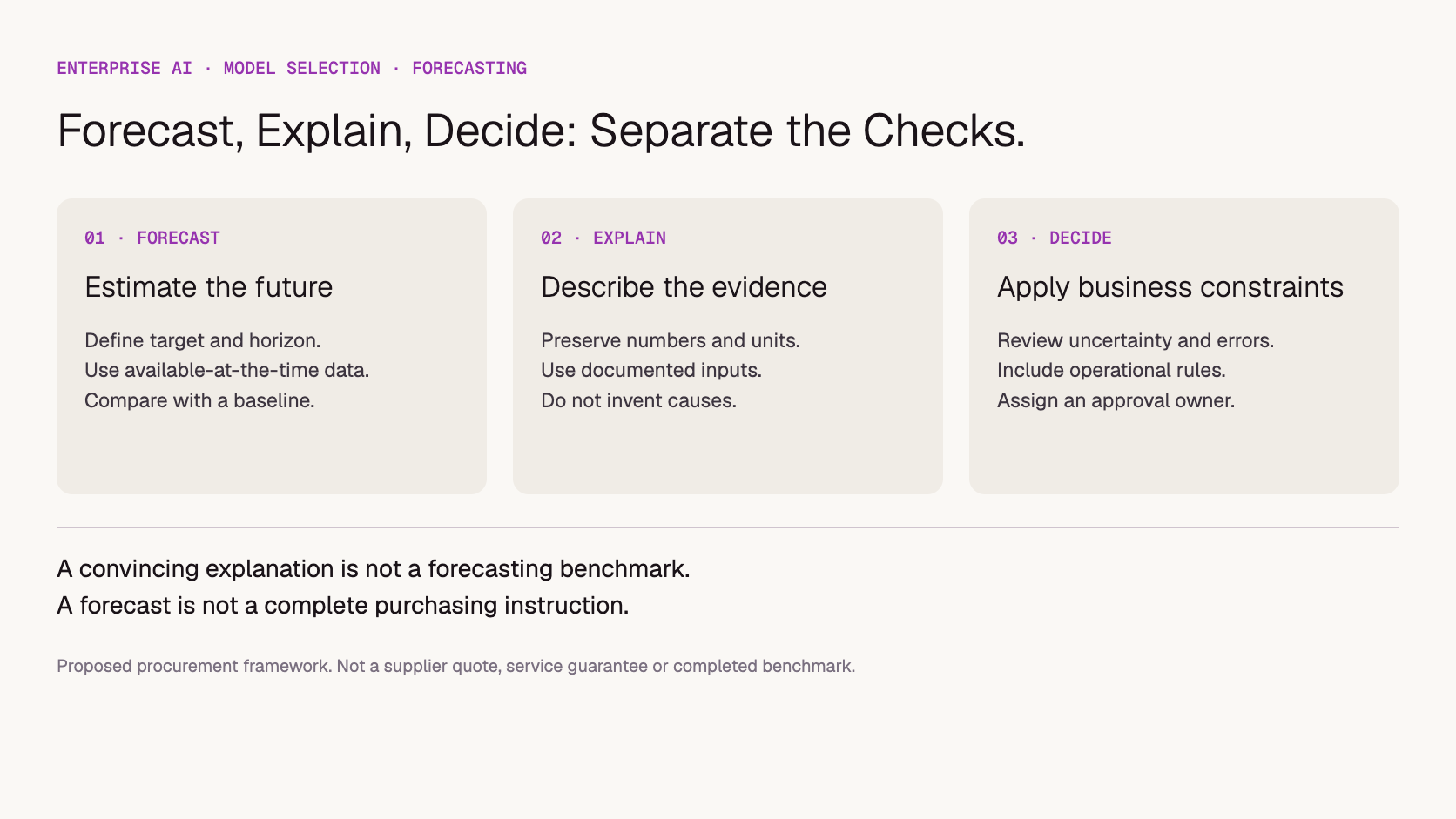
An LLM API should not replace a demand forecasting model simply because it can read historical sales and produce plausible future numbers. Treat replacement as a forecasting evaluation: define the target and horizon, compare predictions against later observations and a baseline, and assess the business consequences. An LLM can also explain forecasts without generating them.
Enterprise buyers often encounter “AI” as one category. But asking a model to summarize last month’s orders is different from predicting next month’s demand. A procurement brief should specify which job the model will perform before comparing endpoints, token prices or a polished demonstration.
How is forecasting different from generating an explanation?
Forecasting estimates a defined future quantity from information available at a specified time. An explanation describes supplied facts, assumptions or model outputs in language. The same interface can present both, but the numbers need their own evaluation. Clear prose is not evidence that the underlying prediction would have worked before the outcome was known.
Business request
Required output
Acceptance evidence
Explain last month’s order changes
A grounded narrative about historical data
Statements trace to the supplied records
Predict next month’s units by product
A dated forecast for a defined target
Errors measured against later observations
Explain why a forecast changed
A comparison of outputs and documented inputs
Differences and explanations remain supported
Decide how much inventory to order
An operational recommendation
Forecast plus lead times, constraints and business rules
A forecasting model is not necessarily a traditional statistical model. Google Cloud’s forecasting overview includes dedicated forecasting approaches and TimesFM, a time-series foundation model. Amazon’s Chronos project likewise provides pretrained models for time-series forecasting. “Foundation model” does not mean every such model is a general-purpose chat model.
What should you define before requesting a forecast?
Define the quantity, time interval, forecast horizon and grouping level before selecting a model. “Predict sales” leaves too much unresolved. Specify whether the target is ordered units, fulfilled units, revenue or another measure, and whether the forecast is per product, location or total business. Those choices determine both data preparation and evaluation.
A proposed brief might ask for weekly ordered units by product and location, produced every Monday for the next four weeks. That is an illustrative specification, not a recommended horizon for every company. Lead times and planning decisions should determine the horizon your team actually needs.
Record how returns, missing periods, stockouts and product changes are handled. In particular, observed fulfilled sales should not automatically be treated as unconstrained demand when availability was limited. Ask the business owner to define what the series represents instead of letting an API integration silently choose the target.
Keep arithmetic verification separate. The business-number verification guide covers whether calculations use the correct inputs and units. Forecasting adds another requirement: whether an estimate of an unknown future value performs well enough for its intended decision.
How can you tell whether a proposed replacement is better?
Evaluate the candidate at past forecast dates using only information that would have been available then. Compare its predictions with subsequent observations and a clear baseline. Repeat across relevant periods and business segments. A single plausible example, or a test that supplies future information, is not enough to justify replacing the current method.
The scikit-learn TimeSeriesSplit documentation explains why ordinary splits can be inappropriate for time-ordered data: they can train on future observations and evaluate on earlier ones. The procurement implication is to ask how the vendor preserved the time boundary, not merely which headline score it achieved.
Include a simple baseline, such as an appropriate seasonal repeat or recent-value rule, and the current production method if one exists. Specify the rule before examining the results. A sophisticated model needs to earn its place relative to the alternatives your business can actually operate.
For an LLM candidate, record the model version, prompt, supplied data, tools and repeated-run behavior. A model tested retrospectively may have encountered public historical information during training; acknowledge that limitation when it could affect the comparison. A prospective pilot with results saved before outcomes arrive can provide additional evidence.
Which errors should enterprise buyers care about?
Choose evaluation measures that reflect the decision, not only a convenient average score. Inspect both error size and whether the model systematically predicts too high or too low. Review important products and locations separately, and decide how uncertainty will be used. The acceptable trade-off depends on the cost of the resulting operational mistake.
For example, an inventory planner may care differently about over-ordering and stockouts. A good aggregate result can still hide poor behavior on a small group of important products. These are evaluation questions, not claims that a particular forecasting model outperforms another.
Ask the evaluation owner how zero or intermittent demand affects the chosen metric. Avoid adopting percentage errors without checking whether they behave sensibly on the target data. If the system returns prediction intervals or quantiles, verify their documented meaning and observed performance; a language model writing “high confidence” is not an equivalent uncertainty estimate.
Where can an LLM help without owning the forecast?
An LLM can support a forecasting workflow by explaining approved outputs, organizing planner questions and drafting summaries of documented changes. Keep numerical forecasts tied to the forecasting service or calculation that produced them. Require the narrative to preserve units, dates and uncertainty, and distinguish a supported explanation from a possible reason that still needs investigation.
Proposed division of responsibilities, not a benchmark or a deployed Token360 forecasting service.
A proposed application could retrieve a forecast table, calculate differences from the previous version with a deterministic tool, and ask an LLM to write the planner’s briefing. The model should not invent a promotion or supply disruption to make the movement sound reasonable. If the documented inputs do not explain a change, the briefing should say that the reason is unconfirmed.
The same boundary applies to scenario analysis. A planner may specify a hypothetical promotion, but the system must label that scenario and document how it changes the forecasting inputs. Fluent narrative alone does not establish a causal effect.
This is one reason a workflow may use multiple specialized components. The multi-model workflow discussion provides broader context; the forecast and its explanation should still be accepted against different criteria.
What should a forecasting procurement pilot include?
A useful pilot should produce reviewable forecasts, a reproducible comparison and an explicit operational decision. Agree on the input snapshot, evaluation periods, baseline and acceptance rules before the test. Include ownership of data preparation and ongoing review. This is a proposed pilot structure; this article contains no completed forecast experiment or accuracy claim.
Define the decision: identify who uses the forecast and what action it informs.
Freeze the specification: record target, units, interval, horizon, grouping and data availability at each forecast date.
Compare candidates fairly: provide equivalent permitted inputs and evaluate against an agreed baseline.
Inspect errors: review overall results, priority segments, bias and the uncertainty output rather than only the best example.
Test the handoff: confirm the explanation matches the forecast and that a human can review assumptions before operational action.
Use the forecasting pilot brief to record the specification. It is a blank planning sheet, not a forecast calculator. If you are comparing an LLM-assisted workflow with an existing forecasting service, measure the value of the explanation separately from any change in numerical accuracy.
Business decision,Target measure,Units,Time interval,Horizon,Grouping,Forecast cutoff,Available input snapshot,Stockout handling,Candidate and version,Prompt or configuration,Baseline,Evaluation periods,Error metric,Bias check,Priority segments,Uncertainty output,Explanation fidelity,Operational constraints,Owner,Acceptance rule,Decision
What should you discuss with Token360?
Explain whether you need language-model assistance around an existing forecasting system or a numerical forecasting engine itself. Specify the required inputs and outputs for each component. Model API access alone does not establish that a service supports your forecasting task, connects to your operational data or includes a validated demand-planning application.
Token360 focuses on enterprise access to text, image, audio and video models, with pricing, capacity and contractual requirements scoped to the engagement. Use the enterprise discussion to confirm the model route and application requirements. This article does not claim that TimesFM, Chronos or a dedicated demand-forecasting endpoint is available through Token360.
For an LLM explanation layer, bring a representative forecast output and the fields that must remain unchanged. Agree on how the application checks numerical fidelity and handles missing evidence. For a dedicated forecasting requirement, request explicit capability confirmation and task-specific evaluation rather than inferring support from a general AI catalog.
What else do buyers ask about LLM forecasting?
Can we upload a spreadsheet and ask for next month’s demand?
You can create a candidate prediction that way, but the ability to return numbers is not validation. Record the inputs and method, then evaluate the result against later observations and a baseline before relying on it operationally.
Does using a tool make the forecast trustworthy?
A tool can make the numerical source clearer. The underlying method, input data and evaluation still matter. Check which tool ran and whether the final explanation faithfully reflects its output.
Do we need to train a custom model?
Not necessarily. Dedicated forecasting options include pretrained approaches, but they still need evaluation on the relevant task. Training effort and forecasting fitness are different questions.
Should the forecast automatically place an order?
Only through a separately designed and approved decision workflow. Inventory actions also depend on constraints such as lead times, current stock and ordering rules. A predicted quantity alone is not a complete purchasing instruction.
Evidence and limits: Reviewed November 17, 2026. This is an enterprise model-selection framework based on the cited primary documentation. Examples are hypothetical; no forecasting performance, financial return or Token360 forecasting deployment is claimed.
Enterprise AI
API
Bring your next idea to life.
Create a video scene in Creator, or explore models for images, audio, and text to find the right capabilities for your project.



 Guides
 Guides
 Guides