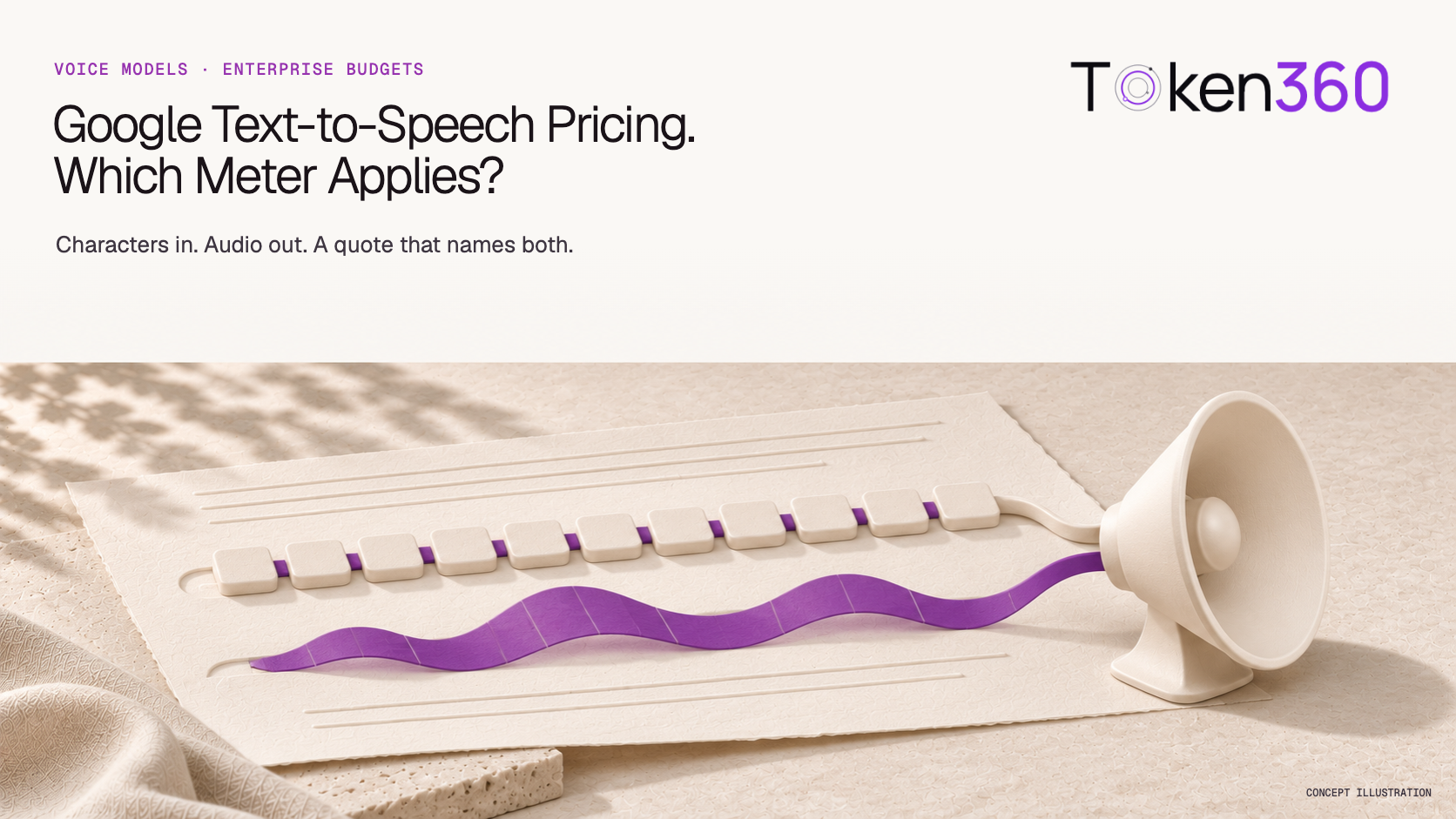
Google text-to-speech API pricing depends on the selected voice or model family. Some offers use input characters; Gemini-TTS pricing separates text input and audio output tokens. Enterprise buyers should specify the voice, billing unit and applicable date before comparing a Google estimate with a Token360 model quote.
A training team may budget narrated lessons, while a software team needs generated speech inside an application. Both can request “Google TTS,” yet choose different models, controls and meters. The purchasing brief needs enough detail to reproduce the estimate after engineering selects the actual voice.
This is a documentation-based guide to Google-specific voice pricing boundaries. The broader text-to-speech API pricing comparison remains the place for a general supplier evaluation. No listening test or supplier savings claim is made here.
Is every Google speech voice priced by characters?
No single meter should be assumed for every voice family. Match the selected model to its own pricing row and keep the unit in the estimate. A character total alone does not fully describe a purchase that separately charges for text input and generated audio output, even when the script is unchanged.
Reference checked November 21, 2026: Google’s TTS pricing page lists Chirp 3: HD at $30 per million characters after its 1-million-character free allowance. Gemini 2.5 Flash TTS is listed at $0.50 per million input text tokens and $10 per million output audio tokens, with no free usage. These are different meters, not directly comparable unit prices.
| Quoted meter | Information procurement needs | Invalid shortcut |
|---|
| Input characters | Actual submitted text and applicable voice schedule | Counting only visible words in an editorial document |
| Text and audio tokens | Measured input and output usage for the chosen model | Using a fixed character-to-token ratio for every script |
| Supplier-specific commercial quote | Named model, meter, eligible usage and terms | Assuming a public rate applies unchanged to the offer |
Keep the implementation configuration with the price reference. A voice name used in a demonstration is useful evidence; a generic label such as “premium narration” is not sufficient to select the billing row. The question is what the application will call, not just how the sample sounds.
How should a company estimate a character-priced workload?
Inventory the text that will actually be submitted, separating the initial library from routine updates and optional variants. Retain any request formatting in the measurement method. A procurement forecast should explain why a script is generated again instead of treating the number of unique documents as the entire amount of processing.
Hypothetical example: 3 million eligible Chirp 3: HD characters, with the full published free allowance available, leave 2 million paid characters. At the reference rate above, the synthesis line is $60. This excludes taxes, other services and negotiated terms. It is an arithmetic illustration, not a Token360 quote or a customer bill.
For a narration library, record new scripts, revised passages and alternative takes separately. If the application regenerates unchanged material, identify why. This is an implementation question to investigate, not an assumption that any provider automatically caches repeated content or makes another take free.
For token-priced speech, run an approved representative sample and use its recorded usage. Avoid assigning the character-priced example to a different voice family. A fair comparison retains each meter and compares the cost of an accepted deliverable later.
Can changing the voice change the implementation scope?
Voice selection is also a capability decision, so price comparisons should preserve the controls the application requires. Confirm language, input format and output behavior for the proposed voice. If a lower-priced option requires a different integration or cannot express a required instruction, that difference belongs in the purchase comparison.
Google’s voice documentation describes different families and their capabilities. Its SSML guide explains controls for pauses and the rendering of dates, acronyms and other text, while noting that only a subset of SSML is supported. Do not assume every voice accepts the same control syntax.
An enterprise sample should include the content that matters to the business: product names, abbreviations, numbers and longer passages where applicable. Ask the content owner to define acceptance before supplier selection. The published price cannot prove that the chosen voice pronounces those items correctly.
Keep any needed editing, regeneration and audio packaging visible as separate work. Purchasing speech synthesis does not by itself establish delivery of a finished training video, a telephony integration or a complete conversational agent. The quote should identify the boundary.
Why should the quote state when a TTS rate applies?
A price reference should cover the period in which the workload will run, not merely the date a demo was approved. When a published offer includes time-limited preview pricing, split the forecast at the effective date or ask for written commercial terms. A single copied unit price can otherwise understate later usage.
The same Google pricing page currently distinguishes Gemini 3.8 preview TTS rates through December 31, 2026 from rates beginning January 1, 2027. This is a dated example of why the model, launch status and effective period should travel together in a procurement record.
For a project spanning those dates, ask finance to retain separate forecast periods. Do not average the two prices without showing how much usage is expected in each period. If a negotiated quote supplies a different schedule, record its applicability rather than silently mixing public and contracted rates.
The broader Google AI API pricing guide covers general model-budget decisions. This article owns the narrower speech-family and meter question, not an exhaustive catalogue of Google model prices.
What should an enterprise send Token360 for a voice quote?
Send the required speech output, language mix, sample scripts and expected usage pattern, then ask Token360 to confirm a suitable available model and meter. If an exact Google voice is mandatory, say so explicitly. Do not treat a functional alternative as an identical service without testing and documenting the differences.
| Quote input | Decision it supports |
|---|
| Required voice or accepted voice characteristics | Whether a named model is mandatory or alternatives may be evaluated |
| Approved scripts and requested controls | Whether the proposed integration can express the task |
| Initial library and recurring generation | Which volume basis should determine the quote |
| Required audio artifact and downstream use | What the supplier delivers and what the application builds |
| Start date and expected production period | Which pricing schedule applies to the forecast |
| Capacity, contract and processing requirements | Which terms need explicit confirmation before approval |
Token360 serves enterprise procurement across text, image, audio and video models. Enterprise quotes are tiered: higher usage receives lower quoted rates. Token360 does not charge a separate service fee. The quote must still identify models, eligible volume and terms; no universal discount percentage or guaranteed saving against Google is established here.
Dedicated capacity, contracts and compliance requirements can be discussed for the engagement. Review the enterprise offering and API documentation, then obtain confirmation of the actual proposed route. This guide does not verify that Token360 offers a particular Google voice or resells Cloud TTS.
What evidence should accompany approval of the budget?
Approve the model choice, accepted output and commercial estimate together. Keep a dated rate reference or quote, the request configuration and a representative usage record. This gives procurement a basis for reviewing changes when the voice, generation behavior or required artifact differs from the assumptions used in the original estimate.
A pilot record should preserve the script, selected voice, submitted controls, returned audio and available usage evidence. The business owner should listen to the output; engineering should confirm that the returned artifact fits the application. A screenshot of a price table cannot replace either check.
No pilot was performed for this article. The proposed checks are a next step for a buyer, not proof that any named voice is suitable. For company context, see About Token360.
Method: Yuki Yu prepared this analysis from linked official documentation and company-confirmed commercial positioning. Rates were checked November 21, 2026. The calculation is hypothetical; no listening, latency or savings test is claimed. Formal publication URL and date remain pending.


 Guides
 Guides
 Guides