Google AI API pricing depends on the model, purchasing channel, processing mode, and applicable billing conditions. Start by identifying whether the budget is for the Gemini Developer API, Google Cloud, or a supplier’s enterprise offer. Then use that channel’s rates. A public Gemini price is not automatically your Token360 enterprise price.
For enterprise buyers, the important question is not simply “How much is Gemini?” It is “Which price and service conditions apply to the Gemini workload we intend to buy?” This guide separates the public pricing references, shows why region and billing tiers need attention, and explains what to request from Token360.
It is a procurement interpretation of current documentation, not a performance test or a ranking of providers. The examples use hypothetical usage. Model availability and feature support through Token360 must be confirmed for the requested route before an offer is accepted.
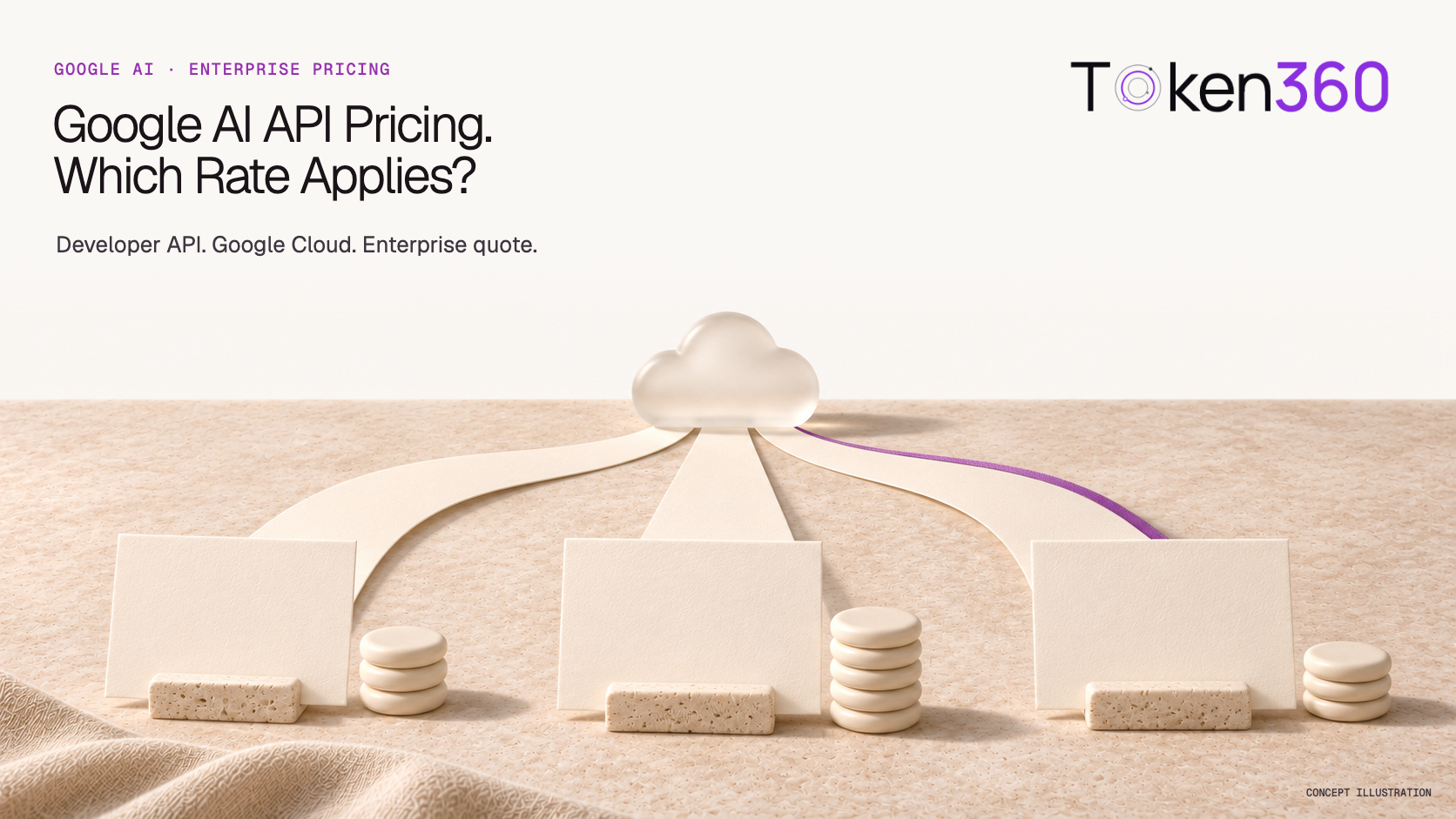
Which Google AI price list applies to your purchase?
Use the price list belonging to the service you will actually buy. The Gemini Developer API has its own pricing documentation; Google Cloud publishes a separate Model Garden pricing page. An enterprise offer from Token360 is another commercial reference. Matching a model name does not establish identical billing or service terms.
Three purchasing references, not a provider ranking
| Purchasing path | Price reference | Buyer’s first check |
|---|
| Gemini Developer API | Google AI Studio’s Developer API pricing and billing documentation | Exact model, paid/free eligibility, processing mode and account limits |
|---|
| Google Cloud | Google Cloud Model Garden rate card and applicable account agreement | Model, region, mode and any separately scoped platform services |
|---|
| Token360 enterprise purchase | Confirmed model route and enterprise quote | Availability, supported operation and the tiered rates offered for your usage |
|---|
The official references are Gemini Developer API pricing and Google Cloud Model Garden pricing, checked November 20, 2026. The older Vertex AI generative-AI pricing URL currently redirects to the latter. Keep the actual product and price-reference URL in the purchasing record, rather than relying on an old bookmark’s label.
A team might test a model through one interface and buy production access through another. That is workable, but the evaluation bill is not enough to approve production spend. Engineering should identify the intended production route before finance copies prices into the forecast.
What does a current Gemini API rate look like?
A useful price snapshot names one model and one processing scope instead of blending the cheapest rates from several tables. For Gemini 4 Hydrogen, the Developer API’s Standard paid rates below separate input, output including thinking, and cached input. These are dated Google public rates, not a Token360 quote.
Gemini 4 Hydrogen · Developer API Standard paid tier · USD per million tokens · November 20, 2026
| Billable category | Public rate |
|---|
| Input | $1.50 |
|---|
| Output, including thinking tokens | $7.50 |
|---|
| Cached input | $0.075 |
|---|
Source: Google’s Gemini 4 Hydrogen pricing section, checked November 20, 2026. The selected row is Standard paid pricing. Do not substitute Batch, Flex or Priority rates without also changing the processing assumptions.
This snapshot is intentionally narrow. It gives procurement a verifiable reference without implying that all Google models have the same rates or that this model is the right choice for every task. For a shortlist, identify the business requirement first; our company AI model-selection guide covers that decision separately.
Record the output category exactly. A budget based only on the length of the visible answer can miss billable work. If your team needs the accounting detail, see the reasoning-token billing explanation; this article does not redefine that broader topic.
Can the Google Cloud region change the forecast?
Yes, a regional pricing distinction can change the amount even when the named model and token quantities are the same. Google Cloud’s current Standard table separates global and non-global Gemini 4 Hydrogen rates. Use the row applicable to the intended deployment; a lower global price does not establish that it meets your requirements.
Google Cloud Gemini 4 Hydrogen · selected Standard rates · USD per million tokens · November 20, 2026
| Scope | Input | Text output, response and reasoning |
|---|
| Global | $1.50 | $7.50 |
|---|
| Non-global | $1.65 | $8.25 |
|---|
Source: Google Cloud Model Garden pricing, checked November 20, 2026. This table is a pricing distinction, not a complete statement about data residency, processing locations or contractual compliance. Those requirements need their own confirmation.
Illustrative calculation: suppose a monthly text workload contains 40 million ordinary input tokens and 10 million billable output tokens, with no cached input, tools or other charges. At the global rates, the subtotal is 40 × $1.50 + 10 × $7.50 = $135. At the non-global rates, it is 40 × $1.65 + 10 × $8.25 = $148.50.
The $13.50 difference in this example comes from the selected pricing row. It is not a supplier margin, a performance measurement or a Token360 savings estimate. The quantities are hypothetical and should be replaced with your workload’s usage before approval.
Keep the requirement that led to the regional choice attached to the forecast. Otherwise, a later reviewer may “optimize” the spreadsheet by replacing the rate while overlooking why that row was selected. Conversely, do not buy a more constrained scope without a business requirement that justifies it.
Does a higher Google usage tier mean cheaper tokens?
A Google usage-tier upgrade should not be treated as proof of a lower token price. Google’s billing documentation describes tiers in relation to payment history, limits and account caps. A commercial volume discount is a separate question. Ask what changes in the actual rate schedule before reducing the forecast’s unit prices.
The Gemini API billing guide explains that paid-tier progression depends on cumulative payments and account age. The rate-limit documentation distinguishes request and token limits and describes spend-based controls. Both were checked November 20, 2026. A larger allowance answers “How much can this account use?”; it does not, by itself, answer “What is the price per unit?”
This distinction matters when someone writes “Tier 3” into a procurement request. Ask them to identify the provider, the meaning of the tier, and the actual price being proposed. Avoid carrying the same label between unrelated suppliers as if it described the same benefit.
Token360’s enterprise tiers refer to quoting: higher usage receives lower quoted rates. That is a company-confirmed commercial policy, not a statement about how Google’s account tiers work. The eligible models, volume bands and application of those rates must be specified in the Token360 offer. Detailed discount mechanics belong in our AI API volume-discount guide.
What can a simple token estimate leave out?
A basic input/output estimate leaves out any additional services used by the application and any assumptions about caching, mode or free access. Before treating it as a production budget, list the actual operations the application needs. Confirm each operation against the model and purchasing channel rather than assuming that “Gemini access” includes everything.
For example, the Gemini 4 Hydrogen model page lists text, image, video, audio and PDF inputs with text output. It describes implicit caching support and says explicit caching is not supported. Source checked November 20, 2026. Understanding a video is therefore not the same purchase as generating a video, and a generic caching plan may not fit the model.
For a document assistant, separate ordinary text processing from search or other tools in the workload description. Ask for the applicable feature charges and limits instead of assigning a tool cost from another model’s example. For a multimodal project, specify whether the team needs to analyze existing media or create new media. That one clarification can prevent quoting the wrong operation.
Do not build the production approval around a free-tier experiment alone. Verify the current free-tier eligibility, available features and applicable data-use terms for the account. This article does not infer a contractual privacy guarantee from the fact that a trial returned a successful response.
When moving from a test into paid production, keep a small representative set of requests and confirm both the expected result and the reported billing categories. This is a recommended validation step, not a test completed for this article. It helps reveal whether the estimate describes the application you are actually buying.
What should you ask Token360 to quote for Gemini usage?
Ask Token360 to confirm the requested Gemini model, supported operation and enterprise rates for your forecast usage. Token360 uses tiered enterprise quotes, with lower quoted rates at higher usage, and does not charge a separate service fee. The offer still needs to define its scope; inference itself is not free.
The Token360 enterprise page describes custom pricing based on volume, model mix and production requirements. Token360 supports enterprise procurement across text, image, audio and video model categories. That does not establish that every Google model, feature, region or processing mode is available through every Token360 route.
A focused request for this purchase should include:
- Exact model and operation: for example, analyze documents and return text; identify any tools or media-generation requirements separately.
- Usage profile: expected monthly input/output quantities and realistic growth levels, with caching assumptions identified.
- Required service scope: interactive or delay-tolerant work, needed throughput, and any regional or contractual constraints.
- Price confirmation: the rate for each applicable category, which usage qualifies for each enterprise band, and when a changed rate takes effect.
Use Google’s public table as a reference, then evaluate the actual offer. Token360’s billing documentation states that an upstream provider’s public price is not automatically the price of a Token360 route. Do not apply an imagined percentage discount to the Google table and present the result as an enterprise quote.
If you are comparing that offer against another supplier, use the complete LLM quote-comparison framework. Keep this article as the Google-specific reference for purchasing channel, regional rates and tier terminology. Those distinctions need to be settled before any comparison can describe the same intended service.
Written by Yuki Yu for Token360. Sources checked November 20, 2026. The numerical example is hypothetical; no Google-versus-Token360 cost or performance test is claimed. Recheck live rates and confirm the offered model route before committing spend.


 Guides
 Guides
 Guides