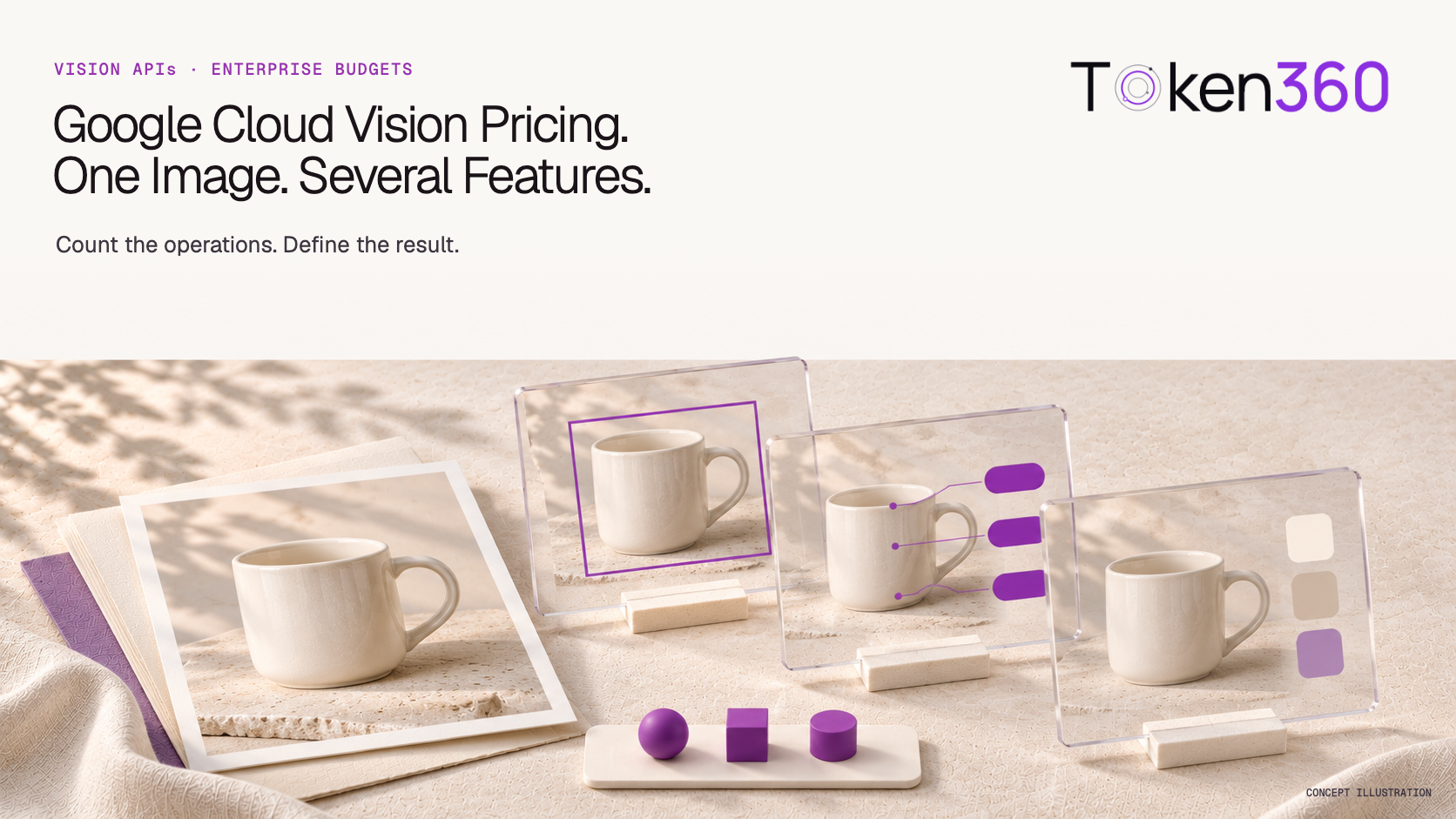
Google Cloud Vision API pricing starts with the features applied to an image, not simply the number of files uploaded. Enterprise buyers should inventory the requested operations and required results before estimating spend. When comparing a Token360 vision-model quote, keep the workload constant and verify that both offers deliver the business output you need.
“We process 100,000 images a month” is a useful starting point for procurement, but it does not describe the whole job. A catalogue team might need object labels, text extraction or object locations. Another team might need a narrative answer about the same photograph. Before comparing suppliers, name the output that the application will consume.
This guide covers Cloud Vision’s feature-based pricing and its implications for a purchase brief. It is not a quality benchmark. The broader image-analysis API cost guide owns multimodal model usage estimates; OCR versus vision-model selection owns the tool-choice question.
Does one image mean one Cloud Vision billable unit?
One source image is not a complete budget specification. Record which analysis features the application requests, and identify the pricing rule for each one. A buyer should be able to trace a forecast row back to a configured operation rather than treating every image-processing request as an identical purchase.
Official reference, checked November 20, 2026: Google’s Cloud Vision pricing page says each applied feature is a billable unit; each page of a multipage file is treated as an image. Its standard Label Detection and Text Detection rows each show the first 1,000 monthly units free, followed by $1.50 per 1,000 through the displayed 5-million-unit tier. Other features, combinations and consumption plans need their own pricing check.
Keep the exact feature list with the estimate. “Read this image” might be an informal description used by a product manager, while engineering configures a particular detection operation. Procurement should preserve both the business description and the technical choice so that a later change can be understood.
Do not substitute Gemini token rates for this feature schedule. The Google AI API budgeting article explains that separate purchase. A shared vendor name does not make two services’ billing units interchangeable.
How should procurement calculate a multi-feature estimate?
Calculate separate workload rows for the features that are actually needed, then combine the applicable charges. Keep the assumptions visible: which assets are processed, how often, and which operations each asset receives. This is more useful than a single “cost per image” figure that hides a changing mix of requests.
Hypothetical example: 100,000 images receive Label Detection and 100,000 receive Text Detection in one month, with the full free allowance available for each. Each row has 99,000 paid units: 99 × $1.50 = $148.50. The combined example is $297, excluding taxes, other services and negotiated terms. This is illustrative arithmetic, not an observed bill.
| Planning question | What to record | Why it matters |
|---|
| Which assets need each operation? | Separate asset groups and requested features | A feature need not be assumed for the entire library |
| Is this a backlog or recurring work? | First migration and ordinary monthly changes separately | A launch month should not silently become the steady-state forecast |
| Will the application process assets again? | Expected refresh and editorial rework | Unique stored files do not describe all requested work |
| Which price schedule applies? | Dated standard or contracted schedule | The approver can reproduce the estimate later |
These are proposed planning fields, not claims about automatic deduplication or free repeat processing. If the application resubmits the entire catalogue whenever one record changes, investigate that implementation before negotiating a larger purchase. Equally, do not remove an operation merely to reduce a forecast if the receiving application depends on its output.
For a budget crossing a published tier boundary, ask finance to reproduce the calculation from the applicable schedule rather than extend this small example. The example establishes the method, not a universal effective rate.
What result is the enterprise actually buying?
Specify the data the downstream application must receive and the decision it must support. Detection output, extracted text and a generated explanation are different deliverables. Procurement should not assume that two services are substitutes because both accept an image, or because both can return something that looks useful in a demonstration.
Google’s feature documentation describes Label Detection as generalized labels with associated scores. Text Detection extracts text and returns annotations; Document Text Detection is intended for dense text and documents. These documented outputs help engineering specify a contract for the application, but do not establish accuracy on your company’s assets.
For example, a retailer may need a category label that maps into its own catalogue taxonomy. Receiving a plausible generic label does not prove that mapping has been completed. If the team needs an explanation of why an image violates a merchandising rule, that should be written as a separate acceptance requirement rather than inferred from the existence of detection labels.
Use a sample of approved business images to define the required fields and acceptable failure handling. Include difficult but relevant inputs, not just the clearest demonstration photo. Keep the choice between OCR and a vision-language model in the existing selection guide; this budget should reflect the choice the business has actually made.
What should be included in a Cloud Vision procurement brief?
A useful brief connects the business task to its requested features, volume and expected response. It also identifies the work outside the API call, such as mapping results into internal records and reviewing uncertain outputs. This prevents a unit-price quote from being mistaken for a complete implementation proposal.
| Brief field | Example of the information needed |
|---|
| Business result | Extract product-package text into named catalogue fields |
| Input set | Approved image types, representative samples and expected arrival pattern |
| Configured operations | Requested features, with separate counts where workloads differ |
| Response contract | Fields, structure and downstream mapping requirements |
| Application responsibilities | Upload, parsing, review, storage and retry ownership |
| Commercial scope | Meter, applicable schedule, billing owner and contract requirements |
The example field is an illustrative purchase requirement, not a capability validated in a customer deployment. Engineering should confirm that the selected operation produces enough information to satisfy it. Procurement can then ask what the supplier provides and what the internal team must build.
Google’s features page links to implementation guides for the individual operations. Follow the relevant path rather than using an unrelated image-generation example. An image-generation API creates new content; this purchase concerns analysis of content you supply.
How should a Token360 vision-model quote be compared?
Ask Token360 to quote the same business task and confirm the proposed model’s availability, input requirements and output scope. Compare measured usage and accepted results on the same sample set. Do not convert a Cloud Vision feature unit into a model token count using an unsupported fixed ratio.
Token360’s enterprise business covers text, image, audio and video model access. Its enterprise quotes are tiered, with lower quoted rates at higher usage, and Token360 does not charge a separate service fee. The quote still needs to establish the models, eligible volume and terms. Neither statement guarantees a lower total cost than a different service.
For an image-analysis proposal, supply the image workload, instructions, expected response and required processing constraints. Ask which charges apply to the actual request and which work remains with your application. Dedicated capacity, contracts and compliance requirements can be discussed for the engagement; do not infer that every requested arrangement is already available.
Review Token360 enterprise procurement and the API documentation for the integration discussion. This article does not claim Token360 resells Cloud Vision, reproduces its feature schema, or has been benchmarked against it.
A model returning a fluent paragraph is not automatically a replacement for a response with machine-readable coordinates or other required annotations. Conversely, fixed annotations may not satisfy a request for contextual reasoning. Resolve the output contract before comparing the final numbers.
What evidence should a purchasing pilot produce?
A purchasing pilot should produce a traceable connection between the request configuration, the required output and the measured charge. Keep its scope small enough to review but representative of the real task. The approval record should distinguish demonstrated results from assumptions that still need supplier confirmation or application work.
Retain the approved sample identifiers, selected operations or model, request settings, returned output and available usage records. Have the business owner check the required result while engineering checks whether the response can be integrated. Record corrections and rejected outputs rather than presenting only a successful example.
Before approving a commitment, reconcile the pilot’s workload with the forecast. If the pilot used only one operation but the production design adds more, update the budget. If the final application asks for a different artifact, repeat the relevant acceptance check rather than relying on the earlier demonstration.
The purchase is ready for comparison when both offers refer to the same task, required result and workload assumptions. For company context, see About Token360.
Method and limits: Yuki Yu prepared this analysis from official documentation and company-confirmed positioning. No production pilot, quality comparison or savings test was performed. The worked estimate is hypothetical. Formal publication URL and publication date remain pending.


 Guides
 Guides
 Guides