Does an Enterprise AI Video Plan Include API Access?
Compare Runway, HeyGen and Token360 on production keys, eligible credits and API billing. See what to confirm in writing before signing a video contract.
An enterprise video plan can grant API access while leaving generation funded separately. Runway and HeyGen document different arrangements. Token360 can negotiate model rates and project-scoped capacity and contracts. Before signing, establish who can issue the key, what funds the job and which recorded charge finance can reconcile.
What does each provider document about enterprise video API access?
The largest practical difference appears when an editor already has credits and engineering wants to use them. Here is what the public documentation supports, and the one account-specific question we would ask each vendor.
Provider
How a team gets access and funds a job
What to confirm in writing
Runway
An organization admin can manage access to linked API projects. Eligible enterprise organizations can transfer credits between web workspaces and API projects. Teams manage project keys and billing in the Developer Portal. Runway enterprise project guide
Has the account team enabled project management for our organization, and is our production project linked?
HeyGen
The web app has a Developers area for obtaining a key. Under its published direct API terms, teams purchase API credits separately from a web subscription. HeyGen API credit policy
Does our signed order include a funded API balance? Which workspace receives it and who can administer its key?
Token360
Multimodal inference access with documented account controls and company-confirmed negotiation of model unit prices, dedicated capacity and contract requirements. Confirm the scope in the written quote.Token360 enterprise offering
Which model route and workspace does the quote cover, who can issue its production key, and what usage is prepaid?
Source review by Token360, November 4, 2026, with company-confirmed Token360 positioning added separately. Public provider pages establish the documented access arrangements; private customer quotes and specific discount levels remain outside this comparison. No cost or service-level superiority was measured.
Which balance pays when the same team uses a web editor and an API?
Follow the execution path of one job. Runway gives a useful example: a workflow run inside the web app uses web credits, while a published workflow invoked as an endpoint uses developer credits. An eligible enterprise admin can first transfer funds to the API project. That transfer and the charge for running the workflow are two distinct events. Runway workflow endpoint billing
Now consider a team that has already funded a HeyGen web account. A developer can get to the key from the web interface, yet a direct API request draws on a separate API balance. The person approving the purchase should ask for that balance by name. This distinction matters even when a single employee manages both accounts. HeyGen API billing by access method
What can a Token360 production key actually prove?
A successful call verifies that one key could reach one model route at the time of the test. In an earlier Token360 workspace check, a request to /v1/chat/completions using gpt-6.1-sol returned HTTP 200 and the requested word READY. The response reported 13 input tokens and 5 output tokens. That observation establishes text access for the tested key. A buyer evaluating video still needs a completed job on the video route named in the quote.
Suppose procurement sees a US$1 lifetime limit in the key settings. Record it as the maximum configured for that key. For funding, look up the authenticated account’s spendable balance or applicable enterprise credit terms. For billing, inspect the usage entry after a video job completes. The three records answer different questions. Token360 billing and usage documentation
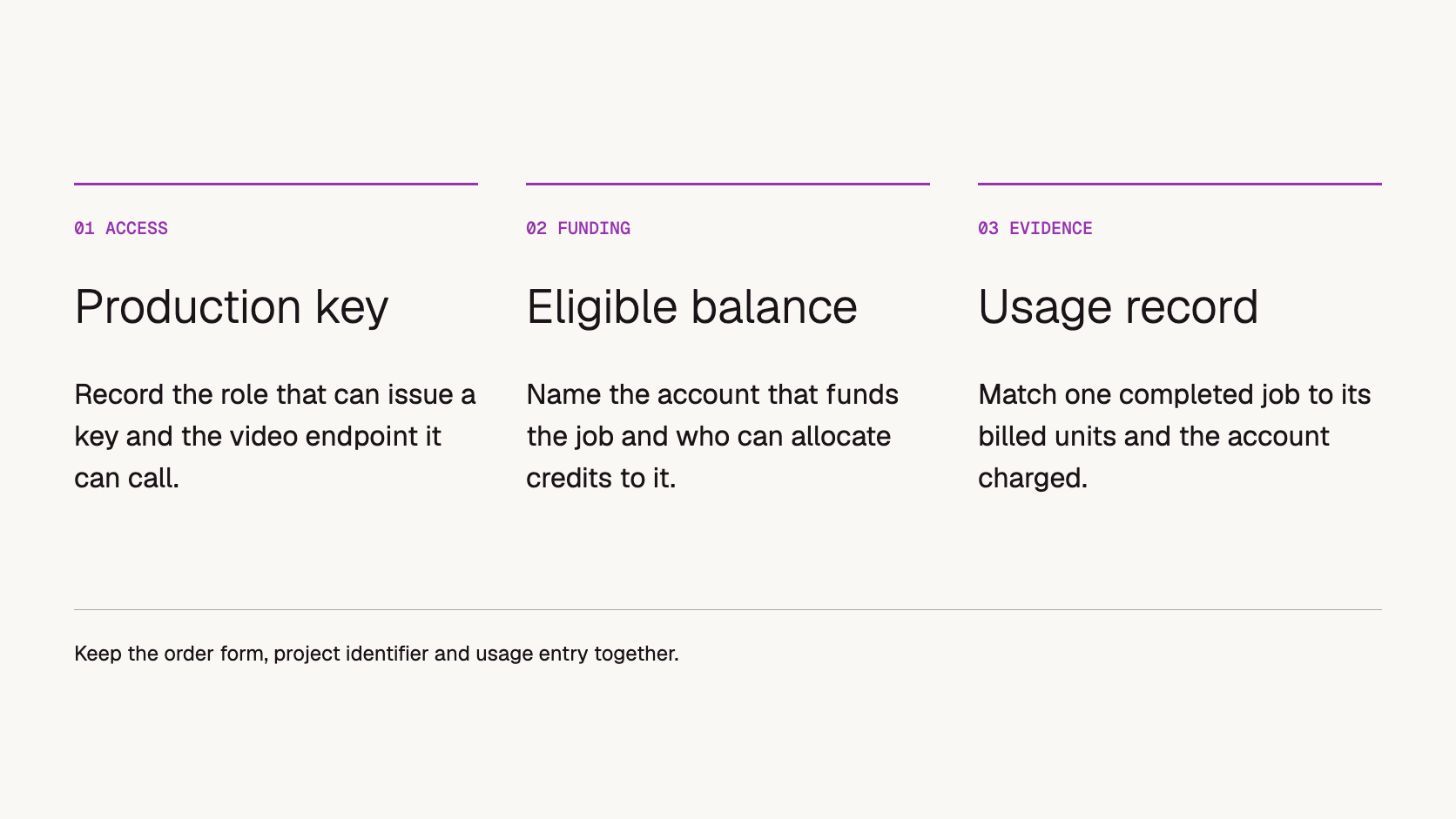
Give engineering the key-issuance question and finance the balance and charge questions. Both teams should be able to identify the same project.
What should the order form say before engineering starts a pilot?
Ask the vendor to complete one sentence using your project and model names. You can send this wording with the quote:
For [workspace], [role] can issue a production key for [video model and endpoint]. Each completed [billing unit] draws from [balance or commitment]. After that amount is exhausted, [rate or stop rule] applies. [Billing role] can retrieve the usage record from [report].
Then run one short clip with the named credentials. Save the job ID and model, wait for completion, and match the resulting entry to the named account. If the contract promises a pooled allowance but the pilot charges a different balance, send the two records to the account team before approving the rollout. Record any delay between job completion and the charge appearing so finance knows when to check.
When should the enterprise access pilot stop?
Stop expanding the pilot when access, funding or charge attribution does not match the written agreement. A valid key is insufficient if it cannot reach the named video route. A completed clip is insufficient if finance cannot determine which account paid for it.
Use three separate acceptance records: the authorized project and model, the available account funding or agreed credit terms, and the settled charge for the test job. Keep an unresolved billing record open rather than substituting a rate-card estimate. If an account team changes the entitlement, repeat the affected check with the new configuration.
This access review answers whether the team can operate the contracted workflow. The size of a commitment, discounted rate and utilization break-even belong in the enterprise pricing comparison. Keeping those decisions separate makes a procurement problem easier to assign to the right owner.
Turn the order-form sentence into a pilot acceptance record
A procurement team can fill the access record without inventing a discount or SLA. For an illustrative project called Demo Launch, name the buyer’s tenant, production environment, approved video model route, credential owner and paying account. Leave any unconfirmed entitlement explicit until the account team resolves it.
Field
Illustrative entry
Close-out evidence
Project
Demo Launch / production
Authorized project scope
Model
Exact route to be confirmed in the order
Successful job on that route, not a different text model
Funding
Named API balance or agreed credit arrangement
Matching account record
Charge attribution
One pilot job identifier
Settled usage entry and currency
Exceptions
Any unresolved entitlement or delayed charge
Owner and follow-up before rollout
This is a filled structure for a fictional project, not a customer contract or a completed video pilot. It answers whether access and funding match the agreement. The utilization, overage and commitment calculations belong in the separate enterprise pricing review, so this article does not duplicate that purchasing analysis.
Frequently asked questions
Can a Runway Enterprise team use web credits for an API project?
Runway documents transfers between linked projects and workspaces for enabled Enterprise organizations. Have the admin verify that the project appears as a transfer destination before budgeting those credits.
Do we need a paid HeyGen web subscription to buy direct API credits?
HeyGen says teams can buy API credits independently. The direct API draws from its API balance. Ask sales to identify any prepaid API allowance in your specific offer.
Does a Token360 key spending limit provide credits?
A spending limit caps what a key can spend. Check the applicable account funding and the commercial terms for your video model separately.
What should finance retain from a pilot?
Keep the model and route, project or workspace identifier, job ID, billed units, currency and matching usage entry. Store the key itself in your secret manager.
Commercial scope reviewed November 4, 2026. Token360 pricing and engagement scope are company-confirmed; individual discounts, capacity commitments and compliance evidence require a written proposal. Token360 enterprise page. Historical test charges remain dated observations, not current universal quotes.


 Prompt Library
 Guides
 Guides